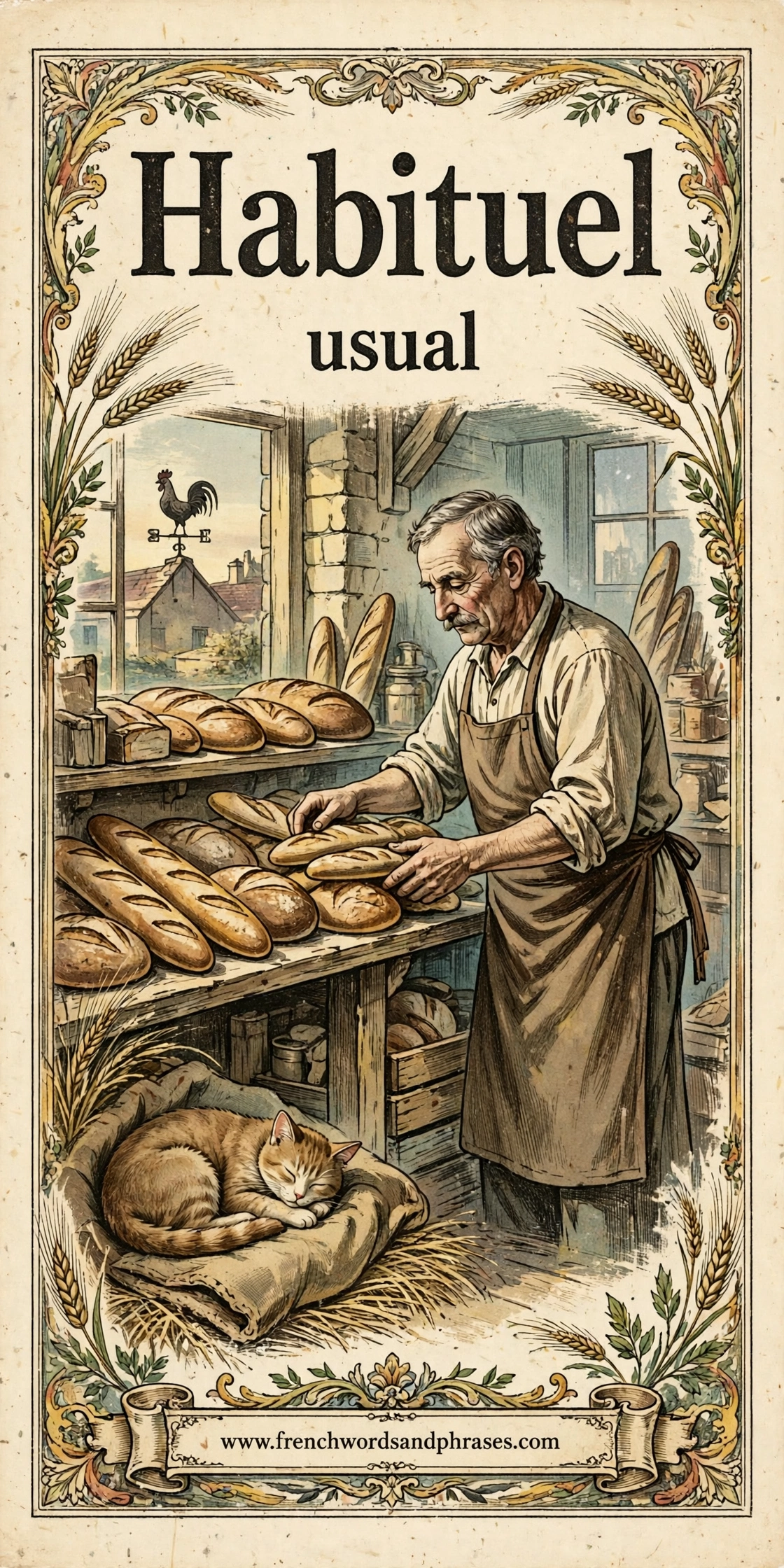
A French Word to Live By
Translate Habituel to English
/a.bi.tɥɛl/
Habituel means usual.
Same train, same seat, same newspaper folded at the same page — « ton café habituel ? » asks the waiter, already pouring. Habituel is the adjective of the routine we love: the usual one, the one that happens every time, the one we would miss if it changed.
In this guide, you’ll learn what habituel means in English, how its feminine habituelle is formed, where it stands in the sentence, and how it differs from d’habitude. Explore French examples, English translations, and practice quizzes.
Understanding the French Adjective Habituel
Habituel is a French adjective of routine, built on habitude, a habit. Its feminine is habituelle, with the doubled l of the -el family: un retard habituel, une erreur habituelle, des horaires habituels. It describes whatever happens regularly, as a matter of habit — people, places, delays, orders at the café.
It means usual — the regular, expected one: son sourire habituel, his usual smile; l’heure habituelle, the usual time; les clients habituels, the regular customers. It paints everything that habit has made familiar: not surprising, not new — the comforting opposite of exceptionnel.
Type: Adjective of routine — what happens regularly, by habit
Answers the question: Which one, as always? — the usual one
Changes form: Feminine habituelle (doubled l) — habituel / habituelle; plurals habituels / habituelles
English equivalents: Usual; customary; regular.
One important usage detail: the feminine of habituel is habituelle, with ll — the whole -el family doubles the l before the feminine e: actuel/actuelle, habituel/habituelle. And keep the pair apart: habituel is the adjective (le train habituel), while d’habitude is the adverb phrase — d’habitude, je prends le train de huit heures, usually, I take the eight o’clock train.
Experience the Word
Habituel is the adjective of the recognised footsteps — the world arranged as it was yesterday, and the small comfort of finding it so.
Imagine the café at seven each morning: the same cup placed before the same customer without a word exchanged. No order was given; none was needed. C’est son café habituel, and the ritual is the friendship.
You have not just called something frequent. You have named the warmth of the expected — the usual, worn smooth by repetition.
How to Use Habituel in French: Complete Guide
Let’s explore how habituel works in French, beginning with the whole word on one card.
Habituel at a Glance
Before the details, here is the whole word on one card.
The Whole Word on One Card
Meaning, type, position and forms — habituel in four lines.
| Point | Habituel |
|---|---|
| Meaning | usual — the regular one, as habit has made it |
| Type | adjective of routine — from habitude, a habit |
| Usual position | after the noun — son café habituel |
| Form | habituel / habituelle — habituels / habituelles in the plural |
Example
Elle prend son café habituel à la même table.
She has her usual coffee at the same table.
The Four Forms of Habituel
Habituel belongs to the -el family: the feminine doubles the l, and the plurals add s.
| Form | Habituel | Example |
|---|---|---|
| Masculine singular | habituel | un retard habituel — a usual delay |
| Feminine singular | habituelle | une erreur habituelle — a usual mistake |
| Masculine plural | habituels | des retards habituels — usual delays |
| Feminine plural | habituelles | des erreurs habituelles — usual mistakes |
Example
Les pannes habituelles retardent le train du matin.
The usual breakdowns delay the morning train.
Quick Quiz 1
What is the feminine of habituel?
Reveal the answer
habituelle
Une heure habituelle — the -el family doubles the l in the feminine.
The usual time.
The Feminine of Habituel: Habituelle
Habituelle is not a separate word to learn later — it is half of this word’s life, with the doubled l that marks the -el family.
| Situation | Example |
|---|---|
| Masculine | un sourire habituel — a usual smile |
| Feminine | une politesse habituelle — a usual politeness |
| Why | adjectives in -el double the l before the feminine e |
| The plural | add s to the feminine — des erreurs habituelles, usual mistakes |
Example
Avec sa gentillesse habituelle, elle a aidé tout le monde.
With her usual kindness, she helped everyone.
Where Habituel Goes: After the Noun
Habituel follows the noun it describes, like most French adjectives, and it sits naturally after être.
| Pattern | Example |
|---|---|
| After the noun | l’heure habituelle — the usual time |
| After être | ce retard est habituel — this delay is usual |
| With a possessive | son café habituel — his usual coffee |
| Before the noun | l’habituelle heure — only in literary style |
Example
Le train a son retard habituel de dix minutes.
The train has its usual ten-minute delay.
Quick Quiz 2
How do you say ‘the usual time’ — l’habituelle heure or l’heure habituelle?
Reveal the answer
l’heure habituelle
Habituel stands after the noun in ordinary French, in its feminine form habituelle.
The usual time.
More Habituel: Comparing with Habituel
Habituel describes a routine, so degrees are expressed with plus or moins — or by leaving the routine behind entirely.
| Degree | Example |
|---|---|
| As usual as | aussi habituel que — as usual as |
| More usual | plus habituel — more usual |
| Less usual | moins habituel — less usual |
| Breaking the routine | inhabituel — unusual, the opposite |
Example
Un retard d’une heure, c’est inhabituel pour ce train.
An hour’s delay is unusual for this train.
Everyday Expressions with Habituel
Habituel appears wherever French leans on its routines — cafés, trains and characters.
| Expression | In English |
|---|---|
| son café habituel | his usual coffee |
| l’heure habituelle | the usual time |
| les clients habituels | the regular customers |
| comme à l’heure habituelle | as at the usual time |
| sa gentillesse habituelle | her usual kindness |
| un retard habituel | a usual delay |
Example
Les clients habituels ont leur table près de la fenêtre.
The regular customers have their table by the window.
Quick Quiz 3
What does les clients habituels mean?
Reveal the answer
The regular customers
Les clients habituels — the ones who come every day, whose order is known by heart.
The regulars.
Habituel and Its Neighbours
Habituel keeps company with the other words of routine — and faces the exceptional.
| French | In English |
|---|---|
| ordinaire | ordinary — the common, everyday one |
| normal | normal — as things should be |
| régulier | regular — at steady intervals |
| d’habitude | usually — the adverb phrase, not the adjective |
| exceptionnel | exceptional — the opposite of the routine |
Example
D’habitude, le train est ponctuel malgré ses retards habituels le vendredi.
Usually, the train is punctual despite its usual delays on Fridays.
Watch Out: The Traps Around Habituel
The traps here are the doubled l of the feminine and the twin d’habitude, which does a different job.
| Trap | The truth |
|---|---|
| The feminine | une erreur habituelle — double the l: habituelle, never habituele |
| habituel vs d’habitude | habituel describes a noun (le train habituel); d’habitude means usually and opens a sentence |
| The opposite | inhabituel — unusual, with in- before it |
| Regular customers | les habitués — the regulars, as a noun, are the people themselves |
Example
Les habitués du café connaissent le serveur par son prénom.
The café’s regulars know the waiter by his first name.
Quick Quiz 4
How do you say ‘the regular customers’ with habituel?
Reveal the answer
les clients habituels
Habituel follows the noun and agrees with the masculine plural: habituels.
The regular customers.
Habituel in Everyday French: Real-Life Examples
Now that you know the word, let’s see how habituel appears in everyday French.
Example 1 — At the café
Le serveur apporte son café habituel.
The waiter brings his usual coffee.
Example 2 — Trains
Le train de huit heures a son retard habituel.
The eight o’clock train has its usual delay.
Example 3 — Character
Avec sa patience habituelle, elle écoute tout.
With her usual patience, she listens to everything.
Example 4 — Time
On se retrouve à l’heure habituelle ?
Shall we meet at the usual time?
Example 5 — Mistakes
C’est son erreur habituelle en dictée.
It’s his usual mistake in dictation.
Example 6 — Surprise
Aujourd’hui, pas de retard : c’est inhabituel.
Today, no delay: that’s unusual.
Beyond Translation: The Meaning of Habituel
Habituel is habitude wearing adjective form — and habitude, in French philosophy, is no small thing: it is the second nature that repetition carves into us. The word therefore carries affection as well as description. The habituel coffee is not merely frequent; it is known, expected, almost owned. French even gives the people their own noun — les habitués, the regulars, the ones whose habits have made them part of the place.
Habituel is routine praised — the word for the familiar that we would miss if it changed.
Learn its doubled-l feminine beside actuel/actuelle, and the whole -el family falls into line.
How to Remember the French Adjective Habituel
Remember it this way: Habituel is the usual one — habituel for him, habituelle (double l) for her, and d’habitude does the adverb’s work.
- You double the l — un retard habituel, une erreur habituelle.
- You place it behind — son café habituel, l’heure habituelle.
- You split the pair — habituel describes; d’habitude means usually.
The key idea is habituel / habituelle means usual; feminine doubles the l.
Test Your Knowledge of Habituel
Let’s see how much you’ve learned. Try answering these questions before revealing the answers.
Question 1
What does habituel mean?
Reveal the answer
Usual — the regular one, as habit has made it.
Question 2
What is the feminine of habituel?
Reveal the answer
habituelle — with a doubled l.
Question 3
Translate: his usual coffee.
Reveal the answer
Son café habituel.
Question 4
Complete the sentence:
C’est son erreur ______ en mathématiques.
Reveal the answer
habituelle
C’est son erreur habituelle en mathématiques.
It’s his usual mistake in maths.
Question 5
How do you say usually at the start of a sentence?
Reveal the answer
D’habitude — d’habitude, je prends le train de huit heures.
Your Final Challenge
Can You Use It?
How would you say this in French?
“The waiter brings his usual coffee.”
Reveal the answer
Le serveur apporte son café habituel.
The waiter brings his usual coffee.
A little French. A little curiosity. A richer everyday life.
LEARN FRENCH ONE WORD AT A TIME