
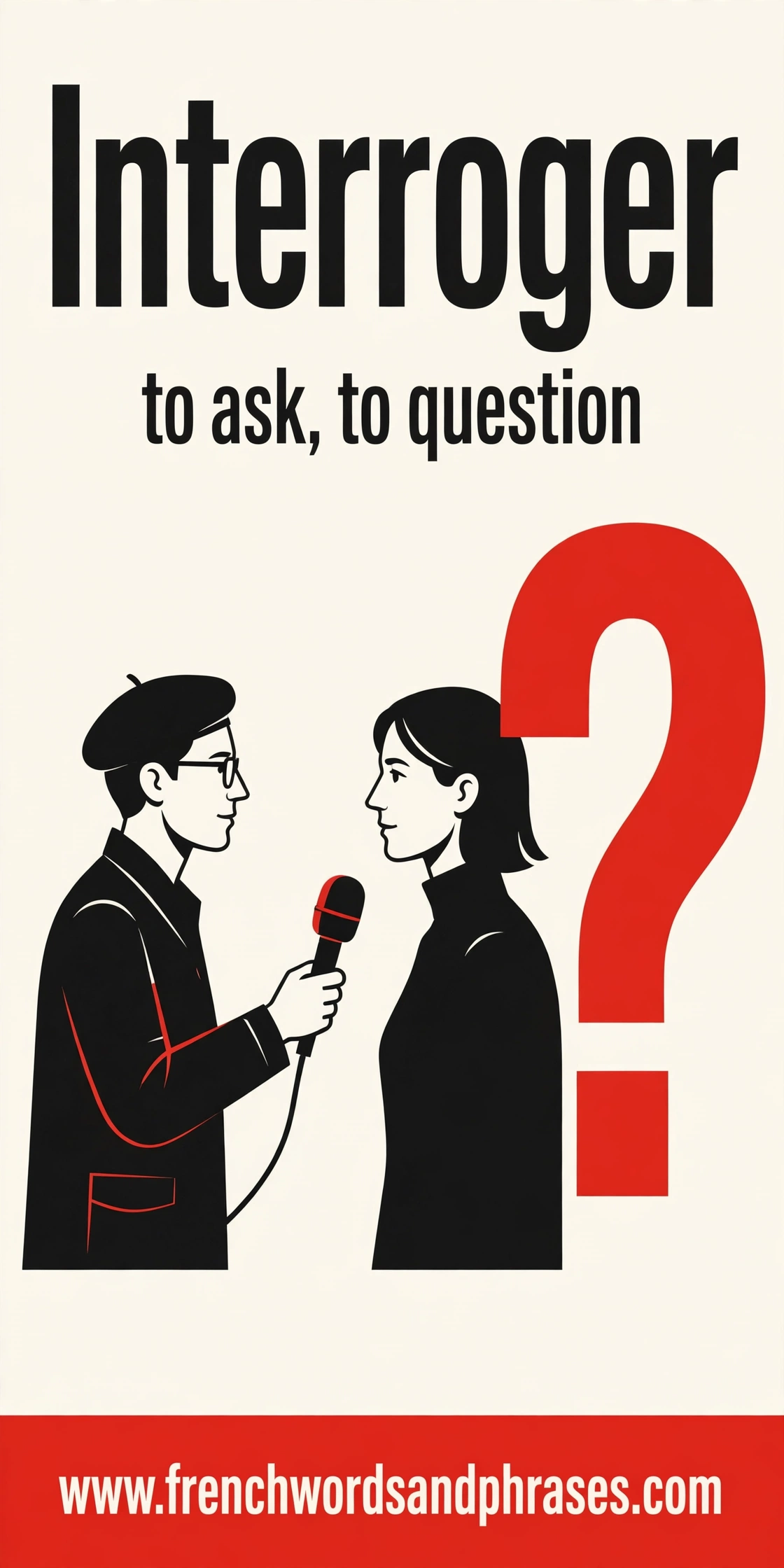
A French Word to Live By
How to Conjugate Interroger in French
/ɛ̃.tɛ.ʁɔ.ʒe/
Interroger means to ask or question someone directly — the teacher examining a pupil, the police questioning a witness, the journalist putting questions to a minister.
A raised hand that is never called on, a witness in a quiet office, a pupil called to the board: interroger is the verb of the formal question — the question that expects an answer and has the right to ask.
In this guide, you’ll learn how to conjugate interroger in all the major French tenses and moods. Explore complete conjugation tables, French examples, English translations, and practice quizzes.
Understanding the French Verb Interroger
Interroger is a regular French verb belonging to the first group of verbs, those ending in-er.
It means to ask, to question. Its everyday centre is the classroom: interroger un élève is the oral test itself, and l’interrogation (often shortened to l’interro) is the quiz — une interro de maths, a maths test. The police sense is the same word at higher stakes: interroger un suspect.
Verb classification: First group (-er)
Auxiliary verb: Avoir
Past participle: interrogé
Present participle: interrogeant
English equivalents: To ask, to question, to examine, to interrogate; interroger un élève — to test a pupil orally; interroger un témoin — to question a witness; s’interroger — to wonder, to ask oneself.
One important detail: interroger is a -ger verb, and verbs in -ger keep a soft g before a and o by adding an e: nous interrogeons, j’interrogeais, interrogeant. Before e and i the plain g is already soft, so no e is added: vous interrogiez. Everything else is perfectly regular.
Experience the Word
Interroger is the verb of the question with authority behind it — curiosity wearing a uniform, a gown, or a teacher’s chalk.
Imagine the morning oral in a French lycée: the teacher opens the register, the class holds its breath, and one name is called. Pendant dix minutes, elle interroge l’élève sur la Révolution — for ten minutes she questions the pupil on the Revolution, and the whole room learns by listening.
The question is asked, and an answer must come. That is interroger — the examined moment.
How to Conjugate Interroger: Complete French Conjugation Guide
Let’s explore every major conjugation of interroger, beginning with the indicative mood.
How to Conjugate Interroger in the Indicative Mood
The indicative mood is used to express facts, observations, actions, and events.
How to Conjugate Interroger in the Present Tense (Présent)
Used for actions happening now, habitual actions, and general truths.
| Subject | Conjugation |
|---|---|
| je | interroge |
| tu | interroges |
| il / elle | interroge |
| nous | interrogeons |
| vous | interrogez |
| ils / elles | interrogent |
Example
Le professeur interroge les élèves sur la leçon.
The teacher questions the pupils on the lesson.
Quick Quiz 1
Complete the sentence:
Nous ______ les élèves un par un.
Reveal the answer
interrogeons
Nous interrogeons les élèves un par un.
We question the pupils one by one — the -ger e keeps the g soft.
How to Conjugate Interroger in the Passé Composé
Used for completed actions in the past. Interroger takes the auxiliary verb avoir.
| Subject | Conjugation |
|---|---|
| j’ | ai interrogé |
| tu | as interrogé |
| il / elle | a interrogé |
| nous | avons interrogé |
| vous | avez interrogé |
| ils / elles | ont interrogé |
Example
La police a interrogé le témoin pendant deux heures.
The police questioned the witness for two hours.
How to Conjugate Interroger in the Imparfait (Imperfect Tense)
Used for habitual past actions, descriptions, and ongoing situations in the past.
| Subject | Conjugation |
|---|---|
| je | interrogeais |
| tu | interrogeais |
| il / elle | interrogeait |
| nous | interrogions |
| vous | interrogiez |
| ils / elles | interrogeaient |
Example
Le juge interrogeait le suspect avec calme.
The judge used to question the suspect calmly.
Quick Quiz 2
Choose the correct form:
The police questioned the witness.
La police ______ le témoin. (a interrogé / est interrogée)
Reveal the answer
a interrogé
La police a interrogé le témoin.
Interroger takes avoir.
How to Conjugate Interroger in the Plus-que-parfait
Used to describe an action that had already been completed before another past event.
| Subject | Conjugation |
|---|---|
| j’ | avais interrogé |
| tu | avais interrogé |
| il / elle | avait interrogé |
| nous | avions interrogé |
| vous | aviez interrogé |
| ils / elles | avaient interrogé |
Example
Elle avait interrogé tous les voisins avant midi.
She had questioned all the neighbours before noon.
How to Conjugate Interroger in the Passé Simple
Primarily used in formal writing, literature, and historical narratives. It is rarely used in everyday conversation.
| Subject | Conjugation |
|---|---|
| je | interrogeai |
| tu | interrogeas |
| il / elle | interrogea |
| nous | interrogeâmes |
| vous | interrogeâtes |
| ils / elles | interrogeèrent |
Example
Le commissaire interrogea le suspect toute la nuit.
The inspector questioned the suspect all night.
How to Conjugate Interroger in the Passé Antérieur
A literary tense used to express an action completed immediately before another past action, generally in the passé simple.
| Subject | Conjugation |
|---|---|
| j’ | eus interrogé |
| tu | eus interrogé |
| il / elle | eut interrogé |
| nous | eûmes interrogé |
| vous | eûtes interrogé |
| ils / elles | eurent interrogé |
Example
Quand ils eurent interrogé le dernier témoin, l’affaire devint claire.
When they had questioned the last witness, the case became clear.
How to Conjugate Interroger in the Future Tense (Futur Simple)
Used to describe actions that will take place in the future.
| Subject | Conjugation |
|---|---|
| je | interrogerai |
| tu | interrogeras |
| il / elle | interrogera |
| nous | interrogerons |
| vous | interrogerez |
| ils / elles | interrogeront |
Example
Demain, le professeur interrogera trois élèves.
Tomorrow, the teacher will question three pupils.
How to Conjugate Interroger in the Futur Antérieur (Future Perfect)
Used for an action that will have been completed before a particular point in the future.
| Subject | Conjugation |
|---|---|
| j’ | aurai interrogé |
| tu | auras interrogé |
| il / elle | aura interrogé |
| nous | aurons interrogé |
| vous | aurez interrogé |
| ils / elles | auront interrogé |
Example
À midi, ils auront interrogé tout le monde.
By noon, they will have questioned everyone.
How to Conjugate Interroger in the Near Future (Futur Proche)
Used to describe something that is going to happen soon. Formed with aller + infinitive.
| Subject | Conjugation |
|---|---|
| je | vais interroger |
| tu | vas interroger |
| il / elle | va interroger |
| nous | allons interroger |
| vous | allez interroger |
| ils / elles | vont interroger |
Example
Attention, elle va interroger la classe sur le chapitre.
Careful, she is going to test the class on the chapter.
How to Conjugate Interroger in the Conditional Mood
The conditional mood expresses what would happen under certain circumstances. It is also frequently used to make polite requests or express wishes.
How to Conjugate Interroger in the Present Conditional
| Subject | Conjugation |
|---|---|
| je | interrogerais |
| tu | interrogerais |
| il / elle | interrogerait |
| nous | interrogerions |
| vous | interrogeriez |
| ils / elles | interrogeraient |
Example
Un bon journaliste interrogerait le ministre sans peur.
A good journalist would question the minister without fear.
How to Conjugate Interroger in the Past Conditional
| Subject | Conjugation |
|---|---|
| j’ | aurais interrogé |
| tu | aurais interrogé |
| il / elle | aurait interrogé |
| nous | aurions interrogé |
| vous | auriez interrogé |
| ils / elles | auraient interrogé |
Example
Il aurait interrogé le témoin plus tôt si la salle avait été libre.
He would have questioned the witness earlier if the room had been free.
Interroger in the Literary Past Conditional Form
This less common literary form uses the imperfect subjunctive of avoir.
| Subject | Conjugation |
|---|---|
| j’ | eusse interrogé |
| tu | eusses interrogé |
| il / elle | eût interrogé |
| nous | eussions interrogé |
| vous | eussiez interrogé |
| ils / elles | eussent interrogé |
Example
Le juge eût interrogé l’accusé avec plus de douceur.
The judge would have questioned the accused more gently.
How to Conjugate Interroger in the Subjunctive Mood
The subjunctive is used to express wishes, emotions, doubts, necessity, and uncertainty. It frequently follows expressions such as il faut que (it is necessary that) or bien que (although).
How to Conjugate Interroger in the Present Subjunctive
| Subject | Conjugation |
|---|---|
| que je | interroge |
| que tu | interroges |
| qu’il / qu’elle | interroge |
| que nous | interrogions |
| que vous | interrogiez |
| qu’ils / qu’elles | interrogent |
Example
Il faut que le professeur interroge chaque élève.
The teacher must question every pupil.
Quick Quiz 3
Complete the sentence using the subjunctive:
Il faut que le juge ______ le suspect.
Reveal the answer
interroge
Il faut que le juge interroge le suspect.
The judge must question the suspect.
How to Conjugate Interroger in the Imperfect Subjunctive
A literary tense, rarely encountered in modern spoken French.
| Subject | Conjugation |
|---|---|
| que je | interrogasse |
| que tu | interrogasses |
| qu’il / qu’elle | interrogât |
| que nous | interrogassions |
| que vous | interrogassiez |
| qu’ils / qu’elles | interrogassent |
Example
Je doutais qu’elle interrogeât le suspect ce soir-là.
I doubted she would question the suspect that evening.
How to Conjugate Interroger in the Pluperfect Subjunctive
A literary construction used to express an action completed before another past action.
| Subject | Conjugation |
|---|---|
| que j’ | eusse interrogé |
| que tu | eusses interrogé |
| qu’il / qu’elle | eût interrogé |
| que nous | eussions interrogé |
| que vous | eussiez interrogé |
| qu’ils / qu’elles | eussent interrogé |
Example
On admirait qu’ils eussent interrogé tant de témoins en une journée.
People admired that they had questioned so many witnesses in one day.
How to Conjugate Interroger in the Past Subjunctive
| Subject | Conjugation |
|---|---|
| que j’ | aie interrogé |
| que tu | aies interrogé |
| qu’il / qu’elle | ait interrogé |
| que nous | ayons interrogé |
| que vous | ayez interrogé |
| qu’ils / qu’elles | aient interrogé |
Example
Je suis content qu’on ait interrogé tous les témoins.
I am glad all the witnesses were questioned.
How to Conjugate Interroger in the Imperative
The imperative is used to give commands, instructions, invitations, or suggestions. Subject pronouns are omitted.
How to Conjugate Interroger in the Present Imperative
| Person | Conjugation |
|---|---|
| (tu) | interroge |
| (nous) | interrogeons |
| (vous) | interrogez |
Example
Interroge les élèves sur le premier chapitre !
Question the pupils on the first chapter!
Quick Quiz 4
How would you say Question the pupils (tu form)?
Reveal the answer
Interroge les élèves !
French Participles of Interroger
Participles are verb forms that can be used in compound tenses and other grammatical constructions.
Present Participle of Interroger
interrogeant
En interrogeant les passants, elle a retrouvé le chien.
By questioning the passers-by, she found the dog.
Past Participle of Interroger
interrogé
Interrogé par la police, le témoin a tout raconté.
Questioned by the police, the witness told everything.
Interroger in Everyday French: Real-Life Examples
Now that you know the conjugations, let’s see how interroger appears in everyday French.
Example 1 — Present
Le professeur interroge les élèves.
The teacher questions the pupils.
Example 2 — Passé composé
La police a interrogé le témoin.
The police questioned the witness.
Example 3 — Imparfait
Le juge interrogeait le suspect avec calme.
The judge used to question the suspect calmly.
Example 4 — Future
Le professeur interrogera trois élèves demain.
The teacher will question three pupils tomorrow.
Example 5 — Conditional
Un bon journaliste interrogerait le ministre sans peur.
A good journalist would question the minister without fear.
Example 6 — Imperative
Interroge les élèves sur le premier chapitre !
Question the pupils on the first chapter!
Beyond Translation: The Meaning of Interroger
English interrogate kept only the police room; French interroger kept the whole corridor — classroom, courtroom, newsroom. Its noun, l’interrogation, is both the philosophical question mark and the school quiz, and schoolchildren shorten it with affection and dread to l’interro.
Interroger is the question that has done its homework.
And turned back on oneself it becomes s’interroger — to wonder, to ask oneself — the verb of every honest doubt.
How to Remember the French Verb Interroger
Remember it this way: Interroger is about the teacher with the register, calling one name while the whole class holds its breath.
- -ger verb: keep the soft g — nous interrogeons, j’interrogeais, interrogeant.
- The classroom sense: interroger un élève = to give an oral test; l’interro is the quiz.
- Regular endings everywhere else: j’interroge, nous interrogeons, past participle interrogé.
The key idea is the teacher with the register, calling one name while the whole class holds its breath.
Test Your Knowledge of Interroger
Let’s see how much you’ve learned. Try answering these questions before revealing the answers.
Question 1
What is the main spelling trap with interroger?
Reveal the answer
It is a -ger verb — an e keeps the g soft before a and o: nous interrogeons, interrogeant.
Question 2
How do you say The police questioned the witness in French?
Reveal the answer
La police a interrogé le témoin.
Question 3
Translate: Tomorrow, the teacher will question three pupils.
Reveal the answer
Demain, le professeur interrogera trois élèves.
Question 4
What is the past participle of interroger?
Reveal the answer
Interrogé.
Question 5
Complete the sentence:
Il faut que le professeur ______ chaque élève.
Reveal the answer
interroge
Il faut que le professeur interroge chaque élève.
The teacher must question every pupil.
Your Final Challenge
Can You Use It?
How would you say this in French?
For ten minutes, the teacher questioned the pupil on the Revolution, and the whole class listened.
Reveal the answer
Pendant dix minutes, le professeur a interrogé l’élève sur la Révolution, et toute la classe écoutait.
For ten minutes, the teacher questioned the pupil on the Revolution, and the whole class listened.
A little French. A little curiosity. A richer everyday life.
LEARN FRENCH ONE WORD AT A TIME




