A French Word to Live By
Translate Port to English
/pɔʁ/
Le port means the port, the harbour.
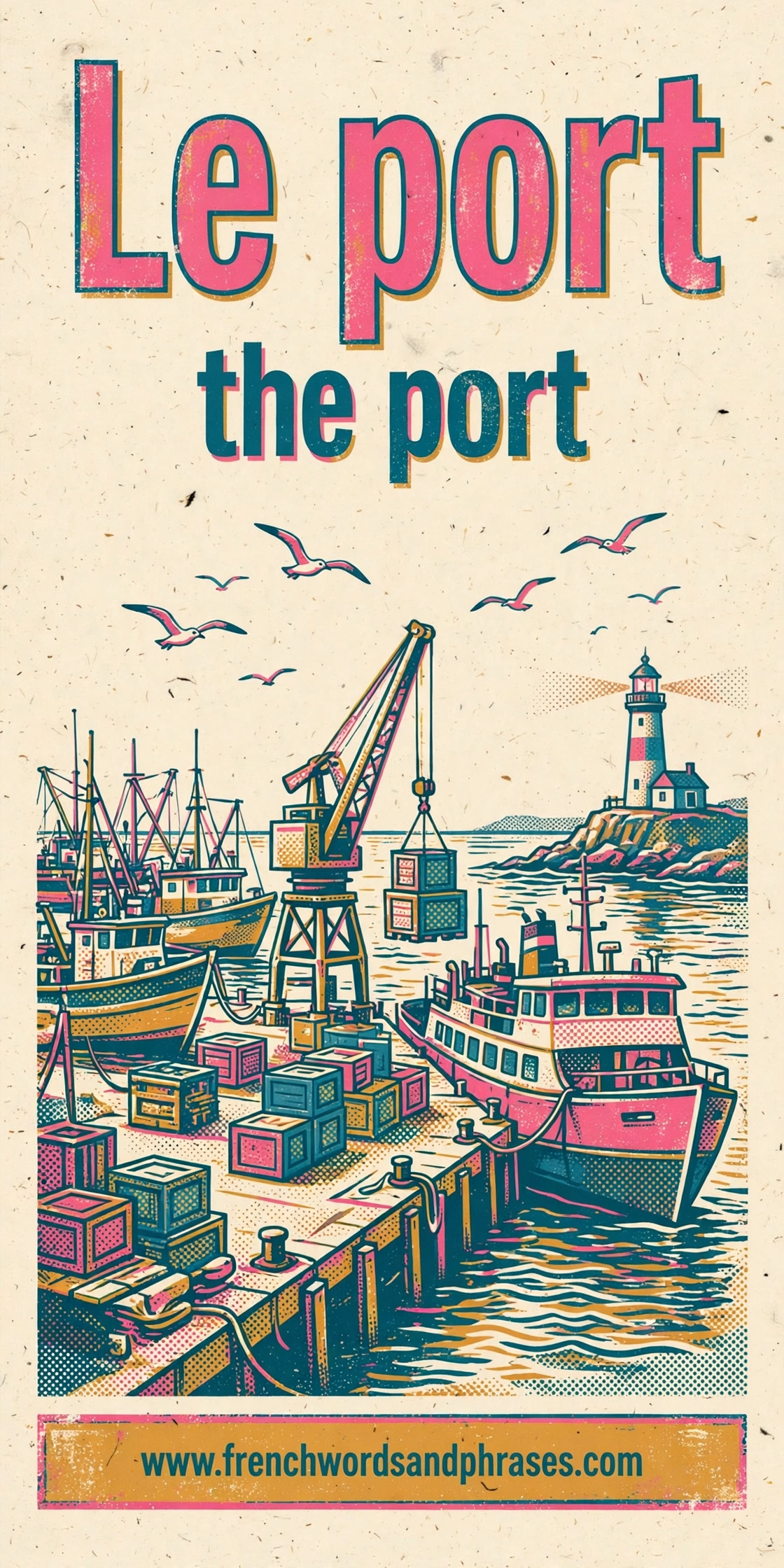
Gulls over the masts at dawn, crates on the quay, a ferry sounding its horn as it slides towards the open sea. « Le bateau rentre au port. » — the boat is coming back into port. Le port is the harbour: the sheltered water where ships arrive, load, and rest.
In this guide, you’ll learn what port means in English, how to use it with its articles, how to form its plural, and how it appears in everyday French. Explore French examples, English translations, and practice quizzes.
Understanding the French Noun Port
Port is a masculine French noun, learned with its article: le port, un port. It names the harbour — the place where ships shelter and trade. From the Latin portus, a haven, it also lives in a family of carrying words: porter, to carry; le port d’armes, the carrying of weapons; and franco de port, postage paid.
It means a port, a harbour: un port de pêche, a fishing port; le port du Havre, the port of Le Havre. Ships enter it (entrer au port), leave it (quitter le port), and rest in it (rester au port). A port de plaisance is a marina, full of pleasure boats; a port marchand is a commercial port of cranes and containers.
Gender: Masculine — le port
Definite article: le — le port (the port)
Indefinite article: un — un port (a port)
Plural: les ports — regular, with a simple -s
Spelling note: the final t is silent — port sounds like ‘por’
Key phrase: un port de pêche — a fishing port; un port de plaisance — a marina
English equivalents: The port, the harbour.
Watch the twins port and porte: le port is the harbour, la porte is the door — one letter and one gender apart, and a whole world between them. And note that a sailor says rentrer au port, to come back into port, with au, not ‘dans le port’.
Experience the Word
Port is the harbour of the homecoming — the word for the water that receives the ship.
Imagine the fishing fleet of Brittany coming in at dusk, lights on the water, the port waking up as the boats arrive: crates, gulls, voices, the smell of salt and diesel. The port is not the sea; it is the sea made safe.
You have not just named a place on the map. You have named the end of every voyage.
How to Use Port in French: Complete Guide
Let’s explore how port works in French, beginning with its articles — le port, un port, rentrer au port.
Port with the Definite Article (Le, Les)
Used for the specific port — the one the ship is heading for.
| Form | French |
|---|---|
| Masculine singular | le port |
| Plural | les ports |
Example
Le port est plein de bateaux.
The port is full of boats.
Port with the Indefinite Article (Un, Des)
Used for a port in general — any harbour on the coast.
| Form | French |
|---|---|
| Masculine singular | un port |
| Plural | des ports |
Example
C’est un port très ancien.
It is a very old port.
Port in Its Kinds (Pêche, Plaisance, Marchand…)
French sorts its ports by what the boats do there.
| Kind | French |
|---|---|
| fishing port | un port de pêche |
| marina | un port de plaisance |
| commercial port | un port marchand |
| home port | un port d’attache |
| free port | un port franc |
Example
Le port de plaisance est derrière la digue.
The marina is behind the breakwater.
Quick Quiz 1
Complete the sentence:
______ port du Havre est immense. (the)
Reveal the answer
Le
Le port du Havre est immense.
The port of Le Havre is immense.
The Plural of Port
Port takes a regular plural in -s.
| Number | French |
|---|---|
| Singular | le port |
| Plural | les ports |
Example
Les ports de Bretagne sont magnifiques.
The ports of Brittany are magnificent.
Port with Possessive Adjectives (Mon, Ton, Son…)
Port is masculine, so the singular possessives are mon, ton, son.
| Owner | French |
|---|---|
| my | mon port |
| your (tu) | ton port |
| his / her | son port |
| our | notre port |
| your (vous) | votre port |
| their | leur port |
Example
Leur port d’attache est Marseille.
Their home port is Marseille.
Quick Quiz 2
Complete the sentence:
Le bateau rentre dans ______ port d’attache. (its)
Reveal the answer
son
Le bateau rentre dans son port d’attache.
The boat is returning to its home port.
Port with Demonstrative Adjectives (Ce, Ces)
Used to point: ce port, this port — the one in front of the traveller.
| Form | French |
|---|---|
| Masculine singular | ce port |
| Plural | ces ports |
Example
Ce port accueille les ferries pour l’Angleterre.
This port receives the ferries for England.
Port with Adjectives
Adjectives agree with port — masculine singular.
| Adjective | With Port |
|---|---|
| grand (big) | un grand port |
| petit (small) | un petit port |
| ancien (old) | un port ancien |
| moderne (modern) | un port moderne |
| célèbre (famous) | un port célèbre |
Example
C’est un petit port de pêche très calme.
It is a very quiet little fishing port.
Quick Quiz 3
Complete the sentence:
C’est un port ______. (modern)
Reveal the answer
moderne
C’est un port moderne.
It is a modern port.
Everyday Expressions with Port
Arrivals, departures and safe havens — the port phrases of daily life.
| Expression | In English |
|---|---|
| rentrer au port | to come back into port |
| quitter le port | to leave port |
| un port de pêche | a fishing port |
| un port de plaisance | a marina |
| arriver à bon port | to arrive safely (at a safe harbour) |
| le port d’attache | the home port |
Example
Après la tempête, tous les bateaux sont arrivés à bon port.
After the storm, all the boats arrived safely.
Words from the Same Family as Port
The carrying family — harbours, doors and loads.
| French | In English |
|---|---|
| porter | to carry, to wear (the verb) |
| la porte | the door — the twin to watch |
| un bateau | a boat, a ship |
| la mer | the sea |
| un phare | a lighthouse |
Example
Le phare guide les bateaux vers le port.
The lighthouse guides the boats towards the port.
Quick Quiz 4
What does arriver à bon port mean?
Reveal the answer
To arrive safely — literally, to reach a good harbour.
Le colis est arrivé à bon port.
The parcel arrived safely.
Port in Everyday French: Real-Life Examples
Now that you know the word, let’s see how port appears in everyday French.
Example 1 — Arrival
Le ferry rentre au port à dix-huit heures.
The ferry comes into port at six o’clock.
Example 2 — A walk
On se promène sur le port après le dîner.
We stroll along the harbour after dinner.
Example 3 — Fishing
Les bateaux de pêche quittent le port à l’aube.
The fishing boats leave port at dawn.
Example 4 — A marina
Son voilier est dans le port de plaisance.
His sailing boat is in the marina.
Example 5 — Safe arrival
Enfin, nous sommes arrivés à bon port.
At last, we have arrived safely.
Example 6 — Trade
Le port marchand reçoit des navires du monde entier.
The commercial port receives ships from all over the world.
Beyond Translation: The Meaning of Port
Portus, the Latin haven, gave French a whole geography of safety: le port is where the sea’s danger ends. French kept the metaphor alive in arriver à bon port — to arrive safely — said of parcels, travellers and even projects that survive their storms.
Every port is a promise that voyages end.
And its family tells the story of carrying: porter, to carry; la porte, the door that carries you through a wall; le port, the water that carries the ship home.
How to Remember the French Noun Port
Remember it this way: Port is the harbour — masculine: le port, with a silent t, and its blessing is arriver à bon port.
- Always masculine — le port, un port, mon port.
- The homecoming phrase — rentrer au port, to come back into port.
- Not the door — that is la porte, feminine.
The key idea is le port — the port, the harbour, masculine; arriver à bon port = to arrive safely.
Test Your Knowledge of Port
Let’s see how much you’ve learned. Try answering these questions before revealing the answers.
Question 1
Is port masculine or feminine?
Reveal the answer
Masculine — le port, un port.
Question 2
How do you say a fishing port?
Reveal the answer
Un port de pêche.
Question 3
Translate: The boat is returning to port.
Reveal the answer
Le bateau rentre au port.
Question 4
What is the difference between port and porte?
Reveal the answer
Le port is the harbour; la porte is the door.
Question 5
Complete the sentence:
______ ports de la côte sont ouverts. (the)
Reveal the answer
Les
Les ports de la côte sont ouverts.
The ports along the coast are open.
Your Final Challenge
Can You Use It?
How would you say this in French?
“After the storm, all the boats arrived safely.”
Reveal the answer
Après la tempête, tous les bateaux sont arrivés à bon port.
After the storm, all the boats arrived safely.
A little French. A little curiosity. A richer everyday life.
LEARN FRENCH ONE WORD AT A TIME