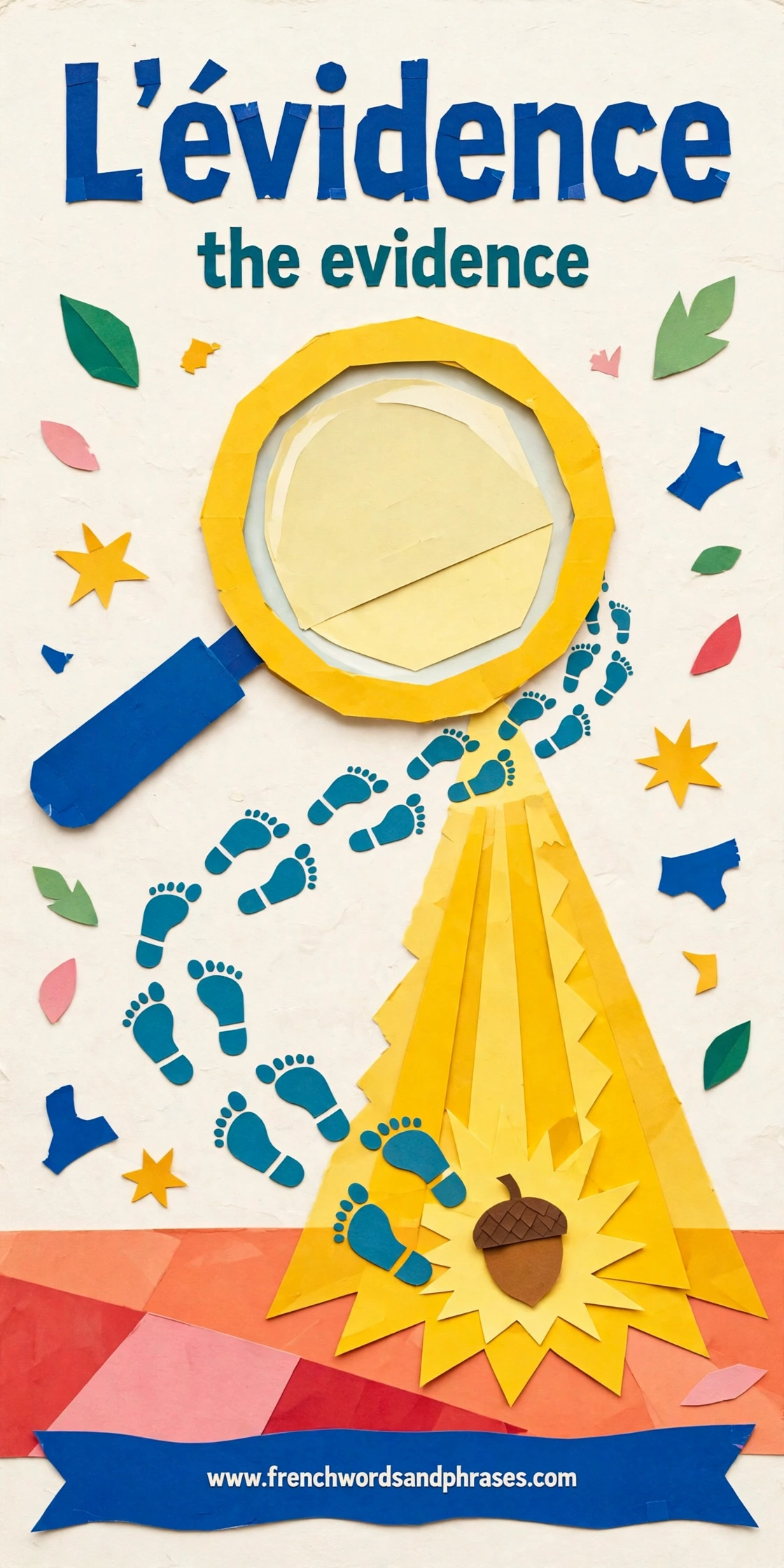
A French Word to Live By
Translate Évidence to English
/e.vi.dɑ̃s/
L’Évidence means the evidence, the obviousness.
It was there all along, in plain sight, needing no detective and no argument — only someone willing to look: l’évidence, the obvious fact, the thing so clear it stares back. French built one of its most useful phrases on this word: mettre en évidence, to highlight, literally to put something into plain sight.
In this guide, you’ll learn what évidence means in English, how to use it with its articles, how to form its plural, and how it appears in everyday French. Explore French examples, English translations, and practice quizzes.
Understanding the French Noun Évidence
Évidence is a feminine French noun, learned with its article: l’évidence, une évidence. It begins with a vowel, so the article melts into it: l’évidence, never la évidence in speech. It comes from the Latin evidentia — e-, out, plus videre, to see: the quality of being out where everyone can see it.
Its first meaning is obviousness — the quality of being plain to see: c’est une évidence, it is obvious, an obvious fact, de toute évidence, obviously, evidently. English speakers must handle it with care, because it is a celebrated false friend: the courtroom English word “evidence”, proof that something happened, is in French les preuves, not évidence. What évidence names is not the proof but the plainness — the fact that a thing needs no proving because it is already staring at you. Its great phrase is mettre en évidence, to highlight, to bring to light, which has its own page on this site.
Gender: Feminine — l’évidence
Definite article: l’ — l’évidence (the evidence), melted before the vowel
Indefinite article: une — une évidence (an obvious fact)
Plural: les évidences — regular, with a simple -s
The false friend: English “evidence” (proof) = les preuves; évidence = obviousness, the plain fact
Key phrase: mettre en évidence — to highlight, to bring to light (its own page on this site)
English equivalents: The evidence, the obviousness, the obvious fact.
Watch the possessives: évidence is feminine but begins with a vowel, so the singular possessives borrow the masculine forms — mon évidence, ton évidence, son évidence — never ma évidence. The phrases to keep are de toute évidence, obviously, se rendre à l’évidence, to face the facts, literally to surrender to the obvious, and nier l’évidence, to deny the obvious. And when a report met en évidence a problem, it does not prove it — it drags it into the light where nobody can miss it.
Experience the Word
Évidence is the moment a fact stops being an opinion: the empty chair at the table, the mud on the shoes, the figure at the bottom of the column.
Imagine the meeting where everyone has argued for an hour — then someone projects one simple graph on the wall, and the room goes quiet: c’est l’évidence, and there is nothing left to debate.
You have not just named proof. You have named plain sight itself — l’évidence, the fact that was never hiding.
How to Use Évidence in French: Complete Guide
Let’s explore how évidence works in French, beginning with its articles — l’évidence, une évidence, mettre en évidence.
Évidence with the Definite Article (L’, Les)
Used for the specific obvious fact — the one in front of everyone’s eyes. The vowel opening makes la melt into l’.
| Form | French |
|---|---|
| Feminine singular | l’évidence |
| Plural | les évidences |
Example
L’évidence saute aux yeux, inutile de discuter.
The obvious fact leaps out at you, there is no point arguing.
Évidence with the Indefinite Article (Une, Des)
Used for an obvious fact in general — stating one is the politest way to end a debate.
| Form | French |
|---|---|
| Feminine singular | une évidence |
| Plural | des évidences |
Example
C’est une évidence : ce village a besoin d’une école.
It is an obvious fact: this village needs a school.
Évidence in Its Set Phrases (Mettre en évidence, De toute évidence…)
Évidence lives in fixed phrases — to highlight, obviously, and facing the facts.
| Expression | French |
|---|---|
| to highlight, to bring to light | mettre en évidence |
| obviously, evidently | de toute évidence |
| to face the facts | se rendre à l’évidence |
| to deny the obvious | nier l’évidence |
| evidently, clearly | à l’évidence |
Example
De toute évidence, le train aura du retard.
Obviously, the train will be late.
Quick Quiz 1
Complete the sentence:
______ évidence est là, devant nous. (the)
Reveal the answer
L’
L’évidence est là, devant nous.
The evidence is there, in front of us — la melts into l’ before the vowel.
The Plural of Évidence
Évidence takes a regular plural in -s — a whole row of plain facts.
| Number | French |
|---|---|
| Singular | l’évidence |
| Plural | les évidences |
Example
Face à tant d’évidences, il a fini par se taire.
Faced with so many obvious facts, he ended up saying nothing.
Évidence with Possessive Adjectives (Mon, Ton, Son…)
Évidence is feminine, but it begins with a vowel, so the singular possessives borrow the masculine forms: mon, ton, son — the words must flow.
| Owner | French |
|---|---|
| my | mon évidence |
| your (tu) | ton évidence |
| his / her | son évidence |
| our | notre évidence |
| your (vous) | votre évidence |
| their | leur évidence |
Example
Son évidence a mis fin au débat.
Its obviousness put an end to the debate.
Quick Quiz 2
How do you say obviously, using évidence?
Reveal the answer
De toute évidence — literally, of all obviousness.
De toute évidence, elle avait raison.
Obviously, she was right.
Évidence with Demonstrative Adjectives (Cette, Ces)
Used to point: cette évidence, this plain fact — usually the one nobody wanted to see.
| Form | French |
|---|---|
| Feminine singular | cette évidence |
| Plural | ces évidences |
Example
Cette évidence, personne ne peut la nier.
This obvious fact, nobody can deny it.
Évidence with Adjectives
Adjectives agree with évidence — feminine singular: une évidence flagrante, une évidence aveuglante.
| Adjective | With Évidence |
|---|---|
| flagrante (blatant) | une évidence flagrante |
| aveuglante (blindingly obvious) | une évidence aveuglante |
| criante (glaring) | une évidence criante |
| simple (plain, simple) | une simple évidence |
| manifeste (manifest, plain) | une évidence manifeste |
Example
C’est une évidence flagrante, même les enfants la voient.
It is blindingly obvious, even the children can see it.
Quick Quiz 3
Complete the sentence:
C’est une évidence ______, tout le monde est d’accord. (blatant)
Reveal the answer
flagrante
C’est une évidence flagrante, tout le monde est d’accord.
It is blindingly obvious, everyone agrees — flagrante, feminine, to agree with évidence.
Everyday Expressions with Évidence
Reports, debates and home truths — the évidence phrases of daily life.
| Expression | In English |
|---|---|
| mettre en évidence | to highlight, to bring to light |
| de toute évidence | obviously, evidently |
| se rendre à l’évidence | to face the facts |
| nier l’évidence | to deny the obvious |
| à l’évidence | evidently, clearly |
Example
Il a dû se rendre à l’évidence : la maison était trop grande.
He had to face the facts: the house was too big.
Words from the Same Family as Évidence
Seeing clearly — the words that travel with évidence.
| French | In English |
|---|---|
| évident | obvious (the adjective: c’est évident) |
| évidemment | obviously, of course (the adverb) |
| mettre en évidence | to highlight — the phrase built on this noun, with its own page on this site |
| la preuve | the proof — the real French word for courtroom “evidence” |
| démontrer | to demonstrate, to show clearly |
Example
C’est évident, le rapport le démontre page après page.
It is obvious, the report demonstrates it page after page.
Quick Quiz 4
What does mettre en évidence mean?
Reveal the answer
To highlight, to bring to light — literally, to put into plain sight; the phrase has its own page on this site.
Le rapport met en évidence trois problèmes.
The report highlights three problems.
Évidence in Everyday French: Real-Life Examples
Now that you know the word, let’s see how évidence appears in everyday French.
Example 1 — In a report
Le rapport met en évidence trois problèmes.
The report highlights three problems.
Example 2 — Obvious
De toute évidence, il est fatigué.
Obviously, he is tired.
Example 3 — Facing facts
Elle s’est rendue à l’évidence et a vendu la voiture.
She faced the facts and sold the car.
Example 4 — Denial
Il nie l’évidence, les chiffres sont pourtant là.
He denies the obvious, yet the figures are there.
Example 5 — Stating it
C’est une évidence : l’hiver sera froid.
It is an obvious fact: the winter will be cold.
Example 6 — Leaping out
L’évidence saute aux yeux dès la première page.
The obvious fact leaps out from the very first page.
Beyond Translation: The Meaning of Évidence
Évidence and English “evidence” are the same Latin word travelling in two directions. Latin evidentia named the quality of being seen out in the open; English steered it into the courtroom, where evidence became the proof laid before a jury, while French kept the visual sense — the plainness of a thing that needs no proof at all. That is why the French phrase built on it is so physical: mettre en évidence does not argue a fact, it moves it — out of the footnotes, into the light, where it becomes une évidence for everyone.
To say évidence is to point at what nobody can unsee.
It evokes the graph on the wall that ends the meeting, the empty chair, the figure at the bottom of the column — French’s word for the moment truth stops whispering.
How to Remember the French Noun Évidence
Remember it this way: Évidence is obviousness — the plain fact, not the proof: l’évidence, and its great phrase mettre en évidence, to highlight.
- Always feminine, vowel first — l’évidence, une évidence, cette évidence.
- The false friend — courtroom “evidence” is les preuves; évidence is the obviousness itself.
- The phrase — mettre en évidence, to highlight; de toute évidence, obviously.
The key idea is l’évidence — the obvious fact, feminine; mettre en évidence = to highlight.
Test Your Knowledge of Évidence
Let’s see how much you’ve learned. Try answering these questions before revealing the answers.
Question 1
Is évidence masculine or feminine?
Reveal the answer
Feminine — l’évidence, une évidence (the article melts before the vowel).
Question 2
How do you say the English word “evidence”, meaning proof, in French?
Reveal the answer
Les preuves — évidence is a false friend: it means obviousness, the plain fact.
Question 3
Translate: The report highlights three problems.
Reveal the answer
Le rapport met en évidence trois problèmes.
Question 4
What does se rendre à l’évidence mean?
Reveal the answer
To face the facts — literally, to surrender to the obvious.
Question 5
Complete the sentence:
______ toute évidence, le magasin est fermé. (obviously)
Reveal the answer
De
De toute évidence, le magasin est fermé.
Obviously, the shop is closed.
Your Final Challenge
Can You Use It?
How would you say this in French?
“The report highlights three problems.”
Reveal the answer
Le rapport met en évidence trois problèmes.
The report highlights three problems.
A little French. A little curiosity. A richer everyday life.
LEARN FRENCH ONE WORD AT A TIME