
A French Word to Live By
How to Conjugate Ignorer in French
/i.ɲɔ.ʁe/
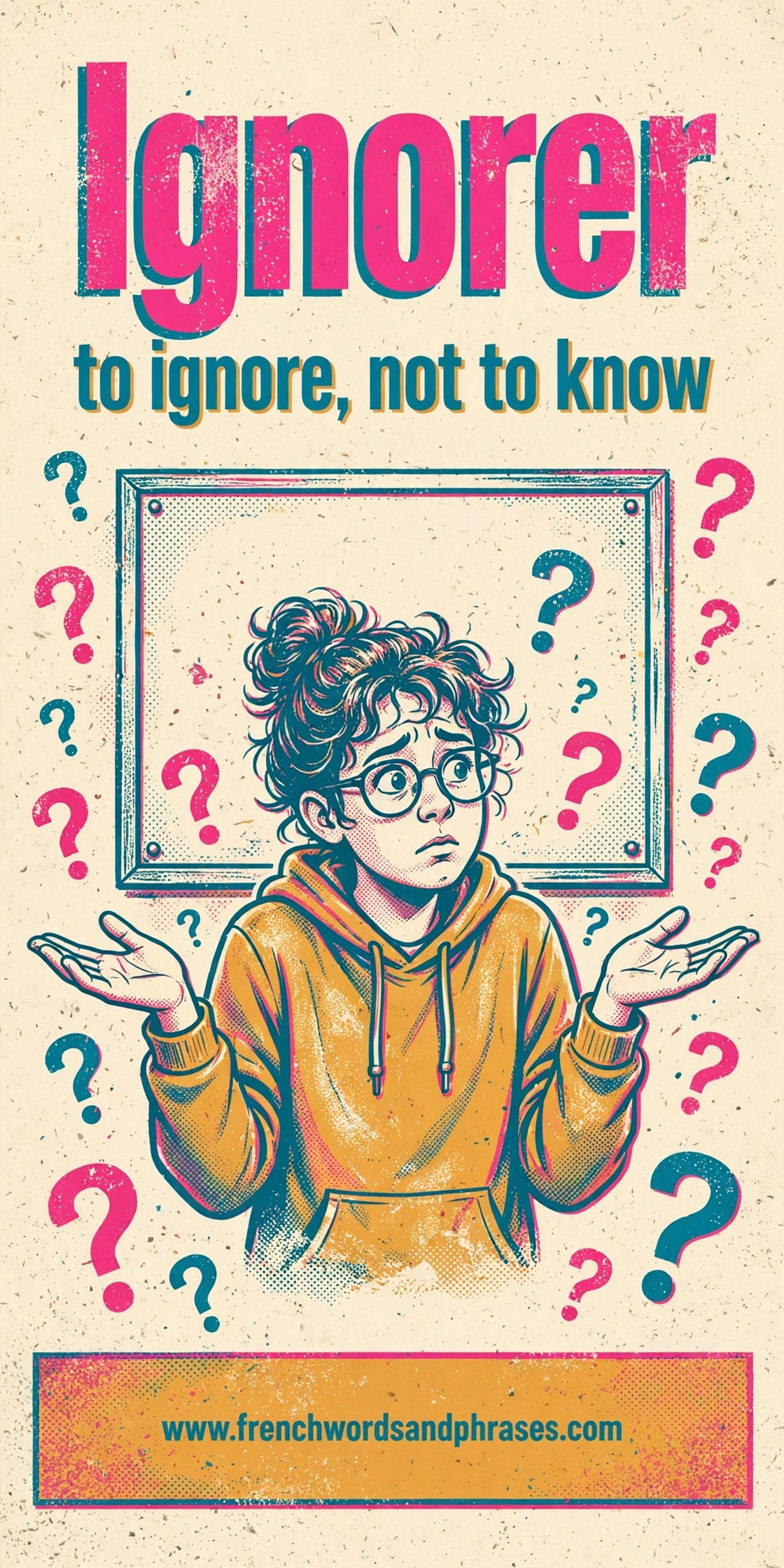
Ignorer means both to not know — to be unaware of a fact — and to ignore, to deliberately pay no attention to a person or a warning.
A student who does not know the answer, a passer-by who deliberately looks through an old enemy — ignorer covers both honest ignorance and the deliberate cold shoulder: what we do not know, and what we choose not to see.
In this guide, you’ll learn how to conjugate ignorer in all the major French tenses and moods. Explore complete conjugation tables, French examples, English translations, and practice quizzes.
Understanding the French Verb Ignorer
Ignorer is a regular French verb belonging to the first group of verbs, those ending in-er.
It means to ignore, not to know. Context decides: with facts, names and answers, ignorer = not to know (j’ignore tout de cette affaire — I know nothing about this business); with people, warnings and advice, it slides towards deliberate disregard (elle a ignoré mes conseils). French also has the noun l’ignorance and the adjective ignorant, used more neutrally than in English.
Verb classification: First group (-er)
Auxiliary verb: Avoir
Past participle: ignoré
Present participle: ignorant
English equivalents: To not know, to be unaware of; to ignore, to disregard; ignorer la réponse — not to know the answer; j’ignore où il est — I don’t know where he is; ignorer un avertissement — to ignore a warning; ignorer quelqu’un — to blank someone, to cut them dead.
One important detail: ignorer has two lives in French, and the first is the opposite of the English one — j’ignore very often means simply I don’t know: j’ignore son nom, I don’t know his name. The deliberate sense (to ignore a person, a rule, a warning) exists too, but when you read il ignorait le danger, it means he was unaware of the danger, not that he snubbed it. The verb is perfectly regular: j’ignore, nous ignorons, ils ignorent, past participle ignoré.
Experience the Word
Ignorer is the verb of the two closed doors — the fact we never learned, and the person we refuse to see.
Imagine a small examination room. The teacher asks the last question; the student looks at the ceiling — il ignore la réponse, honestly, completely. Outside, in the corridor, he passes his rival without a glance: là, il l’ignore, deliberately, and everyone understands the difference.
One verb, two silences. Ignorer — not knowing, and not wanting to know.
How to Conjugate Ignorer: Complete French Conjugation Guide
Let’s explore every major conjugation of ignorer, beginning with the indicative mood.
How to Conjugate Ignorer in the Indicative Mood
The indicative mood is used to express facts, observations, actions, and events.
How to Conjugate Ignorer in the Present Tense (Présent)
Used for actions happening now, habitual actions, and general truths.
| Subject | Conjugation |
|---|---|
| je | ignore |
| tu | ignores |
| il / elle | ignore |
| nous | ignorons |
| vous | ignorez |
| ils / elles | ignorent |
Example
J’ignore la réponse à cette question.
I don’t know the answer to this question.
Quick Quiz 1
Complete the sentence:
Nous ______ complètement les raisons de son départ.
Reveal the answer
ignorons
Nous ignorons complètement les raisons de son départ.
We have no idea why he left.
How to Conjugate Ignorer in the Passé Composé
Used for completed actions in the past. Ignorer takes the auxiliary verb avoir.
| Subject | Conjugation |
|---|---|
| j’ | ai ignoré |
| tu | as ignoré |
| il / elle | a ignoré |
| nous | avons ignoré |
| vous | avez ignoré |
| ils / elles | ont ignoré |
Example
Il a ignoré tous mes avertissements.
He ignored all my warnings.
How to Conjugate Ignorer in the Imparfait (Imperfect Tense)
Used for habitual past actions, descriptions, and ongoing situations in the past.
| Subject | Conjugation |
|---|---|
| je | ignorais |
| tu | ignorais |
| il / elle | ignorait |
| nous | ignorions |
| vous | ignoriez |
| ils / elles | ignoraient |
Example
À l’époque, nous ignorions complètement le danger.
At the time, we were completely unaware of the danger.
Quick Quiz 2
Choose the correct form:
He ignored my warnings.
Il ______ mes avertissements. (a ignoré / est ignoré)
Reveal the answer
a ignoré
Il a ignoré mes avertissements.
Ignorer takes avoir.
How to Conjugate Ignorer in the Plus-que-parfait
Used to describe an action that had already been completed before another past event.
| Subject | Conjugation |
|---|---|
| j’ | avais ignoré |
| tu | avais ignoré |
| il / elle | avait ignoré |
| nous | avions ignoré |
| vous | aviez ignoré |
| ils / elles | avaient ignoré |
Example
Elle avait ignoré la lettre pendant des semaines avant de l’ouvrir.
She had ignored the letter for weeks before opening it.
How to Conjugate Ignorer in the Passé Simple
Primarily used in formal writing, literature, and historical narratives. It is rarely used in everyday conversation.
| Subject | Conjugation |
|---|---|
| je | ignorai |
| tu | ignoras |
| il / elle | ignora |
| nous | ignorâmes |
| vous | ignorâtes |
| ils / elles | ignorèrent |
Example
Le roi ignora les conseils de ses ministres.
The king disregarded his ministers’ advice.
How to Conjugate Ignorer in the Passé Antérieur
A literary tense used to express an action completed immediately before another past action, generally in the passé simple.
| Subject | Conjugation |
|---|---|
| j’ | eus ignoré |
| tu | eus ignoré |
| il / elle | eut ignoré |
| nous | eûmes ignoré |
| vous | eûtes ignoré |
| ils / elles | eurent ignoré |
Example
Quand il eut ignoré le panneau, il se perdit dans la forêt.
When he had ignored the sign, he got lost in the forest.
How to Conjugate Ignorer in the Future Tense (Futur Simple)
Used to describe actions that will take place in the future.
| Subject | Conjugation |
|---|---|
| je | ignorerai |
| tu | ignoreras |
| il / elle | ignorera |
| nous | ignorerons |
| vous | ignorerez |
| ils / elles | ignoreront |
Example
Si tu ignores les règles, tu auras des ennuis.
If you disregard the rules, you will be in trouble.
How to Conjugate Ignorer in the Futur Antérieur (Future Perfect)
Used for an action that will have been completed before a particular point in the future.
| Subject | Conjugation |
|---|---|
| j’ | aurai ignoré |
| tu | auras ignoré |
| il / elle | aura ignoré |
| nous | aurons ignoré |
| vous | aurez ignoré |
| ils / elles | auront ignoré |
Example
À la fin du cours, vous n’ignorerez plus rien de cette grammaire.
By the end of the course, you will no longer be ignorant of any of this grammar.
How to Conjugate Ignorer in the Near Future (Futur Proche)
Used to describe something that is going to happen soon. Formed with aller + infinitive.
| Subject | Conjugation |
|---|---|
| je | vais ignorer |
| tu | vas ignorer |
| il / elle | va ignorer |
| nous | allons ignorer |
| vous | allez ignorer |
| ils / elles | vont ignorer |
Example
Ne va pas ignorer son message, réponds-lui !
Don’t ignore his message, answer him!
How to Conjugate Ignorer in the Conditional Mood
The conditional mood expresses what would happen under certain circumstances. It is also frequently used to make polite requests or express wishes.
How to Conjugate Ignorer in the Present Conditional
| Subject | Conjugation |
|---|---|
| je | ignorerais |
| tu | ignorerais |
| il / elle | ignorerait |
| nous | ignorerions |
| vous | ignoreriez |
| ils / elles | ignoreraient |
Example
À ta place, je n’ignorerais pas cet avertissement.
In your place, I would not ignore this warning.
How to Conjugate Ignorer in the Past Conditional
| Subject | Conjugation |
|---|---|
| j’ | aurais ignoré |
| tu | aurais ignoré |
| il / elle | aurait ignoré |
| nous | aurions ignoré |
| vous | auriez ignoré |
| ils / elles | auraient ignoré |
Example
Il aurait ignoré le danger sans les conseils de son guide.
He would have been unaware of the danger without his guide’s advice.
Ignorer in the Literary Past Conditional Form
This less common literary form uses the imperfect subjunctive of avoir.
| Subject | Conjugation |
|---|---|
| j’ | eusse ignoré |
| tu | eusses ignoré |
| il / elle | eût ignoré |
| nous | eussions ignoré |
| vous | eussiez ignoré |
| ils / elles | eussent ignoré |
Example
Le ministre eût ignoré la rumeur sans les journaux du matin.
The minister would have known nothing of the rumour without the morning papers.
How to Conjugate Ignorer in the Subjunctive Mood
The subjunctive is used to express wishes, emotions, doubts, necessity, and uncertainty. It frequently follows expressions such as il faut que (it is necessary that) or bien que (although).
How to Conjugate Ignorer in the Present Subjunctive
| Subject | Conjugation |
|---|---|
| que je | ignore |
| que tu | ignores |
| qu’il / qu’elle | ignore |
| que nous | ignorions |
| que vous | ignoriez |
| qu’ils / qu’elles | ignorent |
Example
Je regrette qu’il ignore encore la vérité.
I regret that he still does not know the truth.
Quick Quiz 3
Complete the sentence using the subjunctive:
Je suis surpris qu’elle ______ ton invitation.
Reveal the answer
ait ignoré
Je suis surpris qu’elle ait ignoré ton invitation.
I am surprised she ignored your invitation.
How to Conjugate Ignorer in the Imperfect Subjunctive
A literary tense, rarely encountered in modern spoken French.
| Subject | Conjugation |
|---|---|
| que je | ignorasse |
| que tu | ignorasses |
| qu’il / qu’elle | ignorât |
| que nous | ignorassions |
| que vous | ignorassiez |
| qu’ils / qu’elles | ignorassent |
Example
Elle faisait semblant qu’il ignorât son erreur.
She pretended he did not know about his mistake.
How to Conjugate Ignorer in the Pluperfect Subjunctive
A literary construction used to express an action completed before another past action.
| Subject | Conjugation |
|---|---|
| que j’ | eusse ignoré |
| que tu | eusses ignoré |
| qu’il / qu’elle | eût ignoré |
| que nous | eussions ignoré |
| que vous | eussiez ignoré |
| qu’ils / qu’elles | eussent ignoré |
Example
On s’étonnait qu’il eût ignoré un fait si connu.
People were astonished he had not known such a well-known fact.
How to Conjugate Ignorer in the Past Subjunctive
| Subject | Conjugation |
|---|---|
| que j’ | aie ignoré |
| que tu | aies ignoré |
| qu’il / qu’elle | ait ignoré |
| que nous | ayons ignoré |
| que vous | ayez ignoré |
| qu’ils / qu’elles | aient ignoré |
Example
Je suis surpris qu’elle ait ignoré ton invitation.
I am surprised she ignored your invitation.
How to Conjugate Ignorer in the Imperative
The imperative is used to give commands, instructions, invitations, or suggestions. Subject pronouns are omitted.
How to Conjugate Ignorer in the Present Imperative
| Person | Conjugation |
|---|---|
| (tu) | ignore |
| (nous) | ignorons |
| (vous) | ignorez |
Example
N’ignore pas les panneaux, ils sont là pour te protéger !
Do not ignore the signs, they are there to protect you!
Quick Quiz 4
How would you say Do not ignore the signs (tu form)?
Reveal the answer
N’ignore pas les panneaux !
French Participles of Ignorer
Participles are verb forms that can be used in compound tenses and other grammatical constructions.
Present Participle of Ignorer
ignorant
En ignorant les conseils du médecin, il a aggravé son état.
By ignoring the doctor’s advice, he made his condition worse.
Past Participle of Ignorer
ignoré
Ignorée pendant des années, cette règle a enfin été appliquée.
Ignored for years, this rule has finally been applied.
Ignorer in Everyday French: Real-Life Examples
Now that you know the conjugations, let’s see how ignorer appears in everyday French.
Example 1 — Present
J’ignore son adresse.
I don’t know his address.
Example 2 — Passé composé
Il a ignoré mes avertissements.
He ignored my warnings.
Example 3 — Imparfait
Nous ignorions le danger.
We were unaware of the danger.
Example 4 — Future
Tu n’ignoreras plus rien après ce cours.
You will know everything after this course.
Example 5 — Conditional
Je n’ignorerais pas cet avertissement.
I would not ignore this warning.
Example 6 — Imperative
N’ignore pas les panneaux !
Do not ignore the signs!
Beyond Translation: The Meaning of Ignorer
English ignore is always a choice; French ignorer keeps the older Latin sense of ignorare — simply not to know — alongside the deliberate one.
That is why j’ignore is the polite French shrug.
Asked a question you cannot answer, je l’ignore or simply j’ignore is the elegant, slightly formal way of saying I don’t know — no snub intended.
How to Remember the French Verb Ignorer
Remember it this way: Ignorer is about the student who honestly doesn’t know, and the rival blanked in the corridor.
- Two senses: ignorer un fait = not to know it; ignorer une personne = to blank them.
- J’ignore is a polite, formal way of saying I don’t know.
- Regular -er: j’ignore, nous ignorons, past participle ignoré.
The key idea is the student who honestly doesn’t know, and the rival blanked in the corridor.
Test Your Knowledge of Ignorer
Let’s see how much you’ve learned. Try answering these questions before revealing the answers.
Question 1
What does j’ignore most often mean in everyday French?
Reveal the answer
I don’t know — ignorer covers honest ignorance as well as deliberate ignoring.
Question 2
How do you say He ignored all my warnings in French?
Reveal the answer
Il a ignoré tous mes avertissements.
Question 3
Translate: At the time, we were unaware of the danger.
Reveal the answer
À l’époque, nous ignorions le danger.
Question 4
What is the past participle of ignorer?
Reveal the answer
Ignoré.
Question 5
Complete the sentence:
Je regrette qu’il ______ encore la vérité.
Reveal the answer
ignore
Je regrette qu’il ignore encore la vérité.
I regret that he still does not know the truth.
Your Final Challenge
Can You Use It?
How would you say this in French?
He was unaware of the danger, he ignored the warnings, and the mountain taught him the difference.
Reveal the answer
Il ignorait le danger, il a ignoré les avertissements, et la montagne lui a appris la différence.
He was unaware of the danger, he ignored the warnings, and the mountain taught him the difference.
A little French. A little curiosity. A richer everyday life.
LEARN FRENCH ONE WORD AT A TIME




