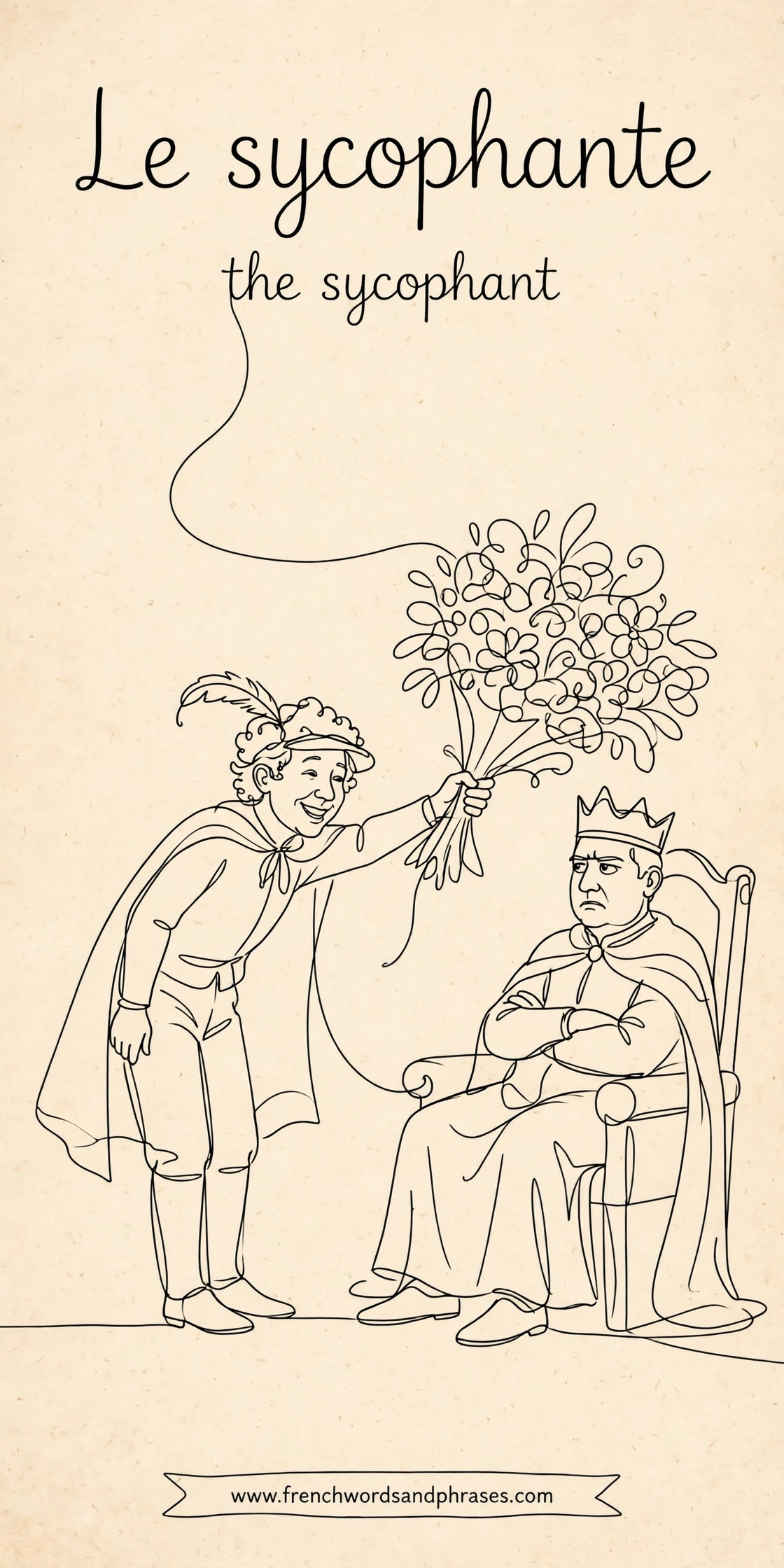
A French Word to Live By
Translate Sycophante to English
/si.kɔ.fɑ̃t/
Le sycophante means the sycophant.
In the antechamber of a great minister, one courtier laughs a little too loudly at every joke and carries every whisper straight back to the throne: le sycophante — the flatterer who denounces, the informer who smiles, a literary word with two blades.
In this guide, you’ll learn what sycophante means in English, how to use it with its articles, how to form its plural, and how it appears in everyday French. Explore French examples, English translations, and practice quizzes.
Understanding the French Noun Sycophante
Sycophante is a masculine French noun, learned with its article: le sycophante, un sycophante. It is a Greek inheritance: in ancient Athens the sykophantēs was a professional informer who denounced citizens in court for profit — tradition links the name to sykon, a fig, and phainein, to show, though the fig’s exact crime is lost. The French word keeps both halves of the Athenian trade: flattery upwards, denunciation sideways.
It means a sycophant — in the French literary sense: a person who flatters the powerful and reports on everyone else, purely out of self-interest: un sycophante de cour, a court sycophant, être entouré de sycophantes, to be surrounded by sycophants who repeat only what the master wants to hear. It is a word of novels, history books and essays, not of the café: spoken French, for the same creature in boots and overalls, prefers the earthier lèche-bottes. Sycophante is the written sting — the word you choose when flattery has become a career and a weapon.
Gender: Masculine — le sycophante
Definite article: le — le sycophante (the sycophant)
Indefinite article: un — un sycophante (a sycophant)
Plural: les sycophantes
Greek roots: sykon (fig) + phainein (to show) — the informer of Athens
Register: literary — novels, history and essays, not everyday speech
English equivalents: The sycophant, the flatterer-informer.
Know the difference the French word keeps and the English one has half-forgotten: an English sycophant mainly flatters, but un sycophante also informs — he denounces, he reports, il rapporte tout au patron, he carries everything back to the boss to make himself look good. And because the word is literary, use it where it belongs: in writing, in history, in the essay. In conversation, aim lower and warmer: un lèche-bottes, a bootlicker, is the spoken cousin.
Experience the Word
Sycophante is flattery with a notebook: the smile that praises you in the corridor and quotes you, accurately and fatally, in the director’s office.
Imagine the court of a vain king at supper: the sycophante laughs before the joke has finished, agrees before the sentence has ended, and notes — oh, he notes — which of the other courtiers laughed a moment too late. Athens invented him, Versailles perfected him, and every office since has kept one in stock.
You have not just named a flatterer. You have named flattery turned into a trade — le sycophante, the informer with the courtier’s smile.
How to Use Sycophante in French: Complete Guide
Let’s explore how sycophante works in French, beginning with its articles — le sycophante, un sycophante, les sycophantes de la cour.
Sycophante with the Definite Article (Le, Les)
Used for a specific sycophant — the one haunting the antechamber, the one in chapter three.
| Form | French |
|---|---|
| Masculine singular | le sycophante |
| Plural | les sycophantes |
Example
Le sycophante répétait chaque parole du ministre avec admiration.
The sycophant repeated the minister’s every word with admiration.
Sycophante with the Indefinite Article (Un, Des)
Used for a sycophant in general — one specimen of a species no court has ever lacked.
| Form | French |
|---|---|
| Masculine singular | un sycophante |
| Plural | des sycophantes |
Example
Méfie-toi de ce sycophante, il rapporte tout au patron.
Beware of that sycophant, he reports everything to the boss.
Sycophante in His Habitat (La cour, Le bureau, Le pouvoir…)
Sycophantes gather where favour is distributed — at court, around ministers, beside any throne with ears.
| Setting | French |
|---|---|
| a court sycophant | un sycophante de cour |
| surrounded by sycophants | entouré de sycophantes |
| to play the sycophant | jouer les sycophantes |
| the sycophant’s flattery | la flatterie du sycophante |
| a professional sycophant | un sycophante professionnel |
Example
Le directeur, entouré de sycophantes, n’entendait jamais la vérité.
The director, surrounded by sycophants, never heard the truth.
Quick Quiz 1
Complete the sentence:
______ sycophante flatte le ministre du matin au soir. (the)
Reveal the answer
Le
Le sycophante flatte le ministre du matin au soir.
The sycophant flatters the minister from morning to evening — sycophante is masculine, so le.
The Plural of Sycophante
A regular plural in -s — and history suggests they are rarely found alone.
| Number | French |
|---|---|
| Singular | le sycophante |
| Plural | les sycophantes |
Example
Les sycophantes de la cour applaudissaient avant même la fin du discours.
The court sycophants applauded before the speech had even ended.
Sycophante with Possessive Adjectives (Mon, Ton, Son…)
Possessives agree with the noun: sycophante is masculine, so mon, ton, son in the singular.
| Owner | French |
|---|---|
| my | mon sycophante |
| your (tu) | ton sycophante |
| his / her | son sycophante |
| our | notre sycophante |
| your (vous) | votre sycophante |
| their | leur sycophante |
Example
Chaque ministre a son sycophante préféré, hélas.
Every minister has his favourite sycophant, alas.
Quick Quiz 2
Complete the sentence:
Le roi écoutait ______ sycophantes au lieu de ses conseillers. (his)
Reveal the answer
ses
Le roi écoutait ses sycophantes au lieu de ses conseillers.
The king listened to his sycophants instead of his advisers — ses, plural, for sycophantes.
Sycophante with Demonstrative Adjectives (Ce, Ces)
Used to point: ce sycophante, this sycophant — usually with a warning attached.
| Form | French |
|---|---|
| Masculine singular | ce sycophante |
| Plural | ces sycophantes |
Example
Ce sycophante a dénoncé deux collègues pour obtenir leur poste.
This sycophant denounced two colleagues to obtain their job.
Sycophante with Adjectives
Adjectives agree with sycophante — masculine singular: un sycophante vil, un sycophante dangereux.
| Adjective | With Sycophante |
|---|---|
| vil (base, vile) | un sycophante vil |
| méprisable (contemptible) | un sycophante méprisable |
| dangereux (dangerous) | un sycophante dangereux |
| servile (servile) | un sycophante servile |
| hypocrite (hypocritical) | un sycophante hypocrite |
Example
Un sycophante dangereux vaut moins qu’un ennemi déclaré.
A dangerous sycophant is worth less than a declared enemy.
Quick Quiz 3
Complete the sentence:
C’est un sycophante ______, prêt à tout pour plaire. (servile)
Reveal the answer
servile
C’est un sycophante servile, prêt à tout pour plaire.
He is a servile sycophant, ready to do anything to please — servile, masculine, to agree with sycophante.
Everyday Expressions with Sycophante
Written French, mostly — the sycophante phrases of novels and essays.
| Expression | In English |
|---|---|
| un sycophante de cour | a court sycophant |
| jouer les sycophantes | to play the sycophant |
| entouré de sycophantes | surrounded by sycophants |
| la flatterie du sycophante | the sycophant’s flattery |
| dénoncer en sycophante | to inform like a sycophant |
Example
Il joue les sycophantes dès que le directeur entre dans la pièce.
He plays the sycophant as soon as the director enters the room.
Words from the Same Family as Sycophante
Flattery and denunciation — the words that travel with sycophante.
| French | In English |
|---|---|
| la flatterie | the flattery |
| flatter | to flatter |
| un dénonciateur | an informer, a denouncer |
| la délation | informing, denunciation |
| un lèche-bottes | a bootlicker — the spoken cousin (familiar) |
Example
La délation était le métier des sycophantes d’Athènes.
Informing was the trade of the sycophants of Athens.
Quick Quiz 4
What two things does a French sycophante do, beyond simple flattery?
Reveal the answer
He denounces and informs — il dénonce, il rapporte tout au patron, purely out of self-interest.
Le sycophante flatte les puissants et dénonce les autres.
The sycophant flatters the powerful and denounces the others.
Sycophante in Everyday French: Real-Life Examples
Now that you know the word, let’s see how sycophante appears in everyday French.
Example 1 — A warning
Méfie-toi de ce sycophante, il rapporte tout au patron.
Beware of that sycophant, he reports everything to the boss.
Example 2 — At court
Les sycophantes entouraient le roi dès le matin.
The sycophants surrounded the king from the morning on.
Example 3 — In a novel
Le roman décrit un sycophante prêt à toutes les bassesses.
The novel describes a sycophant ready for every baseness.
Example 4 — Office politics
Entouré de sycophantes, le directeur ne voyait plus la réalité.
Surrounded by sycophants, the director no longer saw reality.
Example 5 — Athens
À Athènes, les sycophantes dénonçaient les citoyens pour de l’argent.
In Athens, sycophants denounced citizens for money.
Example 6 — Self-interest
Ce sycophante ne flatte jamais sans intérêt.
That sycophant never flatters without self-interest.
Beyond Translation: The Meaning of Sycophante
Sycophante is one of the oldest insults in European politics, and it has kept its passport stamped in Athens. The original sycophants were a recognised nuisance of the democracy: men who made a living bringing accusations — sometimes just, often purchased — against citizens with something to lose. French borrowed the word through Latin and kept it in the library, where Balzac’s courtiers and Saint-Simon’s memoir pages swarm with them. English softened the word into mere flattery; French, more faithful to Athens, kept the informer inside the flatterer. That is why the word still stings in print: to call a man un sycophante is to accuse his praise of being a business model.
To say sycophante is to unmask praise as a trade.
It evokes antechambers, whispered reports and the smile that arrives a second before the knife — the oldest professional in the history of power.
How to Remember the French Noun Sycophante
Remember it this way: Sycophante is the sycophant — the flatterer who also informs, a literary word: le sycophante, un sycophante de cour.
- Always masculine — le sycophante, un sycophante, ce sycophante.
- The double blade — he flatte the powerful and dénonce the rest, par pur intérêt, out of pure self-interest.
- The register — a written word; in speech, French says un lèche-bottes, a bootlicker.
The key idea is le sycophante — the sycophant, masculine, literary; flatters and informs for gain.
Test Your Knowledge of Sycophante
Let’s see how much you’ve learned. Try answering these questions before revealing the answers.
Question 1
Is sycophante masculine or feminine?
Reveal the answer
Masculine — le sycophante, un sycophante.
Question 2
Where does the word sycophante come from?
Reveal the answer
From ancient Athens — the Greek sykophantēs, a professional informer who denounced citizens for profit.
Question 3
Translate: Beware of that sycophant.
Reveal the answer
Méfie-toi de ce sycophante.
Question 4
What is the everyday spoken French word for the same creature?
Reveal the answer
Un lèche-bottes — a bootlicker; sycophante is the literary word.
Question 5
Complete the sentence:
______ sycophantes de la cour riaient à toutes ses plaisanteries. (the)
Reveal the answer
Les
Les sycophantes de la cour riaient à toutes ses plaisanteries.
The court sycophants laughed at all his jokes.
Your Final Challenge
Can You Use It?
How would you say this in French?
“The minister was surrounded by sycophants who told him only what he wanted to hear.”
Reveal the answer
Le ministre était entouré de sycophantes qui ne lui disaient que ce qu’il voulait entendre.
The minister was surrounded by sycophants who told him only what he wanted to hear.
A little French. A little curiosity. A richer everyday life.
LEARN FRENCH ONE WORD AT A TIME