A French Word to Live By
How to Conjugate Captiver in French
/kap.ti.ve/
Captiver means to captivate, to enthrall — to seize an audience’s attention so completely that eyes, ears and hearts are all taken prisoner at once.
A storyteller whose listeners forget to breathe, a singer holding a hall in total silence — captiver is the verb of willing capture: nobody is chained, yet nobody in the room would dream of leaving.
In this guide, you’ll learn how to conjugate captiver in all the major French tenses and moods. Explore complete conjugation tables, French examples, English translations, and practice quizzes.
Understanding the French Verb Captiver
Captiver is a regular French verb belonging to the first group of verbs, those ending in-er.
It means to captivate, to enthrall. It is the critic’s compliment for performers, books and speakers — un acteur qui captive, un roman qui captive dès la première page. The capture is always of the mind: attention, imagination, emotion. For physical capture, French switches to capturer, its twin on the next page of the dictionary.
Verb classification: First group (-er)
Auxiliary verb: Avoir
Past participle: captivé
Present participle: captivant
English equivalents: To captivate, to enthrall, to fascinate; captiver le public — to captivate the audience; captiver l’attention — to capture attention; un récit qui captive — a story that grips; être captivé par un spectacle — to be enthralled by a show.
One important detail: captiver is a perfectly regular -er verb — elle captive, nous captivons, ils captivent, past participle captivé — and it is a false friend worth respecting: it never means to take prisoners in war (that is capturer), only to take attention and hearts. Its captives are happy ones: un public captivé is an audience that has been won, not seized.
Experience the Word
Captiver is the verb of the spellbound room — a thousand people, one voice, and not a single cough.
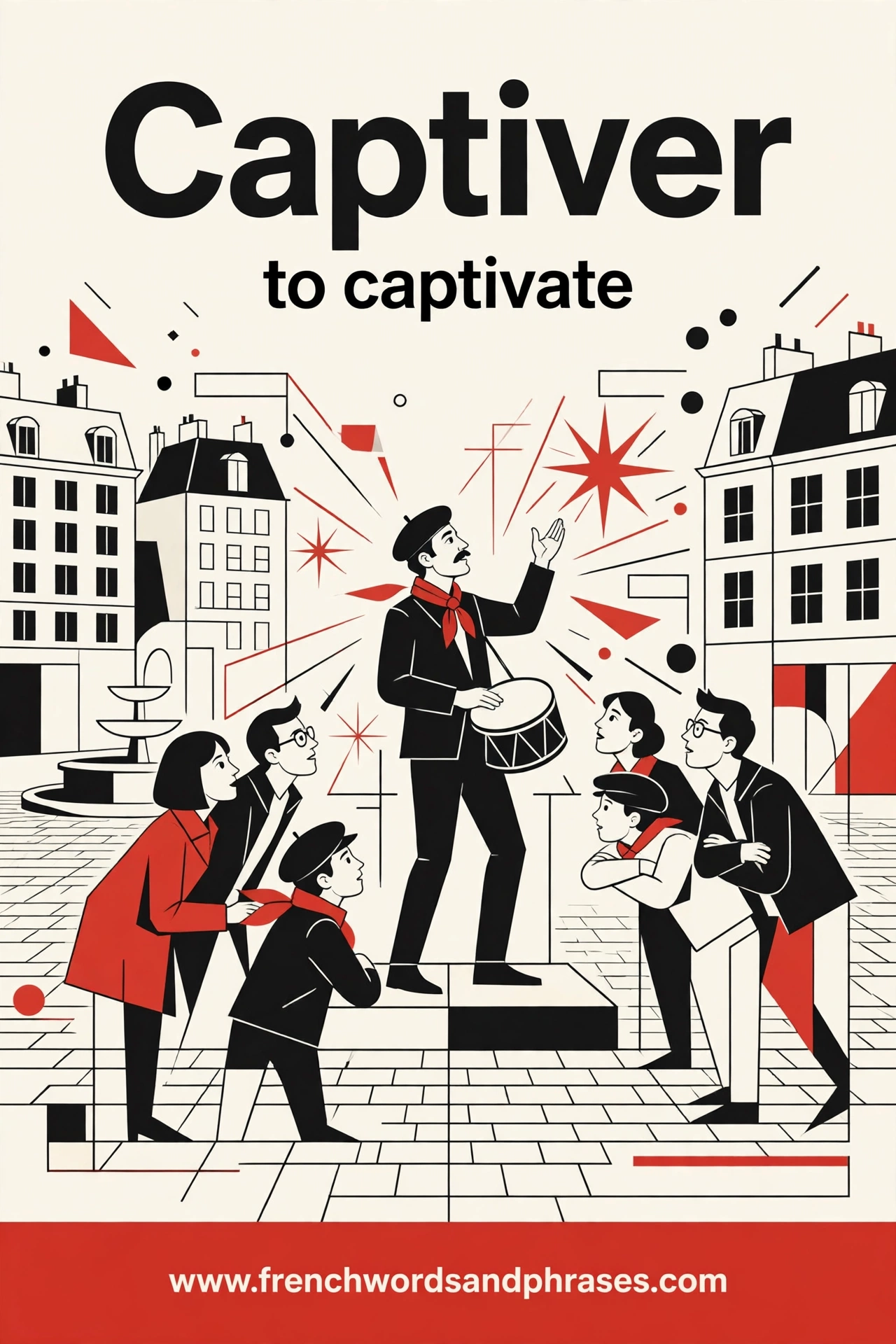
Imagine an old storyteller in a village square at dusk. He begins quietly, almost whispering, and little by little the whole square leans in — il captive son public — until even the café waiters stop mid-step, trays in hand, to hear the end.
Nobody has been forced to stay. They have been captivated — captivés, prisoners by pure pleasure.
How to Conjugate Captiver: Complete French Conjugation Guide
Let’s explore every major conjugation of captiver, beginning with the indicative mood.
How to Conjugate Captiver in the Indicative Mood
The indicative mood is used to express facts, observations, actions, and events.
How to Conjugate Captiver in the Present Tense (Présent)
Used for actions happening now, habitual actions, and general truths.
| Subject | Conjugation |
|---|---|
| je | captive |
| tu | captives |
| il / elle | captive |
| nous | captivons |
| vous | captivez |
| ils / elles | captivent |
Example
Son récit captive les enfants du début à la fin.
Her story captivates the children from start to finish.
Quick Quiz 1
Complete the sentence:
Nous ______ le public avec nos chansons.
Reveal the answer
captivons
Nous captivons le public avec nos chansons.
We captivate the audience with our songs.
How to Conjugate Captiver in the Passé Composé
Used for completed actions in the past. Captiver takes the auxiliary verb avoir.
| Subject | Conjugation |
|---|---|
| j’ | ai captivé |
| tu | as captivé |
| il / elle | a captivé |
| nous | avons captivé |
| vous | avez captivé |
| ils / elles | ont captivé |
Example
L’acteur a captivé le public dès la première scène.
The actor captivated the audience from the very first scene.
How to Conjugate Captiver in the Imparfait (Imperfect Tense)
Used for habitual past actions, descriptions, and ongoing situations in the past.
| Subject | Conjugation |
|---|---|
| je | captivais |
| tu | captivais |
| il / elle | captivait |
| nous | captivions |
| vous | captiviez |
| ils / elles | captivaient |
Example
Sa voix captivait tous ceux qui l’écoutaient.
Her voice used to captivate everyone who listened to her.
Quick Quiz 2
Choose the correct form:
The actor captivated the audience.
L’acteur ______ le public. (a captivé / est captivé)
Reveal the answer
a captivé
L’acteur a captivé le public.
Captiver takes avoir.
How to Conjugate Captiver in the Plus-que-parfait
Used to describe an action that had already been completed before another past event.
| Subject | Conjugation |
|---|---|
| j’ | avais captivé |
| tu | avais captivé |
| il / elle | avait captivé |
| nous | avions captivé |
| vous | aviez captivé |
| ils / elles | avaient captivé |
Example
Le roman avait captivé des générations de lecteurs.
The novel had captivated generations of readers.
How to Conjugate Captiver in the Passé Simple
Primarily used in formal writing, literature, and historical narratives. It is rarely used in everyday conversation.
| Subject | Conjugation |
|---|---|
| je | captivai |
| tu | captivas |
| il / elle | captiva |
| nous | captivâmes |
| vous | captivâtes |
| ils / elles | captivèrent |
Example
Le conteur captiva la place entière jusqu’à la nuit.
The storyteller captivated the whole square until nightfall.
How to Conjugate Captiver in the Passé Antérieur
A literary tense used to express an action completed immediately before another past action, generally in the passé simple.
| Subject | Conjugation |
|---|---|
| j’ | eus captivé |
| tu | eus captivé |
| il / elle | eut captivé |
| nous | eûmes captivé |
| vous | eûtes captivé |
| ils / elles | eurent captivé |
Example
Quand elle eut captivé la salle, elle commença la chanson.
When she had captivated the hall, she began the song.
How to Conjugate Captiver in the Future Tense (Futur Simple)
Used to describe actions that will take place in the future.
| Subject | Conjugation |
|---|---|
| je | captiverai |
| tu | captiveras |
| il / elle | captivera |
| nous | captiverons |
| vous | captiverez |
| ils / elles | captiveront |
Example
Ce film captivera les spectateurs du monde entier.
This film will captivate audiences all over the world.
How to Conjugate Captiver in the Futur Antérieur (Future Perfect)
Used for an action that will have been completed before a particular point in the future.
| Subject | Conjugation |
|---|---|
| j’ | aurai captivé |
| tu | auras captivé |
| il / elle | aura captivé |
| nous | aurons captivé |
| vous | aurez captivé |
| ils / elles | auront captivé |
Example
À la fin du chapitre, l’auteur aura captivé ses lecteurs.
By the end of the chapter, the author will have captivated his readers.
How to Conjugate Captiver in the Near Future (Futur Proche)
Used to describe something that is going to happen soon. Formed with aller + infinitive.
| Subject | Conjugation |
|---|---|
| je | vais captiver |
| tu | vas captiver |
| il / elle | va captiver |
| nous | allons captiver |
| vous | allez captiver |
| ils / elles | vont captiver |
Example
Son histoire va captiver les enfants, tu vas voir.
Her story is going to captivate the children, you will see.
How to Conjugate Captiver in the Conditional Mood
The conditional mood expresses what would happen under certain circumstances. It is also frequently used to make polite requests or express wishes.
How to Conjugate Captiver in the Present Conditional
| Subject | Conjugation |
|---|---|
| je | captiverais |
| tu | captiverais |
| il / elle | captiverait |
| nous | captiverions |
| vous | captiveriez |
| ils / elles | captiveraient |
Example
Avec une meilleure voix, elle captiverait n’importe quel public.
With a better voice, she would captivate any audience.
How to Conjugate Captiver in the Past Conditional
| Subject | Conjugation |
|---|---|
| j’ | aurais captivé |
| tu | aurais captivé |
| il / elle | aurait captivé |
| nous | aurions captivé |
| vous | auriez captivé |
| ils / elles | auraient captivé |
Example
Le spectacle aurait captivé la salle sans cette panne de lumière.
The show would have captivated the hall without that lighting failure.
Captiver in the Literary Past Conditional Form
This less common literary form uses the imperfect subjunctive of avoir.
| Subject | Conjugation |
|---|---|
| j’ | eusse captivé |
| tu | eusses captivé |
| il / elle | eût captivé |
| nous | eussions captivé |
| vous | eussiez captivé |
| ils / elles | eussent captivé |
Example
Le poète eût captivé la cour entière.
The poet would have captivated the whole court.
How to Conjugate Captiver in the Subjunctive Mood
The subjunctive is used to express wishes, emotions, doubts, necessity, and uncertainty. It frequently follows expressions such as il faut que (it is necessary that) or bien que (although).
How to Conjugate Captiver in the Present Subjunctive
| Subject | Conjugation |
|---|---|
| que je | captive |
| que tu | captives |
| qu’il / qu’elle | captive |
| que nous | captivions |
| que vous | captiviez |
| qu’ils / qu’elles | captivent |
Example
Il faut que ton récit captive dès la première page.
Your story must captivate from the very first page.
Quick Quiz 3
Complete the sentence using the subjunctive:
Il faut que vous ______ les enfants dès le début.
Reveal the answer
captiviez
Il faut que vous captiviez les enfants dès le début.
You must captivate the children right from the start.
How to Conjugate Captiver in the Imperfect Subjunctive
A literary tense, rarely encountered in modern spoken French.
| Subject | Conjugation |
|---|---|
| que je | captivasse |
| que tu | captivasses |
| qu’il / qu’elle | captivât |
| que nous | captivassions |
| que vous | captivassiez |
| qu’ils / qu’elles | captivassent |
Example
On espérait que le chanteur captivât la foule.
People hoped the singer would captivate the crowd.
How to Conjugate Captiver in the Pluperfect Subjunctive
A literary construction used to express an action completed before another past action.
| Subject | Conjugation |
|---|---|
| que j’ | eusse captivé |
| que tu | eusses captivé |
| qu’il / qu’elle | eût captivé |
| que nous | eussions captivé |
| que vous | eussiez captivé |
| qu’ils / qu’elles | eussent captivé |
Example
On disait que son livre eût captivé trois générations.
People said her book had captivated three generations.
How to Conjugate Captiver in the Past Subjunctive
| Subject | Conjugation |
|---|---|
| que j’ | aie captivé |
| que tu | aies captivé |
| qu’il / qu’elle | ait captivé |
| que nous | ayons captivé |
| que vous | ayez captivé |
| qu’ils / qu’elles | aient captivé |
Example
Je suis ravi que le spectacle ait captivé les enfants.
I am delighted the show captivated the children.
How to Conjugate Captiver in the Imperative
The imperative is used to give commands, instructions, invitations, or suggestions. Subject pronouns are omitted.
How to Conjugate Captiver in the Present Imperative
| Person | Conjugation |
|---|---|
| (tu) | captive |
| (nous) | captivons |
| (vous) | captivez |
Example
Captiver ton public dès les premières secondes !
Captivate your audience from the very first seconds!
Quick Quiz 4
How would you say Captivate your audience (tu form)?
Reveal the answer
Captiver ton public !
French Participles of Captiver
Participles are verb forms that can be used in compound tenses and other grammatical constructions.
Present Participle of Captiver
captivant
En captivant la salle, elle oublia sa peur.
By captivating the hall, she forgot her fear.
Past Participle of Captiver
captivé
Captivé par le récit, l’enfant ne bougeait plus.
Captivated by the story, the child no longer moved.
Captiver in Everyday French: Real-Life Examples
Now that you know the conjugations, let’s see how captiver appears in everyday French.
Example 1 — Present
Son récit captive les enfants du début à la fin.
Her story captivates the children from start to finish.
Example 2 — Passé composé
L’acteur a captivé le public dès la première scène.
The actor captivated the audience from the first scene.
Example 3 — Imparfait
Sa voix captivait tous ses auditeurs.
Her voice used to captivate all her listeners.
Example 4 — Future
Ce film captivera les spectateurs du monde entier.
This film will captivate audiences all over the world.
Example 5 — Conditional
Elle captiverait n’importe quel public.
She would captivate any audience.
Example 6 — Imperative
Captiver ton public dès le début !
Captivate your audience right from the start!
Beyond Translation: The Meaning of Captiver
English captivate is the true twin — both come from Latin captivus, a prisoner, and both made the same happy journey from the prison cell to the theatre.
The capture is real; only the chains are missing.
French keeps the family tidy: captif the prisoner, captiver to win hearts, capturer to take by force — three cousins, three kinds of taking.
How to Remember the French Verb Captiver
Remember it this way: Captiver is about the storyteller holding the whole square in silence at dusk.
- Captiver takes hearts and attention, never prisoners — real capture is capturer.
- The critic’s compliment: un roman qui captive, un acteur qui captive la salle.
- Regular -er: elle captive, nous captivons, past participle captivé.
The key idea is the storyteller holding the whole square in silence at dusk.
Test Your Knowledge of Captiver
Let’s see how much you’ve learned. Try answering these questions before revealing the answers.
Question 1
What is the difference between captiver and capturer?
Reveal the answer
Captiver wins attention and hearts (to captivate); capturer takes something by force (to capture).
Question 2
How do you say Her story captivates the children in French?
Reveal the answer
Son récit captive les enfants.
Question 3
Translate: The actor captivated the audience from the first scene.
Reveal the answer
L’acteur a captivé le public dès la première scène.
Question 4
What is the past participle of captiver?
Reveal the answer
Captivé.
Question 5
Complete the sentence:
Il faut que ton récit ______ dès la première page.
Reveal the answer
captive
Il faut que ton récit captive dès la première page.
Your story must captivate from the very first page.
Your Final Challenge
Can You Use It?
How would you say this in French?
The old storyteller captivates the whole square with a single story, and the night itself seems to listen.
Reveal the answer
Le vieux conteur captive la place entière avec une seule histoire, et la nuit elle-même semble écouter.
The old storyteller captivates the whole square with a single story, and the night itself seems to listen.
A little French. A little curiosity. A richer everyday life.
LEARN FRENCH ONE WORD AT A TIME