A French Word to Live By
How to Conjugate Calquer in French
/kal.ke/
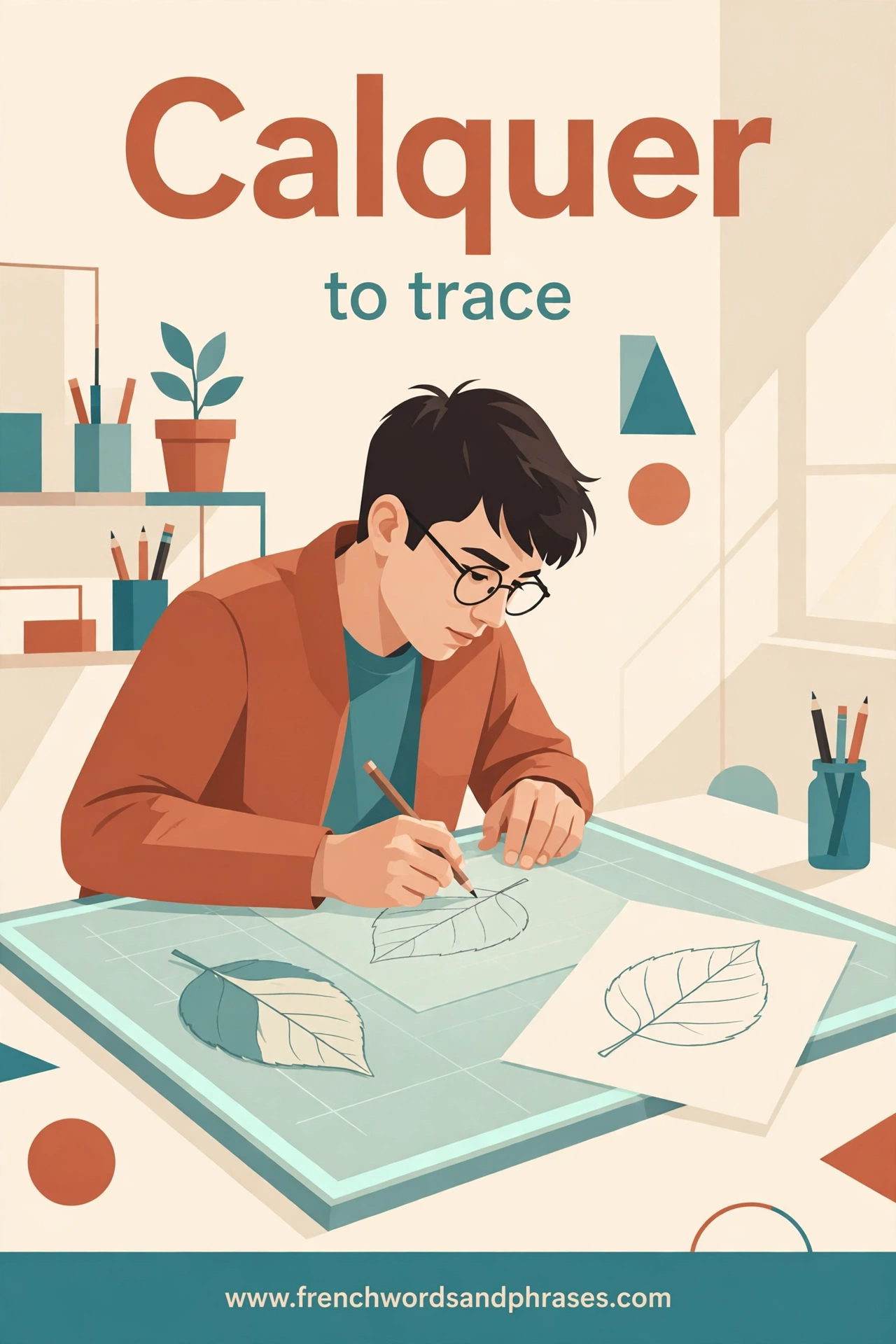
Calquer means to trace, to copy — to lay transparent paper over a drawing and follow every line, or to copy a model exactly, line for line.
A child with a sheet of tracing paper over a map, an artist transferring a sketch to canvas — calquer is the verb of the faithful copy: nothing invented, every line followed exactly.
In this guide, you’ll learn how to conjugate calquer in all the major French tenses and moods. Explore complete conjugation tables, French examples, English translations, and practice quizzes.
Understanding the French Verb Calquer
Calquer is a regular French verb belonging to the first group of verbs, those ending in-er.
It means to trace, to copy. Calquer always implies a model copied faithfully: a drawing traced, a signature copied, a behaviour imitated step by step. For ordinary copying French also has copier, but calquer insists on the exactness — line for line, gesture for gesture.
Verb classification: First group (-er)
Auxiliary verb: Avoir
Past participle: calqué
Present participle: calquant
English equivalents: To trace, to copy exactly; calquer un dessin — to trace a drawing; calquer une carte — to trace a map; calquer sa démarche sur quelqu’un — to model one’s approach on someone; un calque — a tracing, a loan translation (linguistics); papier calque — tracing paper.
One important detail: the qu never changes — je calque, nous calquons, ils calquent, past participle calqué; the u is there to keep the hard k sound before e and i. Remember the tool behind the verb: le papier calque is tracing paper, and un calque is the tracing itself. Linguists use the same word for a loan translation — gratte-ciel is un calque of English skyscraper.
Experience the Word
Calquer is the verb of the copy that hides nothing — transparent paper, a steady hand, and the original showing through.
Imagine a schoolgirl who must reproduce the map of France for tomorrow. She lays her papier calque over the atlas, follows the coastline with her pencil — Brest, Bordeaux, Marseille — and lifts the sheet: elle a calqué la carte, every bay and island in place.
She has drawn nothing from imagination. She has traced it — calqué, line for line, through the transparent paper.
How to Conjugate Calquer: Complete French Conjugation Guide
Let’s explore every major conjugation of calquer, beginning with the indicative mood.
How to Conjugate Calquer in the Indicative Mood
The indicative mood is used to express facts, observations, actions, and events.
How to Conjugate Calquer in the Present Tense (Présent)
Used for actions happening now, habitual actions, and general truths.
| Subject | Conjugation |
|---|---|
| je | calque |
| tu | calques |
| il / elle | calque |
| nous | calquons |
| vous | calquez |
| ils / elles | calquent |
Example
L’enfant calque la carte de France pour son devoir.
The child is tracing the map of France for her homework.
Quick Quiz 1
Complete the sentence:
Nous ______ le plan sur la grande feuille.
Reveal the answer
calquons
Nous calquons le plan sur la grande feuille.
We are tracing the plan onto the big sheet.
How to Conjugate Calquer in the Passé Composé
Used for completed actions in the past. Calquer takes the auxiliary verb avoir.
| Subject | Conjugation |
|---|---|
| j’ | ai calqué |
| tu | as calqué |
| il / elle | a calqué |
| nous | avons calqué |
| vous | avez calqué |
| ils / elles | ont calqué |
Example
Elle a calqué le dessin de son frère avec soin.
She traced her brother’s drawing carefully.
How to Conjugate Calquer in the Imparfait (Imperfect Tense)
Used for habitual past actions, descriptions, and ongoing situations in the past.
| Subject | Conjugation |
|---|---|
| je | calquais |
| tu | calquais |
| il / elle | calquait |
| nous | calquions |
| vous | calquiez |
| ils / elles | calquaient |
Example
Autrefois, les écoliers calquaient les cartes de géographie.
In the old days, schoolchildren traced geography maps.
Quick Quiz 2
Choose the correct form:
She traced the drawing.
Elle ______ le dessin. (a calqué / est calquée)
Reveal the answer
a calqué
Elle a calqué le dessin.
Calquer takes avoir.
How to Conjugate Calquer in the Plus-que-parfait
Used to describe an action that had already been completed before another past event.
| Subject | Conjugation |
|---|---|
| j’ | avais calqué |
| tu | avais calqué |
| il / elle | avait calqué |
| nous | avions calqué |
| vous | aviez calqué |
| ils / elles | avaient calqué |
Example
L’artiste avait calqué son esquisse avant de peindre.
The artist had traced his sketch before painting.
How to Conjugate Calquer in the Passé Simple
Primarily used in formal writing, literature, and historical narratives. It is rarely used in everyday conversation.
| Subject | Conjugation |
|---|---|
| je | calquai |
| tu | calquas |
| il / elle | calqua |
| nous | calquâmes |
| vous | calquâtes |
| ils / elles | calquèrent |
Example
Il calqua la signature en quelques secondes.
He traced the signature in a few seconds.
How to Conjugate Calquer in the Passé Antérieur
A literary tense used to express an action completed immediately before another past action, generally in the passé simple.
| Subject | Conjugation |
|---|---|
| j’ | eus calqué |
| tu | eus calqué |
| il / elle | eut calqué |
| nous | eûmes calqué |
| vous | eûtes calqué |
| ils / elles | eurent calqué |
Example
Quand elle eut calqué la dernière région, elle referma l’atlas.
When she had traced the last region, she closed the atlas.
How to Conjugate Calquer in the Future Tense (Futur Simple)
Used to describe actions that will take place in the future.
| Subject | Conjugation |
|---|---|
| je | calquerai |
| tu | calqueras |
| il / elle | calquera |
| nous | calquerons |
| vous | calquerez |
| ils / elles | calqueront |
Example
Demain, nous calquerons le plan sur la grande feuille.
Tomorrow, we shall trace the plan onto the big sheet.
How to Conjugate Calquer in the Futur Antérieur (Future Perfect)
Used for an action that will have been completed before a particular point in the future.
| Subject | Conjugation |
|---|---|
| j’ | aurai calqué |
| tu | auras calqué |
| il / elle | aura calqué |
| nous | aurons calqué |
| vous | aurez calqué |
| ils / elles | auront calqué |
Example
À midi, tu auras calqué toutes les cartes.
By noon, you will have traced all the maps.
How to Conjugate Calquer in the Near Future (Futur Proche)
Used to describe something that is going to happen soon. Formed with aller + infinitive.
| Subject | Conjugation |
|---|---|
| je | vais calquer |
| tu | vas calquer |
| il / elle | va calquer |
| nous | allons calquer |
| vous | allez calquer |
| ils / elles | vont calquer |
Example
Je vais calquer ce motif sur le tissu.
I am going to trace this pattern onto the fabric.
How to Conjugate Calquer in the Conditional Mood
The conditional mood expresses what would happen under certain circumstances. It is also frequently used to make polite requests or express wishes.
How to Conjugate Calquer in the Present Conditional
| Subject | Conjugation |
|---|---|
| je | calquerais |
| tu | calquerais |
| il / elle | calquerait |
| nous | calquerions |
| vous | calqueriez |
| ils / elles | calqueraient |
Example
Avec du bon papier, on calquerait ce dessin facilement.
With good paper, one would trace this drawing easily.
How to Conjugate Calquer in the Past Conditional
| Subject | Conjugation |
|---|---|
| j’ | aurais calqué |
| tu | aurais calqué |
| il / elle | aurait calqué |
| nous | aurions calqué |
| vous | auriez calqué |
| ils / elles | auraient calqué |
Example
Tu aurais calqué la carte si tu avais eu le temps.
You would have traced the map if you had had time.
Calquer in the Literary Past Conditional Form
This less common literary form uses the imperfect subjunctive of avoir.
| Subject | Conjugation |
|---|---|
| j’ | eusse calqué |
| tu | eusses calqué |
| il / elle | eût calqué |
| nous | eussions calqué |
| vous | eussiez calqué |
| ils / elles | eussent calqué |
Example
Il eût calqué le portrait à la perfection.
He would have traced the portrait to perfection.
How to Conjugate Calquer in the Subjunctive Mood
The subjunctive is used to express wishes, emotions, doubts, necessity, and uncertainty. It frequently follows expressions such as il faut que (it is necessary that) or bien que (although).
How to Conjugate Calquer in the Present Subjunctive
| Subject | Conjugation |
|---|---|
| que je | calque |
| que tu | calques |
| qu’il / qu’elle | calque |
| que nous | calquions |
| que vous | calquiez |
| qu’ils / qu’elles | calquent |
Example
Il faut que tu calques le contour avant de découper.
You must trace the outline before cutting.
Quick Quiz 3
Complete the sentence using the subjunctive:
Il faut que vous ______ la carte entière.
Reveal the answer
calquiez
Il faut que vous calquiez la carte entière.
You must trace the whole map.
How to Conjugate Calquer in the Imperfect Subjunctive
A literary tense, rarely encountered in modern spoken French.
| Subject | Conjugation |
|---|---|
| que je | calquasse |
| que tu | calquasses |
| qu’il / qu’elle | calquât |
| que nous | calquassions |
| que vous | calquassiez |
| qu’ils / qu’elles | calquassent |
Example
Le professeur demandait que l’élève calquât la carte sans aide.
The teacher asked the pupil to trace the map unaided.
How to Conjugate Calquer in the Pluperfect Subjunctive
A literary construction used to express an action completed before another past action.
| Subject | Conjugation |
|---|---|
| que j’ | eusse calqué |
| que tu | eusses calqué |
| qu’il / qu’elle | eût calqué |
| que nous | eussions calqué |
| que vous | eussiez calqué |
| qu’ils / qu’elles | eussent calqué |
Example
On vérifia qu’elle eût calqué le plan correctement.
They checked that she had traced the plan correctly.
How to Conjugate Calquer in the Past Subjunctive
| Subject | Conjugation |
|---|---|
| que j’ | aie calqué |
| que tu | aies calqué |
| qu’il / qu’elle | ait calqué |
| que nous | ayons calqué |
| que vous | ayez calqué |
| qu’ils / qu’elles | aient calqué |
Example
Je suis content que vous ayez calqué le dessin entier.
I am glad you traced the whole drawing.
How to Conjugate Calquer in the Imperative
The imperative is used to give commands, instructions, invitations, or suggestions. Subject pronouns are omitted.
How to Conjugate Calquer in the Present Imperative
| Person | Conjugation |
|---|---|
| (tu) | calque |
| (nous) | calquons |
| (vous) | calquez |
Example
Calque la carte, puis colorie les régions !
Trace the map, then colour the regions!
Quick Quiz 4
How would you say Trace the map (tu form)?
Reveal the answer
Calque la carte !
French Participles of Calquer
Participles are verb forms that can be used in compound tenses and other grammatical constructions.
Present Participle of Calquer
calquant
En calquant le dessin, elle apprend les proportions.
By tracing the drawing, she is learning proportions.
Past Participle of Calquer
calqué
Calqué sur l’original, le plan est parfaitement fidèle.
Traced from the original, the plan is perfectly faithful.
Calquer in Everyday French: Real-Life Examples
Now that you know the conjugations, let’s see how calquer appears in everyday French.
Example 1 — Present
L’enfant calque la carte de France.
The child is tracing the map of France.
Example 2 — Passé composé
Elle a calqué le dessin avec soin.
She traced the drawing carefully.
Example 3 — Imparfait
Les écoliers calquaient les cartes.
Schoolchildren used to trace maps.
Example 4 — Future
Nous calquerons le plan demain.
We shall trace the plan tomorrow.
Example 5 — Conditional
On calquerait ce dessin facilement.
One would trace this drawing easily.
Example 6 — Imperative
Calque le contour avant de découper !
Trace the outline before cutting!
Beyond Translation: The Meaning of Calquer
English to trace covers the paper; French calquer goes further and gives linguists a treasure: un calque is a loan translation, a phrase copied piece by piece from another language.
Skyscraper became gratte-ciel, a French tracing of the English.
So calquer is about fidelity in every field — the traced map, the copied gesture, the translated phrase — always the original showing through the copy.
How to Remember the French Verb Calquer
Remember it this way: Calquer is about tracing paper over a map, the coastline showing through.
- The qu never changes: je calque, nous calquons — u keeps the hard k sound.
- Le papier calque is tracing paper; un calque is the tracing — and a loan translation.
- Calquer means copying with a model showing through: exact, line for line.
The key idea is tracing paper over a map, the coastline showing through.
Test Your Knowledge of Calquer
Let’s see how much you’ve learned. Try answering these questions before revealing the answers.
Question 1
What is le papier calque in English?
Reveal the answer
Tracing paper — the transparent paper used for calquer.
Question 2
How do you say The child is tracing the map of France in French?
Reveal the answer
L’enfant calque la carte de France.
Question 3
Translate: She traced the drawing carefully.
Reveal the answer
Elle a calqué le dessin avec soin.
Question 4
What is the past participle of calquer?
Reveal the answer
Calqué.
Question 5
Complete the sentence:
Il faut que tu ______ le contour avant de découper.
Reveal the answer
calques
Il faut que tu calques le contour avant de découper.
You must trace the outline before cutting.
Your Final Challenge
Can You Use It?
How would you say this in French?
The child traced the map so carefully that even the smallest islands found their place on the sheet.
Reveal the answer
L’enfant calqua la carte si soigneusement que même les plus petites îles trouvèrent leur place sur la feuille.
The child traced the map so carefully that even the smallest islands found their place on the sheet.
A little French. A little curiosity. A richer everyday life.
LEARN FRENCH ONE WORD AT A TIME