
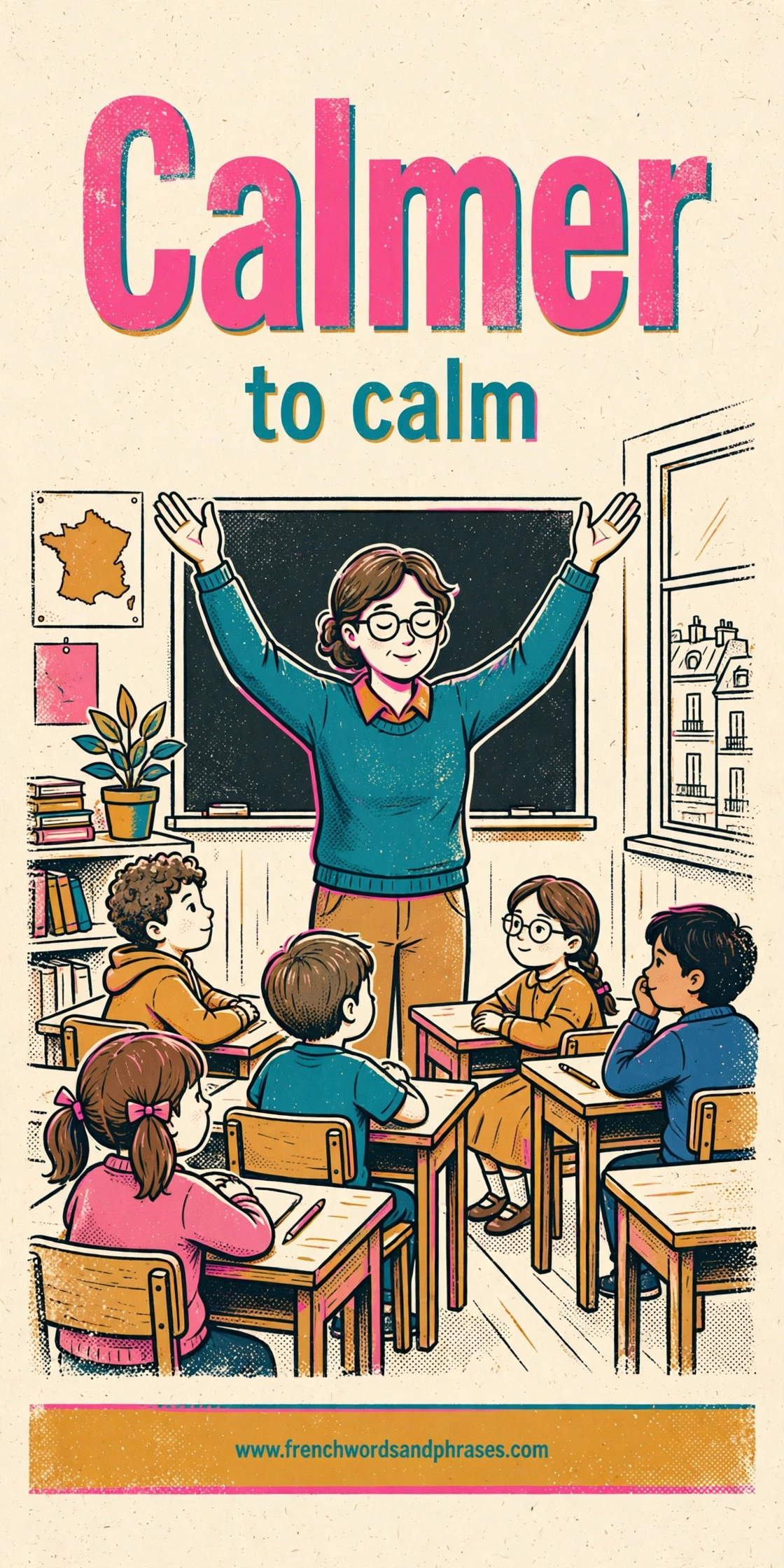
A French Word to Live By
How to Conjugate Calmer in French
/kal.me/
Calmer means to calm, to soothe — to bring a person, an animal or a pain back from agitation to quiet.
A mother soothing a crying baby, a nurse calming a frightened patient, a friend talking someone down after bad news — calmer is the verb of restored quiet: whatever was storming, settles.
In this guide, you’ll learn how to conjugate calmer in all the major French tenses and moods. Explore complete conjugation tables, French examples, English translations, and practice quizzes.
Understanding the French Verb Calmer
Calmer is a regular French verb belonging to the first group of verbs, those ending in-er.
It means to calm, to soothe. It is used of people and animals in distress, of pain and hunger being soothed (calmer la douleur, calmer la faim), and of situations: calmer les esprits calms a heated room, calmer le jeu tells everyone to take the heat out of an argument or a match.
Verb classification: First group (-er)
Auxiliary verb: Avoir
Past participle: calmé
Present participle: calmant
English equivalents: To calm, to soothe, to calm down (someone); calmer un enfant — to calm a child; calmer la douleur — to soothe the pain; calmer les esprits — to calm tempers; calmer le jeu — to calm things down; le calme — calm, quiet.
One important detail: calmer is the active half of a pair — calmer quelqu’un is to calm someone else, while se calmer, its reflexive twin, is to calm down yourself: elle calme l’enfant, puis elle se calme. The verb is a perfectly regular -er: je calme, nous calmons, ils calment, past participle calmé. The noun le calme and the adjective calme share the root — calmer is simply to give calme to someone who has lost it.
Experience the Word
Calmer is the verb of the hand on the shoulder — it does not deny the storm; it walks someone out of it.
Imagine a hospital corridor at night. A young patient, frightened before his operation, cannot stop trembling — and the nurse sits down, takes his hand, and parle doucement jusqu’à le calmer, until his breathing slows and the fear lets go of him, finger by finger.
No medicine was given. He was calmed — calmé, by a voice, a hand and a little time.
How to Conjugate Calmer: Complete French Conjugation Guide
Let’s explore every major conjugation of calmer, beginning with the indicative mood.
How to Conjugate Calmer in the Indicative Mood
The indicative mood is used to express facts, observations, actions, and events.
How to Conjugate Calmer in the Present Tense (Présent)
Used for actions happening now, habitual actions, and general truths.
| Subject | Conjugation |
|---|---|
| je | calme |
| tu | calmes |
| il / elle | calme |
| nous | calmons |
| vous | calmez |
| ils / elles | calment |
Example
Elle calme son bébé en le berçant doucement.
She calms her baby by rocking him gently.
Quick Quiz 1
Complete the sentence:
Nous ______ les enfants avec une histoire.
Reveal the answer
calmons
Nous calmons les enfants avec une histoire.
We calm the children with a story.
How to Conjugate Calmer in the Passé Composé
Used for completed actions in the past. Calmer takes the auxiliary verb avoir.
| Subject | Conjugation |
|---|---|
| j’ | ai calmé |
| tu | as calmé |
| il / elle | a calmé |
| nous | avons calmé |
| vous | avez calmé |
| ils / elles | ont calmé |
Example
Le médecin a calmé le patient avant l’opération.
The doctor calmed the patient before the operation.
How to Conjugate Calmer in the Imparfait (Imperfect Tense)
Used for habitual past actions, descriptions, and ongoing situations in the past.
| Subject | Conjugation |
|---|---|
| je | calmais |
| tu | calmais |
| il / elle | calmait |
| nous | calmions |
| vous | calmiez |
| ils / elles | calmaient |
Example
Sa voix calmait toujours les enfants agités.
Her voice always used to calm restless children.
Quick Quiz 2
Choose the correct form:
The doctor calmed the patient.
Le médecin ______ le patient. (a calmé / est calmé)
Reveal the answer
a calmé
Le médecin a calmé le patient.
Calmer takes avoir.
How to Conjugate Calmer in the Plus-que-parfait
Used to describe an action that had already been completed before another past event.
| Subject | Conjugation |
|---|---|
| j’ | avais calmé |
| tu | avais calmé |
| il / elle | avait calmé |
| nous | avions calmé |
| vous | aviez calmé |
| ils / elles | avaient calmé |
Example
Elle avait calmé la douleur avec une compresse chaude.
She had soothed the pain with a warm compress.
How to Conjugate Calmer in the Passé Simple
Primarily used in formal writing, literature, and historical narratives. It is rarely used in everyday conversation.
| Subject | Conjugation |
|---|---|
| je | calmai |
| tu | calmas |
| il / elle | calma |
| nous | calmâmes |
| vous | calmâtes |
| ils / elles | calmèrent |
Example
Le capitaine calma l’équipage d’une seule phrase.
The captain calmed the crew with a single sentence.
How to Conjugate Calmer in the Passé Antérieur
A literary tense used to express an action completed immediately before another past action, generally in the passé simple.
| Subject | Conjugation |
|---|---|
| j’ | eus calmé |
| tu | eus calmé |
| il / elle | eut calmé |
| nous | eûmes calmé |
| vous | eûtes calmé |
| ils / elles | eurent calmé |
Example
Quand il eut calmé les esprits, la réunion put continuer.
When he had calmed tempers, the meeting could continue.
How to Conjugate Calmer in the Future Tense (Futur Simple)
Used to describe actions that will take place in the future.
| Subject | Conjugation |
|---|---|
| je | calmerai |
| tu | calmeras |
| il / elle | calmera |
| nous | calmerons |
| vous | calmerez |
| ils / elles | calmeront |
Example
Cette musique calmera les enfants avant le coucher.
This music will calm the children before bedtime.
How to Conjugate Calmer in the Futur Antérieur (Future Perfect)
Used for an action that will have been completed before a particular point in the future.
| Subject | Conjugation |
|---|---|
| j’ | aurai calmé |
| tu | auras calmé |
| il / elle | aura calmé |
| nous | aurons calmé |
| vous | aurez calmé |
| ils / elles | auront calmé |
Example
À minuit, la tisane aura calmé sa toux.
By midnight, the herbal tea will have soothed his cough.
How to Conjugate Calmer in the Near Future (Futur Proche)
Used to describe something that is going to happen soon. Formed with aller + infinitive.
| Subject | Conjugation |
|---|---|
| je | vais calmer |
| tu | vas calmer |
| il / elle | va calmer |
| nous | allons calmer |
| vous | allez calmer |
| ils / elles | vont calmer |
Example
Je vais calmer le chien, il aboie pour rien.
I am going to calm the dog down, it is barking at nothing.
How to Conjugate Calmer in the Conditional Mood
The conditional mood expresses what would happen under certain circumstances. It is also frequently used to make polite requests or express wishes.
How to Conjugate Calmer in the Present Conditional
| Subject | Conjugation |
|---|---|
| je | calmerais |
| tu | calmerais |
| il / elle | calmerait |
| nous | calmerions |
| vous | calmeriez |
| ils / elles | calmeraient |
Example
Un peu de repos calmerait ta migraine.
A little rest would soothe your migraine.
How to Conjugate Calmer in the Past Conditional
| Subject | Conjugation |
|---|---|
| j’ | aurais calmé |
| tu | aurais calmé |
| il / elle | aurait calmé |
| nous | aurions calmé |
| vous | auriez calmé |
| ils / elles | auraient calmé |
Example
Tu aurais calmé l’enfant avec une histoire, comme d’habitude.
You would have calmed the child with a story, as usual.
Calmer in the Literary Past Conditional Form
This less common literary form uses the imperfect subjunctive of avoir.
| Subject | Conjugation |
|---|---|
| j’ | eusse calmé |
| tu | eusses calmé |
| il / elle | eût calmé |
| nous | eussions calmé |
| vous | eussiez calmé |
| ils / elles | eussent calmé |
Example
Sa présence eût calmé toute l’assemblée.
Her presence would have calmed the whole assembly.
How to Conjugate Calmer in the Subjunctive Mood
The subjunctive is used to express wishes, emotions, doubts, necessity, and uncertainty. It frequently follows expressions such as il faut que (it is necessary that) or bien que (although).
How to Conjugate Calmer in the Present Subjunctive
| Subject | Conjugation |
|---|---|
| que je | calme |
| que tu | calmes |
| qu’il / qu’elle | calme |
| que nous | calmions |
| que vous | calmiez |
| qu’ils / qu’elles | calment |
Example
Il faut que tu calmes ton frère avant l’arrivée des invités.
You must calm your brother down before the guests arrive.
Quick Quiz 3
Complete the sentence using the subjunctive:
Je souhaitais qu’elle ______ le patient sans médicament.
Reveal the answer
calmât
Je souhaitais qu’elle calmât le patient sans médicament.
I wished she would calm the patient without medicine.
How to Conjugate Calmer in the Imperfect Subjunctive
A literary tense, rarely encountered in modern spoken French.
| Subject | Conjugation |
|---|---|
| que je | calmasse |
| que tu | calmasses |
| qu’il / qu’elle | calmât |
| que nous | calmassions |
| que vous | calmassiez |
| qu’ils / qu’elles | calmassent |
Example
Je souhaitais qu’elle calmât le patient sans médicament.
I wished she would calm the patient without medicine.
How to Conjugate Calmer in the Pluperfect Subjunctive
A literary construction used to express an action completed before another past action.
| Subject | Conjugation |
|---|---|
| que j’ | eusse calmé |
| que tu | eusses calmé |
| qu’il / qu’elle | eût calmé |
| que nous | eussions calmé |
| que vous | eussiez calmé |
| qu’ils / qu’elles | eussent calmé |
Example
On admirait qu’il eût calmé la foule en colère.
People admired that he had calmed the angry crowd.
How to Conjugate Calmer in the Past Subjunctive
| Subject | Conjugation |
|---|---|
| que j’ | aie calmé |
| que tu | aies calmé |
| qu’il / qu’elle | ait calmé |
| que nous | ayons calmé |
| que vous | ayez calmé |
| qu’ils / qu’elles | aient calmé |
Example
Je suis content que la musique ait calmé les enfants.
I am glad the music calmed the children.
How to Conjugate Calmer in the Imperative
The imperative is used to give commands, instructions, invitations, or suggestions. Subject pronouns are omitted.
How to Conjugate Calmer in the Present Imperative
| Person | Conjugation |
|---|---|
| (tu) | calme |
| (nous) | calmons |
| (vous) | calmez |
Example
Calme le bébé, il pleure depuis dix minutes !
Calm the baby, he has been crying for ten minutes!
Quick Quiz 4
How would you say Calm the baby (tu form)?
Reveal the answer
Calme le bébé !
French Participles of Calmer
Participles are verb forms that can be used in compound tenses and other grammatical constructions.
Present Participle of Calmer
calmant
En calmant la douleur, le remède lui a permis de dormir.
By soothing the pain, the remedy allowed him to sleep.
Past Participle of Calmer
calmé
Calmé par sa voix, l’enfant s’endormit enfin.
Calmed by her voice, the child finally fell asleep.
Calmer in Everyday French: Real-Life Examples
Now that you know the conjugations, let’s see how calmer appears in everyday French.
Example 1 — Present
Elle calme son bébé en le berçant.
She calms her baby by rocking him.
Example 2 — Passé composé
Le médecin a calmé le patient.
The doctor calmed the patient.
Example 3 — Imparfait
Sa voix calmait les enfants agités.
Her voice used to calm restless children.
Example 4 — Future
Cette musique calmera les enfants.
This music will calm the children.
Example 5 — Conditional
Un peu de repos calmerait ta migraine.
A little rest would soothe your migraine.
Example 6 — Imperative
Calme le bébé, s’il te plaît !
Calm the baby, please!
Beyond Translation: The Meaning of Calmer
English calm works as noun, adjective and verb; French calmer is the verb of giving calm away — le calme is the quiet itself, and calmer is the act of restoring it to someone else.
It is care expressed as a verb.
Babies, patients, crowds, pains and tempers are all calmés the same way: by something gentler and steadier than the storm — a voice, a hand, a tisane, or a single well-chosen sentence.
How to Remember the French Verb Calmer
Remember it this way: Calmer is about the nurse in the night corridor, talking the fear away finger by finger.
- Calmer is for calming others; se calmer is calming yourself down — elle calme l’enfant, puis elle se calme.
- Beyond people: calmer la douleur, calmer la faim, calmer les esprits.
- Regular -er: je calme, nous calmons, past participle calmé; the noun is le calme.
The key idea is the nurse in the night corridor, talking the fear away finger by finger.
Test Your Knowledge of Calmer
Let’s see how much you’ve learned. Try answering these questions before revealing the answers.
Question 1
What is the difference between calmer and se calmer?
Reveal the answer
Calmer calms someone or something else; se calmer is to calm down yourself.
Question 2
How do you say She calms her baby by rocking him gently in French?
Reveal the answer
Elle calme son bébé en le berçant doucement.
Question 3
Translate: You must calm your brother down before the guests arrive.
Reveal the answer
Il faut que tu calmes ton frère avant l’arrivée des invités.
Question 4
What is the past participle of calmer?
Reveal the answer
Calmé.
Question 5
Complete the sentence:
Cette musique ______ les enfants avant le coucher.
Reveal the answer
calmera
Cette musique calmera les enfants avant le coucher.
This music will calm the children before bedtime.
Your Final Challenge
Can You Use It?
How would you say this in French?
She calms her baby with a gentle song, and the whole house falls silent again.
Reveal the answer
Elle calme son bébé d’une chanson douce, et la maison entière redevient silencieuse.
She calms her baby with a gentle song, and the whole house falls silent again.
A little French. A little curiosity. A richer everyday life.
LEARN FRENCH ONE WORD AT A TIME




