A French Word to Live By
How to Conjugate Calamistrer in French
/ka.la.mis.tʁe/
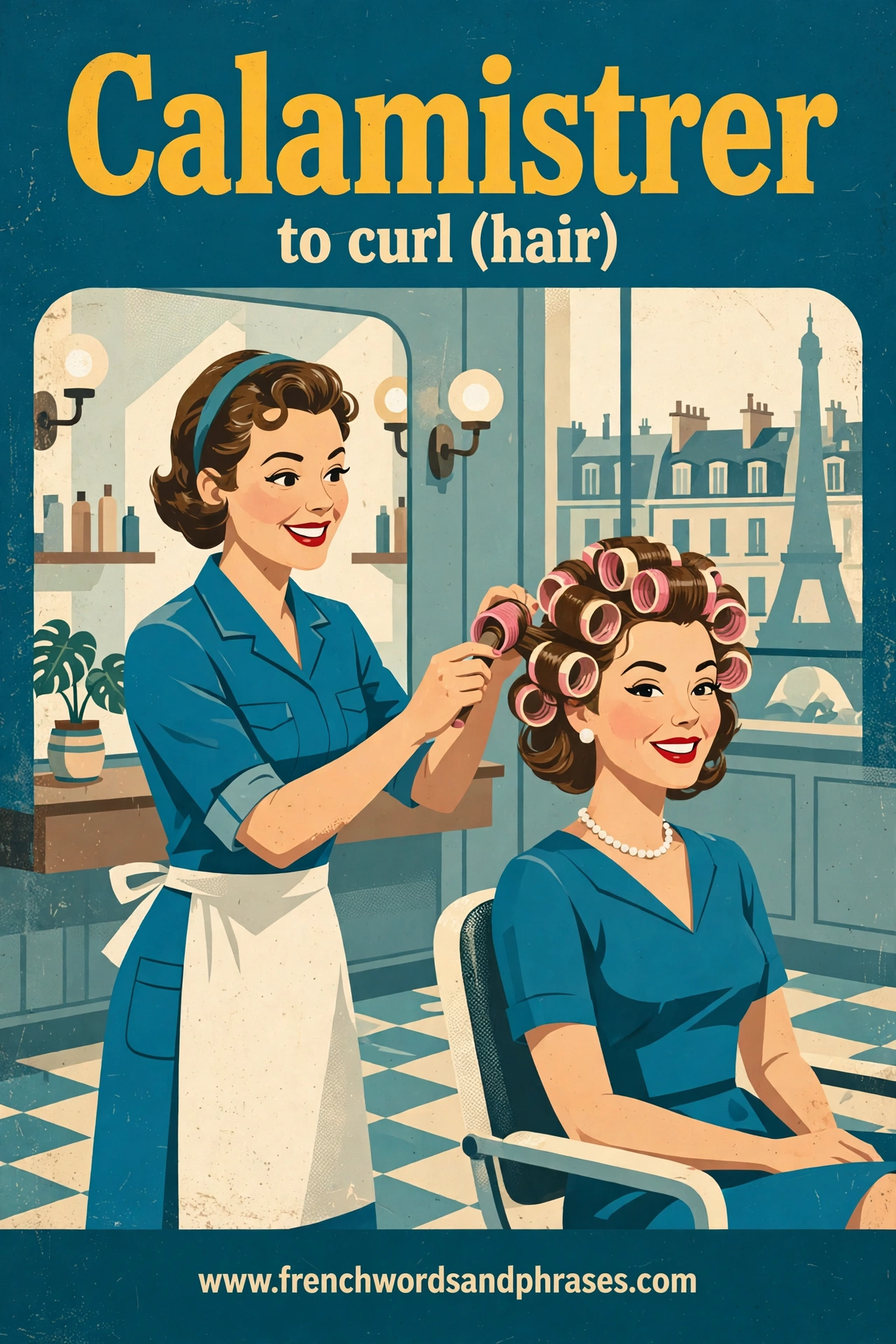
Calamistrer means to curl hair — with the heated iron of another century, coaxing straight locks into the ringlets fashion demanded.
A dressing table in 1880: a slender iron heats in the spirit lamp, and a maid begins, lock by lock, the long work of the evening’s curls. Calamistrer is the vanished verb of that ritual — hairdressing from the age of the curling iron and the ball.
In this guide, you’ll learn how to conjugate calamistrer in all the major French tenses and moods. Explore complete conjugation tables, French examples, English translations, and practice quizzes.
Understanding the French Verb Calamistrer
Calamistrer is a regular French verb belonging to the first group of verbs, those ending in-er.
It means to curl (hair). Expect it in Balzac and Flaubert, in memoirs and in dictionaries — anywhere a heroine is being prepared for an evening. Its object is almost always hair, les cheveux or une chevelure, and the result, une coiffure calamistrée, is the tight, glossy ringlet work that modern curls only imitate.
Verb classification: First group (-er)
Auxiliary verb: Avoir
Past participle: calamistré
Present participle: calamistrant
English equivalents: To curl (hair), to wave (hair) with tongs (dated); calamistrer les cheveux — to curl the hair; une chevelure calamistrée — hair dressed in ringlets; le calamistre — the curling iron; se faire calamistrer — to have one’s hair curled.
One important detail: calamistrer is vieilli — a dated verb that survives in nineteenth-century novels and dictionaries, built on le calamistre, the heated curling iron of the period. Modern hairdressers bouclent or frisent hair; nobody has calamistered since the age of crinolines, and the word now carries an instant perfume of gaslight and ballrooms. The conjugation, at least, never went out of fashion: a plain regular -er verb, je calamistre, nous calamistrons, past participle calamistré.
Experience the Word
Calamistrer is the verb of the heated iron and the patient maid — an hour of small, careful twists for one evening of ringlets.
Imagine a Paris dressing room in 1875. The calamistre warms over the lamp; the maid takes a lock, wraps it round the iron, counts — and lets fall a perfect ringlet. Boucle après boucle, elle calamistre la chevelure de sa maîtresse, while downstairs the carriage already waits for the ball.
By midnight the curls will be dancing. They were curled the slow way — calamistrées, lock by lock, over a spirit lamp.
How to Conjugate Calamistrer: Complete French Conjugation Guide
Let’s explore every major conjugation of calamistrer, beginning with the indicative mood.
How to Conjugate Calamistrer in the Indicative Mood
The indicative mood is used to express facts, observations, actions, and events.
How to Conjugate Calamistrer in the Present Tense (Présent)
Used for actions happening now, habitual actions, and general truths.
| Subject | Conjugation |
|---|---|
| je | calamistre |
| tu | calamistres |
| il / elle | calamistre |
| nous | calamistrons |
| vous | calamistrez |
| ils / elles | calamistrent |
Example
La femme de chambre calamistre les cheveux de sa maîtresse.
The lady’s maid curls her mistress’s hair.
Quick Quiz 1
Complete the sentence:
Nous ______ les cheveux de la mariée.
Reveal the answer
calamistrons
Nous calamistrons les cheveux de la mariée.
We are curling the bride’s hair.
How to Conjugate Calamistrer in the Passé Composé
Used for completed actions in the past. Calamistrer takes the auxiliary verb avoir.
| Subject | Conjugation |
|---|---|
| j’ | ai calamistré |
| tu | as calamistré |
| il / elle | a calamistré |
| nous | avons calamistré |
| vous | avez calamistré |
| ils / elles | ont calamistré |
Example
Le coiffeur a calamistré toute la chevelure en une heure.
The hairdresser curled the whole head of hair in an hour.
How to Conjugate Calamistrer in the Imparfait (Imperfect Tense)
Used for habitual past actions, descriptions, and ongoing situations in the past.
| Subject | Conjugation |
|---|---|
| je | calamistrais |
| tu | calamistrais |
| il / elle | calamistrait |
| nous | calamistrions |
| vous | calamistriez |
| ils / elles | calamistraient |
Example
Autrefois, on calamistrait les jeunes filles avant le bal.
In the old days, young girls’ hair was curled before the ball.
Quick Quiz 2
Choose the correct form:
The hairdresser curled the whole head of hair.
Le coiffeur ______ toute la chevelure. (a calamistré / est calamistré)
Reveal the answer
a calamistré
Le coiffeur a calamistré toute la chevelure.
Calamistrer takes avoir.
How to Conjugate Calamistrer in the Plus-que-parfait
Used to describe an action that had already been completed before another past event.
| Subject | Conjugation |
|---|---|
| j’ | avais calamistré |
| tu | avais calamistré |
| il / elle | avait calamistré |
| nous | avions calamistré |
| vous | aviez calamistré |
| ils / elles | avaient calamistré |
Example
Elle avait calamistré ses cheveux avant l’arrivée des invités.
She had curled her hair before the guests arrived.
How to Conjugate Calamistrer in the Passé Simple
Primarily used in formal writing, literature, and historical narratives. It is rarely used in everyday conversation.
| Subject | Conjugation |
|---|---|
| je | calamistrai |
| tu | calamistras |
| il / elle | calamistra |
| nous | calamistrâmes |
| vous | calamistrâtes |
| ils / elles | calamistrèrent |
Example
La coiffeuse calamistra les cheveux de la mariée dès l’aube.
The hairdresser curled the bride’s hair from dawn.
How to Conjugate Calamistrer in the Passé Antérieur
A literary tense used to express an action completed immediately before another past action, generally in the passé simple.
| Subject | Conjugation |
|---|---|
| j’ | eus calamistré |
| tu | eus calamistré |
| il / elle | eut calamistré |
| nous | eûmes calamistré |
| vous | eûtes calamistré |
| ils / elles | eurent calamistré |
Example
Quand elle eut calamistré la dernière boucle, la cloche sonna.
When she had curled the last ringlet, the bell rang.
How to Conjugate Calamistrer in the Future Tense (Futur Simple)
Used to describe actions that will take place in the future.
| Subject | Conjugation |
|---|---|
| je | calamistrerai |
| tu | calamistreras |
| il / elle | calamistrera |
| nous | calamistrerons |
| vous | calamistrerez |
| ils / elles | calamistreront |
Example
Demain, la femme de chambre calamistrera vos cheveux pour la soirée.
Tomorrow, the maid will curl your hair for the evening.
How to Conjugate Calamistrer in the Futur Antérieur (Future Perfect)
Used for an action that will have been completed before a particular point in the future.
| Subject | Conjugation |
|---|---|
| j’ | aurai calamistré |
| tu | auras calamistré |
| il / elle | aura calamistré |
| nous | aurons calamistré |
| vous | aurez calamistré |
| ils / elles | auront calamistré |
Example
Quand il aura calamistré toutes les boucles, il posera les fleurs.
When he has curled all the ringlets, he will place the flowers.
How to Conjugate Calamistrer in the Near Future (Futur Proche)
Used to describe something that is going to happen soon. Formed with aller + infinitive.
| Subject | Conjugation |
|---|---|
| je | vais calamistrer |
| tu | vas calamistrer |
| il / elle | va calamistrer |
| nous | allons calamistrer |
| vous | allez calamistrer |
| ils / elles | vont calamistrer |
Example
Elle va calamistrer ses cheveux avant le dîner.
She is going to curl her hair before dinner.
How to Conjugate Calamistrer in the Conditional Mood
The conditional mood expresses what would happen under certain circumstances. It is also frequently used to make polite requests or express wishes.
How to Conjugate Calamistrer in the Present Conditional
| Subject | Conjugation |
|---|---|
| je | calamistrerais |
| tu | calamistrerais |
| il / elle | calamistrerait |
| nous | calamistrerions |
| vous | calamistreriez |
| ils / elles | calamistreraient |
Example
Avec un fer plus chaud, elle calamistrerait plus vite.
With a hotter iron, she would curl faster.
How to Conjugate Calamistrer in the Past Conditional
| Subject | Conjugation |
|---|---|
| j’ | aurais calamistré |
| tu | aurais calamistré |
| il / elle | aurait calamistré |
| nous | aurions calamistré |
| vous | auriez calamistré |
| ils / elles | auraient calamistré |
Example
Elle aurait calamistré la chevelure entière sans la panne de lampe.
She would have curled the whole head of hair if the lamp had not failed.
Calamistrer in the Literary Past Conditional Form
This less common literary form uses the imperfect subjunctive of avoir.
| Subject | Conjugation |
|---|---|
| j’ | eusse calamistré |
| tu | eusses calamistré |
| il / elle | eût calamistré |
| nous | eussions calamistré |
| vous | eussiez calamistré |
| ils / elles | eussent calamistré |
Example
La coiffeuse eût calamistré la mariée comme une reine.
The hairdresser would have curled the bride’s hair like a queen’s.
How to Conjugate Calamistrer in the Subjunctive Mood
The subjunctive is used to express wishes, emotions, doubts, necessity, and uncertainty. It frequently follows expressions such as il faut que (it is necessary that) or bien que (although).
How to Conjugate Calamistrer in the Present Subjunctive
| Subject | Conjugation |
|---|---|
| que je | calamistre |
| que tu | calamistres |
| qu’il / qu’elle | calamistre |
| que nous | calamistrions |
| que vous | calamistriez |
| qu’ils / qu’elles | calamistrent |
Example
Il faut que je calamistre vos cheveux avant huit heures.
I must curl your hair before eight o’clock.
Quick Quiz 3
Complete the sentence using the subjunctive:
Il faut que vous ______ les boucles une à une.
Reveal the answer
calamistriez
Il faut que vous calamistriez les boucles une à une.
You must curl the ringlets one by one.
How to Conjugate Calamistrer in the Imperfect Subjunctive
A literary tense, rarely encountered in modern spoken French.
| Subject | Conjugation |
|---|---|
| que je | calamistrasse |
| que tu | calamistrasses |
| qu’il / qu’elle | calamistrât |
| que nous | calamistrassions |
| que vous | calamistrassiez |
| qu’ils / qu’elles | calamistrassent |
Example
Je voulais qu’elle calamistrât les boucles une à une.
I wanted her to curl the ringlets one by one.
How to Conjugate Calamistrer in the Pluperfect Subjunctive
A literary construction used to express an action completed before another past action.
| Subject | Conjugation |
|---|---|
| que j’ | eusse calamistré |
| que tu | eusses calamistré |
| qu’il / qu’elle | eût calamistré |
| que nous | eussions calamistré |
| que vous | eussiez calamistré |
| qu’ils / qu’elles | eussent calamistré |
Example
On racontait que la coiffeuse eût calamistré toutes les dames du bal.
People said the hairdresser had curled all the ladies of the ball.
How to Conjugate Calamistrer in the Past Subjunctive
| Subject | Conjugation |
|---|---|
| que j’ | aie calamistré |
| que tu | aies calamistré |
| qu’il / qu’elle | ait calamistré |
| que nous | ayons calamistré |
| que vous | ayez calamistré |
| qu’ils / qu’elles | aient calamistré |
Example
Je suis content qu’elle ait calamistré si bien la mariée.
I am glad she curled the bride’s hair so well.
How to Conjugate Calamistrer in the Imperative
The imperative is used to give commands, instructions, invitations, or suggestions. Subject pronouns are omitted.
How to Conjugate Calamistrer in the Present Imperative
| Person | Conjugation |
|---|---|
| (tu) | calamistre |
| (nous) | calamistrons |
| (vous) | calamistrez |
Example
Calamistre cette mèche avec précaution, le fer est chaud !
Curl this lock carefully, the iron is hot!
Quick Quiz 4
How would you say Curl this lock carefully (tu form)?
Reveal the answer
Calamistre cette mèche avec précaution !
French Participles of Calamistrer
Participles are verb forms that can be used in compound tenses and other grammatical constructions.
Present Participle of Calamistrer
calamistrant
En calamistrant chaque boucle, elle chantonnait un air ancien.
Curling each ringlet, she hummed an old tune.
Past Participle of Calamistrer
calamistré
Calamistrée pour le bal, la jeune fille descendit l’escalier.
Her hair curled for the ball, the young girl came down the stairs.
Calamistrer in Everyday French: Real-Life Examples
Now that you know the conjugations, let’s see how calamistrer appears in everyday French.
Example 1 — Present
La femme de chambre calamistre les cheveux.
The maid curls the hair.
Example 2 — Passé composé
Le coiffeur a calamistré la chevelure.
The hairdresser curled the head of hair.
Example 3 — Imparfait
On calamistrait les jeunes filles avant le bal.
Young girls’ hair was curled before the ball.
Example 4 — Future
Elle calamistrera vos cheveux demain.
She will curl your hair tomorrow.
Example 5 — Conditional
Elle calamistrerait plus vite avec un fer chaud.
She would curl faster with a hot iron.
Example 6 — Imperative
Calamistre cette mèche avec précaution !
Curl this lock carefully!
Beyond Translation: The Meaning of Calamistrer
English never borrowed this one — it curled hair with tongs and forgot the word — while French calamistrer preserves the tool itself, le calamistre, inside the verb.
It is a museum piece that still conjugates.
Meet it in a nineteenth-century novel and the whole dressing room comes with it: the spirit lamp, the smell of warm hair, the maid counting under her breath. Modern French says boucler; calamistrer is for readers, and it rewards them.
How to Remember the French Verb Calamistrer
Remember it this way: Calamistrer is about the maid, the spirit lamp and the ringlets of 1875.
- Le calamistre is the old curling iron — calamistrer is to work hair with it.
- A dated, literary verb: modern French curls with boucler or friser.
- Regular -er underneath: je calamistre, nous calamistrons, past participle calamistré.
The key idea is the maid, the spirit lamp and the ringlets of 1875.
Test Your Knowledge of Calamistrer
Let’s see how much you’ve learned. Try answering these questions before revealing the answers.
Question 1
What is un calamistre?
Reveal the answer
The heated curling iron of the nineteenth century — calamistrer is to curl hair with it.
Question 2
How do you say The maid curls her mistress’s hair in French?
Reveal the answer
La femme de chambre calamistre les cheveux de sa maîtresse.
Question 3
Translate: She had curled her hair before the guests arrived.
Reveal the answer
Elle avait calamistré ses cheveux avant l’arrivée des invités.
Question 4
What is the past participle of calamistrer?
Reveal the answer
Calamistré.
Question 5
Complete the sentence:
Il faut que je ______ vos cheveux avant huit heures.
Reveal the answer
calamistre
Il faut que je calamistre vos cheveux avant huit heures.
I must curl your hair before eight o’clock.
Your Final Challenge
Can You Use It?
How would you say this in French?
Ringlet after ringlet, she curls the hair, and the young girl becomes, for one evening, the heroine of a novel.
Reveal the answer
Boucle après boucle, elle calamistre la chevelure, et la jeune fille devient, pour un soir, l’héroïne d’un roman.
Ringlet after ringlet, she curls the hair, and the young girl becomes, for one evening, the heroine of a novel.
A little French. A little curiosity. A richer everyday life.
LEARN FRENCH ONE WORD AT A TIME