
A French Word to Live By
Translate Pour changer to English
/puʁ ʃɑ̃.ʒe/
Pour changer means for a change — to break the routine, just this once.
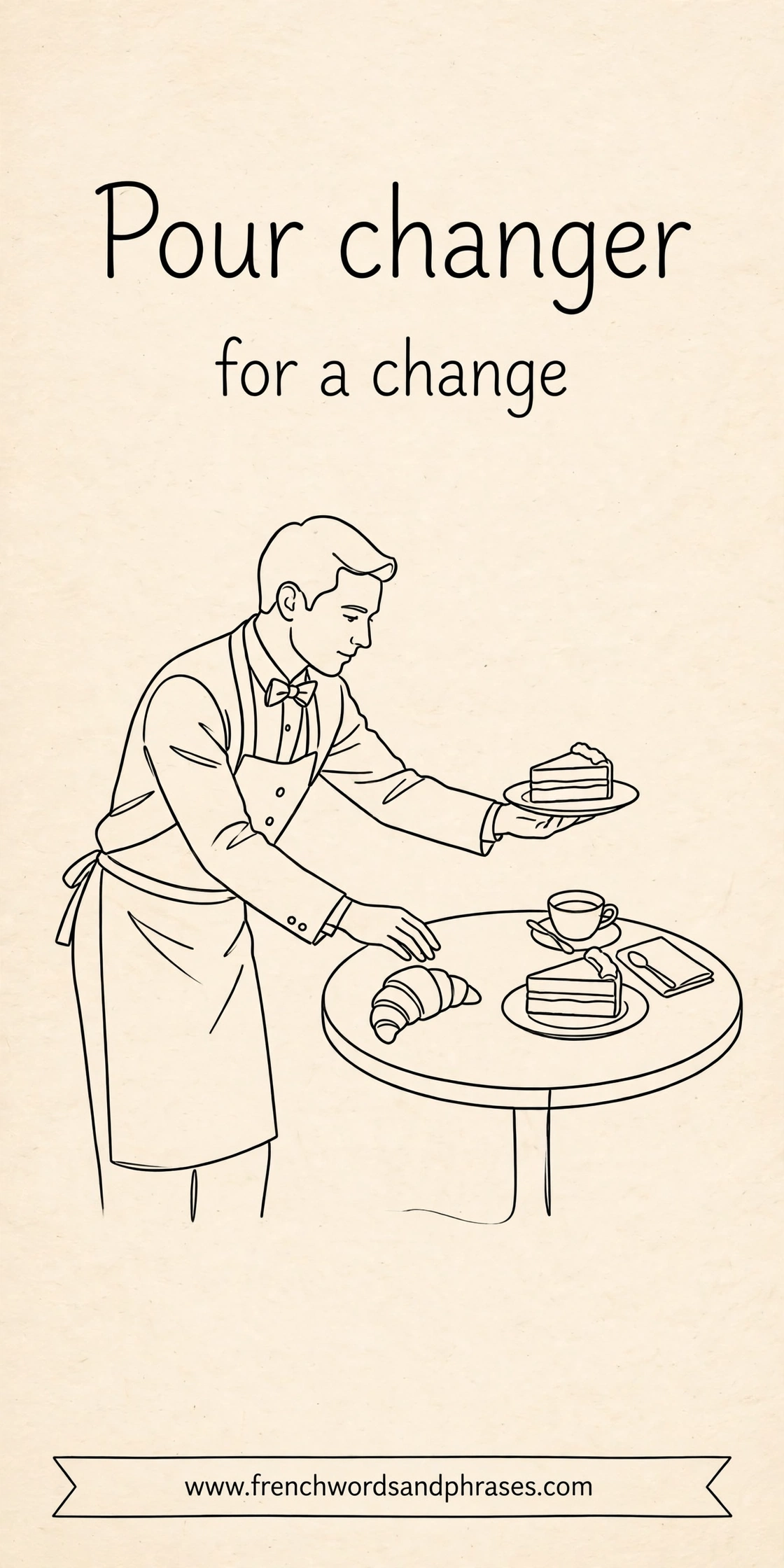
Every Friday for eleven years, Madame Fabre has ordered the same dish at the same bistro: blanquette de veau, no discussion. Tonight she studies the menu like a stranger, closes it, and announces to the startled waiter: « Pour changer, je vais prendre le poisson. »
Let’s explore how pour changer works in French, beginning with the whole phrase on one card.
Understanding the French Phrase Pour changer
Pour changer is a French everyday phrase built from pour (for) and changer (to change — a verb that has its own page on this site). It is a little infinitive phrase with no subject and no tense: French drops it at the head of a sentence, and the whole sentence that follows becomes the exception to a routine.
It means for a change. Pour changer, prenons le train — for a change, let’s take the train. Il fait beau, pour changer — it’s sunny, for a change. The phrase always looks backwards at a habit: something is normally done one way, and this time, deliberately, it will be done another.
Type: Everyday phrase — variety and exception (pour + infinitive)
Answers the need: Marking a deliberate break from a routine or habit
Register: Neutral and friendly — everywhere, often with a smile
Strength: Playful — it only makes sense against the background of a habit
One important usage detail: pour changer usually opens the sentence, set off by a comma — pour changer, on marche ? — and it often carries a gentle irony when the “change” is suspiciously familiar: il est en retard, pour changer — he’s late, for a change (meaning: as usual). The tone tells you whether the change is real or sarcastic.
Experience the Word
Pour changer is the phrase of small rebellions — the different dish, the other road home, the Sunday spent doing nothing on purpose.
Imagine the office worker who has taken the same metro line for a decade. One spring morning she walks the whole way instead, past the bakeries and the flower stall, and arrives slightly late and entirely pleased: pour changer, she tells her colleague, and the two words explain everything.
English says for a change with the same wink. French keeps the machinery visible: pour, for — changer, to change — a purpose and a verb, pointed at your own routine.
How to Use Pour changer in French: Complete Guide
Let’s explore how pour changer works in French, beginning with the whole phrase on one card.
Pour changer at a Glance
The Whole Phrase on One Card
Real meaning, literal picture, English twin and register — pour changer in five lines.
| Point | Pour changer |
|---|---|
| What it really means | for a change — doing something differently, this time |
| Word for word | for to-change — pour (for) + changer (to change) |
| English equivalent | for a change |
| Register | neutral and friendly — often smiling, sometimes ironic |
| Use it for | new dishes, new routes, new plans — and teasing creatures of habit |
Example
Pour changer, nous dînons sur la terrasse.
For a change, we are dining on the terrace.
Word by Word: Building the Exception
Two small pieces — a purpose and a verb, and together they bend a routine.
| Word | Literal meaning | Its job in the phrase |
|---|---|---|
| pour | for | the purpose marker — it aims what follows at a goal |
| changer | to change | the infinitive — the whole point of the phrase |
| (the habit) | what you usually do | never said aloud, but always present: the phrase leans on it |
Example
Il a pris le vélo, pour changer.
He took the bike, for a change.
Quick Quiz 1
What must exist in the background for pour changer to make sense?
Reveal the answer
A routine — the phrase always breaks a habit. No habit, no change: the words lean on what you normally do.
Pour changer, elle est arrivée en avance.
For a change, she arrived early.
When You Say It: The Routine-Breaking Moments
Pour changer fires at moments like these — wherever a habit is politely interrupted.
| Situation | Example |
|---|---|
| A different dish | pour changer, je prends le poisson — for a change, I’ll have the fish |
| A new plan | pour changer, restons à la maison — for a change, let’s stay home |
| A pleasant surprise | il fait beau, pour changer ! — it’s sunny, for a change! |
| A gentle tease | tu es en retard, pour changer — you’re late, for a change (as usual) |
| A real decision | pour changer, je dis non — for a change, I’m saying no |
Example
Pour changer, c’est lui qui fait la cuisine ce soir.
For a change, he is the one cooking tonight.
Make It Yours: Where the Phrase Sits
The phrase is movable — at the head it announces the change, at the tail it comments on it.
| Form | French | In English |
|---|---|---|
| At the start | pour changer, prenons le train | for a change, let’s take the train |
| At the end | prenons le train, pour changer | let’s take the train, for a change |
| As a suggestion | et si on sortait, pour changer ? | how about going out, for a change? |
| Ironic | encore des pâtes, pour changer… | pasta again, for a change… (some change) |
| With a reason | pour changer un peu | just for a bit of a change |
Example
Et si on marchait, pour changer ?
How about walking, for a change?
Quick Quiz 2
Your friend is late for the tenth time and someone sighs: « Il est en retard, pour changer. » Is the speaker pleased?
Reveal the answer
No — it is irony. The “change” is no change at all: he is late as always, and the phrase teases the habit it pretends to break.
Il pleut, pour changer.
It’s raining, for a change. (It rains every day.)
Everyday Expressions: Building on the Change
Pour changer slots into these everyday frames — each one ready to use as it stands.
| Frame | In English |
|---|---|
| pour changer un peu | for a bit of a change |
| ça change ! | that’s a change! — a surprised reaction |
| ça me change | it makes a change for me, it’s a nice change |
| changer d’air | to get a change of scenery |
| pour une fois | for once — the close cousin: one exception, stated plainly |
Example
Ce week-end à la mer, ça nous change !
This weekend at the seaside makes a real change for us!
Close Cousins: The Other Ways to Break a Routine
French has several ways to mark an exception — pour changer is the smiling one; its cousins insist, count or resign themselves.
| Expression | The difference |
|---|---|
| pour changer | for a change — the exception, with a smile or a wink |
| pour une fois | for once — a single exception, often with a sigh of relief |
| exceptionnellement | exceptionally — the formal, written marker |
| d’habitude | usually — the routine itself, the background the phrase breaks |
| comme toujours | as always — the anti-change: nothing broke at all |
Example
D’habitude il conduit ; pour une fois, c’est elle.
Usually he drives; for once, it’s her.
Quick Quiz 3
Which cousin names the routine itself — pour changer or d’habitude?
Reveal the answer
D’habitude — usually. Pour changer breaks the routine; d’habitude is the routine, the background habit.
D’habitude, on mange à midi.
Usually, we eat at noon.
Pour changer and Its Neighbours
The change shelf around the phrase — habits, breaks and surprises.
| French | In English |
|---|---|
| l’habitude | the habit, the routine |
| changer | to change |
| la routine | the routine |
| une surprise | a surprise |
| la nouveauté | the novelty, the new thing |
Example
La nouveauté, pour changer, lui fait plaisir.
The novelty, for a change, pleases her.
Watch Out: The Traps Around Pour changer
The traps: a missing habit, a missed irony, and a changer that swaps jobs.
| Trap | The truth |
|---|---|
| using it with no routine in sight | the phrase needs a habit behind it — otherwise say simplement autrement, differently |
| missing the irony | pour changer after bad news is usually sarcasm: the “change” is the same old thing |
| changer vs se changer | se changer means to change one’s clothes — pour changer never means getting dressed |
| pour changer de… | with de it aims at a topic or scene: pour changer de sujet, to change the subject |
Example
Pour changer de sujet, parlons des vacances.
To change the subject, let’s talk about the holidays.
Quick Quiz 4
True or false: pour changer can be sarcastic.
Reveal the answer
True — said of a familiar annoyance, it means the opposite: nothing has changed at all.
Le train a du retard, pour changer.
The train is late, for a change.
Pour changer in Everyday French: Real-Life Examples
Now that you know the word, let’s see how pour changer appears in everyday French.
Example 1 — At the bistro
Pour changer, je vais prendre le poisson.
For a change, I will have the fish.
Example 2 — Weekend plans
Pour changer, restons à la maison ce soir.
For a change, let’s stay home tonight.
Example 3 — The weather
Il fait beau, pour changer !
It’s sunny, for a change!
Example 4 — The commute
Pour changer, elle est venue à vélo.
For a change, she came by bike.
Example 5 — A tease
Tu as oublié tes clés, pour changer.
You forgot your keys, for a change.
Example 6 — A decision
Pour changer, je pars en vacances en septembre.
For a change, I am going on holiday in September.
Beyond Translation: The Meaning of Pour changer
Every routine secretly dreams of its own exception, and pour changer is the two-word door out of it. The phrase does not abolish the habit — the blanquette will be back next Friday — it simply proves the habit is a choice, not a cage.
To say pour changer is to remind yourself that the routine works for you, not the other way round.
And its irony is the gentlest in French: the same two words that celebrate a real change can sigh at a false one, and only the smile — or its absence — tells you which.
How to Remember the French Phrase Pour changer
Remember it this way: Pour changer means for a change — pour (for) plus changer (to change), the two words that break a routine.
- You need the habit first — pour changer only works against the background of what you usually do.
- You place it at the head — pour changer, prenons le train, comma and all.
- You listen for the wink — after bad news, it usually means nothing has changed at all.
The key idea is pour changer means for a change — it breaks a routine, and can be ironic.
Test Your Knowledge of Pour changer
Let’s see how much you’ve learned. Try answering these questions before revealing the answers.
Question 1
What does pour changer mean?
Reveal the answer
For a change — doing something differently from the usual routine.
Question 2
What are the two words inside the phrase?
Reveal the answer
Pour (for) and changer (to change) — a purpose plus an infinitive.
Question 3
Translate: For a change, let’s stay home.
Reveal the answer
Pour changer, restons à la maison.
Question 4
A colleague sighs: « Il est en retard, pour changer. » What is the tone?
Reveal the answer
Ironic — he is late as always; the “change” is no change at all.
Question 5
Complete the sentence:
______ changer, je prends le poisson. (for a change)
Reveal the answer
Pour
Pour changer, je prends le poisson.
For a change, I’ll have the fish.
Your Final Challenge
Can You Use It?
How would you say this in French?
“For a change, let’s take the train.”
Reveal the answer
Pour changer, prenons le train.
For a change, let’s take the train.
A little French. A little curiosity. A richer everyday life.
LEARN FRENCH ONE WORD AT A TIME




