
A French Word to Live By
How to Conjugate Attirer in French
/a.ti.ʁe/
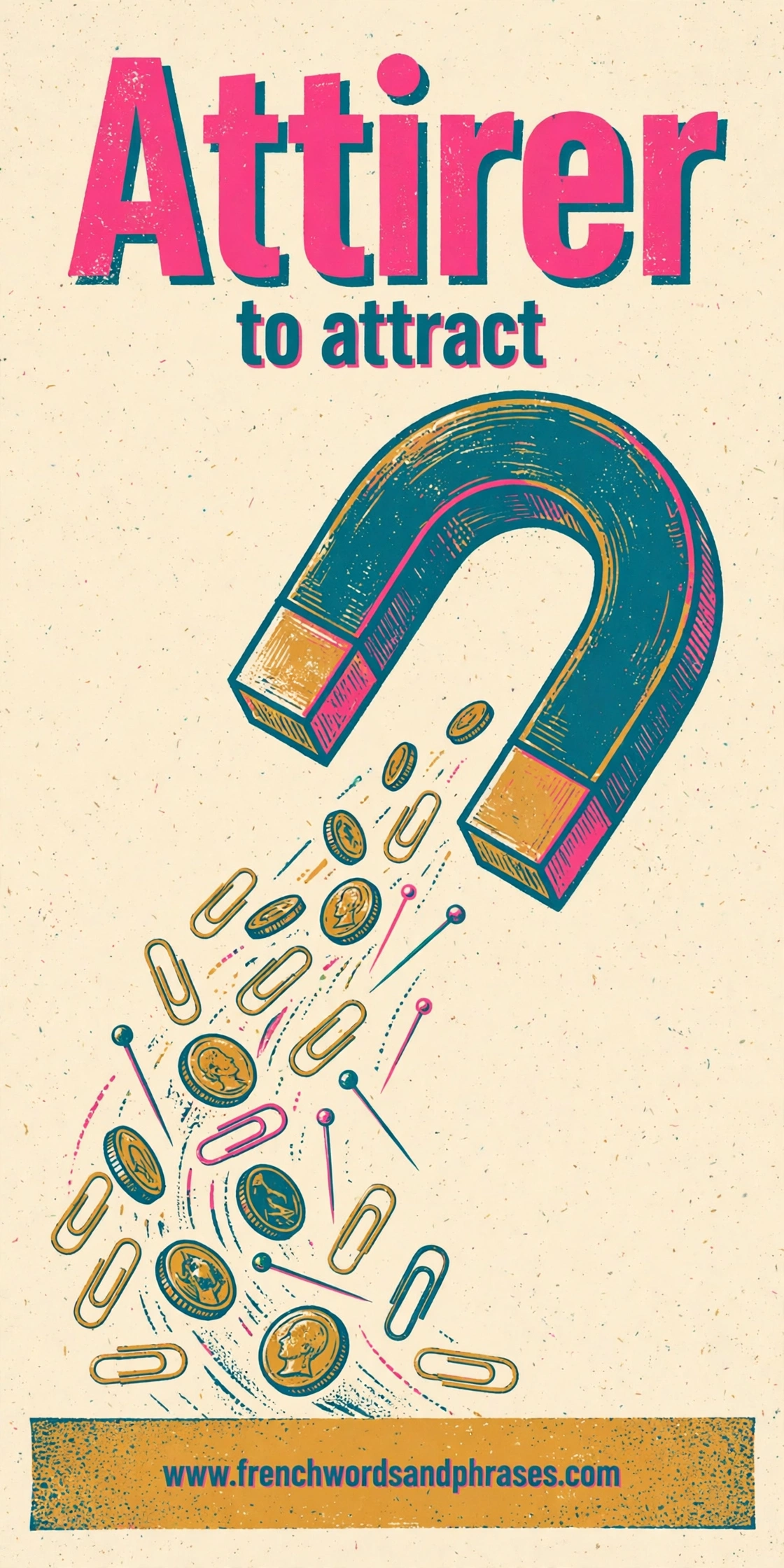
Attirer means to attract — to draw people, animals, eyes or objects towards you the way a magnet draws iron.
A market stall piled high with peaches, a lighthouse on a dark coast, a shop window at Christmas — attirer is the verb of the pull: whatever draws a crowd, a glance or a customer is doing, in French, exactly what a magnet does.
In this guide, you’ll learn how to conjugate attirer in all the major French tenses and moods. Explore complete conjugation tables, French examples, English translations, and practice quizzes.
Understanding the French Verb Attirer
Attirer is a regular French verb belonging to the first group of verbs, those ending in-er.
It means to attract. It is used for magnets and light and honey-pots as much as for people: les fleurs attirent les abeilles, la lumière attire les papillons. With attention as its object — attirer l’attention, attirer le regard — it is one of the most useful verbs in everyday French, for teachers, advertisers and parents alike.
Verb classification: First group (-er)
Auxiliary verb: Avoir
Past participle: attiré
Present participle: attirant
English equivalents: To attract, to draw; attirer l’attention — to attract attention; attirer les clients — to attract customers; attirer le regard — to catch the eye; s’attirer des ennuis — to bring trouble on oneself; s’attirer des critiques — to draw criticism.
One important detail: attirer is a regular -er verb — j’attire, nous attirons, ils attirent, past participle attiré — built on tirer, to pull: to attract is to pull towards. Its reflexive carries a warning: s’attirer + a plural noun means to bring something on yourself, usually unwelcome — s’attirer des ennuis (to get yourself into trouble), s’attirer des critiques, s’attirer la colère de quelqu’un — though it can be kind: s’attirer la sympathie de tous. The phrase s’attirer des ennuis has its own page on this site.
Experience the Word
Attirer is the verb of the invisible rope — something at one end, a drawn crowd at the other, and a pull between them.
Imagine a small bakery that starts giving a warm madeleine to everyone who passes at eight in the morning. Within a month there is a queue on the pavement, les voisins, les étudiants, même le facteur — the little shop attire tout le quartier, and nobody quite remembers deciding to come.
No shouting, no posters. The crowd has simply been attracted — attiré, the way iron goes to a magnet.
How to Conjugate Attirer: Complete French Conjugation Guide
Let’s explore every major conjugation of attirer, beginning with the indicative mood.
How to Conjugate Attirer in the Indicative Mood
The indicative mood is used to express facts, observations, actions, and events.
How to Conjugate Attirer in the Present Tense (Présent)
Used for actions happening now, habitual actions, and general truths.
| Subject | Conjugation |
|---|---|
| je | attire |
| tu | attires |
| il / elle | attire |
| nous | attirons |
| vous | attirez |
| ils / elles | attirent |
Example
Les fleurs attirent les abeilles au printemps.
Flowers attract bees in spring.
Quick Quiz 1
Complete the sentence:
Nous ______ les clients avec cette nouvelle vitrine.
Reveal the answer
attirons
Nous attirons les clients avec cette nouvelle vitrine.
We are attracting customers with this new shop window.
How to Conjugate Attirer in the Passé Composé
Used for completed actions in the past. Attirer takes the auxiliary verb avoir.
| Subject | Conjugation |
|---|---|
| j’ | ai attiré |
| tu | as attiré |
| il / elle | a attiré |
| nous | avons attiré |
| vous | avez attiré |
| ils / elles | ont attiré |
Example
La vitrine a attiré des dizaines de clients.
The shop window attracted dozens of customers.
How to Conjugate Attirer in the Imparfait (Imperfect Tense)
Used for habitual past actions, descriptions, and ongoing situations in the past.
| Subject | Conjugation |
|---|---|
| je | attirais |
| tu | attirais |
| il / elle | attirait |
| nous | attirions |
| vous | attiriez |
| ils / elles | attiraient |
Example
Autrefois, la foire attirait tout le village.
In the old days, the fair used to attract the whole village.
Quick Quiz 2
Choose the correct form:
The window attracted dozens of customers.
La vitrine ______ des dizaines de clients. (a attiré / est attirée)
Reveal the answer
a attiré
La vitrine a attiré des dizaines de clients.
Attirer takes avoir.
How to Conjugate Attirer in the Plus-que-parfait
Used to describe an action that had already been completed before another past event.
| Subject | Conjugation |
|---|---|
| j’ | avais attiré |
| tu | avais attiré |
| il / elle | avait attiré |
| nous | avions attiré |
| vous | aviez attiré |
| ils / elles | avaient attiré |
Example
Elle avait attiré l’attention de tous les invités.
She had attracted the attention of all the guests.
How to Conjugate Attirer in the Passé Simple
Primarily used in formal writing, literature, and historical narratives. It is rarely used in everyday conversation.
| Subject | Conjugation |
|---|---|
| je | attirai |
| tu | attiras |
| il / elle | attira |
| nous | attirâmes |
| vous | attirâtes |
| ils / elles | attirèrent |
Example
Le phare attira les navires vers la côte.
The lighthouse drew the ships towards the coast.
How to Conjugate Attirer in the Passé Antérieur
A literary tense used to express an action completed immediately before another past action, generally in the passé simple.
| Subject | Conjugation |
|---|---|
| j’ | eus attiré |
| tu | eus attiré |
| il / elle | eut attiré |
| nous | eûmes attiré |
| vous | eûtes attiré |
| ils / elles | eurent attiré |
Example
Quand la musique eut attiré la foule, la fête commença.
When the music had drawn the crowd, the party began.
How to Conjugate Attirer in the Future Tense (Futur Simple)
Used to describe actions that will take place in the future.
| Subject | Conjugation |
|---|---|
| je | attirerai |
| tu | attireras |
| il / elle | attirera |
| nous | attirerons |
| vous | attirerez |
| ils / elles | attireront |
Example
Ce nouveau produit attirera beaucoup de clients.
This new product will attract many customers.
How to Conjugate Attirer in the Futur Antérieur (Future Perfect)
Used for an action that will have been completed before a particular point in the future.
| Subject | Conjugation |
|---|---|
| j’ | aurai attiré |
| tu | auras attiré |
| il / elle | aura attiré |
| nous | aurons attiré |
| vous | aurez attiré |
| ils / elles | auront attiré |
Example
À la fin de l’été, la plage aura attiré des milliers de touristes.
By the end of summer, the beach will have attracted thousands of tourists.
How to Conjugate Attirer in the Near Future (Futur Proche)
Used to describe something that is going to happen soon. Formed with aller + infinitive.
| Subject | Conjugation |
|---|---|
| je | vais attirer |
| tu | vas attirer |
| il / elle | va attirer |
| nous | allons attirer |
| vous | allez attirer |
| ils / elles | vont attirer |
Example
Cette affiche va attirer tous les regards.
This poster is going to catch every eye.
How to Conjugate Attirer in the Conditional Mood
The conditional mood expresses what would happen under certain circumstances. It is also frequently used to make polite requests or express wishes.
How to Conjugate Attirer in the Present Conditional
| Subject | Conjugation |
|---|---|
| je | attirerais |
| tu | attirerais |
| il / elle | attirerait |
| nous | attirerions |
| vous | attireriez |
| ils / elles | attireraient |
Example
Avec une meilleure vitrine, le magasin attirerait plus de monde.
With a better window, the shop would attract more people.
How to Conjugate Attirer in the Past Conditional
| Subject | Conjugation |
|---|---|
| j’ | aurais attiré |
| tu | aurais attiré |
| il / elle | aurait attiré |
| nous | aurions attiré |
| vous | auriez attiré |
| ils / elles | auraient attiré |
Example
Il aurait attiré l’attention sans ce bruit soudain.
He would have attracted attention if not for that sudden noise.
Attirer in the Literary Past Conditional Form
This less common literary form uses the imperfect subjunctive of avoir.
| Subject | Conjugation |
|---|---|
| j’ | eusse attiré |
| tu | eusses attiré |
| il / elle | eût attiré |
| nous | eussions attiré |
| vous | eussiez attiré |
| ils / elles | eussent attiré |
Example
Le chant des sirènes attirât les marins vers les rochers.
The sirens’ song would draw the sailors towards the rocks.
How to Conjugate Attirer in the Subjunctive Mood
The subjunctive is used to express wishes, emotions, doubts, necessity, and uncertainty. It frequently follows expressions such as il faut que (it is necessary that) or bien que (although).
How to Conjugate Attirer in the Present Subjunctive
| Subject | Conjugation |
|---|---|
| que je | attire |
| que tu | attires |
| qu’il / qu’elle | attire |
| que nous | attirions |
| que vous | attiriez |
| qu’ils / qu’elles | attirent |
Example
Il faut que ce titre attire l’œil du lecteur.
This headline must catch the reader’s eye.
Quick Quiz 3
Complete the sentence using the subjunctive:
Il faut que vous ______ l’attention des passants.
Reveal the answer
attiriez
Il faut que vous attiriez l’attention des passants.
You must attract the attention of the passers-by.
How to Conjugate Attirer in the Imperfect Subjunctive
A literary tense, rarely encountered in modern spoken French.
| Subject | Conjugation |
|---|---|
| que je | attirasse |
| que tu | attirasses |
| qu’il / qu’elle | attirât |
| que nous | attirassions |
| que vous | attirassiez |
| qu’ils / qu’elles | attirassent |
Example
On voulait que l’affiche attirât les passants dès le premier jour.
They wanted the poster to attract passers-by from the very first day.
How to Conjugate Attirer in the Pluperfect Subjunctive
A literary construction used to express an action completed before another past action.
| Subject | Conjugation |
|---|---|
| que j’ | eusse attiré |
| que tu | eusses attiré |
| qu’il / qu’elle | eût attiré |
| que nous | eussions attiré |
| que vous | eussiez attiré |
| qu’ils / qu’elles | eussent attiré |
Example
On racontait que la lumière eût attiré tous les insectes du jardin.
People said the light had attracted every insect in the garden.
How to Conjugate Attirer in the Past Subjunctive
| Subject | Conjugation |
|---|---|
| que j’ | aie attiré |
| que tu | aies attiré |
| qu’il / qu’elle | ait attiré |
| que nous | ayons attiré |
| que vous | ayez attiré |
| qu’ils / qu’elles | aient attiré |
Example
Je suis content que l’annonce ait attiré tant de réponses.
I am glad the advertisement attracted so many replies.
How to Conjugate Attirer in the Imperative
The imperative is used to give commands, instructions, invitations, or suggestions. Subject pronouns are omitted.
How to Conjugate Attirer in the Present Imperative
| Person | Conjugation |
|---|---|
| (tu) | attire |
| (nous) | attirons |
| (vous) | attirez |
Example
Attire les clients avec le sourire, pas avec le bruit !
Attract customers with a smile, not with noise!
Quick Quiz 4
How would you say Attract customers with a smile (tu form)?
Reveal the answer
Attire les clients avec le sourire !
French Participles of Attirer
Participles are verb forms that can be used in compound tenses and other grammatical constructions.
Present Participle of Attirer
attirant
En attirant les abeilles, les fleurs assurent leur avenir.
By attracting bees, flowers ensure their future.
Past Participle of Attirer
attiré
Attirés par la musique, les voisins sont descendus dans la cour.
Drawn by the music, the neighbours came down into the courtyard.
Attirer in Everyday French: Real-Life Examples
Now that you know the conjugations, let’s see how attirer appears in everyday French.
Example 1 — Present
Les fleurs attirent les abeilles.
Flowers attract bees.
Example 2 — Passé composé
La vitrine a attiré des dizaines de clients.
The shop window attracted dozens of customers.
Example 3 — Imparfait
La foire attirait tout le village.
The fair used to attract the whole village.
Example 4 — Future
Ce produit attirera beaucoup de clients.
This product will attract many customers.
Example 5 — Conditional
Le magasin attirerait plus de monde avec une meilleure vitrine.
The shop would attract more people with a better window.
Example 6 — Imperative
Attire les clients avec le sourire !
Attract customers with a smile!
Beyond Translation: The Meaning of Attirer
English attract and French attirer share the Latin trahere, to pull — and French keeps the rope visible, since tirer is still its everyday verb for pulling.
Every attraction, in French, is a small act of pulling.
And the reflexive turns the rope around: s’attirer des ennuis is to pull trouble onto your own head — which is why French parents say it, with a sigh, to children who are busy attracting exactly that.
How to Remember the French Verb Attirer
Remember it this way: Attirer is about the magnet and the rope — everything attracted is being pulled.
- Built on tirer, to pull: attirer is to pull towards — magnets, crowds, glances.
- The classic frames: attirer l’attention, attirer le regard, attirer les clients.
- The reflexive s’attirer + noun = to bring something on yourself: s’attirer des ennuis, des critiques.
The key idea is the magnet and the rope — everything attracted is being pulled.
Test Your Knowledge of Attirer
Let’s see how much you’ve learned. Try answering these questions before revealing the answers.
Question 1
What everyday verb is attirer built on, and what does it mean?
Reveal the answer
Tirer — to pull: to attract is to pull towards you.
Question 2
How do you say Flowers attract bees in French?
Reveal the answer
Les fleurs attirent les abeilles.
Question 3
Translate: The shop window attracted dozens of customers.
Reveal the answer
La vitrine a attiré des dizaines de clients.
Question 4
What is the past participle of attirer?
Reveal the answer
Attiré.
Question 5
Complete the sentence:
Il faut que ce titre ______ l’œil du lecteur.
Reveal the answer
attire
Il faut que ce titre attire l’œil du lecteur.
This headline must catch the reader’s eye.
Your Final Challenge
Can You Use It?
How would you say this in French?
With its warm madeleines, the little bakery attracts the whole neighbourhood from eight in the morning.
Reveal the answer
Avec ses madeleines chaudes, la petite boulangerie attire tout le quartier dès huit heures du matin.
With its warm madeleines, the little bakery attracts the whole neighbourhood from eight in the morning.
A little French. A little curiosity. A richer everyday life.
LEARN FRENCH ONE WORD AT A TIME




