
A French Word to Live By
How to Conjugate Inspirer in French
/ɛ̃.spi.ʁe/
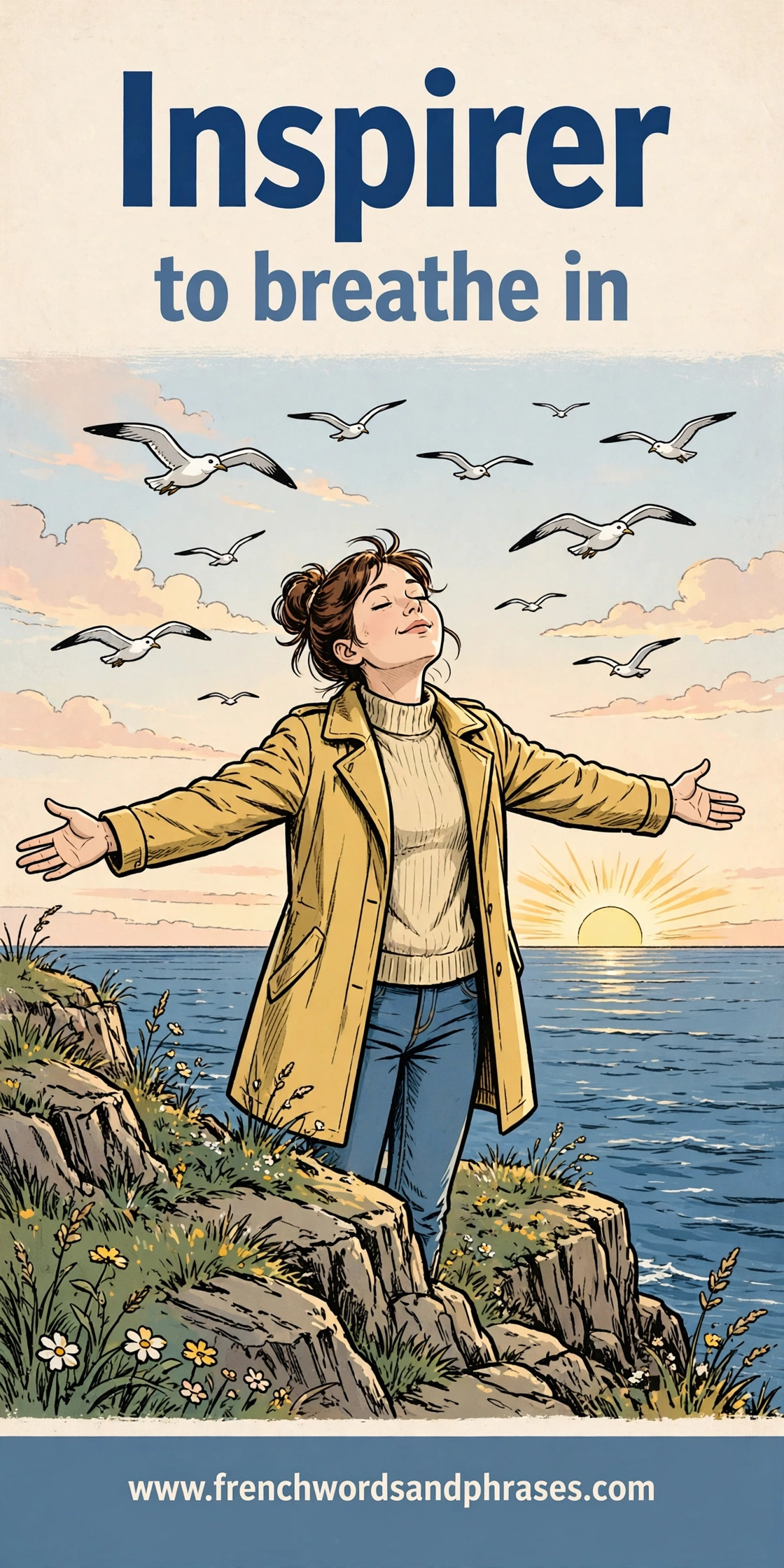
Inspirer means to breathe in, to inspire — one verb for the breath entering the lungs and for the idea entering the mind, because French hears them as the same movement.
A swimmer filling his lungs at the surface, a painter stopped in front of a landscape with the canvas suddenly clear in her head — inspirer joins the two: the body breathes in air, the artist breathes in the world, and both are filled from outside.
In this guide, you’ll learn how to conjugate inspirer in all the major French tenses and moods. Explore complete conjugation tables, French examples, English translations, and practice quizzes.
Understanding the French Verb Inspirer
Inspirer is a regular French verb belonging to the first group of verbs, those ending in-er.
It means to breathe in, to inspire. In the breathing sense it belongs to medicine, sport and yoga: inspirer par le nez, inspirer lentement. In the artistic sense its subjects are landscapes, people, books and events, and its favourite companions are confiance, respect and peur as well as art: inspirer confiance, to inspire trust, is one of the commonest phrases in the language.
Verb classification: First group (-er)
Auxiliary verb: Avoir
Past participle: inspiré
Present participle: inspirant
English equivalents: To breathe in, to inhale; to inspire; inspirer profondément — to breathe in deeply; inspirer confiance — to inspire confidence; inspirer un artiste — to inspire an artist; s’inspirer de — to draw inspiration from; être inspiré par — to be inspired by.
One important detail: inspirer is a regular -er verb — j’inspire, nous inspirons, ils inspirent, past participle inspiré — with two lives that share one root, the Latin inspirare, to breathe into. For the body, the pair is inspirer / expirer, breathe in / breathe out. For the mind, the living construction is the reflexive: s’inspirer de — elle s’inspire de la nature, le film s’inspire d’une histoire vraie — while the plain verb takes the person inspired as its object: ce paysage inspire les peintres.
Experience the Word
Inspirer is the verb of the intake — air into the lungs, world into the mind, both received, not made.
Imagine a freediver at the side of a boat. Before the long descent she closes her eyes and breathes slowly, une dernière fois elle inspire profondément — and in that same filled silence, the whole dive is already present, the way a painting is present in the painter’s mind before the first stroke.
One breath, two gifts. She has breathed in — inspiré — and been inspired in the same moment.
How to Conjugate Inspirer: Complete French Conjugation Guide
Let’s explore every major conjugation of inspirer, beginning with the indicative mood.
How to Conjugate Inspirer in the Indicative Mood
The indicative mood is used to express facts, observations, actions, and events.
How to Conjugate Inspirer in the Present Tense (Présent)
Used for actions happening now, habitual actions, and general truths.
| Subject | Conjugation |
|---|---|
| je | inspire |
| tu | inspires |
| il / elle | inspire |
| nous | inspirons |
| vous | inspirez |
| ils / elles | inspirent |
Example
Ce paysage inspire les peintres depuis des siècles.
This landscape has inspired painters for centuries.
Quick Quiz 1
Complete the sentence:
Nous ______ les peintres avec ce paysage.
Reveal the answer
inspirons
Nous inspirons les peintres avec ce paysage.
We inspire painters with this landscape.
How to Conjugate Inspirer in the Passé Composé
Used for completed actions in the past. Inspirer takes the auxiliary verb avoir.
| Subject | Conjugation |
|---|---|
| j’ | ai inspiré |
| tu | as inspiré |
| il / elle | a inspiré |
| nous | avons inspiré |
| vous | avez inspiré |
| ils / elles | ont inspiré |
Example
Son discours a inspiré toute une génération.
His speech inspired a whole generation.
How to Conjugate Inspirer in the Imparfait (Imperfect Tense)
Used for habitual past actions, descriptions, and ongoing situations in the past.
| Subject | Conjugation |
|---|---|
| je | inspirais |
| tu | inspirais |
| il / elle | inspirait |
| nous | inspirions |
| vous | inspiriez |
| ils / elles | inspiraient |
Example
La mer inspirait le poète chaque matin.
The sea used to inspire the poet every morning.
Quick Quiz 2
Choose the correct form:
His speech inspired a whole generation.
Son discours ______ toute une génération. (a inspiré / est inspiré)
Reveal the answer
a inspiré
Son discours a inspiré toute une génération.
Inspirer takes avoir.
How to Conjugate Inspirer in the Plus-que-parfait
Used to describe an action that had already been completed before another past event.
| Subject | Conjugation |
|---|---|
| j’ | avais inspiré |
| tu | avais inspiré |
| il / elle | avait inspiré |
| nous | avions inspiré |
| vous | aviez inspiré |
| ils / elles | avaient inspiré |
Example
Elle avait inspiré profondément avant de plonger.
She had breathed in deeply before diving.
How to Conjugate Inspirer in the Passé Simple
Primarily used in formal writing, literature, and historical narratives. It is rarely used in everyday conversation.
| Subject | Conjugation |
|---|---|
| je | inspirai |
| tu | inspiras |
| il / elle | inspira |
| nous | inspirâmes |
| vous | inspirâtes |
| ils / elles | inspirèrent |
Example
La vue des montagnes inspira l’écrivain.
The sight of the mountains inspired the writer.
How to Conjugate Inspirer in the Passé Antérieur
A literary tense used to express an action completed immediately before another past action, generally in the passé simple.
| Subject | Conjugation |
|---|---|
| j’ | eus inspiré |
| tu | eus inspiré |
| il / elle | eut inspiré |
| nous | eûmes inspiré |
| vous | eûtes inspiré |
| ils / elles | eurent inspiré |
Example
Quand il eut inspiré lentement, le médecin écouta son cœur.
When he had breathed in slowly, the doctor listened to his heart.
How to Conjugate Inspirer in the Future Tense (Futur Simple)
Used to describe actions that will take place in the future.
| Subject | Conjugation |
|---|---|
| je | inspirerai |
| tu | inspireras |
| il / elle | inspirera |
| nous | inspirerons |
| vous | inspirerez |
| ils / elles | inspireront |
Example
Ce voyage inspirera ton prochain roman.
This journey will inspire your next novel.
How to Conjugate Inspirer in the Futur Antérieur (Future Perfect)
Used for an action that will have been completed before a particular point in the future.
| Subject | Conjugation |
|---|---|
| j’ | aurai inspiré |
| tu | auras inspiré |
| il / elle | aura inspiré |
| nous | aurons inspiré |
| vous | aurez inspiré |
| ils / elles | auront inspiré |
Example
À la fin du cours, vous aurez inspiré et expiré cent fois.
By the end of the class, you will have breathed in and out a hundred times.
How to Conjugate Inspirer in the Near Future (Futur Proche)
Used to describe something that is going to happen soon. Formed with aller + infinitive.
| Subject | Conjugation |
|---|---|
| je | vais inspirer |
| tu | vas inspirer |
| il / elle | va inspirer |
| nous | allons inspirer |
| vous | allez inspirer |
| ils / elles | vont inspirer |
Example
Le professeur va inspirer ses élèves avec cette histoire.
The teacher is going to inspire his pupils with this story.
How to Conjugate Inspirer in the Conditional Mood
The conditional mood expresses what would happen under certain circumstances. It is also frequently used to make polite requests or express wishes.
How to Conjugate Inspirer in the Present Conditional
| Subject | Conjugation |
|---|---|
| je | inspirerais |
| tu | inspirerais |
| il / elle | inspirerait |
| nous | inspirerions |
| vous | inspireriez |
| ils / elles | inspireraient |
Example
Un bon exemple inspirerait davantage que dix discours.
A good example would inspire more than ten speeches.
How to Conjugate Inspirer in the Past Conditional
| Subject | Conjugation |
|---|---|
| j’ | aurais inspiré |
| tu | aurais inspiré |
| il / elle | aurait inspiré |
| nous | aurions inspiré |
| vous | auriez inspiré |
| ils / elles | auraient inspiré |
Example
Ce film aurait inspiré le jeune réalisateur sans le festival.
This film would have inspired the young director even without the festival.
Inspirer in the Literary Past Conditional Form
This less common literary form uses the imperfect subjunctive of avoir.
| Subject | Conjugation |
|---|---|
| j’ | eusse inspiré |
| tu | eusses inspiré |
| il / elle | eût inspiré |
| nous | eussions inspiré |
| vous | eussiez inspiré |
| ils / elles | eussent inspiré |
Example
La forêt inspirât le poète dès l’aube.
The forest would inspire the poet from dawn.
How to Conjugate Inspirer in the Subjunctive Mood
The subjunctive is used to express wishes, emotions, doubts, necessity, and uncertainty. It frequently follows expressions such as il faut que (it is necessary that) or bien que (although).
How to Conjugate Inspirer in the Present Subjunctive
| Subject | Conjugation |
|---|---|
| que je | inspire |
| que tu | inspires |
| qu’il / qu’elle | inspire |
| que nous | inspirions |
| que vous | inspiriez |
| qu’ils / qu’elles | inspirent |
Example
Il faut que tu inspires lentement par le nez.
You must breathe in slowly through your nose.
Quick Quiz 3
Complete the sentence using the subjunctive:
Il faut que vous ______ lentement par le nez.
Reveal the answer
inspiriez
Il faut que vous inspiriez lentement par le nez.
You must breathe in slowly through your nose.
How to Conjugate Inspirer in the Imperfect Subjunctive
A literary tense, rarely encountered in modern spoken French.
| Subject | Conjugation |
|---|---|
| que je | inspirasse |
| que tu | inspirasses |
| qu’il / qu’elle | inspirât |
| que nous | inspirassions |
| que vous | inspirassiez |
| qu’ils / qu’elles | inspirassent |
Example
On espérait que le paysage inspirât le peintre fatigué.
They hoped the landscape might inspire the tired painter.
How to Conjugate Inspirer in the Pluperfect Subjunctive
A literary construction used to express an action completed before another past action.
| Subject | Conjugation |
|---|---|
| que j’ | eusse inspiré |
| que tu | eusses inspiré |
| qu’il / qu’elle | eût inspiré |
| que nous | eussions inspiré |
| que vous | eussiez inspiré |
| qu’ils / qu’elles | eussent inspiré |
Example
On disait que la mer eût inspiré ses plus beaux poèmes.
People said the sea had inspired his finest poems.
How to Conjugate Inspirer in the Past Subjunctive
| Subject | Conjugation |
|---|---|
| que j’ | aie inspiré |
| que tu | aies inspiré |
| qu’il / qu’elle | ait inspiré |
| que nous | ayons inspiré |
| que vous | ayez inspiré |
| qu’ils / qu’elles | aient inspiré |
Example
Je suis content que ce livre ait inspiré tant de lecteurs.
I am glad this book has inspired so many readers.
How to Conjugate Inspirer in the Imperative
The imperative is used to give commands, instructions, invitations, or suggestions. Subject pronouns are omitted.
How to Conjugate Inspirer in the Present Imperative
| Person | Conjugation |
|---|---|
| (tu) | inspire |
| (nous) | inspirons |
| (vous) | inspirez |
Example
Inspire profondément, puis expire lentement !
Breathe in deeply, then breathe out slowly!
Quick Quiz 4
How would you say Breathe in deeply (tu form)?
Reveal the answer
Inspire profondément !
French Participles of Inspirer
Participles are verb forms that can be used in compound tenses and other grammatical constructions.
Present Participle of Inspirer
inspirant
En inspirant l’air froid du matin, elle se sentit revivre.
Breathing in the cold morning air, she felt herself come back to life.
Past Participle of Inspirer
inspiré
Inspiré par la mer, le poète écrivit son plus beau recueil.
Inspired by the sea, the poet wrote his finest collection.
Inspirer in Everyday French: Real-Life Examples
Now that you know the conjugations, let’s see how inspirer appears in everyday French.
Example 1 — Present
Ce paysage inspire les peintres.
This landscape inspires painters.
Example 2 — Passé composé
Son discours a inspiré toute une génération.
His speech inspired a whole generation.
Example 3 — Imparfait
La mer inspirait le poète chaque matin.
The sea used to inspire the poet every morning.
Example 4 — Future
Ce voyage inspirera ton prochain roman.
This journey will inspire your next novel.
Example 5 — Conditional
Un bon exemple inspirerait davantage.
A good example would inspire more.
Example 6 — Imperative
Inspire profondément, puis expire lentement !
Breathe in deeply, then breathe out slowly!
Beyond Translation: The Meaning of Inspirer
English split the twins — inhale for the body, inspire for the mind — but French inspirer refuses to choose, and the old picture survives intact: inspiration is a breath received from outside.
The muse, in French grammar, is a lungful of air.
That is why the reflexive s’inspirer de is so graceful: the artist does not manufacture the idea, she breathes it in from the world — s’inspirer de la nature — and exhales a work.
How to Remember the French Verb Inspirer
Remember it this way: Inspirer is about the freediver’s deep breath — air in, idea in, the same movement.
- Two senses, one root: inspirer = to breathe in (body) and to inspire (mind).
- For drawing inspiration, use the reflexive: s’inspirer de la nature, d’une histoire vraie.
- Regular -er: j’inspire, nous inspirons, past participle inspiré; the breathing pair is inspirer / expirer.
The key idea is the freediver’s deep breath — air in, idea in, the same movement.
Test Your Knowledge of Inspirer
Let’s see how much you’ve learned. Try answering these questions before revealing the answers.
Question 1
What are the two great senses of inspirer?
Reveal the answer
To breathe in (the body) and to inspire (the mind) — one Latin root, inspirare, to breathe into.
Question 2
How do you say This landscape inspires painters in French?
Reveal the answer
Ce paysage inspire les peintres.
Question 3
Translate: Breathe in deeply, then breathe out slowly.
Reveal the answer
Inspire profondément, puis expire lentement.
Question 4
What is the past participle of inspirer?
Reveal the answer
Inspiré.
Question 5
Complete the sentence:
Il faut que tu ______ lentement par le nez.
Reveal the answer
inspires
Il faut que tu inspires lentement par le nez.
You must breathe in slowly through your nose.
Your Final Challenge
Can You Use It?
How would you say this in French?
She breathes in deeply facing the sea, and the poem begins all by itself.
Reveal the answer
Elle inspire profondément face à la mer, et le poème commence tout seul.
She breathes in deeply facing the sea, and the poem begins all by itself.
A little French. A little curiosity. A richer everyday life.
LEARN FRENCH ONE WORD AT A TIME




