
A French Word to Live By
How to Conjugate Inquiéter in French
/ɛ̃.kje.te/
Inquiéter means to worry, to concern — to make someone uneasy; and its reflexive twin, s’inquiéter, is how French says to worry, to be anxious.
A letter that does not arrive, a silence at the other end of the phone, a child’s fever in the night — inquiéter is the verb of unease arriving, and s’inquiéter is the verb of living with it: French splits worry in two, the cause and the feeling.
In this guide, you’ll learn how to conjugate inquiéter in all the major French tenses and moods. Explore complete conjugation tables, French examples, English translations, and practice quizzes.
Understanding the French Verb Inquiéter
Inquiéter is a regular French verb belonging to the first group of verbs, those ending in-er.
It means to worry, to concern. S’inquiéter is one of the most useful reflexive verbs in daily French — parents, friends and doctors all s’inquiètent — and it takes être in compound tenses with agreement: elle s’est inquiétée pour rien. The adjective inquiétant (worrying) and the noun une inquiétude (anxiety, a worry) complete the family; a formal synonym for the plain verb is préoccuper.
Verb classification: First group (-er)
Auxiliary verb: Avoir
Past participle: inquiété
Present participle: inquiétant
English equivalents: To worry, to concern, to trouble; son silence m’inquiète — his silence worries me; ne vous inquiétez pas — do not worry; s’inquiéter pour quelqu’un — to worry about someone; s’inquiéter de quelque chose — to worry about something; une nouvelle inquiétante — worrying news.
Two details govern inquiéter. First, the accent: it is an espérer-type verb, so é opens to è in the present singular and third plural, in the subjunctive singular and third plural, and in the tu imperative — je m’inquiète, tu t’inquiètes, ils s’inquiètent — while the future and conditional keep é: je m’inquiéterai, never with è. Second, the pair: inquiéter quelqu’un is to make someone worry — ce bruit m’inquiète — and s’inquiéter is to feel the worry yourself, with pour for a person and de for a thing: elle s’inquiète pour son fils, il s’inquiète de l’avenir. The gentlest order in French is its negative imperative: ne t’inquiète pas !
Experience the Word
Inquiéter is the verb of the small shadow — nothing has happened, and yet the mind will not rest.
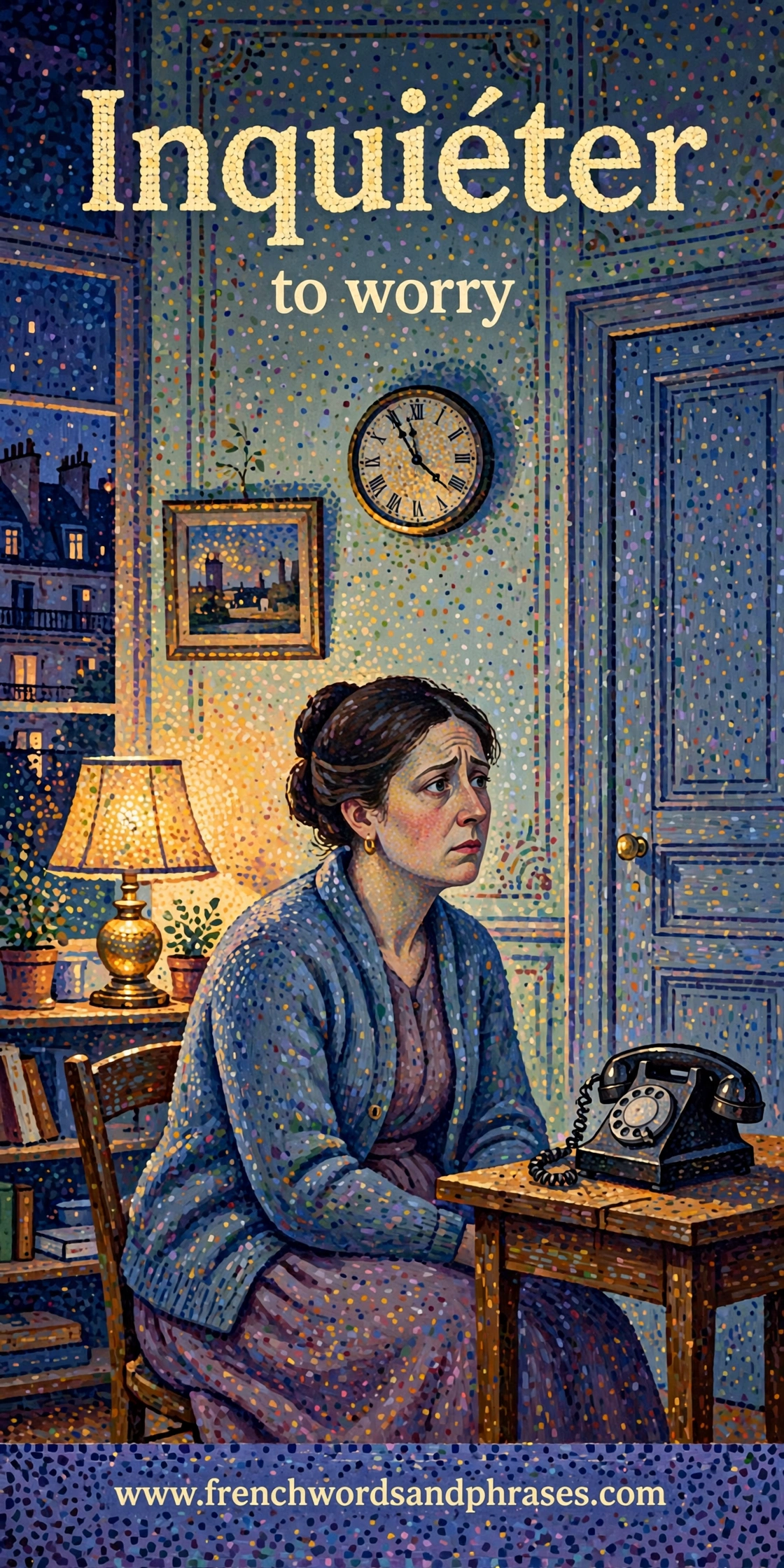
Imagine a mother at the window at midnight. Her son’s train was due an hour ago; the phone stays dark — elle s’inquiète, rehearsing accidents that exist only in her love for him. At half past twelve, headlights sweep the street, and the worry evaporates like breath off glass.
Nothing bad had happened at all. She had simply worried — elle s’était inquiétée, the way only love worries.
How to Conjugate Inquiéter: Complete French Conjugation Guide
Let’s explore every major conjugation of inquiéter, beginning with the indicative mood.
How to Conjugate Inquiéter in the Indicative Mood
The indicative mood is used to express facts, observations, actions, and events.
How to Conjugate Inquiéter in the Present Tense (Présent)
Used for actions happening now, habitual actions, and general truths.
| Subject | Conjugation |
|---|---|
| je | inquiète |
| tu | inquiètes |
| il / elle | inquiète |
| nous | inquiétons |
| vous | inquiétez |
| ils / elles | inquiètent |
Example
Son silence commence à m’inquiéter sérieusement.
His silence is beginning to worry me seriously.
Quick Quiz 1
Complete the sentence:
Nous nous ______ pour nos enfants.
Reveal the answer
inquiétons
Nous nous inquiétons pour nos enfants.
We worry about our children.
How to Conjugate Inquiéter in the Passé Composé
Used for completed actions in the past. Inquiéter takes the auxiliary verb avoir.
| Subject | Conjugation |
|---|---|
| j’ | ai inquiété |
| tu | as inquiété |
| il / elle | a inquiété |
| nous | avons inquiété |
| vous | avez inquiété |
| ils / elles | ont inquiété |
Example
Cette nouvelle a inquiété toute la famille.
This news worried the whole family.
How to Conjugate Inquiéter in the Imparfait (Imperfect Tense)
Used for habitual past actions, descriptions, and ongoing situations in the past.
| Subject | Conjugation |
|---|---|
| je | inquiétais |
| tu | inquiétais |
| il / elle | inquiétait |
| nous | inquiétions |
| vous | inquiétiez |
| ils / elles | inquiétaient |
Example
Le médecin s’inquiétait de la fièvre de l’enfant.
The doctor was worried about the child’s fever.
Quick Quiz 2
Choose the correct form:
His silence worries me.
Son silence ______ . (m’inquiète / m’inquiéte)
Reveal the answer
m’inquiète
Son silence m’inquiète.
The present stem takes è: j’inquiète, tu inquiètes, il inquiète.
How to Conjugate Inquiéter in the Plus-que-parfait
Used to describe an action that had already been completed before another past event.
| Subject | Conjugation |
|---|---|
| j’ | avais inquiété |
| tu | avais inquiété |
| il / elle | avait inquiété |
| nous | avions inquiété |
| vous | aviez inquiété |
| ils / elles | avaient inquiété |
Example
Elle s’était inquiétée pour rien : le train avait simplement du retard.
She had worried for nothing: the train was simply late.
How to Conjugate Inquiéter in the Passé Simple
Primarily used in formal writing, literature, and historical narratives. It is rarely used in everyday conversation.
| Subject | Conjugation |
|---|---|
| je | inquiétai |
| tu | inquiétas |
| il / elle | inquiéta |
| nous | inquiétâmes |
| vous | inquiétâtes |
| ils / elles | inquiétèrent |
Example
La disparition du chien inquiéta tout le quartier.
The dog’s disappearance worried the whole neighbourhood.
How to Conjugate Inquiéter in the Passé Antérieur
A literary tense used to express an action completed immediately before another past action, generally in the passé simple.
| Subject | Conjugation |
|---|---|
| j’ | eus inquiété |
| tu | eus inquiété |
| il / elle | eut inquiété |
| nous | eûmes inquiété |
| vous | eûtes inquiété |
| ils / elles | eurent inquiété |
Example
Dès que la lettre fut arrivée, elle cessa de s’inquiéter.
As soon as the letter had arrived, she stopped worrying.
How to Conjugate Inquiéter in the Future Tense (Futur Simple)
Used to describe actions that will take place in the future.
| Subject | Conjugation |
|---|---|
| je | inquiéterai |
| tu | inquiéteras |
| il / elle | inquiétera |
| nous | inquiéterons |
| vous | inquiéterez |
| ils / elles | inquiéteront |
Example
Ne pars pas sans écrire, tu inquiéteras ta mère.
Do not leave without writing, you will worry your mother.
How to Conjugate Inquiéter in the Futur Antérieur (Future Perfect)
Used for an action that will have been completed before a particular point in the future.
| Subject | Conjugation |
|---|---|
| j’ | aurai inquiété |
| tu | auras inquiété |
| il / elle | aura inquiété |
| nous | aurons inquiété |
| vous | aurez inquiété |
| ils / elles | auront inquiété |
Example
À minuit, elle se sera inquiétée pour rien, comme toujours.
By midnight, she will have worried for nothing, as always.
How to Conjugate Inquiéter in the Near Future (Futur Proche)
Used to describe something that is going to happen soon. Formed with aller + infinitive.
| Subject | Conjugation |
|---|---|
| je | vais inquiéter |
| tu | vas inquiéter |
| il / elle | va inquiéter |
| nous | allons inquiéter |
| vous | allez inquiéter |
| ils / elles | vont inquiéter |
Example
Ce retard va inquiéter les passagers.
This delay is going to worry the passengers.
How to Conjugate Inquiéter in the Conditional Mood
The conditional mood expresses what would happen under certain circumstances. It is also frequently used to make polite requests or express wishes.
How to Conjugate Inquiéter in the Present Conditional
| Subject | Conjugation |
|---|---|
| je | inquiéterais |
| tu | inquiéterais |
| il / elle | inquiéterait |
| nous | inquiéterions |
| vous | inquiéteriez |
| ils / elles | inquiéteraient |
Example
À ta place, je ne m’inquiéterais pas pour si peu.
In your place, I would not worry over so little.
How to Conjugate Inquiéter in the Past Conditional
| Subject | Conjugation |
|---|---|
| j’ | aurais inquiété |
| tu | aurais inquiété |
| il / elle | aurait inquiété |
| nous | aurions inquiété |
| vous | auriez inquiété |
| ils / elles | auraient inquiété |
Example
Elle se serait inquiétée davantage sans ton message.
She would have worried more without your message.
Inquiéter in the Literary Past Conditional Form
This less common literary form uses the imperfect subjunctive of avoir.
| Subject | Conjugation |
|---|---|
| j’ | eusse inquiété |
| tu | eusses inquiété |
| il / elle | eût inquiété |
| nous | eussions inquiété |
| vous | eussiez inquiété |
| ils / elles | eussent inquiété |
Example
On craignait qu’elle s’inquiétât de son absence.
People feared she might worry about his absence.
How to Conjugate Inquiéter in the Subjunctive Mood
The subjunctive is used to express wishes, emotions, doubts, necessity, and uncertainty. It frequently follows expressions such as il faut que (it is necessary that) or bien que (although).
How to Conjugate Inquiéter in the Present Subjunctive
| Subject | Conjugation |
|---|---|
| que je | inquiète |
| que tu | inquiètes |
| qu’il / qu’elle | inquiète |
| que nous | inquiétions |
| que vous | inquiétiez |
| qu’ils / qu’elles | inquiètent |
Example
Il ne faut pas que tu t’inquiètes pour demain.
You must not worry about tomorrow.
Quick Quiz 3
Complete the sentence using the subjunctive:
Il ne faut pas que vous vous ______ pour le voyage.
Reveal the answer
inquiétiez
Il ne faut pas que vous vous inquiétiez pour le voyage.
You must not worry about the trip.
How to Conjugate Inquiéter in the Imperfect Subjunctive
A literary tense, rarely encountered in modern spoken French.
| Subject | Conjugation |
|---|---|
| que je | inquiétasse |
| que tu | inquiétasses |
| qu’il / qu’elle | inquiétât |
| que nous | inquiétassions |
| que vous | inquiétassiez |
| qu’ils / qu’elles | inquiétassent |
Example
Le médecin ne voulait pas que la famille s’inquiétât trop vite.
The doctor did not want the family to worry too quickly.
How to Conjugate Inquiéter in the Pluperfect Subjunctive
A literary construction used to express an action completed before another past action.
| Subject | Conjugation |
|---|---|
| que j’ | eusse inquiété |
| que tu | eusses inquiété |
| qu’il / qu’elle | eût inquiété |
| que nous | eussions inquiété |
| que vous | eussiez inquiété |
| qu’ils / qu’elles | eussent inquiété |
Example
On racontait qu’elle se fût inquiétée de tout, même du beau temps.
People said she had worried about everything, even the good weather.
How to Conjugate Inquiéter in the Past Subjunctive
| Subject | Conjugation |
|---|---|
| que j’ | aie inquiété |
| que tu | aies inquiété |
| qu’il / qu’elle | ait inquiété |
| que nous | ayons inquiété |
| que vous | ayez inquiété |
| qu’ils / qu’elles | aient inquiété |
Example
Je suis étonné qu’il se soit inquiété pour si peu.
I am amazed he worried over so little.
How to Conjugate Inquiéter in the Imperative
The imperative is used to give commands, instructions, invitations, or suggestions. Subject pronouns are omitted.
How to Conjugate Inquiéter in the Present Imperative
| Person | Conjugation |
|---|---|
| (tu) | inquiète |
| (nous) | inquiétons |
| (vous) | inquiétez |
Example
Ne t’inquiète pas, tout va bien se passer !
Do not worry, everything will be fine!
Quick Quiz 4
How would you say Do not worry (vous form)?
Reveal the answer
Ne vous inquiétez pas !
French Participles of Inquiéter
Participles are verb forms that can be used in compound tenses and other grammatical constructions.
Present Participle of Inquiéter
inquiétant
En s’inquiétant pour tous, elle s’oubliait elle-même.
By worrying about everyone, she forgot herself.
Past Participle of Inquiéter
inquiété
Inquiété par ce silence, il a téléphoné à la police.
Worried by this silence, he phoned the police.
Inquiéter in Everyday French: Real-Life Examples
Now that you know the conjugations, let’s see how inquiéter appears in everyday French.
Example 1 — Present
Son silence m’inquiète.
His silence worries me.
Example 2 — Passé composé
Elle s’est inquiétée pour rien.
She worried for nothing.
Example 3 — Imparfait
Le médecin s’inquiétait de la fièvre.
The doctor was worried about the fever.
Example 4 — Future
Tu inquiéteras ta mère si tu n’écris pas.
You will worry your mother if you do not write.
Example 5 — Conditional
Je ne m’inquiéterais pas pour si peu.
I would not worry over so little.
Example 6 — Imperative
Ne t’inquiète pas !
Do not worry!
Beyond Translation: The Meaning of Inquiéter
English worry covers both directions; French inquiéter splits them with a pronoun.
The cause inquiète; the person s’inquiète.
That little reflexive is a whole philosophy: worry is something news does to you from outside — and something you then carry inside, pour les gens que vous aimez. No wonder the commonest sentence in the family is a kindness: ne t’inquiète pas.
How to Remember the French Verb Inquiéter
Remember it this way: Inquiéter is about the mother at the window — and the headlights that end the worry.
- Espérer-type accent: je m’inquiète with è in the present, but je m’inquiéterai with é in the future.
- The pair: inquiéter quelqu’un (to worry someone) — s’inquiéter (to worry), pour a person, de a thing.
- The kindest command in French: ne t’inquiète pas, ne vous inquiétez pas.
The key idea is the mother at the window — and the headlights that end the worry.
Test Your Knowledge of Inquiéter
Let’s see how much you’ve learned. Try answering these questions before revealing the answers.
Question 1
What is the difference between inquiéter and s’inquiéter?
Reveal the answer
Inquiéter quelqu’un is to make someone worry; s’inquiéter is to worry yourself — son silence m’inquiète, je m’inquiète pour lui.
Question 2
How do you say Do not worry (tu form) in French?
Reveal the answer
Ne t’inquiète pas !
Question 3
Translate: She worried for nothing.
Reveal the answer
Elle s’est inquiétée pour rien.
Question 4
What is the past participle of inquiéter?
Reveal the answer
Inquiété — and for the reflexive, agreeing: elle s’est inquiétée.
Question 5
Complete the sentence:
Il ne faut pas que tu t’______ pour demain.
Reveal the answer
inquiètes
Il ne faut pas que tu t’inquiètes pour demain.
You must not worry about tomorrow.
Your Final Challenge
Can You Use It?
How would you say this in French?
She worries about everyone, and everyone tells her the same thing: do not worry.
Reveal the answer
Elle s’inquiète pour tout le monde, et tout le monde lui dit la même chose : ne t’inquiète pas.
She worries about everyone, and everyone tells her the same thing: do not worry.
A little French. A little curiosity. A richer everyday life.
LEARN FRENCH ONE WORD AT A TIME




