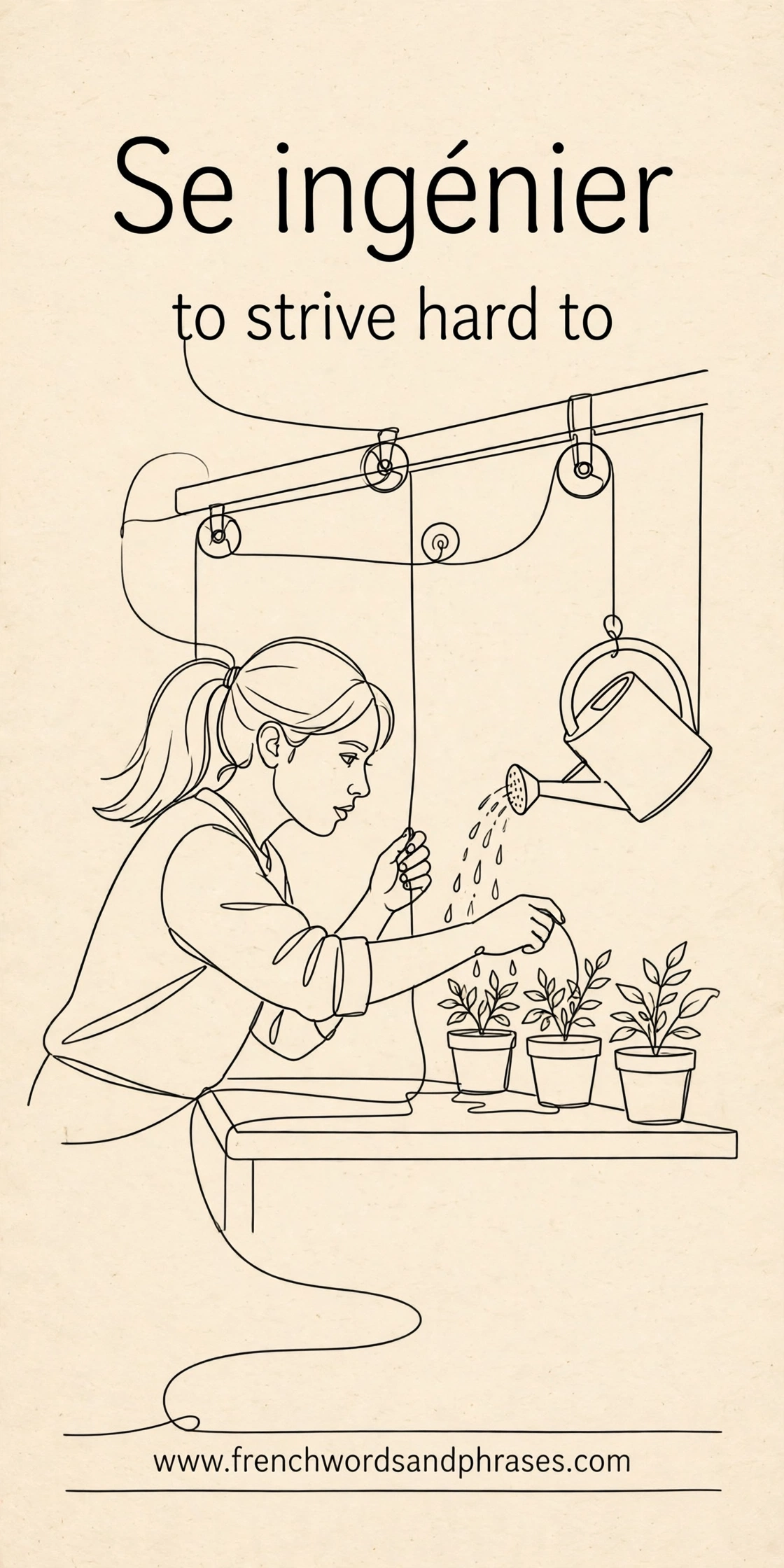
A French Word to Live By
How to Conjugate Se ingénier in French
/sə ɛ̃.ʒe.nje/
Se ingénier means to strive hard to — to rack your brains and bend every scrap of ingenuity toward a goal, almost always followed by à and an infinitive: s’ingénier à trouver une solution.
A locksmith before a jammed door, a mother inventing a game to make a long journey pass, a cook saving a sauce that has split — s’ingénier is the verb of resourceful effort: no easy path exists, so you engineer one.
In this guide, you’ll learn how to conjugate se ingénier in all the major French tenses and moods. Explore complete conjugation tables, French examples, English translations, and practice quizzes.
Understanding the French Verb Se ingénier
Se ingénier is a regular French verb belonging to the first group of verbs, those ending in-er.
It means to strive hard to. It is built on the same root as ingénieur, engineer, and le génie, genius: to s’ingénier is to put your inner engineer to work. The classic construction is s’ingénier à + infinitive — the effort is always aimed at doing something — and the tone is admiring or gently amused, never neutral: real ingenuity, or conspicuous over-engineering, is always in the picture.
Verb classification: First group (-er), reflexive
Auxiliary verb: Être
Past participle: ingénié
Present participle: ingéniant
English equivalents: To strive hard to, to rack one’s brains to, to go to great lengths to; s’ingénier à résoudre un problème — to rack one’s brains to solve a problem; s’ingénier à plaire — to go to great lengths to please; s’ingénier pour trouver une issue — to strive hard to find a way out; s’ingénier en vain — to strive in vain.
One important detail: s’ingénier is an -ier verb, and -ier verbs double the i in the nous and vous forms of the imperfect and the subjunctive: nous nous ingéniions, que vous vous ingéniiez — but the present keeps a single i there: nous nous ingénions. Being reflexive, it takes être in every compound tense and the past participle agrees with the subject: elle s’est ingéniée à réparer la machine, ils se sont ingéniés à nous convaincre. The tu imperative tucks the pronoun behind the verb: ingénie-toi à trouver mieux !
Experience the Word
S’ingénier is the verb of the honourable struggle — the problem will not move, so the mind goes around it, under it, through it.
Imagine a grandfather whose grandson’s bicycle chain has snapped, ten kilometres from home, with no tools but a penknife and a hairpin. He kneels in the dust, frowns, tries, adjusts — il s’ingénie à réparer la chaîne — and twenty minutes later the bicycle rolls again, slowly, gloriously.
He has not merely tried. He has striven — ingénié, with all the ingenuity he owns, until the impossible gave way.
How to Conjugate Se ingénier: Complete French Conjugation Guide
Let’s explore every major conjugation of se ingénier, beginning with the indicative mood.
How to Conjugate Se ingénier in the Indicative Mood
The indicative mood is used to express facts, observations, actions, and events.
How to Conjugate Se ingénier in the Present Tense (Présent)
Used for actions happening now, habitual actions, and general truths.
| Subject | Conjugation |
|---|---|
| je | m’ingénie |
| tu | t’ingénies |
| il / elle | s’ingénie |
| nous | nous ingénions |
| vous | vous ingéniez |
| ils / elles | s’ingénient |
Example
Elle s’ingénie à trouver une solution élégante.
She strives hard to find an elegant solution.
Quick Quiz 1
Complete the sentence:
Nous nous ______ à organiser la fête en secret.
Reveal the answer
ingénions
Nous nous ingénions à organiser la fête en secret.
We are striving to organise the party in secret.
How to Conjugate Se ingénier in the Passé Composé
Used for completed actions in the past. Se ingénier takes the auxiliary verb être.
| Subject | Conjugation |
|---|---|
| je | me suis ingénié / me suis ingéniée |
| tu | t’es ingénié / t’es ingéniée |
| il / elle | s’est ingénié / s’est ingéniée |
| nous | nous sommes ingéniés / nous sommes ingéniées |
| vous | vous êtes ingéniés / vous êtes ingéniées / vous êtes ingénié / vous êtes ingéniée |
| ils / elles | se sont ingéniés / se sont ingéniées |
Example
Il s’est ingénié à réparer la vieille horloge.
He racked his brains to repair the old clock.
How to Conjugate Se ingénier in the Imparfait (Imperfect Tense)
Used for habitual past actions, descriptions, and ongoing situations in the past.
| Subject | Conjugation |
|---|---|
| je | m’ingéniais |
| tu | t’ingéniais |
| il / elle | s’ingéniait |
| nous | nous ingéniions |
| vous | vous ingéniiez |
| ils / elles | s’ingéniaient |
Example
Chaque soir, elle s’ingéniait à inventer une nouvelle histoire.
Every evening, she strove to invent a new story.
Quick Quiz 2
Choose the correct form:
She went to great lengths to help us.
Elle ______ à nous aider. (s’est ingéniée / a ingénié)
Reveal the answer
s’est ingéniée
Elle s’est ingéniée à nous aider.
S’ingénier is reflexive, takes être, and the participle agrees: ingéniée.
How to Conjugate Se ingénier in the Plus-que-parfait
Used to describe an action that had already been completed before another past event.
| Subject | Conjugation |
|---|---|
| je | m’étais ingénié / m’étais ingéniée |
| tu | t’étais ingénié / t’étais ingéniée |
| il / elle | s’était ingénié / s’était ingéniée |
| nous | nous étions ingéniés / nous étions ingéniées |
| vous | vous étiez ingéniés / vous étiez ingéniées / vous étiez ingénié / vous étiez ingéniée |
| ils / elles | s’étaient ingéniés / s’étaient ingéniées |
Example
Ils s’étaient ingéniés à préparer la fête en secret.
They had gone to great lengths to prepare the party in secret.
How to Conjugate Se ingénier in the Passé Simple
Primarily used in formal writing, literature, and historical narratives. It is rarely used in everyday conversation.
| Subject | Conjugation |
|---|---|
| je | m’ingéniai |
| tu | t’ingénias |
| il / elle | s’ingénia |
| nous | nous ingéniâmes |
| vous | vous ingéniâtes |
| ils / elles | s’ingénièrent |
Example
Le prisonnier s’ingénia à fabriquer une clé avec un clou.
The prisoner strove hard to make a key out of a nail.
How to Conjugate Se ingénier in the Passé Antérieur
A literary tense used to express an action completed immediately before another past action, generally in the passé simple.
| Subject | Conjugation |
|---|---|
| je | me fus ingénié / me fus ingéniée |
| tu | te fus ingénié / te fus ingéniée |
| il / elle | se fut ingénié / se fut ingéniée |
| nous | nous fûmes ingéniés / nous fûmes ingéniées |
| vous | vous fûtes ingéniés / vous fûtes ingéniées / vous fûtes ingénié / vous fûtes ingéniée |
| ils / elles | se furent ingéniés / se furent ingéniées |
Example
Dès qu’il se fut ingénié à ouvrir la serrure, la porte céda.
As soon as he had racked his brains to open the lock, the door gave way.
How to Conjugate Se ingénier in the Future Tense (Futur Simple)
Used to describe actions that will take place in the future.
| Subject | Conjugation |
|---|---|
| je | m’ingénierai |
| tu | t’ingénieras |
| il / elle | s’ingéniera |
| nous | nous ingénierons |
| vous | vous ingénierez |
| ils / elles | s’ingénieront |
Example
Tu t’ingénieras à convaincre ton père, je te connais.
You will strive hard to convince your father, I know you.
How to Conjugate Se ingénier in the Futur Antérieur (Future Perfect)
Used for an action that will have been completed before a particular point in the future.
| Subject | Conjugation |
|---|---|
| je | me serai ingénié / me serai ingéniée |
| tu | te seras ingénié / te seras ingéniée |
| il / elle | se sera ingénié / se sera ingéniée |
| nous | nous serons ingéniés / nous serons ingéniées |
| vous | vous serez ingéniés / vous serez ingéniées / vous serez ingénié / vous serez ingéniée |
| ils / elles | se seront ingéniés / se seront ingéniées |
Example
À la fin de la semaine, elle se sera ingéniée à tout organiser.
By the end of the week, she will have striven to organise everything.
How to Conjugate Se ingénier in the Near Future (Futur Proche)
Used to describe something that is going to happen soon. Formed with aller + infinitive.
| Subject | Conjugation |
|---|---|
| je | vais m’ingénier |
| tu | vas t’ingénier |
| il / elle | va s’ingénier |
| nous | allons nous ingénier |
| vous | allez vous ingénier |
| ils / elles | vont s’ingénier |
Example
Regarde-le, il va s’ingénier à réparer ce jouet cassé.
Look at him, he is going to rack his brains to repair that broken toy.
How to Conjugate Se ingénier in the Conditional Mood
The conditional mood expresses what would happen under certain circumstances. It is also frequently used to make polite requests or express wishes.
How to Conjugate Se ingénier in the Present Conditional
| Subject | Conjugation |
|---|---|
| je | m’ingénierais |
| tu | t’ingénierais |
| il / elle | s’ingénierait |
| nous | nous ingénierions |
| vous | vous ingénieriez |
| ils / elles | s’ingénieraient |
Example
Sans aide, nous nous ingénierions à trouver une autre route.
Without help, we would strive hard to find another road.
How to Conjugate Se ingénier in the Past Conditional
| Subject | Conjugation |
|---|---|
| je | me serais ingénié / me serais ingéniée |
| tu | te serais ingénié / te serais ingéniée |
| il / elle | se serait ingénié / se serait ingéniée |
| nous | nous serions ingéniés / nous serions ingéniées |
| vous | vous seriez ingéniés / vous seriez ingéniées / vous seriez ingénié / vous seriez ingéniée |
| ils / elles | se seraient ingéniés / se seraient ingéniées |
Example
Elle se serait ingéniée à le sauver si elle avait su.
She would have striven to save him if she had known.
Se ingénier in the Literary Past Conditional Form
This less common literary form uses the imperfect subjunctive of être.
| Subject | Conjugation |
|---|---|
| je | me fusse ingénié / me fusse ingéniée |
| tu | te fusses ingénié / te fusses ingéniée |
| il / elle | se fût ingénié / se fût ingéniée |
| nous | nous fussions ingéniés / nous fussions ingéniées |
| vous | vous fussiez ingéniés / vous fussiez ingéniées / vous fussiez ingénié / vous fussiez ingéniée |
| ils / elles | se fussent ingéniés / se fussent ingéniées |
Example
Il se fût ingénié à réparer la machine sans outils.
He would have racked his brains to repair the machine without tools.
How to Conjugate Se ingénier in the Subjunctive Mood
The subjunctive is used to express wishes, emotions, doubts, necessity, and uncertainty. It frequently follows expressions such as il faut que (it is necessary that) or bien que (although).
How to Conjugate Se ingénier in the Present Subjunctive
| Subject | Conjugation |
|---|---|
| que je | m’ingénie |
| que tu | t’ingénies |
| qu’il / qu’elle | s’ingénie |
| que nous | nous ingéniions |
| que vous | vous ingéniiez |
| qu’ils / qu’elles | s’ingénient |
Example
Il faut que tu t’ingénies à finir ce travail à temps.
You must strive hard to finish this work on time.
Quick Quiz 3
Complete the sentence using the subjunctive:
Il faut que tu t’______ à trouver mieux.
Reveal the answer
ingénies
Il faut que tu t’ingénies à trouver mieux.
You must strive to find something better.
How to Conjugate Se ingénier in the Imperfect Subjunctive
A literary tense, rarely encountered in modern spoken French.
| Subject | Conjugation |
|---|---|
| que je | m’ingéniasse |
| que tu | t’ingéniasses |
| qu’il / qu’elle | s’ingéniât |
| que nous | nous ingéniassions |
| que vous | vous ingéniassiez |
| qu’ils / qu’elles | s’ingéniassent |
Example
Je doutais qu’il s’ingéniât à trouver une issue.
I doubted he would strive to find a way out.
How to Conjugate Se ingénier in the Pluperfect Subjunctive
A literary construction used to express an action completed before another past action.
| Subject | Conjugation |
|---|---|
| que je | me fusse ingénié / me fusse ingéniée |
| que tu | te fusses ingénié / te fusses ingéniée |
| qu’il / qu’elle | se fût ingénié / se fût ingéniée |
| que nous | nous fussions ingéniés / nous fussions ingéniées |
| que vous | vous fussiez ingéniés / vous fussiez ingéniées / vous fussiez ingénié / vous fussiez ingéniée |
| qu’ils / qu’elles | se fussent ingéniés / se fussent ingéniées |
Example
On admirait qu’elle se fût ingéniée à sauver l’entreprise.
People admired that she had striven to save the company.
How to Conjugate Se ingénier in the Past Subjunctive
| Subject | Conjugation |
|---|---|
| que je | me sois ingénié / me sois ingéniée |
| que tu | te sois ingénié / te sois ingéniée |
| qu’il / qu’elle | se soit ingénié / se soit ingéniée |
| que nous | nous soyons ingéniés / nous soyons ingéniées |
| que vous | vous soyez ingéniés / vous soyez ingéniées / vous soyez ingénié / vous soyez ingéniée |
| qu’ils / qu’elles | se soient ingéniés / se soient ingéniées |
Example
Je suis content qu’il se soit ingénié à nous aider.
I am glad he went to such lengths to help us.
How to Conjugate Se ingénier in the Imperative
The imperative is used to give commands, instructions, invitations, or suggestions. Subject pronouns are omitted.
How to Conjugate Se ingénier in the Present Imperative
| Person | Conjugation |
|---|---|
| (tu) | ingénie-toi |
| (nous) | ingénions-nous |
| (vous) | ingéniez-vous |
Example
Ingénie-toi à trouver une meilleure idée !
Rack your brains to find a better idea!
Quick Quiz 4
How would you say Rack your brains (tu form)?
Reveal the answer
Ingénie-toi !
French Participles of Se ingénier
Participles are verb forms that can be used in compound tenses and other grammatical constructions.
Present Participle of Se ingénier
ingéniant
En s’ingéniant à ouvrir le coffre, il a fini par trouver le code.
By striving hard to open the safe, he ended up finding the code.
Past Participle of Se ingénier
ingénié
Ingéniée à plaire à tout le monde, elle s’est épuisée.
Having striven to please everyone, she wore herself out.
Se ingénier in Everyday French: Real-Life Examples
Now that you know the conjugations, let’s see how se ingénier appears in everyday French.
Example 1 — Present
Elle s’ingénie à trouver une solution.
She strives hard to find a solution.
Example 2 — Passé composé
Il s’est ingénié à réparer l’horloge.
He racked his brains to repair the clock.
Example 3 — Imparfait
Elle s’ingéniait à inventer des histoires.
She strove to invent stories.
Example 4 — Future
Tu t’ingénieras à le convaincre.
You will strive hard to convince him.
Example 5 — Conditional
Nous nous ingénierions à trouver une route.
We would strive to find a road.
Example 6 — Imperative
Ingénie-toi un peu, la solution existe !
Use your ingenuity a little, the solution exists!
Beyond Translation: The Meaning of Se ingénier
English engineer as a verb — to engineer a solution — is the close cousin, and French s’ingénier keeps the family visible: un ingénieur is an engineer, le génie is genius itself.
To s’ingénier is to send your inner engineer in.
The verb praises effort with brains in it: not brute force, not luck — ingenuity, applied patiently, until the jammed thing moves.
How to Remember the French Verb Se ingénier
Remember it this way: Se ingénier is about the grandfather, the penknife and the bicycle chain — ingenuity at work.
- Always reflexive here: je m’ingénie, elle s’est ingéniée — être, and the participle agrees.
- The classic frame is s’ingénier à + infinitive: s’ingénier à réparer, à convaincre, à plaire.
- -ier spelling: nous nous ingéniions in the imperfect — the double i belongs to -ier verbs.
The key idea is the grandfather, the penknife and the bicycle chain — ingenuity at work.
Test Your Knowledge of Se ingénier
Let’s see how much you’ve learned. Try answering these questions before revealing the answers.
Question 1
Which auxiliary does s’ingénier use, and why?
Reveal the answer
Être — it is a reflexive verb: elle s’est ingéniée à trouver une solution.
Question 2
How do you say She strives hard to find a solution in French?
Reveal the answer
Elle s’ingénie à trouver une solution.
Question 3
Translate: He racked his brains to repair the old clock.
Reveal the answer
Il s’est ingénié à réparer la vieille horloge.
Question 4
What is the past participle of s’ingénier?
Reveal the answer
Ingénié — agreeing: ingéniée, ingéniés, ingéniées.
Question 5
Complete the sentence:
Il faut que vous vous ______ à finir à temps.
Reveal the answer
ingéniiez
Il faut que vous vous ingéniiez à finir à temps.
You must strive hard to finish on time — note the double i of the -ier subjunctive.
Your Final Challenge
Can You Use It?
How would you say this in French?
Without tools or light, the old man strove all night to repair the pump, and by morning the water was flowing.
Reveal the answer
Privé d’outils et de lumière, le vieil homme s’est ingénié toute la nuit à réparer la pompe, et au matin l’eau coulait.
Without tools or light, the old man strove all night to repair the pump, and by morning the water was flowing.
A little French. A little curiosity. A richer everyday life.
LEARN FRENCH ONE WORD AT A TIME