
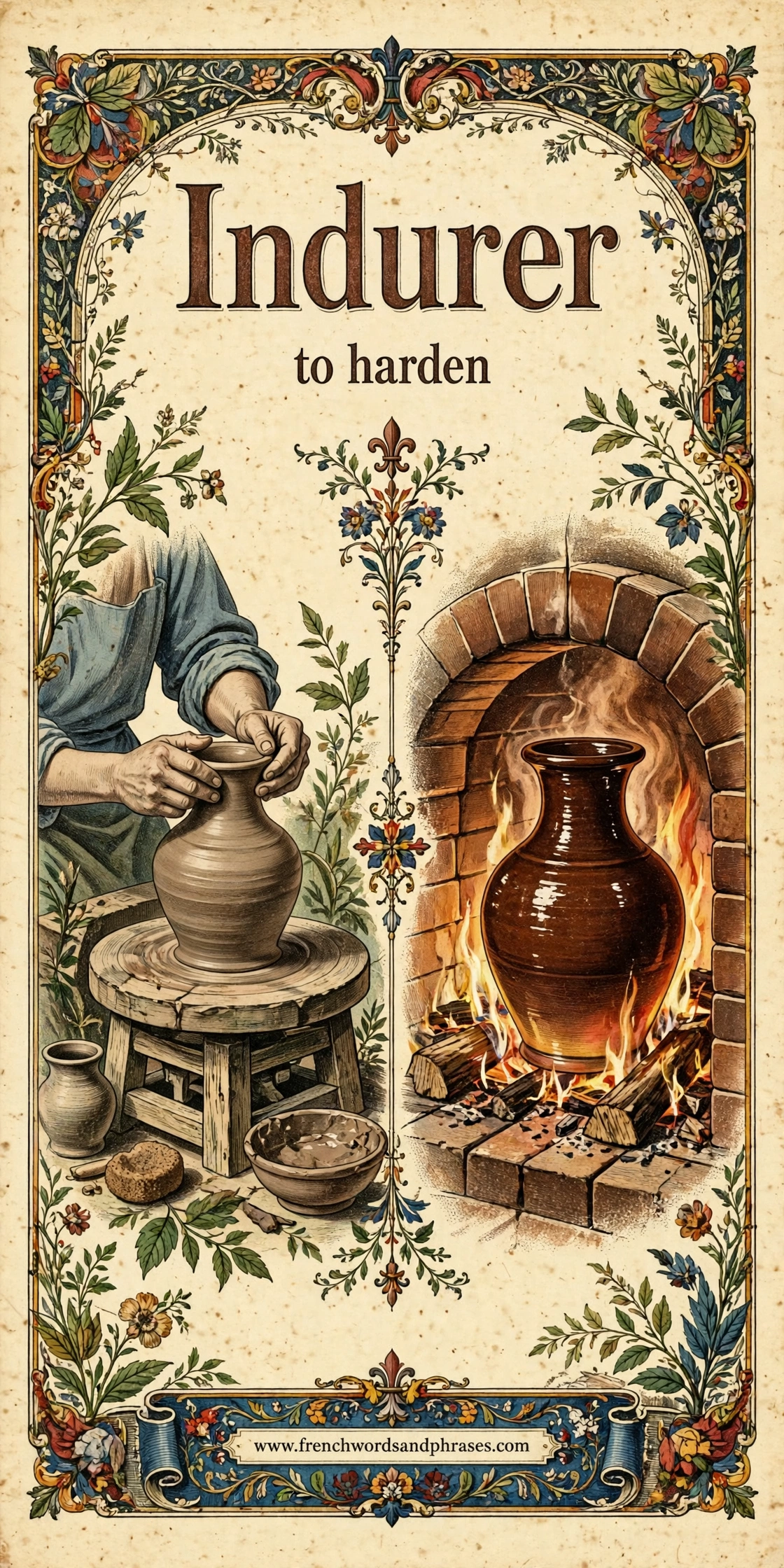
A French Word to Live By
How to Conjugate Indurer in French
/ɛ̃.dy.ʁe/
Indurer means to harden — a medical verb for living tissue that grows hard, thick and unyielding under the skin.
A callus on a workman’s hand, a lump the doctor’s fingers find and note — indurer is the quiet clinical verb for flesh turning hard, met far more often in its reflexive form, s’indurer, and in the adjective induré.
In this guide, you’ll learn how to conjugate indurer in all the major French tenses and moods. Explore complete conjugation tables, French examples, English translations, and practice quizzes.
Understanding the French Verb Indurer
Indurer is a regular French verb belonging to the first group of verbs, those ending in-er.
It means to harden. In medicine, induration is a standard examination finding: tissue that should be soft has become firm — around an old wound, in a gland, under the skin. Outside the clinic the verb is rare, and for ordinary hardening French prefers durcir: it is the clinic, not the kitchen, that indure.
Verb classification: First group (-er)
Auxiliary verb: Avoir
Past participle: induré
Present participle: indurant
English equivalents: To harden (of tissue); indurer la peau — to harden the skin; s’indurer — to become hard, to harden (of a lump, a gland, the skin); un tissu induré — hardened tissue; une zone indurée — a hardened area.
One important detail: indurer is a doctor’s verb, and its natural life is reflexive — a wound, a gland or a patch of skin s’indure, becomes hard: la plaie s’est indurée. The plain transitive use exists in medical writing (a disease indure les tissus), but in everyday encounters you will mostly read the past participle as an adjective: un nodule induré, une peau indurée. The conjugation itself is perfectly regular: j’indure, nous indurons.
Experience the Word
Indurer is hardening with a stethoscope nearby — the body quietly turning its own soft tissue to wood.
Imagine an old sailor at a medical visit. The doctor presses the skin of his forearm, frowns slightly, and writes in the file: la zone s’indure. Nothing hurts; nothing is red. But under the weathered skin, the tissue has slowly grown hard, like rope left too long in the sun.
No drama, no fever. The flesh has simply hardened — induré, in the doctor’s patient word.
How to Conjugate Indurer: Complete French Conjugation Guide
Let’s explore every major conjugation of indurer, beginning with the indicative mood.
How to Conjugate Indurer in the Indicative Mood
The indicative mood is used to express facts, observations, actions, and events.
How to Conjugate Indurer in the Present Tense (Présent)
Used for actions happening now, habitual actions, and general truths.
| Subject | Conjugation |
|---|---|
| je | indure |
| tu | indures |
| il / elle | indure |
| nous | indurons |
| vous | indurez |
| ils / elles | indurent |
Example
Cette maladie indure lentement les tissus autour de la plaie.
This disease slowly hardens the tissues around the wound.
Quick Quiz 1
Complete the sentence:
Nous constatons que la maladie ______ les tissus voisins.
Reveal the answer
indure
Nous constatons que la maladie indure les tissus voisins.
We note that the disease hardens the neighbouring tissues.
How to Conjugate Indurer in the Passé Composé
Used for completed actions in the past. Indurer takes the auxiliary verb avoir.
| Subject | Conjugation |
|---|---|
| j’ | ai induré |
| tu | as induré |
| il / elle | a induré |
| nous | avons induré |
| vous | avez induré |
| ils / elles | ont induré |
Example
Le soleil et le sel ont induré la peau du marin.
Sun and salt have hardened the sailor’s skin.
How to Conjugate Indurer in the Imparfait (Imperfect Tense)
Used for habitual past actions, descriptions, and ongoing situations in the past.
| Subject | Conjugation |
|---|---|
| je | indurais |
| tu | indurais |
| il / elle | indurait |
| nous | indurions |
| vous | induriez |
| ils / elles | induraient |
Example
Avec les années, le froid indurait ses mains d’ouvrier.
Over the years, the cold hardened his workman’s hands.
Quick Quiz 2
Choose the correct form:
The cold hardened his hands.
Le froid ______ ses mains. (a induré / est induré)
Reveal the answer
a induré
Le froid a induré ses mains.
Indurer takes avoir.
How to Conjugate Indurer in the Plus-que-parfait
Used to describe an action that had already been completed before another past event.
| Subject | Conjugation |
|---|---|
| j’ | avais induré |
| tu | avais induré |
| il / elle | avait induré |
| nous | avions induré |
| vous | aviez induré |
| ils / elles | avaient induré |
Example
L’inflammation avait induré la glande avant l’opération.
The inflammation had hardened the gland before the operation.
How to Conjugate Indurer in the Passé Simple
Primarily used in formal writing, literature, and historical narratives. It is rarely used in everyday conversation.
| Subject | Conjugation |
|---|---|
| je | indurai |
| tu | induras |
| il / elle | indura |
| nous | indurâmes |
| vous | indurâtes |
| ils / elles | indurèrent |
Example
La maladie indura peu à peu toute la région du cou.
The disease gradually hardened the whole region of the neck.
How to Conjugate Indurer in the Passé Antérieur
A literary tense used to express an action completed immediately before another past action, generally in the passé simple.
| Subject | Conjugation |
|---|---|
| j’ | eus induré |
| tu | eus induré |
| il / elle | eut induré |
| nous | eûmes induré |
| vous | eûtes induré |
| ils / elles | eurent induré |
Example
Quand le traitement eut induré la peau, on changea de méthode.
When the treatment had hardened the skin, they changed method.
How to Conjugate Indurer in the Future Tense (Futur Simple)
Used to describe actions that will take place in the future.
| Subject | Conjugation |
|---|---|
| je | indurerai |
| tu | indureras |
| il / elle | indurera |
| nous | indurerons |
| vous | indurerez |
| ils / elles | indureront |
Example
Sans soins, cette plaie indurera les chairs autour.
Without care, this wound will harden the flesh around it.
How to Conjugate Indurer in the Futur Antérieur (Future Perfect)
Used for an action that will have been completed before a particular point in the future.
| Subject | Conjugation |
|---|---|
| j’ | aurai induré |
| tu | auras induré |
| il / elle | aura induré |
| nous | aurons induré |
| vous | aurez induré |
| ils / elles | auront induré |
Example
À ce stade, la maladie aura induré tous les tissus voisins.
By that stage, the disease will have hardened all the neighbouring tissues.
How to Conjugate Indurer in the Near Future (Futur Proche)
Used to describe something that is going to happen soon. Formed with aller + infinitive.
| Subject | Conjugation |
|---|---|
| je | vais indurer |
| tu | vas indurer |
| il / elle | va indurer |
| nous | allons indurer |
| vous | allez indurer |
| ils / elles | vont indurer |
Example
Ce produit va indurer la peau si tu en abuses.
This product is going to harden your skin if you overuse it.
How to Conjugate Indurer in the Conditional Mood
The conditional mood expresses what would happen under certain circumstances. It is also frequently used to make polite requests or express wishes.
How to Conjugate Indurer in the Present Conditional
| Subject | Conjugation |
|---|---|
| je | indurerais |
| tu | indurerais |
| il / elle | indurerait |
| nous | indurerions |
| vous | indureriez |
| ils / elles | indureraient |
Example
Un tel traitement indurerait la peau des patients fragiles.
Such a treatment would harden the skin of delicate patients.
How to Conjugate Indurer in the Past Conditional
| Subject | Conjugation |
|---|---|
| j’ | aurais induré |
| tu | aurais induré |
| il / elle | aurait induré |
| nous | aurions induré |
| vous | auriez induré |
| ils / elles | auraient induré |
Example
Le froid aurait induré ses mains sans ses bons gants.
The cold would have hardened his hands without his good gloves.
Indurer in the Literary Past Conditional Form
This less common literary form uses the imperfect subjunctive of avoir.
| Subject | Conjugation |
|---|---|
| j’ | eusse induré |
| tu | eusses induré |
| il / elle | eût induré |
| nous | eussions induré |
| vous | eussiez induré |
| ils / elles | eussent induré |
Example
La maladie eût induré les tissus sans le remède.
The disease would have hardened the tissues without the remedy.
How to Conjugate Indurer in the Subjunctive Mood
The subjunctive is used to express wishes, emotions, doubts, necessity, and uncertainty. It frequently follows expressions such as il faut que (it is necessary that) or bien que (although).
How to Conjugate Indurer in the Present Subjunctive
| Subject | Conjugation |
|---|---|
| que je | indure |
| que tu | indures |
| qu’il / qu’elle | indure |
| que nous | indurions |
| que vous | induriez |
| qu’ils / qu’elles | indurent |
Example
Le médecin craint que la plaie n’indure les tissus.
The doctor fears the wound may harden the tissues.
Quick Quiz 3
Complete the sentence using the subjunctive:
On craint que l’inflammation ______ la glande.
Reveal the answer
indure
On craint que l’inflammation indure la glande.
They fear the inflammation may harden the gland.
How to Conjugate Indurer in the Imperfect Subjunctive
A literary tense, rarely encountered in modern spoken French.
| Subject | Conjugation |
|---|---|
| que je | indurasse |
| que tu | indurasses |
| qu’il / qu’elle | indurât |
| que nous | indurassions |
| que vous | indurassiez |
| qu’ils / qu’elles | indurassent |
Example
On craignait que l’inflammation indurât la glande.
They feared the inflammation might harden the gland.
How to Conjugate Indurer in the Pluperfect Subjunctive
A literary construction used to express an action completed before another past action.
| Subject | Conjugation |
|---|---|
| que j’ | eusse induré |
| que tu | eusses induré |
| qu’il / qu’elle | eût induré |
| que nous | eussions induré |
| que vous | eussiez induré |
| qu’ils / qu’elles | eussent induré |
Example
Le rapport disait que la maladie eût induré toute la zone.
The report said the disease had hardened the whole area.
How to Conjugate Indurer in the Past Subjunctive
| Subject | Conjugation |
|---|---|
| que j’ | aie induré |
| que tu | aies induré |
| qu’il / qu’elle | ait induré |
| que nous | ayons induré |
| que vous | ayez induré |
| qu’ils / qu’elles | aient induré |
Example
Je suis surpris que ce produit ait induré sa peau.
I am surprised this product has hardened her skin.
How to Conjugate Indurer in the Imperative
The imperative is used to give commands, instructions, invitations, or suggestions. Subject pronouns are omitted.
How to Conjugate Indurer in the Present Imperative
| Person | Conjugation |
|---|---|
| (tu) | indure |
| (nous) | indurons |
| (vous) | indurez |
Example
N’indure pas ta peau avec ces produits agressifs !
Do not harden your skin with those harsh products!
Quick Quiz 4
How would you say Do not harden your skin (tu form)?
Reveal the answer
N’indure pas ta peau !
French Participles of Indurer
Participles are verb forms that can be used in compound tenses and other grammatical constructions.
Present Participle of Indurer
indurant
En indurant les tissus, la maladie ralentit la guérison.
By hardening the tissues, the disease slows healing.
Past Participle of Indurer
induré
Indurée par des années de travail, sa peau ne craignait plus rien.
Hardened by years of work, his skin feared nothing any more.
Indurer in Everyday French: Real-Life Examples
Now that you know the conjugations, let’s see how indurer appears in everyday French.
Example 1 — Present
Cette maladie indure les tissus autour de la plaie.
This disease hardens the tissues around the wound.
Example 2 — Passé composé
Le sel a induré la peau du marin.
Salt has hardened the sailor’s skin.
Example 3 — Imparfait
Le froid indurait ses mains d’ouvrier.
The cold used to harden his workman’s hands.
Example 4 — Future
Cette plaie indurera les chairs autour.
This wound will harden the flesh around it.
Example 5 — Conditional
Un tel traitement indurerait la peau.
Such a treatment would harden the skin.
Example 6 — Imperative
N’indure pas ta peau !
Do not harden your skin!
Beyond Translation: The Meaning of Indurer
English medicine uses the noun induration for exactly this finding, but everyday English has no verb to match.
Indurer is the clinic’s word, durcir is everyone else’s.
A road durcit in the frost and a heart durcit with age, but tissue — examined, noted, written into a file — s’indure: same hardening, different white coat.
How to Remember the French Verb Indurer
Remember it this way: Indurer is about the doctor’s fingers finding wood under the skin.
- A medical verb: tissue indure — or, more naturally, s’indure — when it grows hard.
- You will meet the adjective most: un tissu induré, une zone indurée.
- Regular -er: j’indure, nous indurons, past participle induré; everyday hardening is durcir.
The key idea is the doctor’s fingers finding wood under the skin.
Test Your Knowledge of Indurer
Let’s see how much you’ve learned. Try answering these questions before revealing the answers.
Question 1
Where are you most likely to meet indurer?
Reveal the answer
In medicine — for tissue, glands or skin that have become hard; everyday French says durcir.
Question 2
How do you say This disease hardens the tissues in French?
Reveal the answer
Cette maladie indure les tissus.
Question 3
Translate: Sun and salt have hardened the sailor’s skin.
Reveal the answer
Le soleil et le sel ont induré la peau du marin.
Question 4
What is the past participle of indurer?
Reveal the answer
Induré — very common as an adjective: un tissu induré.
Question 5
Complete the sentence:
Le médecin craint que la plaie n’______ les tissus.
Reveal the answer
indure
Le médecin craint que la plaie n’indure les tissus.
The doctor fears the wound may harden the tissues.
Your Final Challenge
Can You Use It?
How would you say this in French?
The doctor gently feels the area that is hardening and reassures the sailor: nothing serious, just the work of the years.
Reveal the answer
Le médecin palpe doucement la zone qui s’indure et rassure le marin : rien de grave, juste le travail des années.
The doctor gently feels the area that is hardening and reassures the sailor: nothing serious, just the work of the years.
A little French. A little curiosity. A richer everyday life.
LEARN FRENCH ONE WORD AT A TIME




