A French Word to Live By
How to Conjugate Indifférer in French
/ɛ̃.di.fe.ʁe/
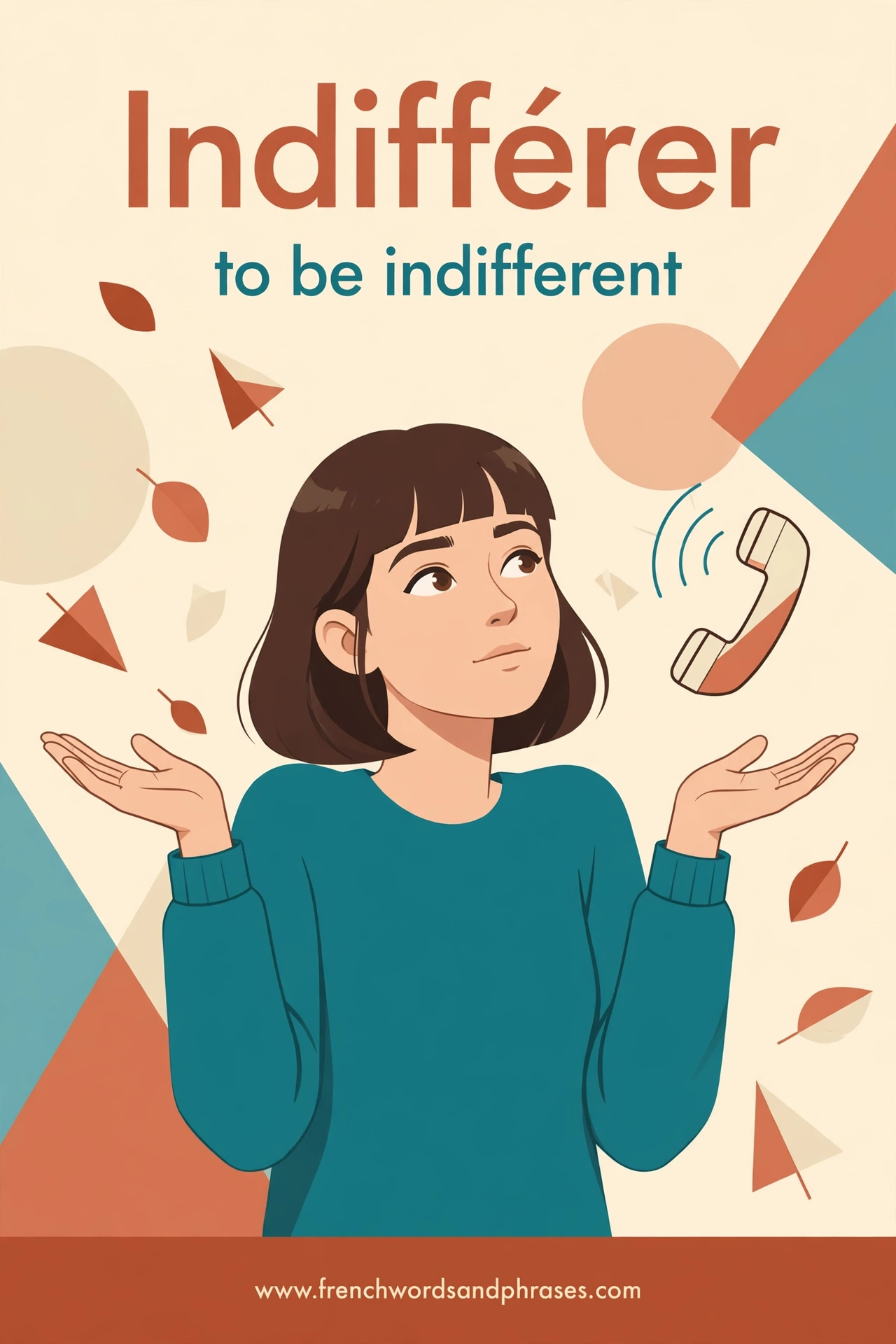
Indifférer means to leave indifferent — a rare verb whose living form is the impersonal frame cela m’indiffère: it makes no difference to me, I do not mind either way.
You will not hear it in a café, but you may meet it in a novel: indifférer is the bookish verb of indifference, and its one truly living use is a small masterpiece of understatement — cela m’indiffère, said with a shrug that English renders as: it is all the same to me.
In this guide, you’ll learn how to conjugate indifférer in all the major French tenses and moods. Explore complete conjugation tables, French examples, English translations, and practice quizzes.
Understanding the French Verb Indifférer
Indifférer is a regular French verb belonging to the first group of verbs, those ending in-er.
It means to be indifferent, to leave indifferent. It survives mainly in the impersonal construction il indiffère à quelqu’un de… and in the short verdict cela m’indiffère — it leaves me cold, it is a matter of indifference to me. As a plain personal verb (le bruit l’indiffère, the noise leaves him indifferent) it belongs to written, formal French; learners should recognise it, and reach for ça m’est égal in conversation.
Verb classification: First group (-er)
Auxiliary verb: Avoir
Past participle: indifféré
Present participle: indifférant
English equivalents: To leave indifferent, to make no difference to; cela m’indiffère — it makes no difference to me, I do not mind; rien ne l’indiffère — nothing leaves him indifferent (rare); être indifférent — to be indifferent (the common adjective); ça m’est égal — it is all the same to me (the everyday phrase).
One important detail: indifférer is an espérer-type verb — the é of the stem opens to è in the present singular and third plural, in the subjunctive singular and third plural, and in the tu imperative: cela m’indiffère, ils indiffèrent. But the future and conditional keep é: cela m’indifférera, cela m’indifférerait. Honesty about usage: the verb is rare and literary. Its classic frame is impersonal — il m’indiffère de partir ou de rester — and everyday French says ça m’est égal or uses the adjective: je suis indifférent.
Experience the Word
Indifférer is indifference with a library card — the shrug of French, dressed in its Sunday clothes.
Imagine a great lady in a Balzac novel, offered two suitors, two houses and two futures by a breathless matchmaker. She turns a page of her book, barely looks up, and answers with the calmest sentence in the language: tout cela m’indiffère — all of that leaves me perfectly indifferent.
She has not refused anything. She has declared it all beneath her interest — indifféré, completely, with one verb.
How to Conjugate Indifférer: Complete French Conjugation Guide
Let’s explore every major conjugation of indifférer, beginning with the indicative mood.
How to Conjugate Indifférer in the Indicative Mood
The indicative mood is used to express facts, observations, actions, and events.
How to Conjugate Indifférer in the Present Tense (Présent)
Used for actions happening now, habitual actions, and general truths.
| Subject | Conjugation |
|---|---|
| je | indiffère |
| tu | indiffères |
| il / elle | indiffère |
| nous | indifférons |
| vous | indifférez |
| ils / elles | indiffèrent |
Example
Tout cela l’indiffère : il ne lève même pas les yeux.
All of that leaves him indifferent: he does not even look up.
Quick Quiz 1
Complete the sentence:
Tout cela nous ______ , nous ne lèverons pas les yeux.
Reveal the answer
indiffère
Tout cela nous indiffère, nous ne lèverons pas les yeux.
All of that leaves us indifferent, we shall not look up.
How to Conjugate Indifférer in the Passé Composé
Used for completed actions in the past. Indifférer takes the auxiliary verb avoir.
| Subject | Conjugation |
|---|---|
| j’ | ai indifféré |
| tu | as indifféré |
| il / elle | a indifféré |
| nous | avons indifféré |
| vous | avez indifféré |
| ils / elles | ont indifféré |
Example
Sa froideur a indifféré même ses plus vieux amis.
His coldness left even his oldest friends indifferent.
How to Conjugate Indifférer in the Imparfait (Imperfect Tense)
Used for habitual past actions, descriptions, and ongoing situations in the past.
| Subject | Conjugation |
|---|---|
| je | indifférais |
| tu | indifférais |
| il / elle | indifférait |
| nous | indifférions |
| vous | indiffériez |
| ils / elles | indifféraient |
Example
Rien ne l’indifférait, ni les honneurs ni les critiques.
Nothing left him indifferent, neither honours nor criticism.
Quick Quiz 2
Choose the correct form:
His coldness left his friends indifferent.
Sa froideur ______ ses amis. (a indifféré / est indifféré)
Reveal the answer
a indifféré
Sa froideur a indifféré ses amis.
Indifférer takes avoir.
How to Conjugate Indifférer in the Plus-que-parfait
Used to describe an action that had already been completed before another past event.
| Subject | Conjugation |
|---|---|
| j’ | avais indifféré |
| tu | avais indifféré |
| il / elle | avait indifféré |
| nous | avions indifféré |
| vous | aviez indifféré |
| ils / elles | avaient indifféré |
Example
Le succès l’avait indifféré bien avant la fin de sa carrière.
Success had left him indifferent long before the end of his career.
How to Conjugate Indifférer in the Passé Simple
Primarily used in formal writing, literature, and historical narratives. It is rarely used in everyday conversation.
| Subject | Conjugation |
|---|---|
| je | indifférai |
| tu | indifféras |
| il / elle | indifféra |
| nous | indifférâmes |
| vous | indifférâtes |
| ils / elles | indifférèrent |
Example
La nouvelle indifféra le public, las de ces promesses.
The news left the public indifferent, tired of these promises.
How to Conjugate Indifférer in the Passé Antérieur
A literary tense used to express an action completed immediately before another past action, generally in the passé simple.
| Subject | Conjugation |
|---|---|
| j’ | eus indifféré |
| tu | eus indifféré |
| il / elle | eut indifféré |
| nous | eûmes indifféré |
| vous | eûtes indifféré |
| ils / elles | eurent indifféré |
Example
Quand la nouvelle l’eut indifféré, il tourna la page du journal.
When the news had left him indifferent, he turned the page of the newspaper.
How to Conjugate Indifférer in the Future Tense (Futur Simple)
Used to describe actions that will take place in the future.
| Subject | Conjugation |
|---|---|
| je | indifférerai |
| tu | indifféreras |
| il / elle | indifférera |
| nous | indifférerons |
| vous | indifférerez |
| ils / elles | indifféreront |
Example
Ce rapport indifférera les électeurs, trop technique pour eux.
This report will leave voters indifferent, too technical for them.
How to Conjugate Indifférer in the Futur Antérieur (Future Perfect)
Used for an action that will have been completed before a particular point in the future.
| Subject | Conjugation |
|---|---|
| j’ | aurai indifféré |
| tu | auras indifféré |
| il / elle | aura indifféré |
| nous | aurons indifféré |
| vous | aurez indifféré |
| ils / elles | auront indifféré |
Example
À la fin, même les honneurs l’auront indifféré.
In the end, even honours will have left him indifferent.
How to Conjugate Indifférer in the Near Future (Futur Proche)
Used to describe something that is going to happen soon. Formed with aller + infinitive.
| Subject | Conjugation |
|---|---|
| je | vais indifférer |
| tu | vas indifférer |
| il / elle | va indifférer |
| nous | allons indifférer |
| vous | allez indifférer |
| ils / elles | vont indifférer |
Example
Attention, ce ton froid va indifférer ton public.
Careful, that cold tone is going to leave your audience indifferent.
How to Conjugate Indifférer in the Conditional Mood
The conditional mood expresses what would happen under certain circumstances. It is also frequently used to make polite requests or express wishes.
How to Conjugate Indifférer in the Present Conditional
| Subject | Conjugation |
|---|---|
| je | indifférerais |
| tu | indifférerais |
| il / elle | indifférerait |
| nous | indifférerions |
| vous | indifféreriez |
| ils / elles | indifféreraient |
Example
Un tel discours indifférerait les jeunes électeurs.
Such a speech would leave young voters indifferent.
How to Conjugate Indifférer in the Past Conditional
| Subject | Conjugation |
|---|---|
| j’ | aurais indifféré |
| tu | aurais indifféré |
| il / elle | aurait indifféré |
| nous | aurions indifféré |
| vous | auriez indifféré |
| ils / elles | auraient indifféré |
Example
Cette affaire l’aurait indifféré sans l’article du journal.
This business would have left him indifferent without the newspaper article.
Indifférer in the Literary Past Conditional Form
This less common literary form uses the imperfect subjunctive of avoir.
| Subject | Conjugation |
|---|---|
| j’ | eusse indifféré |
| tu | eusses indifféré |
| il / elle | eût indifféré |
| nous | eussions indifféré |
| vous | eussiez indifféré |
| ils / elles | eussent indifféré |
Example
Rien ne l’eût indifféré davantage que ce silence.
Nothing would have left him more indifferent than that silence.
How to Conjugate Indifférer in the Subjunctive Mood
The subjunctive is used to express wishes, emotions, doubts, necessity, and uncertainty. It frequently follows expressions such as il faut que (it is necessary that) or bien que (although).
How to Conjugate Indifférer in the Present Subjunctive
| Subject | Conjugation |
|---|---|
| que je | indiffère |
| que tu | indiffères |
| qu’il / qu’elle | indiffère |
| que nous | indifférions |
| que vous | indiffériez |
| qu’ils / qu’elles | indiffèrent |
Example
Je doute que cela indiffère qui que ce soit.
I doubt that leaves anyone indifferent.
Quick Quiz 3
Complete the sentence using the subjunctive:
Je suis surpris que cela l’______ à ce point.
Reveal the answer
ait indifféré
Je suis surpris que cela l’ait indifféré à ce point.
I am surprised that left him so completely indifferent.
How to Conjugate Indifférer in the Imperfect Subjunctive
A literary tense, rarely encountered in modern spoken French.
| Subject | Conjugation |
|---|---|
| que je | indifférasse |
| que tu | indifférasses |
| qu’il / qu’elle | indifférât |
| que nous | indifférassions |
| que vous | indifférassiez |
| qu’ils / qu’elles | indifférassent |
Example
On craignait que la nouvelle indifférât le public.
People feared the news might leave the public indifferent.
How to Conjugate Indifférer in the Pluperfect Subjunctive
A literary construction used to express an action completed before another past action.
| Subject | Conjugation |
|---|---|
| que j’ | eusse indifféré |
| que tu | eusses indifféré |
| qu’il / qu’elle | eût indifféré |
| que nous | eussions indifféré |
| que vous | eussiez indifféré |
| qu’ils / qu’elles | eussent indifféré |
Example
On disait que le succès l’eût indifféré très tôt.
People said success had left him indifferent very early.
How to Conjugate Indifférer in the Past Subjunctive
| Subject | Conjugation |
|---|---|
| que j’ | aie indifféré |
| que tu | aies indifféré |
| qu’il / qu’elle | ait indifféré |
| que nous | ayons indifféré |
| que vous | ayez indifféré |
| qu’ils / qu’elles | aient indifféré |
Example
Je suis surpris que cela l’ait indifféré à ce point.
I am surprised that left him so completely indifferent.
How to Conjugate Indifférer in the Imperative
The imperative is used to give commands, instructions, invitations, or suggestions. Subject pronouns are omitted.
How to Conjugate Indifférer in the Present Imperative
| Person | Conjugation |
|---|---|
| (tu) | indiffère |
| (nous) | indifférons |
| (vous) | indifférez |
Example
Indiffère ! Fais comme si de rien n’était.
Be indifferent! Act as if nothing had happened.
Quick Quiz 4
How would you say It makes no difference to me, with indifférer?
Reveal the answer
Cela m’indiffère.
French Participles of Indifférer
Participles are verb forms that can be used in compound tenses and other grammatical constructions.
Present Participle of Indifférer
indifférant
En indifférant ses électeurs, le maire a perdu leur confiance.
By leaving his voters indifferent, the mayor lost their trust.
Past Participle of Indifférer
indifféré
Indifféré par les honneurs, il vivait loin du monde.
Made indifferent by honours, he lived far from the world.
Indifférer in Everyday French: Real-Life Examples
Now that you know the conjugations, let’s see how indifférer appears in everyday French.
Example 1 — Present
Cela m’indiffère.
It makes no difference to me.
Example 2 — Passé composé
Sa froideur a indifféré ses amis.
His coldness left his friends indifferent.
Example 3 — Imparfait
Rien ne l’indifférait.
Nothing left him indifferent.
Example 4 — Future
Ce rapport indifférera les électeurs.
This report will leave voters indifferent.
Example 5 — Conditional
Un tel discours indifférerait les jeunes.
Such a speech would leave the young indifferent.
Example 6 — Imperative
Indiffère ! Fais comme si de rien n’était.
Be indifferent! Act as if nothing had happened.
Beyond Translation: The Meaning of Indifférer
English indifferent is only an adjective; French indifférer dares to make indifference a verb — something that happens to you, or that you do to a room.
Its kingdom is one small sentence: cela m’indiffère.
Learn that frame and you own the verb; for everything else, French itself reaches for the adjective indifférent or the shrug of ça m’est égal — and knowing that, too, is knowing the word honestly.
How to Remember the French Verb Indifférer
Remember it this way: Indifférer is about the great lady’s shrug — tout cela m’indiffère.
- The living frame is impersonal: cela m’indiffère — it makes no difference to me.
- Espérer-type spelling: je indiffère with è in the present, but je indifférerai with é in the future.
- A rare, literary verb: everyday French says ça m’est égal or je suis indifférent.
The key idea is the great lady’s shrug — tout cela m’indiffère.
Test Your Knowledge of Indifférer
Let’s see how much you’ve learned. Try answering these questions before revealing the answers.
Question 1
What is the classic impersonal frame of indifférer?
Reveal the answer
Cela m’indiffère — it makes no difference to me, I do not mind either way.
Question 2
How do you say It makes no difference to me in the verb’s own frame?
Reveal the answer
Cela m’indiffère.
Question 3
Translate: Nothing left him indifferent, neither honours nor criticism.
Reveal the answer
Rien ne l’indifférait, ni les honneurs ni les critiques.
Question 4
What is the past participle of indifférer?
Reveal the answer
Indifféré.
Question 5
Complete the sentence:
Je doute que cela ______ qui que ce soit.
Reveal the answer
indiffère
Je doute que cela indiffère qui que ce soit.
I doubt that leaves anyone indifferent.
Your Final Challenge
Can You Use It?
How would you say this in French?
Choose whichever day you like: it makes no difference to me, as long as we leave together.
Reveal the answer
Choisis le jour que tu veux : cela m’indiffère, pourvu que nous partions ensemble.
Choose whichever day you like: it makes no difference to me, as long as we leave together.
A little French. A little curiosity. A richer everyday life.
LEARN FRENCH ONE WORD AT A TIME