
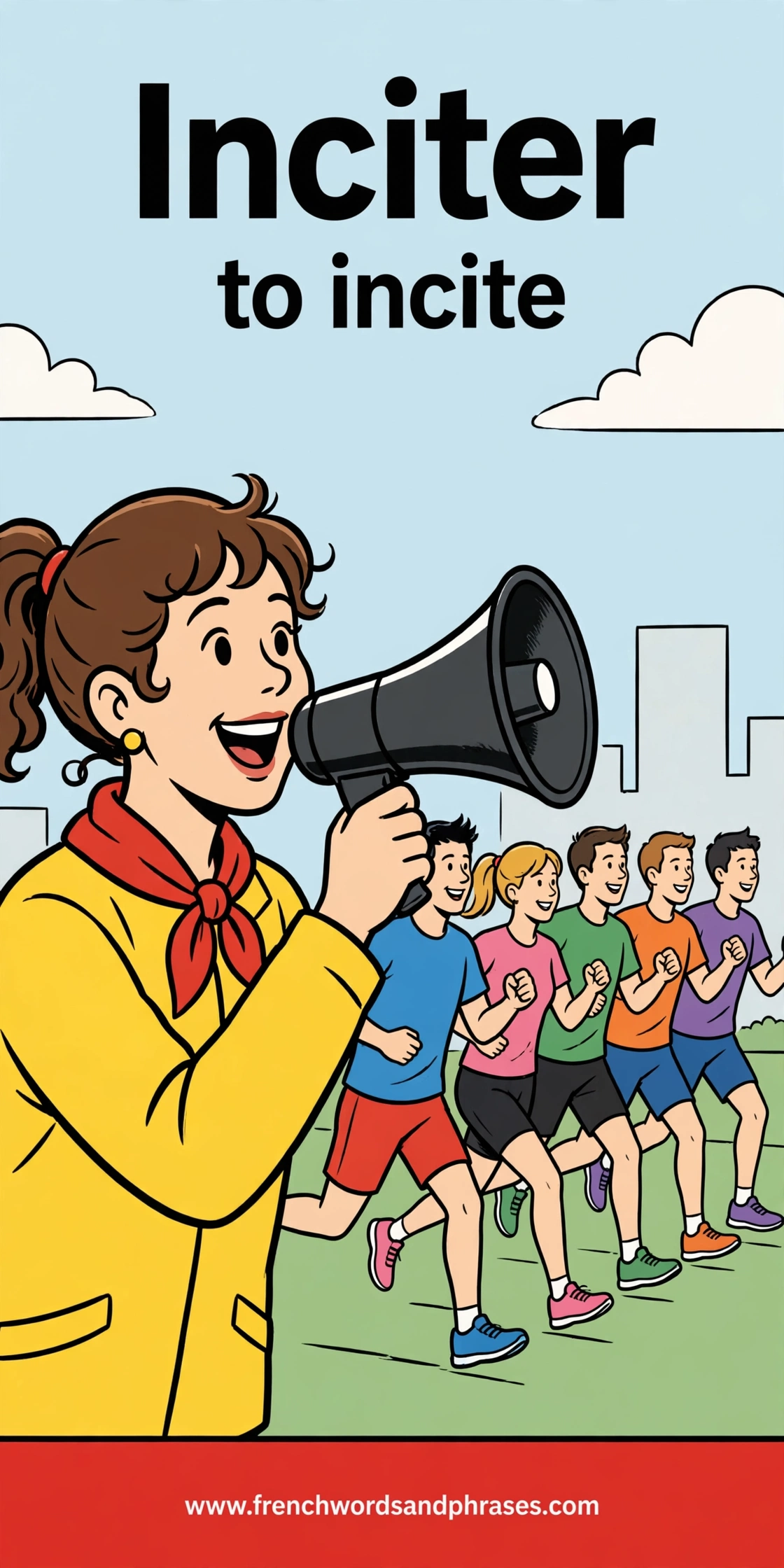
A French Word to Live By
How to Conjugate Inciter in French
/ɛ̃.si.te/
Inciter means to incite — to urge, push or provoke someone into doing something, usually something bold, unwise or forbidden.
A whisper in the corridor before the vote, a chant rising in the street, a friend daring you at the edge of the diving board — inciter is the verb of the push: words that move other people to act, for better and often for worse.
In this guide, you’ll learn how to conjugate inciter in all the major French tenses and moods. Explore complete conjugation tables, French examples, English translations, and practice quizzes.
Understanding the French Verb Inciter
Inciter is a regular French verb belonging to the first group of verbs, those ending in-er.
It means to incite. Its colour depends on its object: inciter à la prudence or inciter à travailler are almost praise, but its commonest partners are darker — inciter à la haine, à la violence, au crime — which is why French law speaks of provocation and incitation. Between friends it is simply ‘to egg on’: ne l’incite pas, il est déjà assez fou !
Verb classification: First group (-er)
Auxiliary verb: Avoir
Past participle: incité
Present participle: incitant
English equivalents: To incite, to urge on, to encourage (towards an act); inciter quelqu’un à faire quelque chose — to incite someone to do something; inciter à la révolte — to incite to revolt; inciter à la prudence — to urge caution; une incitation à la haine — incitement to hatred.
One important detail: inciter is a regular -er verb — j’incite, nous incitons, ils incitent, past participle incité — and it is almost never used alone: it governs à plus an infinitive or a noun: inciter les ouvriers à la grève, inciter quelqu’un à partir. Do not confuse it with inciser (to incise, to cut): the surgeon incise la peau, the agitator incite la foule.
Experience the Word
Inciter is a verb about levers: one person’s words, applied at the right spot, move another person to act.
Imagine the schoolyard at break, a ring of children around two boys, neither of whom really wants to fight. It takes one voice at the back — « Vas-y, il a peur ! » — and the voice incite les deux garçons, pushes them past the point where either can step back with honour. The fists belong to the boys; the fight belongs to the voice.
Nobody was forced. They were incited — incités, by words alone, which is exactly the verb’s quiet power.
How to Conjugate Inciter: Complete French Conjugation Guide
Let’s explore every major conjugation of inciter, beginning with the indicative mood.
How to Conjugate Inciter in the Indicative Mood
The indicative mood is used to express facts, observations, actions, and events.
How to Conjugate Inciter in the Present Tense (Présent)
Used for actions happening now, habitual actions, and general truths.
| Subject | Conjugation |
|---|---|
| je | incite |
| tu | incites |
| il / elle | incite |
| nous | incitons |
| vous | incitez |
| ils / elles | incitent |
Example
Ses discours incitent les jeunes à la révolte.
His speeches incite the young people to revolt.
Quick Quiz 1
Complete the sentence:
Nous ______ les élèves à poser des questions.
Reveal the answer
incitons
Nous incitons les élèves à poser des questions.
We encourage the pupils to ask questions.
How to Conjugate Inciter in the Passé Composé
Used for completed actions in the past. Inciter takes the auxiliary verb avoir.
| Subject | Conjugation |
|---|---|
| j’ | ai incité |
| tu | as incité |
| il / elle | a incité |
| nous | avons incité |
| vous | avez incité |
| ils / elles | ont incité |
Example
L’article a incité les lecteurs à signer la pétition.
The article moved the readers to sign the petition.
How to Conjugate Inciter in the Imparfait (Imperfect Tense)
Used for habitual past actions, descriptions, and ongoing situations in the past.
| Subject | Conjugation |
|---|---|
| je | incitais |
| tu | incitais |
| il / elle | incitait |
| nous | incitions |
| vous | incitiez |
| ils / elles | incitaient |
Example
Un inconnu incitait les passants à entrer dans la boutique.
A stranger was urging passers-by to come into the shop.
Quick Quiz 2
Choose the correct form:
The article moved the readers to sign.
L’article ______ les lecteurs à signer. (a incité / est incité)
Reveal the answer
a incité
L’article a incité les lecteurs à signer.
Inciter takes avoir.
How to Conjugate Inciter in the Plus-que-parfait
Used to describe an action that had already been completed before another past event.
| Subject | Conjugation |
|---|---|
| j’ | avais incité |
| tu | avais incité |
| il / elle | avait incité |
| nous | avions incité |
| vous | aviez incité |
| ils / elles | avaient incité |
Example
Elle avait incité son frère à dénoncer le vol.
She had urged her brother to report the theft.
How to Conjugate Inciter in the Passé Simple
Primarily used in formal writing, literature, and historical narratives. It is rarely used in everyday conversation.
| Subject | Conjugation |
|---|---|
| je | incitai |
| tu | incitas |
| il / elle | incita |
| nous | incitâmes |
| vous | incitâtes |
| ils / elles | incitèrent |
Example
L’orateur incita la foule à marcher sur la préfecture.
The speaker incited the crowd to march on the prefecture.
How to Conjugate Inciter in the Passé Antérieur
A literary tense used to express an action completed immediately before another past action, generally in the passé simple.
| Subject | Conjugation |
|---|---|
| j’ | eus incité |
| tu | eus incité |
| il / elle | eut incité |
| nous | eûmes incité |
| vous | eûtes incité |
| ils / elles | eurent incité |
Example
Dès qu’il eut incité les ouvriers à la grève, l’usine s’arrêta.
As soon as he had incited the workers to strike, the factory stopped.
How to Conjugate Inciter in the Future Tense (Futur Simple)
Used to describe actions that will take place in the future.
| Subject | Conjugation |
|---|---|
| je | inciterai |
| tu | inciteras |
| il / elle | incitera |
| nous | inciterons |
| vous | inciterez |
| ils / elles | inciteront |
Example
Ce film incitera les adolescents à voyager.
This film will inspire teenagers to travel.
How to Conjugate Inciter in the Futur Antérieur (Future Perfect)
Used for an action that will have been completed before a particular point in the future.
| Subject | Conjugation |
|---|---|
| j’ | aurai incité |
| tu | auras incité |
| il / elle | aura incité |
| nous | aurons incité |
| vous | aurez incité |
| ils / elles | auront incité |
Example
Quand la rumeur aura incité tout le village, il sera trop tard pour la démentir.
When the rumour has stirred up the whole village, it will be too late to deny it.
How to Conjugate Inciter in the Near Future (Futur Proche)
Used to describe something that is going to happen soon. Formed with aller + infinitive.
| Subject | Conjugation |
|---|---|
| je | vais inciter |
| tu | vas inciter |
| il / elle | va inciter |
| nous | allons inciter |
| vous | allez inciter |
| ils / elles | vont inciter |
Example
Ne va pas inciter les enfants à grimper sur le toit !
Do not go egging the children on to climb onto the roof!
How to Conjugate Inciter in the Conditional Mood
The conditional mood expresses what would happen under certain circumstances. It is also frequently used to make polite requests or express wishes.
How to Conjugate Inciter in the Present Conditional
| Subject | Conjugation |
|---|---|
| je | inciterais |
| tu | inciterais |
| il / elle | inciterait |
| nous | inciterions |
| vous | inciteriez |
| ils / elles | inciteraient |
Example
Un bon professeur inciterait ses élèves à poser des questions.
A good teacher would encourage his pupils to ask questions.
How to Conjugate Inciter in the Past Conditional
| Subject | Conjugation |
|---|---|
| j’ | aurais incité |
| tu | aurais incité |
| il / elle | aurait incité |
| nous | aurions incité |
| vous | auriez incité |
| ils / elles | auraient incité |
Example
Sans son ami, il n’aurait jamais incité les autres à se plaindre.
Without his friend, he would never have urged the others to complain.
Inciter in the Literary Past Conditional Form
This less common literary form uses the imperfect subjunctive of avoir.
| Subject | Conjugation |
|---|---|
| j’ | eusse incité |
| tu | eusses incité |
| il / elle | eût incité |
| nous | eussions incité |
| vous | eussiez incité |
| ils / elles | eussent incité |
Example
L’orateur eût incité la foule à la révolte si la police n’était intervenue.
The speaker would have incited the crowd to revolt if the police had not intervened.
How to Conjugate Inciter in the Subjunctive Mood
The subjunctive is used to express wishes, emotions, doubts, necessity, and uncertainty. It frequently follows expressions such as il faut que (it is necessary that) or bien que (although).
How to Conjugate Inciter in the Present Subjunctive
| Subject | Conjugation |
|---|---|
| que je | incite |
| que tu | incites |
| qu’il / qu’elle | incite |
| que nous | incitions |
| que vous | incitiez |
| qu’ils / qu’elles | incitent |
Example
Je ne veux pas que tes paroles incitent les élèves à la désobéissance.
I do not want your words to incite the pupils to disobedience.
Quick Quiz 3
Complete the sentence using the subjunctive:
Je ne veux pas que vous ______ les enfants à désobéir.
Reveal the answer
incitiez
Je ne veux pas que vous incitiez les enfants à désobéir.
I do not want you to incite the children to disobey.
How to Conjugate Inciter in the Imperfect Subjunctive
A literary tense, rarely encountered in modern spoken French.
| Subject | Conjugation |
|---|---|
| que je | incitasse |
| que tu | incitasses |
| qu’il / qu’elle | incitât |
| que nous | incitassions |
| que vous | incitassiez |
| qu’ils / qu’elles | incitassent |
Example
On craignait que le tract incitât les ouvriers à occuper l’usine.
People feared the leaflet might incite the workers to occupy the factory.
How to Conjugate Inciter in the Pluperfect Subjunctive
A literary construction used to express an action completed before another past action.
| Subject | Conjugation |
|---|---|
| que j’ | eusse incité |
| que tu | eusses incité |
| qu’il / qu’elle | eût incité |
| que nous | eussions incité |
| que vous | eussiez incité |
| qu’ils / qu’elles | eussent incité |
Example
On racontait que son discours eût incité la ville entière à manifester.
People said his speech had moved the whole town to demonstrate.
How to Conjugate Inciter in the Past Subjunctive
| Subject | Conjugation |
|---|---|
| que j’ | aie incité |
| que tu | aies incité |
| qu’il / qu’elle | ait incité |
| que nous | ayons incité |
| que vous | ayez incité |
| qu’ils / qu’elles | aient incité |
Example
Je regrette que cette chanson ait incité tant de jeunes à partir.
I regret that this song encouraged so many young people to leave.
How to Conjugate Inciter in the Imperative
The imperative is used to give commands, instructions, invitations, or suggestions. Subject pronouns are omitted.
How to Conjugate Inciter in the Present Imperative
| Person | Conjugation |
|---|---|
| (tu) | incite |
| (nous) | incitons |
| (vous) | incitez |
Example
Incite tes camarades à travailler, pas à chahuter !
Urge your classmates to work, not to mess about!
Quick Quiz 4
How would you say Urge your classmates to work (tu form)?
Reveal the answer
Incite tes camarades à travailler !
French Participles of Inciter
Participles are verb forms that can be used in compound tenses and other grammatical constructions.
Present Participle of Inciter
incitant
En incitant les enfants à la prudence, l’institutrice évite les accidents.
By urging the children to be careful, the teacher avoids accidents.
Past Participle of Inciter
incité
Incités par leurs chefs, les manifestants ont marché jusqu’à la place.
Urged on by their leaders, the demonstrators marched to the square.
Inciter in Everyday French: Real-Life Examples
Now that you know the conjugations, let’s see how inciter appears in everyday French.
Example 1 — Present
Ses discours incitent les jeunes à agir.
His speeches incite the young to act.
Example 2 — Passé composé
L’article a incité les lecteurs à signer.
The article moved readers to sign.
Example 3 — Imparfait
Un inconnu incitait les passants à entrer.
A stranger was urging passers-by to come in.
Example 4 — Future
Ce film incitera les adolescents à voyager.
This film will inspire teenagers to travel.
Example 5 — Conditional
Un bon professeur inciterait ses élèves à réfléchir.
A good teacher would encourage his pupils to think.
Example 6 — Imperative
N’incite pas les enfants à grimper sur le toit !
Do not egg the children on to climb onto the roof!
Beyond Translation: The Meaning of Inciter
English incite is the same word with the same Latin root — incitare, to set in rapid motion, to spur on.
Words that push people.
French law takes the verb seriously — incitation à la haine is a charge, not a metaphor — because inciter names the exact moment speech becomes action in somebody else’s hands. Use it for encouragement if you like, but know that the verb always keeps one foot in the street, near the crowd, where voices carry.
How to Remember the French Verb Inciter
Remember it this way: Inciter is about the voice at the back of the crowd — words that push people to act.
- Inciter always pushes towards something: inciter quelqu’un À faire quelque chose — the à is part of the machine.
- Its noun is une incitation: une incitation à la prudence, une incitation à la haine.
- Regular -er: j’incite, nous incitons, past participle incité — twin of inciser (to cut), so watch the spelling.
The key idea is the voice at the back of the crowd — words that push people to act.
Test Your Knowledge of Inciter
Let’s see how much you’ve learned. Try answering these questions before revealing the answers.
Question 1
Which preposition does inciter govern before an infinitive?
Reveal the answer
À — inciter quelqu’un à faire quelque chose.
Question 2
How do you say His speeches incite the young people to revolt in French?
Reveal the answer
Ses discours incitent les jeunes à la révolte.
Question 3
Translate: The article moved the readers to sign the petition.
Reveal the answer
L’article a incité les lecteurs à signer la pétition.
Question 4
What is the past participle of inciter?
Reveal the answer
Incité.
Question 5
Complete the sentence:
Je ne veux pas que tes paroles ______ les élèves à la désobéissance.
Reveal the answer
incitent
Je ne veux pas que tes paroles incitent les élèves à la désobéissance.
I do not want your words to incite the pupils to disobedience.
Your Final Challenge
Can You Use It?
How would you say this in French?
A single speech can move a whole people to hope — or to hate; everything depends on the voice.
Reveal the answer
Un seul discours peut inciter tout un peuple à espérer — ou à haïr ; tout dépend de la voix.
A single speech can move a whole people to hope — or to hate; everything depends on the voice.
A little French. A little curiosity. A richer everyday life.
LEARN FRENCH ONE WORD AT A TIME




