
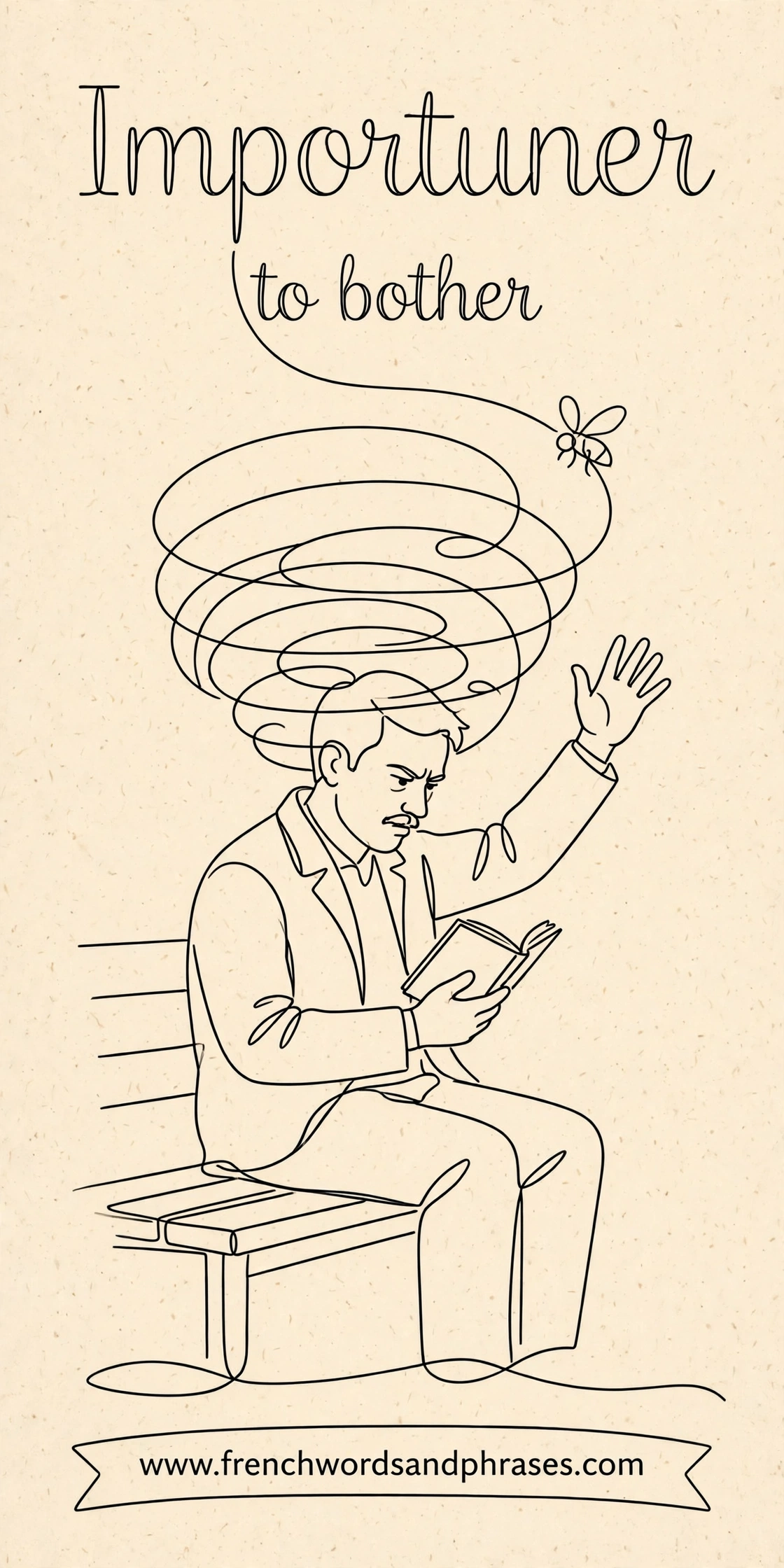
A French Word to Live By
How to Conjugate Importuner in French
/ɛ̃.pɔʁ.ty.ne/
Importuner means to bother, to pester, to trouble — to impose yourself on someone at the wrong moment, again and again, until their patience runs out.
A salesman who will not leave the doorstep, a neighbour knocking for the third time in an evening — importuner is the verb of unwelcome persistence: the visit, the call, the request that comes once too often.
In this guide, you’ll learn how to conjugate importuner in all the major French tenses and moods. Explore complete conjugation tables, French examples, English translations, and practice quizzes.
Understanding the French Verb Importuner
Importuner is a regular French verb belonging to the first group of verbs, those ending in-er.
It means to bother, to pester, to trouble. It is used of people pestering with visits, calls and requests, and of insects and noises troubling animals and sleepers. The register is careful and a little literary; in the street you will hear déranger, embêter or ennuyer, but importuner remains the word of the well-bred apology.
Verb classification: First group (-er)
Auxiliary verb: Avoir
Past participle: importuné
Present participle: importunant
English equivalents: To bother, to pester, to trouble; importuner quelqu’un — to bother someone; je suis désolé de vous importuner — I am sorry to trouble you; ne pas importuner les voisins — not to disturb the neighbours; un importun — a nuisance, an unwelcome visitor; les mouches importunent les chevaux — the flies pester the horses.
One important detail: importuner is the polite, slightly old-fashioned way to say déranger — it lives in apologies (pardonnez-moi de vous importuner) and in formal complaints. Its noun twin un importun is the unwelcome person himself, and the adjective importun means ill-timed, out of place: une visite importune. Do not confuse it with importer: importuner has nothing to do with trade. The verb is regular: j’importune, nous importunons.
Experience the Word
Importuner is the verb of the third knock — the moment a visit stops being welcome.
Imagine an old lady writing to the town hall about the neighbour’s dog, the neighbour’s music and the neighbour’s bonfires. Her letter is a model of politeness: « Je suis désolée de vous importuner, mais… » — sorry to trouble you, but the whole street has not slept for a week.
The apology is courteous, the complaint is iron. She is troubling them — importunant — in the politest French there is.
How to Conjugate Importuner: Complete French Conjugation Guide
Let’s explore every major conjugation of importuner, beginning with the indicative mood.
How to Conjugate Importuner in the Indicative Mood
The indicative mood is used to express facts, observations, actions, and events.
How to Conjugate Importuner in the Present Tense (Présent)
Used for actions happening now, habitual actions, and general truths.
| Subject | Conjugation |
|---|---|
| je | importune |
| tu | importunes |
| il / elle | importune |
| nous | importunons |
| vous | importunez |
| ils / elles | importunent |
Example
Ce vendeur importune tout le quartier avec ses visites.
This salesman pesters the whole neighbourhood with his visits.
Quick Quiz 1
Complete the sentence:
Nous ______ la mairie avec nos lettres.
Reveal the answer
importunons
Nous importunons la mairie avec nos lettres.
We are troubling the town hall with our letters.
How to Conjugate Importuner in the Passé Composé
Used for completed actions in the past. Importuner takes the auxiliary verb avoir.
| Subject | Conjugation |
|---|---|
| j’ | ai importuné |
| tu | as importuné |
| il / elle | a importuné |
| nous | avons importuné |
| vous | avez importuné |
| ils / elles | ont importuné |
Example
Il a importuné la mairie avec ses lettres pendant des mois.
He troubled the town hall with his letters for months.
How to Conjugate Importuner in the Imparfait (Imperfect Tense)
Used for habitual past actions, descriptions, and ongoing situations in the past.
| Subject | Conjugation |
|---|---|
| je | importunais |
| tu | importunais |
| il / elle | importunait |
| nous | importunions |
| vous | importuniez |
| ils / elles | importunaient |
Example
Les mouches importunaient les chevaux tout l’été.
The flies used to pester the horses all summer.
Quick Quiz 2
Choose the correct form:
He troubled the town hall for months.
Il ______ la mairie pendant des mois. (a importuné / est importuné)
Reveal the answer
a importuné
Il a importuné la mairie pendant des mois.
Importuner takes avoir.
How to Conjugate Importuner in the Plus-que-parfait
Used to describe an action that had already been completed before another past event.
| Subject | Conjugation |
|---|---|
| j’ | avais importuné |
| tu | avais importuné |
| il / elle | avait importuné |
| nous | avions importuné |
| vous | aviez importuné |
| ils / elles | avaient importuné |
Example
Elle avait importuné tout le monde avec ses questions.
She had bothered everyone with her questions.
How to Conjugate Importuner in the Passé Simple
Primarily used in formal writing, literature, and historical narratives. It is rarely used in everyday conversation.
| Subject | Conjugation |
|---|---|
| je | importunai |
| tu | importunas |
| il / elle | importuna |
| nous | importunâmes |
| vous | importunâtes |
| ils / elles | importunèrent |
Example
Un inconnu importuna la famille pendant le dîner.
A stranger troubled the family during dinner.
How to Conjugate Importuner in the Passé Antérieur
A literary tense used to express an action completed immediately before another past action, generally in the passé simple.
| Subject | Conjugation |
|---|---|
| j’ | eus importuné |
| tu | eus importuné |
| il / elle | eut importuné |
| nous | eûmes importuné |
| vous | eûtes importuné |
| ils / elles | eurent importuné |
Example
Quand il eut importuné le gardien une fois de trop, la porte se ferma.
When he had troubled the caretaker once too often, the door closed.
How to Conjugate Importuner in the Future Tense (Futur Simple)
Used to describe actions that will take place in the future.
| Subject | Conjugation |
|---|---|
| je | importunerai |
| tu | importuneras |
| il / elle | importunera |
| nous | importunerons |
| vous | importunerez |
| ils / elles | importuneront |
Example
Je ne vous importunerai plus avec mes demandes.
I shall not trouble you again with my requests.
How to Conjugate Importuner in the Futur Antérieur (Future Perfect)
Used for an action that will have been completed before a particular point in the future.
| Subject | Conjugation |
|---|---|
| j’ | aurai importuné |
| tu | auras importuné |
| il / elle | aura importuné |
| nous | aurons importuné |
| vous | aurez importuné |
| ils / elles | auront importuné |
Example
À force d’appels, il aura importuné tout le bureau.
With all his calls, he will have bothered the whole office.
How to Conjugate Importuner in the Near Future (Futur Proche)
Used to describe something that is going to happen soon. Formed with aller + infinitive.
| Subject | Conjugation |
|---|---|
| je | vais importuner |
| tu | vas importuner |
| il / elle | va importuner |
| nous | allons importuner |
| vous | allez importuner |
| ils / elles | vont importuner |
Example
Ce bruit va importuner les voisins toute la nuit.
This noise is going to disturb the neighbours all night.
How to Conjugate Importuner in the Conditional Mood
The conditional mood expresses what would happen under certain circumstances. It is also frequently used to make polite requests or express wishes.
How to Conjugate Importuner in the Present Conditional
| Subject | Conjugation |
|---|---|
| je | importunerais |
| tu | importunerais |
| il / elle | importunerait |
| nous | importunerions |
| vous | importuneriez |
| ils / elles | importuneraient |
Example
Sans ce problème, je ne vous importunerais pas.
Without this problem, I would not trouble you.
How to Conjugate Importuner in the Past Conditional
| Subject | Conjugation |
|---|---|
| j’ | aurais importuné |
| tu | aurais importuné |
| il / elle | aurait importuné |
| nous | aurions importuné |
| vous | auriez importuné |
| ils / elles | auraient importuné |
Example
Il aurait importuné le directeur s’il avait osé.
He would have troubled the manager if he had dared.
Importuner in the Literary Past Conditional Form
This less common literary form uses the imperfect subjunctive of avoir.
| Subject | Conjugation |
|---|---|
| j’ | eusse importuné |
| tu | eusses importuné |
| il / elle | eût importuné |
| nous | eussions importuné |
| vous | eussiez importuné |
| ils / elles | eussent importuné |
Example
Le solliciteur eût importuné le ministre sans l’huissier.
The petitioner would have troubled the minister without the usher.
How to Conjugate Importuner in the Subjunctive Mood
The subjunctive is used to express wishes, emotions, doubts, necessity, and uncertainty. It frequently follows expressions such as il faut que (it is necessary that) or bien que (although).
How to Conjugate Importuner in the Present Subjunctive
| Subject | Conjugation |
|---|---|
| que je | importune |
| que tu | importunes |
| qu’il / qu’elle | importune |
| que nous | importunions |
| que vous | importuniez |
| qu’ils / qu’elles | importunent |
Example
Je regrette qu’il vous importune si souvent.
I am sorry he troubles you so often.
Quick Quiz 3
Complete the sentence using the subjunctive:
On craignait que les journalistes ______ la famille.
Reveal the answer
importunassent
On craignait que les journalistes importunassent la famille.
People feared the journalists might trouble the family.
How to Conjugate Importuner in the Imperfect Subjunctive
A literary tense, rarely encountered in modern spoken French.
| Subject | Conjugation |
|---|---|
| que je | importunasse |
| que tu | importunasses |
| qu’il / qu’elle | importunât |
| que nous | importunassions |
| que vous | importunassiez |
| qu’ils / qu’elles | importunassent |
Example
On craignait que les journalistes importunassent la famille.
People feared the journalists might trouble the family.
How to Conjugate Importuner in the Pluperfect Subjunctive
A literary construction used to express an action completed before another past action.
| Subject | Conjugation |
|---|---|
| que j’ | eusse importuné |
| que tu | eusses importuné |
| qu’il / qu’elle | eût importuné |
| que nous | eussions importuné |
| que vous | eussiez importuné |
| qu’ils / qu’elles | eussent importuné |
Example
On racontait qu’elle eût importuné le roi lui-même.
People said she had troubled the king himself.
How to Conjugate Importuner in the Past Subjunctive
| Subject | Conjugation |
|---|---|
| que j’ | aie importuné |
| que tu | aies importuné |
| qu’il / qu’elle | ait importuné |
| que nous | ayons importuné |
| que vous | ayez importuné |
| qu’ils / qu’elles | aient importuné |
Example
Je suis désolé qu’il ait importuné vos invités.
I am sorry he bothered your guests.
How to Conjugate Importuner in the Imperative
The imperative is used to give commands, instructions, invitations, or suggestions. Subject pronouns are omitted.
How to Conjugate Importuner in the Present Imperative
| Person | Conjugation |
|---|---|
| (tu) | importune |
| (nous) | importunons |
| (vous) | importunez |
Example
N’importunez pas les voisins après dix heures !
Do not disturb the neighbours after ten o’clock!
Quick Quiz 4
How would you say Do not disturb the neighbours (tu form)?
Reveal the answer
N’importune pas les voisins !
French Participles of Importuner
Participles are verb forms that can be used in compound tenses and other grammatical constructions.
Present Participle of Importuner
importunant
En importunant le personnel, il a retardé tout le service.
By pestering the staff, he delayed the whole department.
Past Participle of Importuner
importuné
Importunée par les appels, elle a changé de numéro.
Pestered by the calls, she changed her number.
Importuner in Everyday French: Real-Life Examples
Now that you know the conjugations, let’s see how importuner appears in everyday French.
Example 1 — Present
Ce vendeur importune tout le quartier.
This salesman pesters the whole neighbourhood.
Example 2 — Passé composé
Il a importuné la mairie pendant des mois.
He troubled the town hall for months.
Example 3 — Imparfait
Les mouches importunaient les chevaux.
The flies used to pester the horses.
Example 4 — Future
Je ne vous importunerai plus.
I shall not trouble you again.
Example 5 — Conditional
Je ne vous importunerais pas sans ce problème.
I would not trouble you without this problem.
Example 6 — Imperative
N’importune pas les voisins !
Do not disturb the neighbours!
Beyond Translation: The Meaning of Importuner
English importune exists but is a museum piece; French importuner still earns its living in the politest corner of the language.
It is the bother that apologises.
« Pardonnez-moi de vous importuner » opens a thousand formal letters — the verb lets you complain, request and insist while keeping your gloves on, and its noun un importun remains the perfect label for the guest who arrives at the wrong moment.
How to Remember the French Verb Importuner
Remember it this way: Importuner is about the third knock on the door — persistence once too often.
- The polite déranger: pardonnez-moi de vous importuner — sorry to trouble you.
- Its family: un importun (a nuisance), une visite importune (an ill-timed visit).
- Not importer: importuner is about bothering people, never about trade.
The key idea is the third knock on the door — persistence once too often.
Test Your Knowledge of Importuner
Let’s see how much you’ve learned. Try answering these questions before revealing the answers.
Question 1
In what kind of phrase does importuner live most happily?
Reveal the answer
The formal apology — pardonnez-moi de vous importuner, sorry to trouble you.
Question 2
How do you say This salesman pesters the whole neighbourhood in French?
Reveal the answer
Ce vendeur importune tout le quartier.
Question 3
Translate: The flies used to pester the horses all summer.
Reveal the answer
Les mouches importunaient les chevaux tout l’été.
Question 4
What is the past participle of importuner?
Reveal the answer
Importuné.
Question 5
Complete the sentence:
Je regrette qu’il vous ______ si souvent.
Reveal the answer
importune
Je regrette qu’il vous importune si souvent.
I am sorry he troubles you so often.
Your Final Challenge
Can You Use It?
How would you say this in French?
I am sorry to trouble you, says the neighbour, but your dog sings all night long.
Reveal the answer
Je suis désolé de vous importuner, dit le voisin, mais votre chien chante toute la nuit.
I am sorry to trouble you, says the neighbour, but your dog sings all night long.
A little French. A little curiosity. A richer everyday life.
LEARN FRENCH ONE WORD AT A TIME




