
A French Word to Live By
How to Conjugate Accréditer in French
/a.kʁe.di.te/
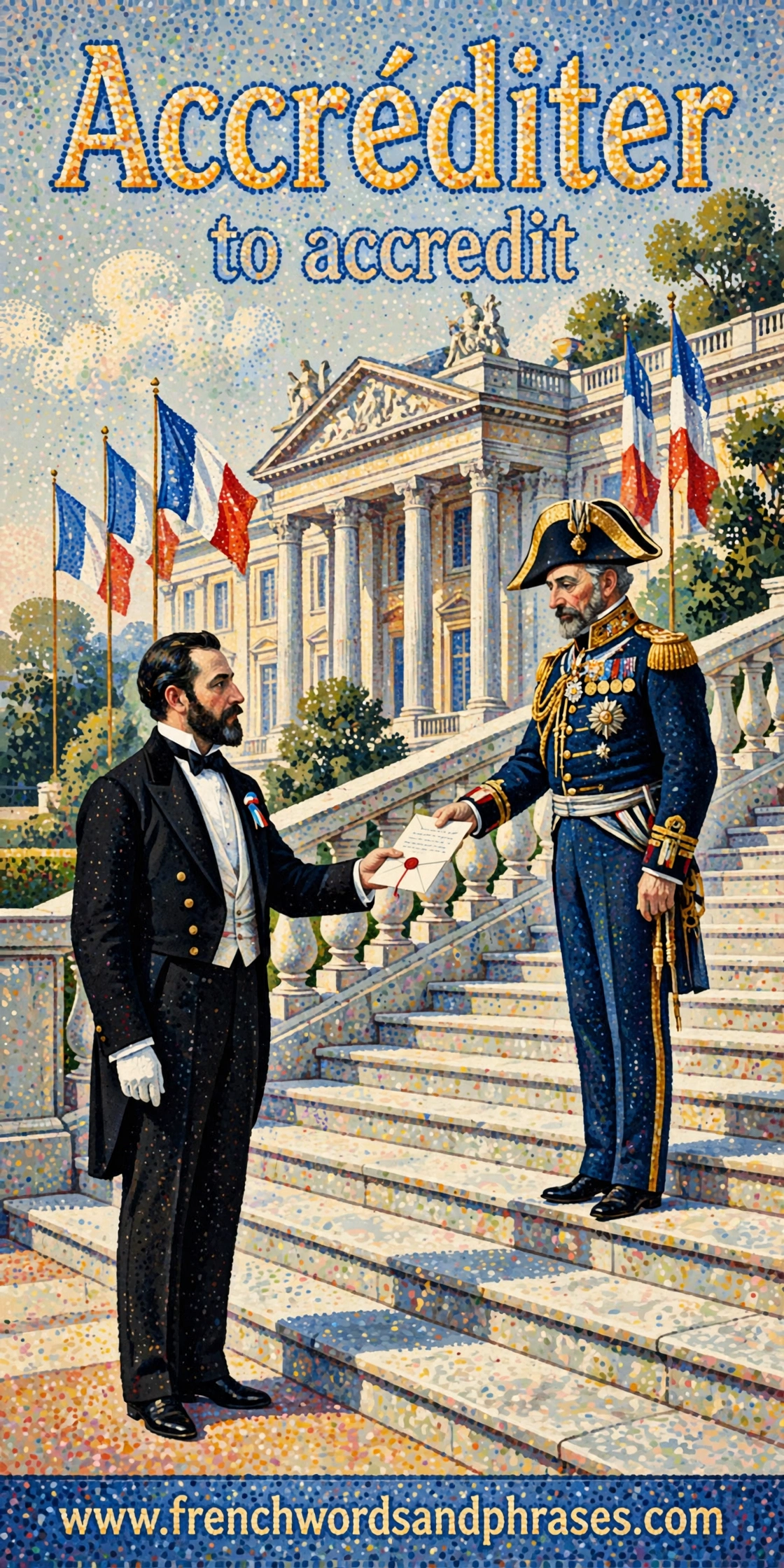
Accréditer means to accredit — to give someone or something official credit: a journalist authorised to cover an event, an ambassador recognised by a court, a theory backed by evidence.
A press badge handed over at a festival gate, an ambassador presenting his letters to a foreign court, a laboratory result that suddenly makes a theory believable — accréditer is the verb of official trust: to stamp someone, or something, as credible and authorised.
In this guide, you’ll learn how to conjugate accréditer in all the major French tenses and moods. Explore complete conjugation tables, French examples, English translations, and practice quizzes.
Understanding the French Verb Accréditer
Accréditer is a regular French verb belonging to the first group of verbs, those ending in-er.
It means to accredit. Festivals, summits and sporting events accréditent the press; states accréditent ambassadors auprès d’autres états; and in essays and newspapers, evidence accrédite a theory while careless reporting accrédite rumours. If you are officially allowed in with a badge around your neck, you are accrédité — the participle is the word on the badge itself.
Verb classification: First group (-er)
Auxiliary verb: Avoir
Past participle: accrédité
Present participle: accréditant
English equivalents: To accredit, to give credence to, to substantiate; accréditer un journaliste — to accredit a journalist; accréditer un ambassadeur auprès d’une cour — to accredit an ambassador to a court; accréditer une thèse — to lend credence to a theory; accréditer une rumeur — to give credence to a rumour; un photographe accrédité — an accredited photographer.
One important spelling detail: accréditer belongs to the espérer family — the é of the stem becomes è wherever the ending is mute: j’accrédite, tu accrédites, il accrédite, ils accréditent, subjunctive qu’il accrédite, imperative accrédite ! — but the future and conditional keep é: j’accréditerai, j’accréditerais, and nous/vous keep é too: nous accréditons. The word has two great uses: officially authorising people (journalists, ambassadors, laboratories — always auprès de for the body they are sent to) and lending belief to ideas: accréditer une thèse, une rumeur, une version des faits. Past participle accrédité.
Experience the Word
Accréditer is the verb of the official stamp — the moment an institution says: this person, this claim, may be trusted.
Imagine the press room of a great film festival an hour before the opening. A queue of photographers shuffles towards a desk; one by one, passports are checked, names are ticked, and a badge on a red cord is handed over. Each of them has just been accrédité — transformed from a tourist with a camera into the festival’s authorised witness. Behind the desk, nobody’s theory about the winning film is accréditée yet. That takes evidence of another kind.
The badge is only plastic and cord. But its owner has been accredited — accrédité — and every door in the building now opens.
How to Conjugate Accréditer: Complete French Conjugation Guide
Let’s explore every major conjugation of accréditer, beginning with the indicative mood.
How to Conjugate Accréditer in the Indicative Mood
The indicative mood is used to express facts, observations, actions, and events.
How to Conjugate Accréditer in the Present Tense (Présent)
Used for actionshappening now, habitual actions, and general truths.
| Subject | Conjugation |
|---|---|
| je | accrédite |
| tu | accrédites |
| il / elle | accrédite |
| nous | accréditons |
| vous | accréditez |
| ils / elles | accréditent |
Example
L’organisation accrédite les journalistes pour la conférence.
The organisation accredits the journalists for the conference.
Quick Quiz 1
Complete the sentence:
Nous ______ les photographes pour la cérémonie.
Reveal the answer
accréditons
Nous accréditons les photographes pour la cérémonie.
We accredit the photographers for the ceremony.
How to Conjugate Accréditer in the Passé Composé
Used for completed actions in the past. Accréditer takes the auxiliary verb avoir.
| Subject | Conjugation |
|---|---|
| j’ | ai accrédité |
| tu | as accrédité |
| il / elle | a accrédité |
| nous | avons accrédité |
| vous | avez accrédité |
| ils / elles | ont accrédité |
Example
La découverte a accrédité la thèse des chercheurs.
The discovery lent credence to the researchers’ theory.
How to Conjugate Accréditer in the Imparfait (Imperfect Tense)
Used for habitual past actions, descriptions, and ongoing situations in the past.
| Subject | Conjugation |
|---|---|
| je | accréditais |
| tu | accréditais |
| il / elle | accréditait |
| nous | accréditions |
| vous | accréditiez |
| ils / elles | accréditaient |
Example
Chaque année, l’ambassade accréditait les correspondants étrangers.
Every year, the embassy accredited the foreign correspondents.
Quick Quiz 2
Choose the correct form:
The congress accredited our whole team.
Le congrès ______ toute notre équipe. (a accrédité / est accrédité)
Reveal the answer
a accrédité
Le congrès a accrédité toute notre équipe.
Accréditer takes avoir.
How to Conjugate Accréditer in the Plus-que-parfait
Used to describe an action that had already been completed before another past event.
| Subject | Conjugation |
|---|---|
| j’ | avais accrédité |
| tu | avais accrédité |
| il / elle | avait accrédité |
| nous | avions accrédité |
| vous | aviez accrédité |
| ils / elles | avaient accrédité |
Example
Ils avaient accrédité deux photographes pour la cérémonie.
They had accredited two photographers for the ceremony.
How to Conjugate Accréditer in the Passé Simple
Primarily used in formal writing, literature, and historical narratives. It is rarely used in everyday conversation.
| Subject | Conjugation |
|---|---|
| je | accréditai |
| tu | accréditas |
| il / elle | accrédita |
| nous | accréditâmes |
| vous | accréditâtes |
| ils / elles | accréditèrent |
Example
Le ministère accrédita l’envoyé spécial auprès de la cour.
The ministry accredited the special envoy to the court.
How to Conjugate Accréditer in the Passé Antérieur
A literary tense used to express an action completed immediately before another past action, generally in the passé simple.
| Subject | Conjugation |
|---|---|
| j’ | eus accrédité |
| tu | eus accrédité |
| il / elle | eut accrédité |
| nous | eûmes accrédité |
| vous | eûtes accrédité |
| ils / elles | eurent accrédité |
Example
Quand le journal eut accrédité son reporter, il partit pour la capitale.
When the newspaper had accredited its reporter, he left for the capital.
How to Conjugate Accréditer in the Future Tense (Futur Simple)
Used to describe actions that will take place in the future.
| Subject | Conjugation |
|---|---|
| je | accréditerai |
| tu | accréditeras |
| il / elle | accréditera |
| nous | accréditerons |
| vous | accréditerez |
| ils / elles | accréditeront |
Example
Le festival accréditera la presse dès lundi.
The festival will accredit the press from Monday.
How to Conjugate Accréditer in the Futur Antérieur (Future Perfect)
Used for an action that will have been completed before a particular point in the future.
| Subject | Conjugation |
|---|---|
| j’ | aurai accrédité |
| tu | auras accrédité |
| il / elle | aura accrédité |
| nous | aurons accrédité |
| vous | aurez accrédité |
| ils / elles | auront accrédité |
Example
Quand tu auras accrédité tes invités, ils recevront leur badge.
When you have accredited your guests, they will receive their badge.
How to Conjugate Accréditer in the Near Future (Futur Proche)
Used to describe something that is going to happen soon. Formed with aller + infinitive.
| Subject | Conjugation |
|---|---|
| je | vais accréditer |
| tu | vas accréditer |
| il / elle | va accréditer |
| nous | allons accréditer |
| vous | allez accréditer |
| ils / elles | vont accréditer |
Example
Le ministère va accréditer un nouvel ambassadeur.
The ministry is going to accredit a new ambassador.
How to Conjugate Accréditer in the Conditional Mood
The conditional mood expresses what would happen under certain circumstances. It is also frequently used to make polite requests or express wishes.
How to Conjugate Accréditer in the Present Conditional
| Subject | Conjugation |
|---|---|
| je | accréditerais |
| tu | accréditerais |
| il / elle | accréditerait |
| nous | accréditerions |
| vous | accréditeriez |
| ils / elles | accréditeraient |
Example
Sans ces preuves, aucun expert n’accréditerait cette thèse.
Without this evidence, no expert would give credence to this theory.
How to Conjugate Accréditer in the Past Conditional
| Subject | Conjugation |
|---|---|
| j’ | aurais accrédité |
| tu | aurais accrédité |
| il / elle | aurait accrédité |
| nous | aurions accrédité |
| vous | auriez accrédité |
| ils / elles | auraient accrédité |
Example
Il aurait accrédité la rumeur s’il l’avait crue vraie.
He would have given credence to the rumour if he had believed it true.
Accréditer in the Literary Past Conditional Form
This less common literary form uses the imperfect subjunctive of avoir.
| Subject | Conjugation |
|---|---|
| j’ | eusse accrédité |
| tu | eusses accrédité |
| il / elle | eût accrédité |
| nous | eussions accrédité |
| vous | eussiez accrédité |
| ils / elles | eussent accrédité |
Example
Le savant eût accrédité la théorie sans les erreurs de calcul.
The scholar would have credited the theory, were it not for the errors in calculation.
How to Conjugate Accréditer in the Subjunctive Mood
The subjunctive is used to express wishes, emotions, doubts, necessity, and uncertainty. It frequently follows expressions such as il faut que (it is necessary that) or bien que (although).
How to Conjugate Accréditer in the Present Subjunctive
| Subject | Conjugation |
|---|---|
| que je | accrédite |
| que tu | accrédites |
| qu’il / qu’elle | accrédite |
| que nous | accréditions |
| que vous | accréditiez |
| qu’ils / qu’elles | accréditent |
Example
Il faut que le festival accrédite notre photographe.
The festival must accredit our photographer.
Quick Quiz 3
Complete the sentence using the subjunctive:
Il faut que vous ______ les correspondants avant le sommet.
Reveal the answer
accréditiez
Il faut que vous accréditiez les correspondants avant le sommet.
You must accredit the correspondents before the summit.
How to Conjugate Accréditer in the Imperfect Subjunctive
A literary tense, rarely encountered in modern spoken French.
| Subject | Conjugation |
|---|---|
| que je | accréditasse |
| que tu | accréditasses |
| qu’il / qu’elle | accréditât |
| que nous | accréditassions |
| que vous | accréditassiez |
| qu’ils / qu’elles | accréditassent |
Example
On attendait que l’agence accréditât ses correspondants avant le sommet.
They waited for the agency to accredit its correspondents before the summit.
How to Conjugate Accréditer in the Pluperfect Subjunctive
A literary construction used to express an action completed before another past action.
| Subject | Conjugation |
|---|---|
| que j’ | eusse accrédité |
| que tu | eusses accrédité |
| qu’il / qu’elle | eût accrédité |
| que nous | eussions accrédité |
| que vous | eussiez accrédité |
| qu’ils / qu’elles | eussent accrédité |
Example
On doutait que ce témoignage eût accrédité la version officielle.
People doubted that this testimony had substantiated the official version.
How to Conjugate Accréditer in the Past Subjunctive
| Subject | Conjugation |
|---|---|
| que j’ | aie accrédité |
| que tu | aies accrédité |
| qu’il / qu’elle | ait accrédité |
| que nous | ayons accrédité |
| que vous | ayez accrédité |
| qu’ils / qu’elles | aient accrédité |
Example
Je suis heureux que le congrès ait accrédité toute notre équipe.
I am glad the congress accredited our whole team.
How to Conjugate Accréditer in the Imperative
The imperative is used to give commands, instructions, invitations, or suggestions. Subject pronouns are omitted.
How to Conjugate Accréditer in the Present Imperative
| Person | Conjugation |
|---|---|
| (tu) | accrédite |
| (nous) | accréditons |
| (vous) | accréditez |
Example
Accréditez les journalistes à l’entrée, s’il vous plaît !
Accredit the journalists at the entrance, please!
Quick Quiz 4
How would you say Accredit our photographer (tu form)?
Reveal the answer
Accrédite notre photographe !
French Participles of Accréditer
Participles are verb forms that can be used in compound tenses and other grammatical constructions.
Present Participle of Accréditer
accréditant
En accréditant cette rumeur, le journal a commis une erreur.
By giving credence to this rumour, the newspaper made a mistake.
Past Participle of Accréditer
accrédité
Accrédité auprès du festival, le photographe avait accès aux coulisses.
Accredited to the festival, the photographer had access backstage.
Accréditer in Everyday French: Real-Life Examples
Now that you know the conjugations, let’s see how accréditer appears in everyday French.
Example 1 — Present
Le festival accrédite les journalistes dès lundi.
The festival accredits journalists from Monday.
Example 2 — Passé composé
La découverte a accrédité la thèse des chercheurs.
The discovery lent credence to the researchers’ theory.
Example 3 — Imparfait
L’ambassade accréditait les correspondants étrangers.
The embassy used to accredit the foreign correspondents.
Example 4 — Future
Le ministère accréditera un nouvel ambassadeur.
The ministry will accredit a new ambassador.
Example 5 — Conditional
Aucun expert n’accréditerait cette thèse sans preuves.
No expert would credit this theory without evidence.
Example 6 — Imperative
Accrédite notre photographe auprès du festival !
Accredit our photographer to the festival!
Beyond Translation: The Meaning of Accréditer
English accredit is the same word, from the same Latin root — credere, to believe, to trust — which also gives French le crédit and English credible.
To accredit is to lend belief, officially.
That is why one verb serves both the badge desk and the laboratory: the accredited journalist is believed to belong, the accredited theory is believed to be true. Be careful with rumours, though — accréditer une rumeur is how false stories borrow a badge they never earned.
How to Remember the French Verb Accréditer
Remember it this way: Accréditer is about the press badge on its red cord — belief, officially stamped.
- Espérer-type spelling: j’accrédite with è before mute endings, but j’accréditerai with é in the future.
- Two jobs: authorising people (accréditer un journaliste, auprès du festival) and backing ideas (accréditer une thèse).
- Past participle accrédité — the word printed on every press badge in France.
The key idea is the press badge on its red cord — belief, officially stamped.
Test Your Knowledge of Accréditer
Let’s see how much you’ve learned. Try answering these questions before revealing the answers.
Question 1
Why does j’accrédite take è but j’accréditerai keep é?
Reveal the answer
The espérer rule — é becomes è before a mute ending (j’accrédite), and stays é in the future and conditional stems (j’accréditerai).
Question 2
How do you say The discovery lent credence to the researchers’ theory in French?
Reveal the answer
La découverte a accrédité la thèse des chercheurs.
Question 3
Translate: The festival accredits journalists from Monday.
Reveal the answer
Le festival accrédite les journalistes dès lundi.
Question 4
What is the past participle of accréditer?
Reveal the answer
Accrédité.
Question 5
Complete the sentence:
Il faut que le festival ______ notre photographe.
Reveal the answer
accrédite
Il faut que le festival accrédite notre photographe.
The festival must accredit our photographer.
Your Final Challenge
Can You Use It?
How would you say this in French?
Every spring, the festival accredits hundreds of journalists, and every badge tells the same story: you can be believed.
Reveal the answer
Chaque printemps, le festival accrédite des centaines de journalistes, et chaque badge raconte la même histoire : on peut vous croire.
Every spring, the festival accredits hundreds of journalists, and every badge tells the same story: you can be believed.
A little French. A little curiosity. A richer everyday life.
LEARN FRENCH ONE WORD AT A TIME




