A French Word to Live By
Translate Accoutumé to English
/a.ku.ty.me/
Accoutumé means accustomed.
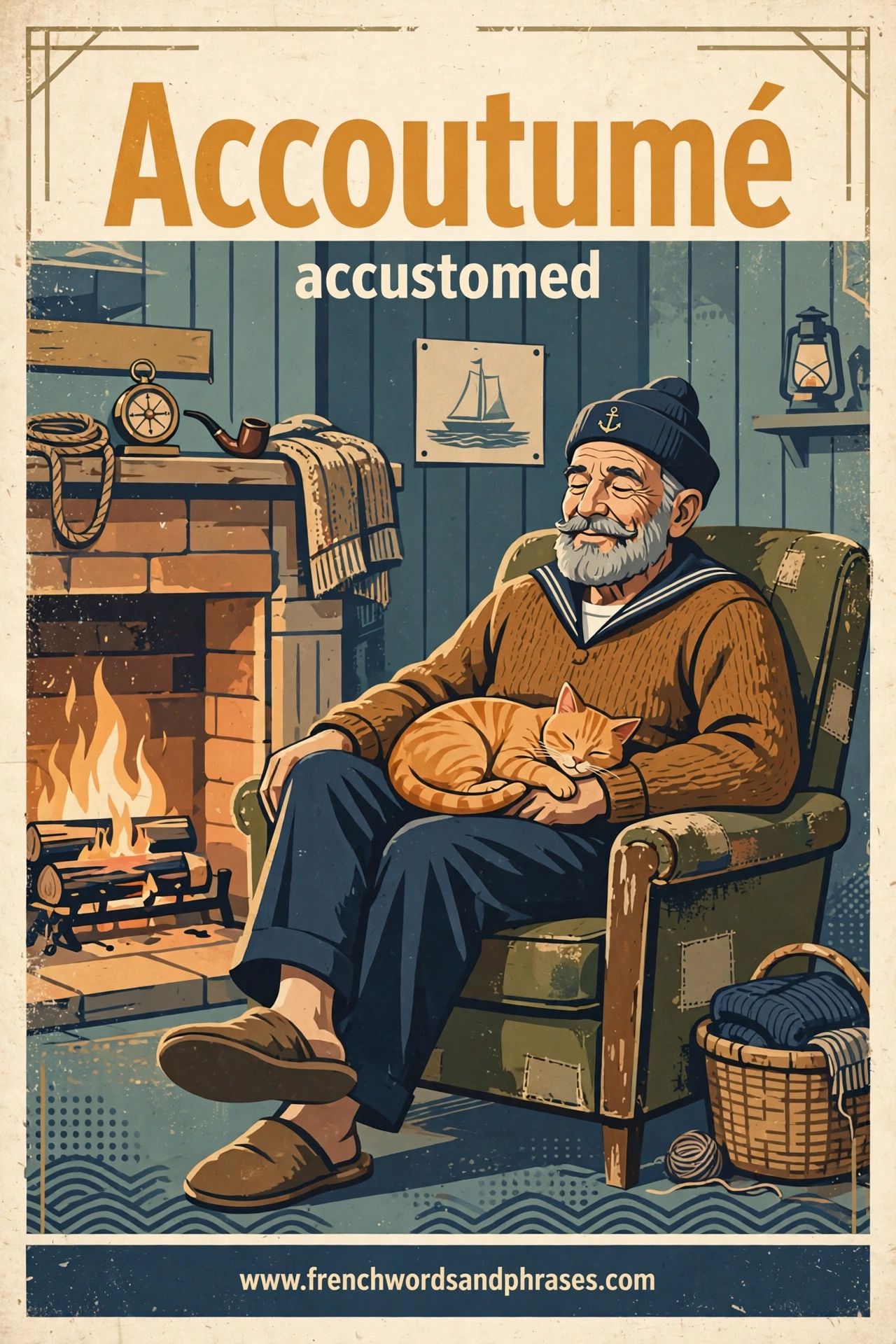
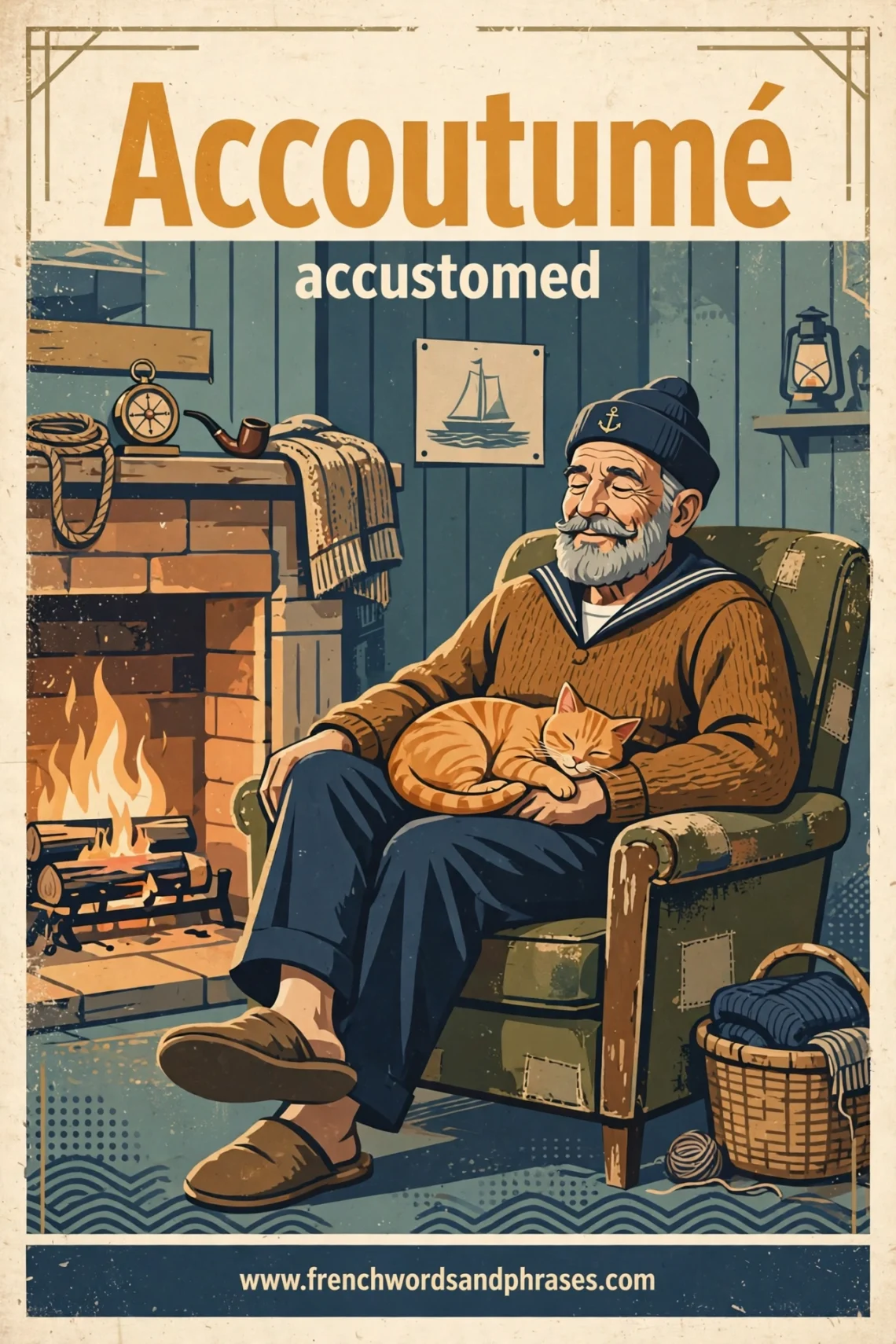
Every morning at seven, the old fisherman walks the harbour wall with his thermos, whatever the weather. The gulls do not even move any more. « Il est accoutumé », laughs the café owner, setting out his usual cup. Accoutumé is the adjective of habit settled deep: used to something, at home with it, shaped by a thousand repetitions.
In this guide, you’ll learn what accoutumé means in English, how its feminine accoutumée is formed, the preposition à that always walks beside it, and the beautiful set phrase comme à l’accoutumée — as usual. Explore French examples, English translations, and practice quizzes.
Understanding the French Adjective Accoutumé
Accoutumé is a French adjective of quality — the adjective of settled habit. It is the past participle of the verb accoutumer, almost always used in its reflexive form s’accoutumer (to get used to), working as an adjective: un œil accoutumé, une oreille accoutumée, des mains accoutumées. It never travels alone: the thing you are used to is introduced by à — accoutumé au froid, accustomed to the cold.
It means accustomed — used to, in the habit of: accoutumé à la solitude, accustomed to solitude; un palais accoutumé aux épices, a palate accustomed to spices. In its most loved phrase it turns into a noun: comme à l’accoutumée, as usual — the way things are always done.
Type: Adjective of quality — habit; past participle of (s’)accoutumer
Answers the question: What is he like? — accustomed, used to it, in the habit
Changes form: Feminine adds -e — accoutumé / accoutumée; plurals accoutumés / accoutumées
English equivalents: Accustomed; used to; wonted; habitual.
One important usage detail: accoutumé is always followed by à before the habit — accoutumé au bruit, accustomed to the noise; accoutumé à travailler tôt, accustomed to working early. Note that au is simply à + le in disguise. And when French wants the everyday, spoken version, it often switches to the shorter habitué: je suis habitué, I’m used to it.
Experience the Word
Accoutumé is the adjective of the well-worn path — the sailor’s legs that no longer notice the swell, the baker’s hands that judge the oven without a thermometer, the ear that sleeps through the church bells.
Imagine a lighthouse keeper’s daughter who has read by storm-light all her life. Visitors flinch at the thunder; she turns a page. She is accoutumée — the extraordinary has become her ordinary, and there is a quiet strength in it.
You have not just said someone is used to something. You have named habit become second nature — accoutumé, what a thousand days have made easy.
How to Use Accoutumé in French: Complete Guide
Let’s explore how accoutumé works in French, beginning with the whole word on one card.
Accoutumé at a Glance
Before the details, here is the whole word on one card.
The Whole Word on One Card
Meaning, type, position and forms — accoutumé in four lines.
| Point | Accoutumé |
|---|---|
| Meaning | accustomed — used to, in the habit of |
| Type | adjective of quality — habit (participle of s’accoutumer) |
| Usual position | after the noun or être, followed by à — accoutumé au froid |
| Form | accoutumé / accoutumée — accoutumés / accoutumées in the plural |
Example
Il est accoutumé au froid du matin.
He is accustomed to the morning cold.
The Four Forms of Accoutumé
Accoutumé follows the regular participle pattern: the feminine adds an e, the plurals add an s.
| Form | Accoutumé | Example |
|---|---|---|
| Masculine singular | accoutumé | un œil accoutumé — an accustomed eye |
| Feminine singular | accoutumée | une oreille accoutumée — an accustomed ear |
| Masculine plural | accoutumés | des marins accoutumés — accustomed sailors |
| Feminine plural | accoutumées | des mains accoutumées — accustomed hands |
Example
Des mains accoutumées reconnaissent l’outil sans regarder.
Accustomed hands recognise the tool without looking.
Quick Quiz 1
What is the feminine of accoutumé?
Reveal the answer
accoutumée
Une oreille accoutumée — the feminine adds an e.
An accustomed ear.
The Feminine of Accoutumé: Accoutumée
Accoutumée is not a separate word to learn later — it is half of this word’s life, formed exactly like the feminine of habitué or arrivé.
| Situation | Example |
|---|---|
| Masculine | un lecteur accoutumé — an accustomed reader |
| Feminine | une lectrice accoutumée — identical but for the added e |
| Why | participle adjectives in -é form their feminine with -ée |
| The plural | add s — des lectrices accoutumées, accustomed readers |
Example
La lectrice, accoutumée aux romans fleuves, finit le tome en deux jours.
The reader, accustomed to long novels, finishes the volume in two days.
Where Accoutumé Goes: With À, Always
Accoutumé follows the noun or être, and the habit itself is introduced by à — au, aux and à l’ included.
| Pattern | Example |
|---|---|
| With à + noun | accoutumé au bruit — accustomed to the noise |
| With à + infinitive | accoutumé à travailler tôt — accustomed to working early |
| After être | elle est accoutumée à la solitude — she is accustomed to solitude |
| The set phrase | comme à l’accoutumée — as usual |
Example
Comme à l’accoutumée, le café ouvre à six heures.
As usual, the café opens at six o’clock.
Quick Quiz 2
How do you say ‘accustomed to the noise’ — accoutumé le bruit or accoutumé au bruit?
Reveal the answer
accoutumé au bruit
The habit is introduced by à — and à + le becomes au.
Accustomed to the noise.
More Accoutumé: Comparing with Accoutumé
Accoutumé compares the regular way, with plus, moins and aussi — habit, too, has its degrees.
| Degree | Example |
|---|---|
| As accustomed as | aussi accoutumé que — as accustomed as |
| More accustomed | plus accoutumé — more accustomed |
| Less accustomed | moins accoutumé — less accustomed |
| The most accustomed (masc.) | le plus accoutumé — le plus accoutumé des marins |
| The most accustomed (fem.) | la plus accoutumée — la plus accoutumée des lectrices |
Example
Personne n’est plus accoutumé à la mer que ce vieux pêcheur.
No one is more accustomed to the sea than this old fisherman.
Everyday Expressions with Accoutumé
Accoutumé appears wherever French talks about habits — and in one phrase every learner should steal at once.
| Expression | In English |
|---|---|
| comme à l’accoutumée | as usual — the set phrase |
| accoutumé au froid | accustomed to the cold |
| accoutumé à travailler tôt | accustomed to working early |
| un œil accoutumé | an accustomed, practised eye |
| être accoutumé à | to be accustomed to |
| s’accoutumer à | to get used to — the verb |
Example
Un œil accoutumé voit le défaut que les autres manquent.
An accustomed eye sees the flaw that others miss.
Quick Quiz 3
What does comme à l’accoutumée mean?
Reveal the answer
As usual
Comme à l’accoutumée — in the accustomed way, as things are always done.
As usual.
Accoutumé and Its Neighbours
Accoutumé stands in the family of habit, between its everyday twin habitué and its elegant cousin coutumier.
| French | In English |
|---|---|
| habitué | used to, accustomed — the everyday twin: je suis habitué |
| coutumier | customary, habitual — un geste coutumier |
| la coutume | the custom, the habit — the noun at its heart |
| s’accoutumer | to get used to — the verb it comes from |
| dérouté | thrown off, unsettled — the opposite feeling |
| l’habitude | the habit — the everyday noun |
Example
Habitué au bruit de la ville, il reste accoutumé aux nuits silencieuses de la campagne.
Used to the city’s noise, he is still becoming accustomed to the countryside’s silent nights.
Watch Out: The Traps Around Accoutumé
The traps here are the little à that must never be dropped, and a verb that lives in reflexive dress.
| Trap | The truth |
|---|---|
| The preposition | accoutumé à, never without it — accoutumé au froid, accoutumée à la chaleur |
| The verb | to get used to is s’accoutumer à; plain accoutumer someone means to accustom them — rare and formal |
| Agreement | une oreille accoutumée, des oreilles accoutumées — the participle agrees like any adjective |
| The register | accoutumé is a touch literary; everyday speech often prefers habitué |
Example
Elle s’est vite accoutumée au rythme de la boulangerie.
She quickly got used to the bakery’s rhythm.
Quick Quiz 4
How do you say ‘accustomed hands’?
Reveal the answer
des mains accoutumées
Accoutumé follows the noun and agrees: feminine plural accoutumées.
Accustomed hands.
Accoutumé in Everyday French: Real-Life Examples
Now that you know the word, let’s see how accoutumé appears in everyday French.
Example 1 — Morning routine
Comme à l’accoutumée, il se lève à cinq heures.
As usual, he gets up at five o’clock.
Example 2 — At sea
Les marins accoutumés ne sentent plus le roulis.
The accustomed sailors no longer feel the rolling.
Example 3 — At the desk
Son œil accoutumé repère la faute aussitôt.
His accustomed eye spots the mistake at once.
Example 4 — Weather
Accoutumée au vent, elle ne ferme jamais les volets.
Accustomed to the wind, she never closes the shutters.
Example 5 — Food
Un palais accoutumé aux épices demande toujours plus.
A palate accustomed to spices always asks for more.
Example 6 — A new job
Pas encore accoutumé aux horaires, il bâille en réunion.
Not yet accustomed to the hours, he yawns in the meeting.
Beyond Translation: The Meaning of Accoutumé
English speakers can feel accoutumé’s root without help: custom — the word is built on coutume, a custom, the thing a community or a life repeats until it fits like clothing. French even turned the adjective back into a noun for its loveliest phrase, l’accoutumée, the accustomed way.
Accoutumé is the adjective of habit become nature — what once took effort, now done by eyes, ears and hands that no longer need to think.
Learn it with its inseparable à and its famous phrase comme à l’accoutumée, and you can describe every routine in French, from the fisherman’s walk to the café’s opening hour.
How to Remember the French Adjective Accoutumé
Remember it this way: Accoutumé is the accustomed adjective — accoutumé for him, accoutumée for her, and à always introduces the habit.
- You learn the pair together — un œil accoutumé, une oreille accoutumée.
- You keep the little key — accoutumé à, au froid, à la solitude, à travailler tôt.
- You steal the phrase — comme à l’accoutumée, comme d’habitude, as usual.
The key idea is accoutumé / accoutumée means accustomed, used to — always with à; comme à l’accoutumée = as usual.
Test Your Knowledge of Accoutumé
Let’s see how much you’ve learned. Try answering these questions before revealing the answers.
Question 1
What does accoutumé mean?
Reveal the answer
Accustomed — used to something, in the habit of it.
Question 2
What is the feminine of accoutumé?
Reveal the answer
accoutumée — the feminine adds an e.
Question 3
Translate: accustomed to the cold.
Reveal the answer
Accoutumé au froid.
Question 4
Complete the sentence:
Ses mains ______ reconnaissent chaque outil.
Reveal the answer
accoutumées
Ses mains accoutumées reconnaissent chaque outil.
Her accustomed hands recognise every tool.
Question 5
How do you say ‘as usual’ with this word?
Reveal the answer
comme à l’accoutumée — the set phrase, with the adjective turned noun.
Your Final Challenge
Can You Use It?
How would you say this in French?
“As usual, the café opens at six o’clock.”
Reveal the answer
Comme à l’accoutumée, le café ouvre à six heures.
As usual, the café opens at six o’clock.
A little French. A little curiosity. A richer everyday life.
LEARN FRENCH ONE WORD AT A TIME