
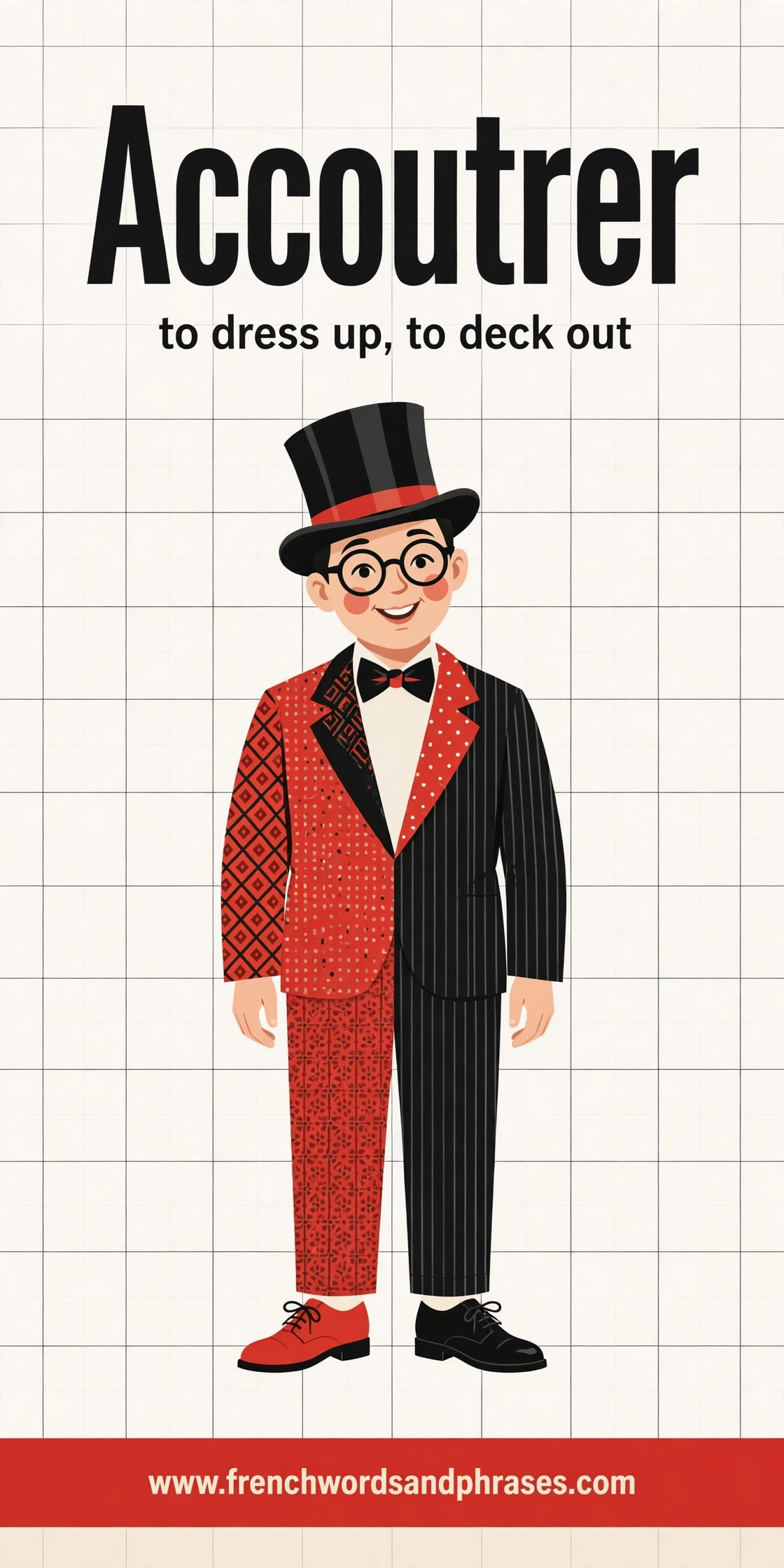
A French Word to Live By
How to Conjugate Accoutrer in French
/a.ku.tʁe/
Accoutrer means to dress up, to deck out — almost always with a smile: to rig someone out in clothes that are odd, old-fashioned or ridiculous.
Carnival morning: a father in a too-small pirate hat, a grandmother wearing curtains as a cape, a dog in a knitted waistcoat — accoutrer is the verb of dressing up badly on purpose: decking out, rigging out, in outfits no tailor would sign.
In this guide, you’ll learn how to conjugate accoutrer in all the major French tenses and moods. Explore complete conjugation tables, French examples, English translations, and practice quizzes.
Understanding the French Verb Accoutrer
Accoutrer is a regular French verb belonging to the first group of verbs, those ending in-er.
It means to dress up, to deck out. It belongs to carnivals, school plays, fancy-dress parties and teasing between friends — any scene where the clothes are the joke. The noun un accoutrement names the whole get-up, and journalists reach for both words when a public figure appears in a truly remarkable outfit.
Verb classification: First group (-er)
Auxiliary verb: Avoir
Past participle: accoutré
Present participle: accoutrant
English equivalents: To deck out, to rig out, to dress up (oddly); accoutrer quelqu’un de — to deck someone out in; s’accoutrer — to get oneself rigged out, to dress up strangely; accoutré d’un manteau trop grand — decked out in a too-big coat; un accoutrement — a strange get-up, an outfit (often ridiculous).
One important detail: accoutrer is almost never a compliment. Where habiller dresses and parer adorns, accoutrer decks someone out in something strange — the word itself is chuckling: comment t’es-tu accoutré ? means “what on earth have you got on?”. The reflexive s’accoutrer is the commonest form, and it takes être with agreement: elle s’est accoutrée d’un chapeau vert. The plain verb is perfectly regular: j’accoutre, nous accoutrons, past participle accoutré.
Experience the Word
Accoutrer is the verb of the glorious get-up — dressing that is too much, too old or too strange, and worn with total confidence.
Imagine the village carnival. Monsieur le maire leads the parade accoutré d’un manteau de son grand-père, d’un chapeau à plumes et de bottes dépareillées — decked out in his grandfather’s coat, a feathered hat and odd boots. The children shriek with laughter, the mayor waves like a king, and nobody in the village would trade his accoutrement for a proper suit.
He is not dressed, exactly. He is rigged out — accoutré — and the whole village is richer for it.
How to Conjugate Accoutrer: Complete French Conjugation Guide
Let’s explore every major conjugation of accoutrer, beginning with the indicative mood.
How to Conjugate Accoutrer in the Indicative Mood
The indicative mood is used to express facts, observations, actions, and events.
How to Conjugate Accoutrer in the Present Tense (Présent)
Used for actions happening now, habitual actions, and general truths.
| Subject | Conjugation |
|---|---|
| je | accoutre |
| tu | accoutres |
| il / elle | accoutre |
| nous | accoutrons |
| vous | accoutrez |
| ils / elles | accoutrent |
Example
Pour le carnaval, elle accoutre ses enfants de vieux rideaux.
For the carnival, she decks her children out in old curtains.
Quick Quiz 1
Complete the sentence:
Nous ______ les enfants pour le carnaval.
Reveal the answer
accoutrons
Nous accoutrons les enfants pour le carnaval.
We deck the children out for the carnival.
How to Conjugate Accoutrer in the Passé Composé
Used for completed actions in the past. Accoutrer takes the auxiliary verb avoir.
| Subject | Conjugation |
|---|---|
| j’ | ai accoutré |
| tu | as accoutré |
| il / elle | a accoutré |
| nous | avons accoutré |
| vous | avez accoutré |
| ils / elles | ont accoutré |
Example
Ils l’ont accoutré d’une cape rouge pour la pièce de théâtre.
They decked him out in a red cape for the school play.
How to Conjugate Accoutrer in the Imparfait (Imperfect Tense)
Used for habitual past actions, descriptions, and ongoing situations in the past.
| Subject | Conjugation |
|---|---|
| je | accoutrais |
| tu | accoutrais |
| il / elle | accoutrait |
| nous | accoutrions |
| vous | accoutriez |
| ils / elles | accoutraient |
Example
Pour rire, il accoutrait son chien d’un petit manteau.
For fun, he used to deck his dog out in a little coat.
Quick Quiz 2
Choose the correct form:
They decked the dog out in a checked coat.
Ils ______ le chien d’un manteau à carreaux. (ont accoutré / sont accoutré)
Reveal the answer
ont accoutré
Ils ont accoutré le chien d’un manteau à carreaux.
Accoutrer takes avoir.
How to Conjugate Accoutrer in the Plus-que-parfait
Used to describe an action that had already been completed before another past event.
| Subject | Conjugation |
|---|---|
| j’ | avais accoutré |
| tu | avais accoutré |
| il / elle | avait accoutré |
| nous | avions accoutré |
| vous | aviez accoutré |
| ils / elles | avaient accoutré |
Example
Elle avait accoutré la poupée de rubans et de dentelles.
She had decked the doll out in ribbons and lace.
How to Conjugate Accoutrer in the Passé Simple
Primarily used in formal writing, literature, and historical narratives. It is rarely used in everyday conversation.
| Subject | Conjugation |
|---|---|
| je | accoutrai |
| tu | accoutras |
| il / elle | accoutra |
| nous | accoutrâmes |
| vous | accoutrâtes |
| ils / elles | accoutrèrent |
Example
La couturière accoutra le mannequin de tissus éclatants.
The seamstress decked the mannequin out in bright fabrics.
How to Conjugate Accoutrer in the Passé Antérieur
A literary tense used to express an action completed immediately before another past action, generally in the passé simple.
| Subject | Conjugation |
|---|---|
| j’ | eus accoutré |
| tu | eus accoutré |
| il / elle | eut accoutré |
| nous | eûmes accoutré |
| vous | eûtes accoutré |
| ils / elles | eurent accoutré |
Example
Quand ils eurent accoutré le clown, le spectacle commença.
When they had rigged out the clown, the show began.
How to Conjugate Accoutrer in the Future Tense (Futur Simple)
Used to describe actions that will take place in the future.
| Subject | Conjugation |
|---|---|
| je | accoutrerai |
| tu | accoutreras |
| il / elle | accoutrera |
| nous | accoutrerons |
| vous | accoutrerez |
| ils / elles | accoutreront |
Example
Demain, tu accoutreras les enfants pour le défilé du carnaval.
Tomorrow, you will deck the children out for the carnival parade.
How to Conjugate Accoutrer in the Futur Antérieur (Future Perfect)
Used for an action that will have been completed before a particular point in the future.
| Subject | Conjugation |
|---|---|
| j’ | aurai accoutré |
| tu | auras accoutré |
| il / elle | aura accoutré |
| nous | aurons accoutré |
| vous | aurez accoutré |
| ils / elles | auront accoutré |
Example
Quand tu auras accoutré le personnage, la scène pourra commencer.
When you have rigged out the character, the scene can begin.
How to Conjugate Accoutrer in the Near Future (Futur Proche)
Used to describe something that is going to happen soon. Formed with aller + infinitive.
| Subject | Conjugation |
|---|---|
| je | vais accoutrer |
| tu | vas accoutrer |
| il / elle | va accoutrer |
| nous | allons accoutrer |
| vous | allez accoutrer |
| ils / elles | vont accoutrer |
Example
Elle va accoutrer son frère d’un déguisement de pirate.
She is going to deck her brother out in a pirate costume.
How to Conjugate Accoutrer in the Conditional Mood
The conditional mood expresses what would happen under certain circumstances. It is also frequently used to make polite requests or express wishes.
How to Conjugate Accoutrer in the Present Conditional
| Subject | Conjugation |
|---|---|
| je | accoutrerais |
| tu | accoutrerais |
| il / elle | accoutrerait |
| nous | accoutrerions |
| vous | accoutreriez |
| ils / elles | accoutreraient |
Example
Avec ces vieux vêtements, on accoutrerait tout le village pour le carnaval.
With these old clothes, we could rig out the whole village for the carnival.
How to Conjugate Accoutrer in the Past Conditional
| Subject | Conjugation |
|---|---|
| j’ | aurais accoutré |
| tu | aurais accoutré |
| il / elle | aurait accoutré |
| nous | aurions accoutré |
| vous | auriez accoutré |
| ils / elles | auraient accoutré |
Example
Elle aurait accoutré les enfants plus tôt sans la pluie.
She would have decked the children out earlier if not for the rain.
Accoutrer in the Literary Past Conditional Form
This less common literary form uses the imperfect subjunctive of avoir.
| Subject | Conjugation |
|---|---|
| j’ | eusse accoutré |
| tu | eusses accoutré |
| il / elle | eût accoutré |
| nous | eussions accoutré |
| vous | eussiez accoutré |
| ils / elles | eussent accoutré |
Example
Elle eût accoutré le mannequin de soie sans la pénurie de tissu.
She would have decked the mannequin out in silk, were it not for the shortage of cloth.
How to Conjugate Accoutrer in the Subjunctive Mood
The subjunctive is used to express wishes, emotions, doubts, necessity, and uncertainty. It frequently follows expressions such as il faut que (it is necessary that) or bien que (although).
How to Conjugate Accoutrer in the Present Subjunctive
| Subject | Conjugation |
|---|---|
| que je | accoutre |
| que tu | accoutres |
| qu’il / qu’elle | accoutre |
| que nous | accoutrions |
| que vous | accoutriez |
| qu’ils / qu’elles | accoutrent |
Example
Je ne veux pas que tu accoutres le chat de ce chapeau ridicule.
I do not want you decking the cat out in that ridiculous hat.
Quick Quiz 3
Complete the sentence using the subjunctive:
Je suis amusé que vous ______ le mannequin de ces tissus éclatants.
Reveal the answer
ayez accoutré
Je suis amusé que vous ayez accoutré le mannequin de ces tissus éclatants.
I am amused that you decked the mannequin out in those bright fabrics.
How to Conjugate Accoutrer in the Imperfect Subjunctive
A literary tense, rarely encountered in modern spoken French.
| Subject | Conjugation |
|---|---|
| que je | accoutrasse |
| que tu | accoutrasses |
| qu’il / qu’elle | accoutrât |
| que nous | accoutrassions |
| que vous | accoutrassiez |
| qu’ils / qu’elles | accoutrassent |
Example
Tout le village plaisantait à l’idée qu’on accoutrât le maire d’un costume de clown.
The whole village joked at the idea of the mayor being rigged out in a clown costume.
How to Conjugate Accoutrer in the Pluperfect Subjunctive
A literary construction used to express an action completed before another past action.
| Subject | Conjugation |
|---|---|
| que j’ | eusse accoutré |
| que tu | eusses accoutré |
| qu’il / qu’elle | eût accoutré |
| que nous | eussions accoutré |
| que vous | eussiez accoutré |
| qu’ils / qu’elles | eussent accoutré |
Example
On raconta qu’elle eût accoutré ses invités de costumes du siècle passé.
It was said she had decked her guests out in costumes from the last century.
How to Conjugate Accoutrer in the Past Subjunctive
| Subject | Conjugation |
|---|---|
| que j’ | aie accoutré |
| que tu | aies accoutré |
| qu’il / qu’elle | ait accoutré |
| que nous | ayons accoutré |
| que vous | ayez accoutré |
| qu’ils / qu’elles | aient accoutré |
Example
Je suis amusé qu’ils aient accoutré le chien d’un manteau à carreaux.
I am amused that they decked the dog out in a checked coat.
How to Conjugate Accoutrer in the Imperative
The imperative is used to give commands, instructions, invitations, or suggestions. Subject pronouns are omitted.
How to Conjugate Accoutrer in the Present Imperative
| Person | Conjugation |
|---|---|
| (tu) | accoutre |
| (nous) | accoutrons |
| (vous) | accoutrez |
Example
Accoutre-toi de tes plus vieux vêtements pour la fête !
Deck yourself out in your oldest clothes for the party!
Quick Quiz 4
How would you say Deck yourself out, it is carnival (tu form)?
Reveal the answer
Accoutre-toi, c’est carnaval !
French Participles of Accoutrer
Participles are verb forms that can be used in compound tenses and other grammatical constructions.
Present Participle of Accoutrer
accoutrant
En accoutrant le mannequin, elle riait de son œuvre.
While decking out the mannequin, she laughed at her handiwork.
Past Participle of Accoutrer
accoutré
Accoutré d’un manteau trop grand, il faisait rire tout le quartier.
Decked out in a too-big coat, he made the whole neighbourhood laugh.
Accoutrer in Everyday French: Real-Life Examples
Now that you know the conjugations, let’s see how accoutrer appears in everyday French.
Example 1 — Present
Elle accoutre ses enfants pour le carnaval.
She decks her children out for the carnival.
Example 2 — Passé composé
Il s’est accoutré d’un chapeau vert et d’un manteau trop grand.
He rigged himself out in a green hat and a too-big coat.
Example 3 — Imparfait
Il accoutrait son chien d’un petit manteau.
He used to deck his dog out in a little coat.
Example 4 — Future
Tu accoutreras les enfants pour le défilé.
You will deck the children out for the parade.
Example 5 — Conditional
On accoutrerait tout le village avec ces vieux vêtements.
We could rig out the whole village with these old clothes.
Example 6 — Imperative
Accoutre-toi comme tu veux, c’est carnaval !
Deck yourself out as you like, it is carnival!
Beyond Translation: The Meaning of Accoutrer
English has no single verb for accoutrer — deck out and rig out come close, but neither carries the raised eyebrow.
Accoutrer is dressing with the volume of comedy turned up.
Its noun, un accoutrement, is the get-up itself, and French speakers aim both words like friendly fire: quel accoutrement ! What saves the verb from cruelty is that it is usually affectionate — the carnival mayor accoutré is the hero of the day, not its fool.
How to Remember the French Verb Accoutrer
Remember it this way: Accoutrer is about the carnival mayor in his grandfather’s coat, a feathered hat and odd boots.
- Accoutrer is dressing up with a grin: odd, old or ridiculous clothes — never a compliment, often affectionate.
- The everyday form is reflexive: s’accoutrer de — elle s’est accoutrée d’un chapeau vert (with être and agreement).
- Regular -er: j’accoutre, nous accoutrons, past participle accoutré; the outfit itself is un accoutrement.
The key idea is the carnival mayor in his grandfather’s coat, a feathered hat and odd boots.
Test Your Knowledge of Accoutrer
Let’s see how much you’ve learned. Try answering these questions before revealing the answers.
Question 1
Why is accoutrer not a compliment?
Reveal the answer
It implies a strange or ridiculous outfit — accoutrer decks someone out oddly; habiller simply dresses them.
Question 2
How do you say They decked him out in a red cape in French?
Reveal the answer
Ils l’ont accoutré d’une cape rouge.
Question 3
Translate: He rigged himself out in a green hat and a too-big coat.
Reveal the answer
Il s’est accoutré d’un chapeau vert et d’un manteau trop grand.
Question 4
What is the past participle of accoutrer?
Reveal the answer
Accoutré.
Question 5
Complete the sentence:
Je ne veux pas que tu ______ le chat de ce chapeau ridicule.
Reveal the answer
accoutres
Je ne veux pas que tu accoutres le chat de ce chapeau ridicule.
I do not want you decking the cat out in that ridiculous hat.
Your Final Challenge
Can You Use It?
How would you say this in French?
Decked out in a feathered hat and odd boots, the mayor opened the carnival to applause.
Reveal the answer
Accoutré d’un chapeau à plumes et de bottes dépareillées, le maire a ouvert le carnaval sous les applaudissements.
Decked out in a feathered hat and odd boots, the mayor opened the carnival to applause.
A little French. A little curiosity. A richer everyday life.
LEARN FRENCH ONE WORD AT A TIME




