A French Word to Live By
How to Conjugate Accoupler in French
/a.ku.ple/
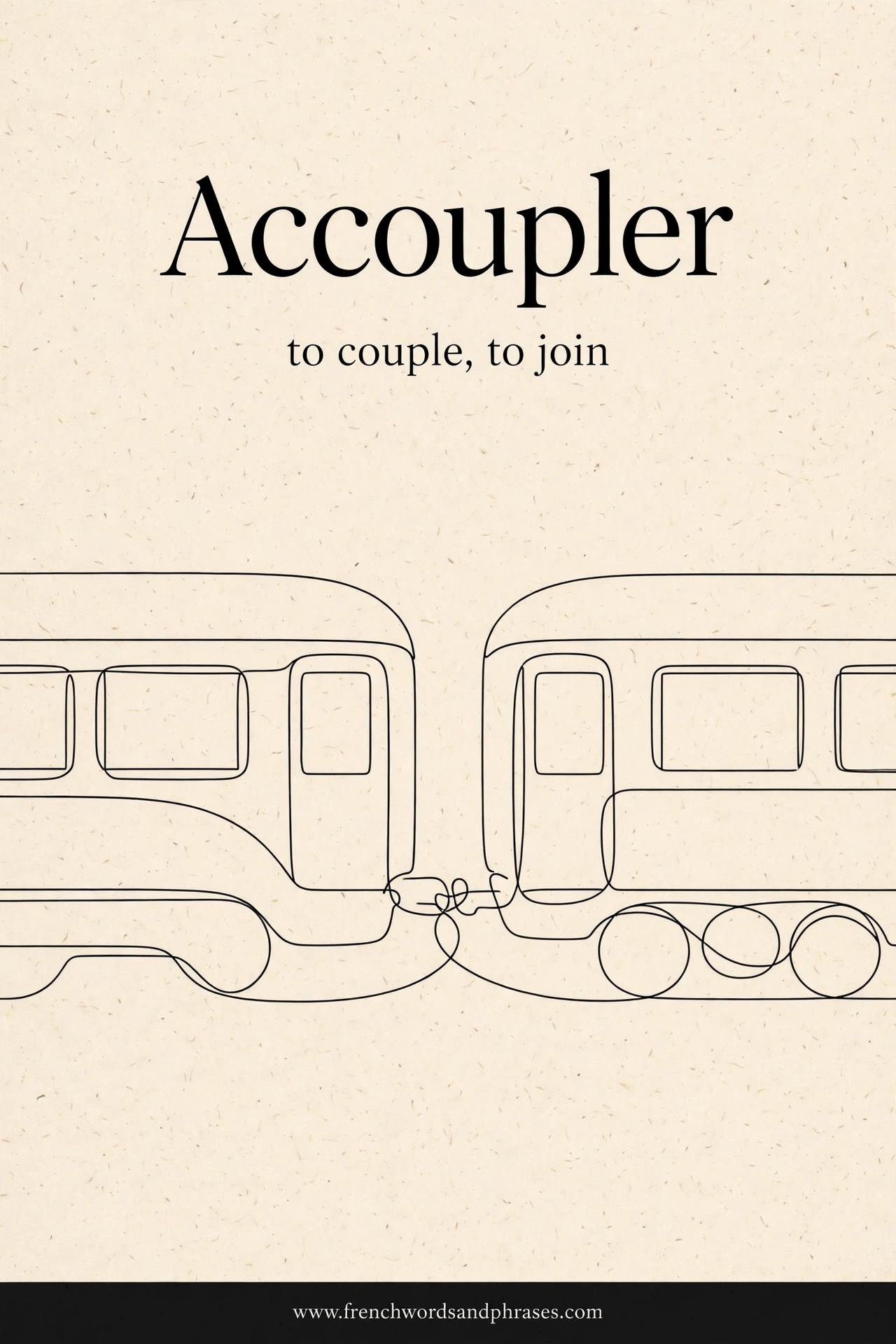
Accoupler means to couple, to join — to link two things so they work as a pair: wagons, cables, machines, and, in nature, two animals that mate.
A railway worker locking two wagons together with a heavy steel coupling, an electrician joining two cables, two swans pairing on a spring lake — accoupler is the verb of joining in twos: things, machines and animals linked into a working couple.
In this guide, you’ll learn how to conjugate accoupler in all the major French tenses and moods. Explore complete conjugation tables, French examples, English translations, and practice quizzes.
Understanding the French Verb Accoupler
Accoupler is a regular French verb belonging to the first group of verbs, those ending in-er.
It means to couple, to join. Engineers accouplent motors, shafts and circuits; railway staff accouplent wagons; farmers and biologists talk of animals that s’accouplent in season. The noun l’accouplement covers both the mechanical coupling and the mating — context tells you whether you are in the workshop or the meadow.
Verb classification: First group (-er)
Auxiliary verb: Avoir
Past participle: accouplé
Present participle: accouplant
English equivalents: To couple, to join, to pair, to mate; accoupler deux wagons — to couple two railway carriages; accoupler un moteur à une remorque — to hitch an engine to a trailer; s’accoupler — to mate (of animals); des pièces accouplées — joined parts; un accouplement — a coupling, a mating.
One important detail: accoupler works in two directions. Transitively, someone couples things: le mécanicien accouple les wagons. Reflexively, s’accoupler is what animals do — to mate: les cygnes s’accouplent au printemps — and the reflexive form takes être in compound tenses with agreement: ils se sont accouplés. The word inside it is un couple, a pair: accoupler makes couples out of single things. The plain verb is perfectly regular: j’accouple, nous accouplons, past participle accouplé.
Experience the Word
Accoupler is the verb of the pair — two separate things locked together so that they move, work or live as one.
Imagine a country station at dawn. The shunter walks the length of the train with his lantern, wagon by wagon, dropping the heavy coupling over each hook and tightening it home — clank, clank, clank. In the field beyond the fence, unnoticed, two hares are doing spring’s version of the same work. L’homme accouple les wagons; les lièvres s’accouplent. The whole world is joining in twos.
The train pulls away as one piece. Everything has been coupled — accouplé — nothing travels alone this morning.
How to Conjugate Accoupler: Complete French Conjugation Guide
Let’s explore every major conjugation of accoupler, beginning with the indicative mood.
How to Conjugate Accoupler in the Indicative Mood
The indicative mood is used to express facts, observations, actions, and events.
How to Conjugate Accoupler in the Present Tense (Présent)
Used for actions happening now, habitual actions, and general truths.
| Subject | Conjugation |
|---|---|
| je | accouple |
| tu | accouples |
| il / elle | accouple |
| nous | accouplons |
| vous | accouplez |
| ils / elles | accouplent |
Example
L’électricien accouple les deux câbles avec soin.
The electrician joins the two cables carefully.
Quick Quiz 1
Complete the sentence:
Nous ______ les tuyaux demain matin.
Reveal the answer
accouplerons
Nous accouplerons les tuyaux demain matin.
We will join the pipes tomorrow morning.
How to Conjugate Accoupler in the Passé Composé
Used for completed actions in the past. Accoupler takes the auxiliary verb avoir.
| Subject | Conjugation |
|---|---|
| j’ | ai accouplé |
| tu | as accouplé |
| il / elle | a accouplé |
| nous | avons accouplé |
| vous | avez accouplé |
| ils / elles | ont accouplé |
Example
Ils ont accouplé les deux wagons avant le départ.
They coupled the two carriages before departure.
How to Conjugate Accoupler in the Imparfait (Imperfect Tense)
Used for habitual past actions, descriptions, and ongoing situations in the past.
| Subject | Conjugation |
|---|---|
| je | accouplais |
| tu | accouplais |
| il / elle | accouplait |
| nous | accouplions |
| vous | accoupliez |
| ils / elles | accouplaient |
Example
Au printemps, les oiseaux s’accouplaient dans les haies.
In spring, the birds mated in the hedgerows.
Quick Quiz 2
Choose the correct form:
They coupled the two carriages.
Ils ______ les deux wagons. (ont accouplé / sont accouplé)
Reveal the answer
ont accouplé
Ils ont accouplé les deux wagons.
Accoupler takes avoir.
How to Conjugate Accoupler in the Plus-que-parfait
Used to describe an action that had already been completed before another past event.
| Subject | Conjugation |
|---|---|
| j’ | avais accouplé |
| tu | avais accouplé |
| il / elle | avait accouplé |
| nous | avions accouplé |
| vous | aviez accouplé |
| ils / elles | avaient accouplé |
Example
Le mécanicien avait accouplé le moteur à la remorque.
The mechanic had hitched the engine to the trailer.
How to Conjugate Accoupler in the Passé Simple
Primarily used in formal writing, literature, and historical narratives. It is rarely used in everyday conversation.
| Subject | Conjugation |
|---|---|
| je | accouplai |
| tu | accouplas |
| il / elle | accoupla |
| nous | accouplâmes |
| vous | accouplâtes |
| ils / elles | accouplèrent |
Example
L’ouvrier accoupla les deux pièces en quelques minutes.
The worker joined the two parts in a few minutes.
How to Conjugate Accoupler in the Passé Antérieur
A literary tense used to express an action completed immediately before another past action, generally in the passé simple.
| Subject | Conjugation |
|---|---|
| j’ | eus accouplé |
| tu | eus accouplé |
| il / elle | eut accouplé |
| nous | eûmes accouplé |
| vous | eûtes accouplé |
| ils / elles | eurent accouplé |
Example
Quand il eut accouplé les wagons, le train repartit.
When he had coupled the carriages, the train set off again.
How to Conjugate Accoupler in the Future Tense (Futur Simple)
Used to describe actions that will take place in the future.
| Subject | Conjugation |
|---|---|
| je | accouplerai |
| tu | accoupleras |
| il / elle | accouplera |
| nous | accouplerons |
| vous | accouplerez |
| ils / elles | accoupleront |
Example
Nous accouplerons les tuyaux demain matin.
We will join the pipes tomorrow morning.
How to Conjugate Accoupler in the Futur Antérieur (Future Perfect)
Used for an action that will have been completed before a particular point in the future.
| Subject | Conjugation |
|---|---|
| j’ | aurai accouplé |
| tu | auras accouplé |
| il / elle | aura accouplé |
| nous | aurons accouplé |
| vous | aurez accouplé |
| ils / elles | auront accouplé |
Example
Quand tu auras accouplé les deux parties, la machine marchera.
When you have joined the two parts, the machine will work.
How to Conjugate Accoupler in the Near Future (Futur Proche)
Used to describe something that is going to happen soon. Formed with aller + infinitive.
| Subject | Conjugation |
|---|---|
| je | vais accoupler |
| tu | vas accoupler |
| il / elle | va accoupler |
| nous | allons accoupler |
| vous | allez accoupler |
| ils / elles | vont accoupler |
Example
Le technicien va accoupler le générateur au réseau.
The technician is going to connect the generator to the grid.
How to Conjugate Accoupler in the Conditional Mood
The conditional mood expresses what would happen under certain circumstances. It is also frequently used to make polite requests or express wishes.
How to Conjugate Accoupler in the Present Conditional
| Subject | Conjugation |
|---|---|
| je | accouplerais |
| tu | accouplerais |
| il / elle | accouplerait |
| nous | accouplerions |
| vous | accoupleriez |
| ils / elles | accoupleraient |
Example
Avec la bonne pièce, on accouplerait les deux éléments facilement.
With the right part, we would join the two elements easily.
How to Conjugate Accoupler in the Past Conditional
| Subject | Conjugation |
|---|---|
| j’ | aurais accouplé |
| tu | aurais accouplé |
| il / elle | aurait accouplé |
| nous | aurions accouplé |
| vous | auriez accouplé |
| ils / elles | auraient accouplé |
Example
Ils auraient accouplé les wagons plus vite avec de l’aide.
They would have coupled the carriages faster with help.
Accoupler in the Literary Past Conditional Form
This less common literary form uses the imperfect subjunctive of avoir.
| Subject | Conjugation |
|---|---|
| j’ | eusse accouplé |
| tu | eusses accouplé |
| il / elle | eût accouplé |
| nous | eussions accouplé |
| vous | eussiez accouplé |
| ils / elles | eussent accouplé |
Example
Il eût accouplé les deux pièces sans la rouille des boulons.
He would have joined the two parts, were it not for the rust on the bolts.
How to Conjugate Accoupler in the Subjunctive Mood
The subjunctive is used to express wishes, emotions, doubts, necessity, and uncertainty. It frequently follows expressions such as il faut que (it is necessary that) or bien que (although).
How to Conjugate Accoupler in the Present Subjunctive
| Subject | Conjugation |
|---|---|
| que je | accouple |
| que tu | accouples |
| qu’il / qu’elle | accouple |
| que nous | accouplions |
| que vous | accoupliez |
| qu’ils / qu’elles | accouplent |
Example
Il faut que tu accouples bien les deux câbles.
You must join the two cables properly.
Quick Quiz 3
Complete the sentence using the subjunctive:
Il faut que vous ______ les pièces avant midi.
Reveal the answer
accoupliez
Il faut que vous accoupliez les pièces avant midi.
You must join the parts before noon.
How to Conjugate Accoupler in the Imperfect Subjunctive
A literary tense, rarely encountered in modern spoken French.
| Subject | Conjugation |
|---|---|
| que je | accouplasse |
| que tu | accouplasses |
| qu’il / qu’elle | accouplât |
| que nous | accouplassions |
| que vous | accouplassiez |
| qu’ils / qu’elles | accouplassent |
Example
L’ingénieur voulait que l’on accouplât les pièces avant midi.
The engineer wanted the parts joined before noon.
How to Conjugate Accoupler in the Pluperfect Subjunctive
A literary construction used to express an action completed before another past action.
| Subject | Conjugation |
|---|---|
| que j’ | eusse accouplé |
| que tu | eusses accouplé |
| qu’il / qu’elle | eût accouplé |
| que nous | eussions accouplé |
| que vous | eussiez accouplé |
| qu’ils / qu’elles | eussent accouplé |
Example
On vérifia qu’ils eussent accouplé les wagons correctement.
They checked that the carriages had been coupled correctly.
How to Conjugate Accoupler in the Past Subjunctive
| Subject | Conjugation |
|---|---|
| que j’ | aie accouplé |
| que tu | aies accouplé |
| qu’il / qu’elle | ait accouplé |
| que nous | ayons accouplé |
| que vous | ayez accouplé |
| qu’ils / qu’elles | aient accouplé |
Example
C’est parfait que vous ayez accouplé les deux tuyaux.
It is perfect that you joined the two pipes.
How to Conjugate Accoupler in the Imperative
The imperative is used to give commands, instructions, invitations, or suggestions. Subject pronouns are omitted.
How to Conjugate Accoupler in the Present Imperative
| Person | Conjugation |
|---|---|
| (tu) | accouple |
| (nous) | accouplons |
| (vous) | accouplez |
Example
Accouple les deux wagons, puis vérifie le verrouillage !
Couple the two carriages, then check the locking!
Quick Quiz 4
How would you say Couple the two carriages (tu form)?
Reveal the answer
Accouple les deux wagons !
French Participles of Accoupler
Participles are verb forms that can be used in compound tenses and other grammatical constructions.
Present Participle of Accoupler
accouplant
En accouplant les pièces, il faut respecter l’ordre du plan.
When joining the parts, you must follow the order on the plan.
Past Participle of Accoupler
accouplé
Accouplés au printemps, les cygnes restent ensemble toute la vie.
Mated in spring, swans stay together for life.
Accoupler in Everyday French: Real-Life Examples
Now that you know the conjugations, let’s see how accoupler appears in everyday French.
Example 1 — Present
L’électricien accouple les deux câbles.
The electrician joins the two cables.
Example 2 — Passé composé
Ils ont accouplé les deux wagons.
They coupled the two carriages.
Example 3 — Imparfait
Les oiseaux s’accouplaient au printemps.
The birds used to mate in spring.
Example 4 — Future
Nous accouplerons les tuyaux demain.
We will join the pipes tomorrow.
Example 5 — Conditional
On accouplerait les pièces avec le bon outil.
We would join the parts with the right tool.
Example 6 — Imperative
Accouple les deux wagons !
Couple the two carriages!
Beyond Translation: The Meaning of Accoupler
English couple is the same word wearing work clothes — and French accoupler keeps the pair at its centre: un couple is two.
Whatever accoupler touches stops being single.
Wagons become a train, cables become a circuit, swans become a pair for life. The noun l’accouplement serves the engineer and the naturalist alike — French sees no difference between a coupling of steel and a coupling of swans, and the verb does both jobs with the same three syllables.
How to Remember the French Verb Accoupler
Remember it this way: Accoupler is about the shunter at dawn, coupling wagon to wagon — clank, clank — while the hares pair off in the field.
- Un couple is a pair — accoupler makes couples: wagons, cables, machines, animals.
- Two directions: accoupler quelque chose (couple things) and s’accoupler (animals mate, with être).
- Regular -er: j’accouple, nous accouplons, past participle accouplé.
The key idea is the shunter at dawn, coupling wagon to wagon — clank, clank — while the hares pair off in the field.
Test Your Knowledge of Accoupler
Let’s see how much you’ve learned. Try answering these questions before revealing the answers.
Question 1
What two worlds does accoupler join together in its meanings?
Reveal the answer
Machines and animals — coupling wagons and cables, and s’accoupler, animals mating.
Question 2
How do you say They coupled the two carriages before departure in French?
Reveal the answer
Ils ont accouplé les deux wagons avant le départ.
Question 3
Translate: In spring, the birds mated in the hedgerows.
Reveal the answer
Au printemps, les oiseaux s’accouplaient dans les haies.
Question 4
What is the past participle of accoupler?
Reveal the answer
Accouplé.
Question 5
Complete the sentence:
Il faut que tu ______ bien les deux câbles.
Reveal the answer
accouples
Il faut que tu accouples bien les deux câbles.
You must join the two cables properly.
Your Final Challenge
Can You Use It?
How would you say this in French?
In the early morning, the worker couples the carriages one by one, and the whole train shudders before leaving.
Reveal the answer
Au petit matin, l’ouvrier accouple les wagons un à un, et le train entier frémit avant de partir.
In the early morning, the worker couples the carriages one by one, and the whole train shudders before leaving.
A little French. A little curiosity. A richer everyday life.
LEARN FRENCH ONE WORD AT A TIME