
A French Word to Live By
How to Conjugate Accoucher in French
/a.ku.ʃe/
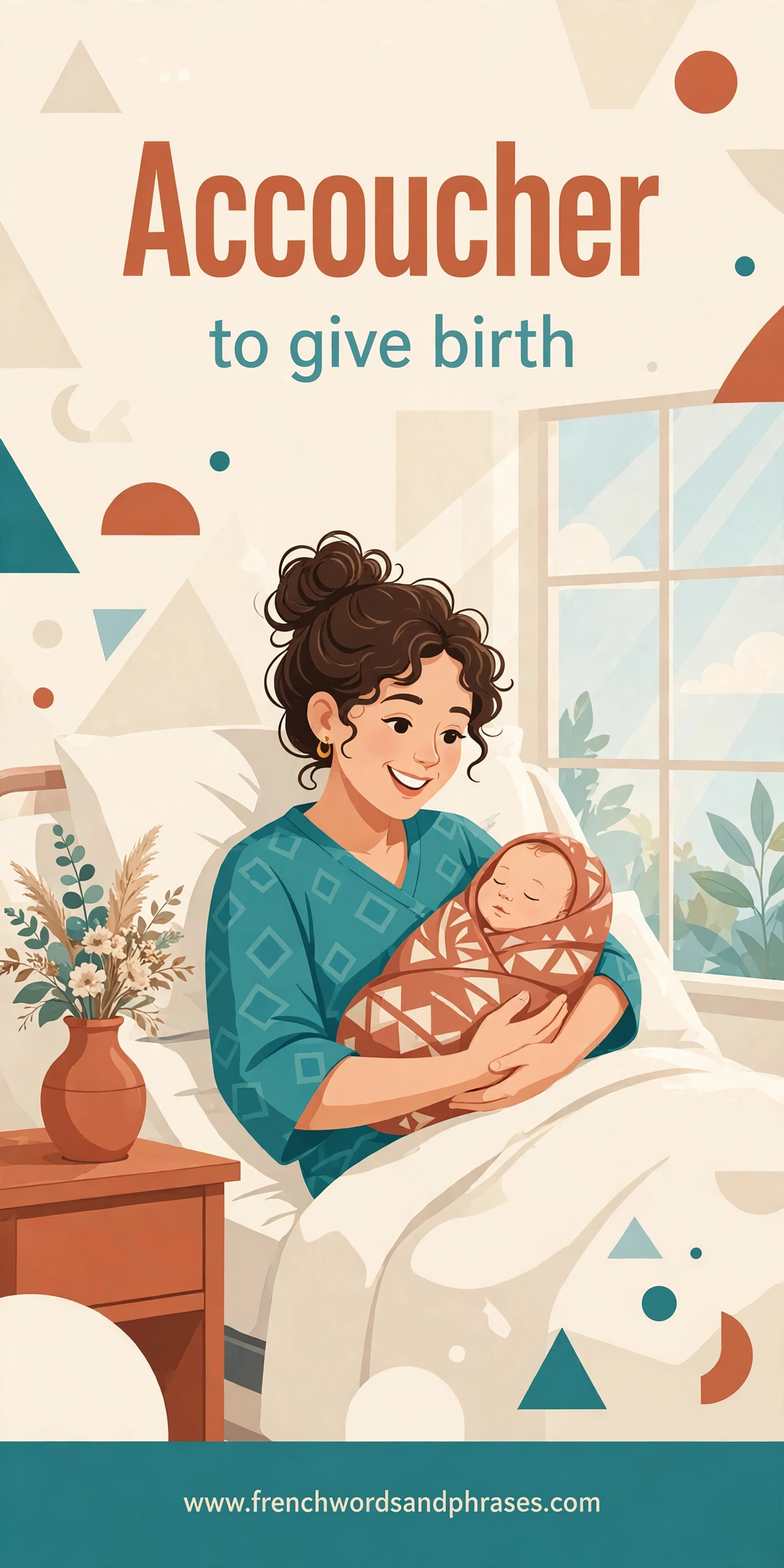
Accoucher means to give birth — to bring a child into the world, almost always with de: accoucher d’un enfant, to give birth to a child.
A quiet room in the maternity ward, a midwife’s calm voice, a whole family waiting in the corridor with flowers — accoucher is the verb of the great arrival: the moment a woman gives birth and a child begins. French uses it for mothers, and, figuratively, for anything delivered after long labour, from a novel to a compromise.
In this guide, you’ll learn how to conjugate accoucher in all the major French tenses and moods. Explore complete conjugation tables, French examples, English translations, and practice quizzes.
Understanding the French Verb Accoucher
Accoucher is a regular French verb belonging to the first group of verbs, those ending in-er.
It means to give birth. It is the standard, neutral verb for childbirth — the word of hospitals, announcements and family stories (elle a accouché hier soir). Midwives and doctors also accouchent in the transitive sense of delivering a mother: la sage-femme l’a accouchée, the midwife delivered her. Figuratively, French accouche ideas, books and agreements that took a long, painful time to arrive.
Verb classification: First group (-er)
Auxiliary verb: Avoir
Past participle: accouché
Present participle: accouchant
English equivalents: To give birth, to deliver, to be delivered of; accoucher d’un enfant — to give birth to a child; accoucher de jumeaux — to give birth to twins; accoucher à domicile — to give birth at home; une femme accouchée — a woman who has just given birth; (figurative) accoucher d’un roman — to produce a novel after long labour.
One important detail: accoucher almost always travels with the preposition de — elle a accouché d’une fille, elle va accoucher de jumeaux. Used without de, it simply means to be in labour or to deliver: elle accouche demain. Do not mix it up with coucher (to put to bed, to lie down) or se coucher (to go to bed) — accoucher is the birth verb, and it takes avoir: elle a accouché, never être. The verb is perfectly regular: j’accouche, nous accouchons, past participle accouché, and the new mother herself can be described as une accouchée, a woman recently delivered.
Experience the Word
Accoucher is the verb of arrival after waiting — nine months of patience ending in a single, enormous moment.
Imagine the corridor of a small maternity hospital at three in the morning. A father paces, a grandmother knits without looking at her hands, and behind the door a midwife says, calmly, « poussez, voilà, elle arrive ». Minutes later a cry crosses the wall, and the knitting stops. Elle a accouché d’une petite fille — the waiting is over, and everything has changed.
The corridor fills with flowers and whispers. She has given birth — elle a accouché — and the family is one person larger.
How to Conjugate Accoucher: Complete French Conjugation Guide
Let’s explore every major conjugation of accoucher, beginning with the indicative mood.
How to Conjugate Accoucher in the Indicative Mood
The indicative mood is used to express facts, observations, actions, and events.
How to Conjugate Accoucher in the Present Tense (Présent)
Used for actions happening now, habitual actions, and general truths.
| Subject | Conjugation |
|---|---|
| je | accouche |
| tu | accouches |
| il / elle | accouche |
| nous | accouchons |
| vous | accouchez |
| ils / elles | accouchent |
Example
Elle accouche de son premier enfant cette semaine.
She is giving birth to her first child this week.
Quick Quiz 1
Complete the sentence:
Elles ______ à la maison, comme autrefois.
Reveal the answer
accouchent
Elles accouchent à la maison, comme autrefois.
They give birth at home, as in the old days.
How to Conjugate Accoucher in the Passé Composé
Used for completed actions in the past. Accoucher takes the auxiliary verb avoir.
| Subject | Conjugation |
|---|---|
| j’ | ai accouché |
| tu | as accouché |
| il / elle | a accouché |
| nous | avons accouché |
| vous | avez accouché |
| ils / elles | ont accouché |
Example
Elle a accouché d’une petite fille en pleine santé.
She gave birth to a healthy baby girl.
How to Conjugate Accoucher in the Imparfait (Imperfect Tense)
Used for habitual past actions, descriptions, and ongoing situations in the past.
| Subject | Conjugation |
|---|---|
| je | accouchais |
| tu | accouchais |
| il / elle | accouchait |
| nous | accouchions |
| vous | accouchiez |
| ils / elles | accouchaient |
Example
Autrefois, les femmes accouchaient à la maison.
In the old days, women gave birth at home.
Quick Quiz 2
Choose the correct form:
She gave birth last night.
Elle ______ hier soir. (a accouché / est accouché)
Reveal the answer
a accouché
Elle a accouché hier soir.
Accoucher takes avoir.
How to Conjugate Accoucher in the Plus-que-parfait
Used to describe an action that had already been completed before another past event.
| Subject | Conjugation |
|---|---|
| j’ | avais accouché |
| tu | avais accouché |
| il / elle | avait accouché |
| nous | avions accouché |
| vous | aviez accouché |
| ils / elles | avaient accouché |
Example
Elle avait accouché de jumeaux l’année précédente.
She had given birth to twins the previous year.
How to Conjugate Accoucher in the Passé Simple
Primarily used in formal writing, literature, and historical narratives. It is rarely used in everyday conversation.
| Subject | Conjugation |
|---|---|
| je | accouchai |
| tu | accouchas |
| il / elle | accoucha |
| nous | accouchâmes |
| vous | accouchâtes |
| ils / elles | accouchèrent |
Example
La reine accoucha d’un héritier au printemps.
The queen gave birth to an heir in the spring.
How to Conjugate Accoucher in the Passé Antérieur
A literary tense used to express an action completed immediately before another past action, generally in the passé simple.
| Subject | Conjugation |
|---|---|
| j’ | eus accouché |
| tu | eus accouché |
| il / elle | eut accouché |
| nous | eûmes accouché |
| vous | eûtes accouché |
| ils / elles | eurent accouché |
Example
Quand elle eut accouché, toute la famille se réjouit.
When she had given birth, the whole family rejoiced.
How to Conjugate Accoucher in the Future Tense (Futur Simple)
Used to describe actions that will take place in the future.
| Subject | Conjugation |
|---|---|
| je | accoucherai |
| tu | accoucheras |
| il / elle | accouchera |
| nous | accoucherons |
| vous | accoucherez |
| ils / elles | accoucheront |
Example
Elle accouchera à la clinique Sainte-Anne.
She will give birth at the Sainte-Anne clinic.
How to Conjugate Accoucher in the Futur Antérieur (Future Perfect)
Used for an action that will have been completed before a particular point in the future.
| Subject | Conjugation |
|---|---|
| j’ | aurai accouché |
| tu | auras accouché |
| il / elle | aura accouché |
| nous | aurons accouché |
| vous | aurez accouché |
| ils / elles | auront accouché |
Example
Quand elle aura accouché, nous irons la voir.
When she has given birth, we will go and see her.
How to Conjugate Accoucher in the Near Future (Futur Proche)
Used to describe something that is going to happen soon. Formed with aller + infinitive.
| Subject | Conjugation |
|---|---|
| je | vais accoucher |
| tu | vas accoucher |
| il / elle | va accoucher |
| nous | allons accoucher |
| vous | allez accoucher |
| ils / elles | vont accoucher |
Example
Elle va accoucher d’un moment à l’autre !
She is going to give birth at any moment!
How to Conjugate Accoucher in the Conditional Mood
The conditional mood expresses what would happen under certain circumstances. It is also frequently used to make polite requests or express wishes.
How to Conjugate Accoucher in the Present Conditional
| Subject | Conjugation |
|---|---|
| je | accoucherais |
| tu | accoucherais |
| il / elle | accoucherait |
| nous | accoucherions |
| vous | accoucheriez |
| ils / elles | accoucheraient |
Example
Sans complications, elle accoucherait à domicile.
Without complications, she would give birth at home.
How to Conjugate Accoucher in the Past Conditional
| Subject | Conjugation |
|---|---|
| j’ | aurais accouché |
| tu | aurais accouché |
| il / elle | aurait accouché |
| nous | aurions accouché |
| vous | auriez accouché |
| ils / elles | auraient accouché |
Example
Elle aurait accouché plus tôt si le médecin était arrivé à temps.
She would have given birth sooner if the doctor had arrived in time.
Accoucher in the Literary Past Conditional Form
This less common literary form uses the imperfect subjunctive of avoir.
| Subject | Conjugation |
|---|---|
| j’ | eusse accouché |
| tu | eusses accouché |
| il / elle | eût accouché |
| nous | eussions accouché |
| vous | eussiez accouché |
| ils / elles | eussent accouché |
Example
Elle eût accouché avant la nuit sans le retard de la sage-femme.
She would have given birth before nightfall, were it not for the midwife’s delay.
How to Conjugate Accoucher in the Subjunctive Mood
The subjunctive is used to express wishes, emotions, doubts, necessity, and uncertainty. It frequently follows expressions such as il faut que (it is necessary that) or bien que (although).
How to Conjugate Accoucher in the Present Subjunctive
| Subject | Conjugation |
|---|---|
| que je | accouche |
| que tu | accouches |
| qu’il / qu’elle | accouche |
| que nous | accouchions |
| que vous | accouchiez |
| qu’ils / qu’elles | accouchent |
Example
Il est possible qu’elle accouche cette nuit.
It is possible she will give birth tonight.
Quick Quiz 3
Complete the sentence using the subjunctive:
Je suis heureux qu’elle ______ sans difficulté.
Reveal the answer
ait accouché
Je suis heureux qu’elle ait accouché sans difficulté.
I am glad she gave birth without difficulty.
How to Conjugate Accoucher in the Imperfect Subjunctive
A literary tense, rarely encountered in modern spoken French.
| Subject | Conjugation |
|---|---|
| que je | accouchasse |
| que tu | accouchasses |
| qu’il / qu’elle | accouchât |
| que nous | accouchassions |
| que vous | accouchassiez |
| qu’ils / qu’elles | accouchassent |
Example
On craignait qu’elle accouchât avant d’arriver à l’hôpital.
They feared she might give birth before reaching the hospital.
How to Conjugate Accoucher in the Pluperfect Subjunctive
A literary construction used to express an action completed before another past action.
| Subject | Conjugation |
|---|---|
| que j’ | eusse accouché |
| que tu | eusses accouché |
| qu’il / qu’elle | eût accouché |
| que nous | eussions accouché |
| que vous | eussiez accouché |
| qu’ils / qu’elles | eussent accouché |
Example
Le journal rapporta qu’elle eût accouché avant terme.
The newspaper reported that she had given birth prematurely.
How to Conjugate Accoucher in the Past Subjunctive
| Subject | Conjugation |
|---|---|
| que j’ | aie accouché |
| que tu | aies accouché |
| qu’il / qu’elle | ait accouché |
| que nous | ayons accouché |
| que vous | ayez accouché |
| qu’ils / qu’elles | aient accouché |
Example
Je suis heureux qu’elle ait accouché sans difficulté.
I am glad she gave birth without difficulty.
How to Conjugate Accoucher in the Imperative
The imperative is used to give commands, instructions, invitations, or suggestions. Subject pronouns are omitted.
How to Conjugate Accoucher in the Present Imperative
| Person | Conjugation |
|---|---|
| (tu) | accouche |
| (nous) | accouchons |
| (vous) | accouchez |
Example
Accouche à la maternité, tu y seras mieux suivie.
Give birth at the maternity hospital, you will be better looked after there.
Quick Quiz 4
How would you say Give birth at the clinic (tu form)?
Reveal the answer
Accouche à la clinique !
French Participles of Accoucher
Participles are verb forms that can be used in compound tenses and other grammatical constructions.
Present Participle of Accoucher
accouchant
En accouchant à domicile, elle a choisi un cadre familier.
By giving birth at home, she chose familiar surroundings.
Past Participle of Accoucher
accouché
À peine accouchée, elle demandait déjà des nouvelles du bébé.
Scarcely delivered, she was already asking for news of the baby.
Accoucher in Everyday French: Real-Life Examples
Now that you know the conjugations, let’s see how accoucher appears in everyday French.
Example 1 — Present
Ma sœur accouche au printemps.
My sister is giving birth in the spring.
Example 2 — Passé composé
Elle a accouché d’une petite fille.
She gave birth to a baby girl.
Example 3 — Imparfait
Autrefois, les femmes accouchaient à la maison.
In the old days, women gave birth at home.
Example 4 — Future
Elle accouchera à la clinique.
She will give birth at the clinic.
Example 5 — Conditional
Sans complications, elle accoucherait à domicile.
Without complications, she would give birth at home.
Example 6 — Imperative
Accouche à la maternité, c’est plus sûr.
Give birth at the maternity hospital, it is safer.
Beyond Translation: The Meaning of Accoucher
English deliver hides in the hospital phrase she was delivered of a son — and French accoucher is just as formal and just as tender.
In French, even ideas can be born the hard way.
A writer who has suffered over a book for ten years a accouché d’un roman; a committee that finally agrees accouche d’un compromis — usually dans la douleur, in pain. The family completes the picture: l’accouchement is the birth itself, un accoucheur an obstetrician, une accoucheuse a midwife of the old school.
How to Remember the French Verb Accoucher
Remember it this way: Accoucher is about the maternity corridor at 3 a.m. — flowers, whispers, and a first cry behind the door.
- The partner preposition is de: accoucher d’un enfant, accoucher de jumeaux — to give birth TO a child.
- Not coucher: coucher puts children to bed; accoucher brings them into the world — and it takes avoir.
- Regular -er: j’accouche, nous accouchons, past participle accouché; the new mother is une accouchée.
The key idea is the maternity corridor at 3 a.m. — flowers, whispers, and a first cry behind the door.
Test Your Knowledge of Accoucher
Let’s see how much you’ve learned. Try answering these questions before revealing the answers.
Question 1
Which preposition follows accoucher when the baby is named?
Reveal the answer
De — elle a accouché d’une petite fille, she gave birth to a baby girl.
Question 2
How do you say She gave birth to twins in French?
Reveal the answer
Elle a accouché de jumeaux.
Question 3
Translate: In the old days, women gave birth at home.
Reveal the answer
Autrefois, les femmes accouchaient à la maison.
Question 4
What is the past participle of accoucher?
Reveal the answer
Accouché — and a woman just delivered is une accouchée.
Question 5
Complete the sentence:
Il est possible qu’elle ______ cette nuit.
Reveal the answer
accouche
Il est possible qu’elle accouche cette nuit.
It is possible she will give birth tonight.
Your Final Challenge
Can You Use It?
How would you say this in French?
After a long night of waiting, she gave birth to a little boy, and the whole family wept with joy.
Reveal the answer
Après une longue nuit d’attente, elle a accouché d’un petit garçon, et la famille entière a pleuré de joie.
After a long night of waiting, she gave birth to a little boy, and the whole family wept with joy.
A little French. A little curiosity. A richer everyday life.
LEARN FRENCH ONE WORD AT A TIME




