
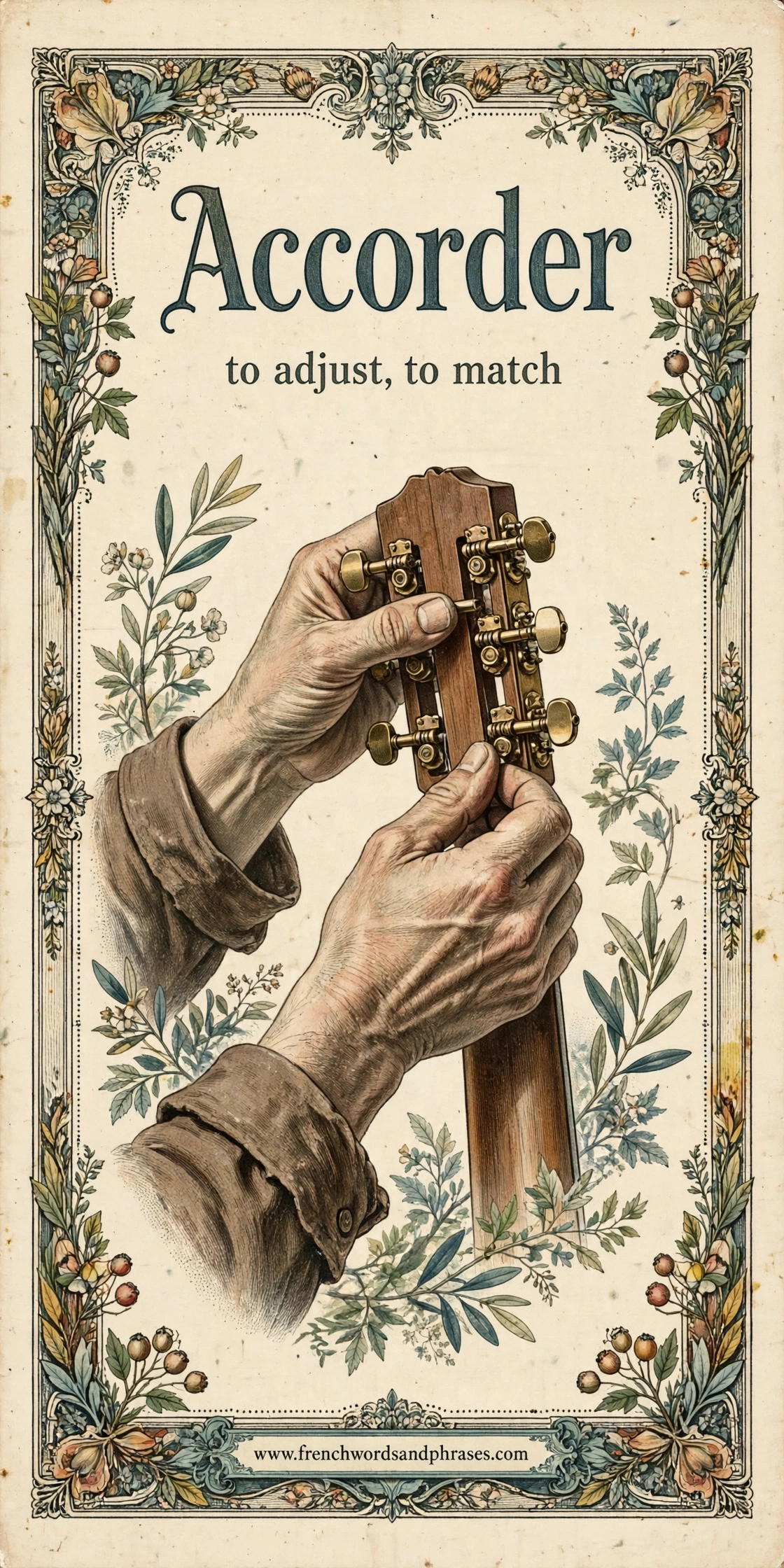
A French Word to Live By
How to Conjugate Accorder in French
/a.kɔʁ.de/
Accorder means to adjust, to match — to bring two things into agreement: an instrument tuned to the right pitch, a request granted, a verb made to agree with its subject.
A piano tuner leaning into the strings before a concert, a bank manager signing a loan, a pupil checking that her adjective matches its noun — accorder is the verb of agreement in action: tuning, granting and matching, all from one idea, making things fit together.
In this guide, you’ll learn how to conjugate accorder in all the major French tenses and moods. Explore complete conjugation tables, French examples, English translations, and practice quizzes.
Understanding the French Verb Accorder
Accorder is a regular French verb belonging to the first group of verbs, those ending in-er.
It means to adjust, to match. It is the everyday verb of official generosity (banks, judges and employers accorder loans, deadlines and days off), of music (every orchestra accordes its instruments before playing) and of the grammar classroom, where accorder means making words agree in gender and number.
Verb classification: First group (-er)
Auxiliary verb: Avoir
Past participle: accordé
Present participle: accordant
English equivalents: To grant, to tune, to match, to give; accorder un délai — to grant an extension; accorder une interview — to give an interview; accorder un piano — to tune a piano; accorder le verbe avec le sujet — to make the verb agree with the subject; accorder du temps à quelqu’un — to give someone some of your time.
One important detail: accorder covers three English verbs at once — to grant (accorder une faveur, un prêt, un entretien), to tune (accorder un violon, une guitare) and to match or agree in grammar (accorder l’adjectif avec le nom). The construction is accorder quelque chose à quelqu’un — you grant something TO someone. The verb itself is perfectly regular: j’accorde, nous accordons, past participle accordé. Do not confuse it with its reflexive cousin s’accorder, to agree with each other.
Experience the Word
Accorder is the verb of things brought into harmony — strings to a pitch, words to each other, people to what they asked for.
Imagine the minute before a concert. Forty musicians lift their instruments, one oboe sounds a long A, and the whole orchestra bends towards it, string by string, until forty sounds become one. Backstage, at the same moment, the director is signing a day off for the soloist. Two worlds, one verb: ils accordent.
Nothing has been played yet. Everything has been tuned, granted and matched — accordé — and the evening can begin.
How to Conjugate Accorder: Complete French Conjugation Guide
Let’s explore every major conjugation of accorder, beginning with the indicative mood.
How to Conjugate Accorder in the Indicative Mood
The indicative mood is used to express facts, observations, actions, and events.
How to Conjugate Accorder in the Present Tense (Présent)
Used for actions happening now, habitual actions, and general truths.
| Subject | Conjugation |
|---|---|
| je | accorde |
| tu | accordes |
| il / elle | accorde |
| nous | accordons |
| vous | accordez |
| ils / elles | accordent |
Example
Le luthier accorde la guitare avant le concert.
The luthier tunes the guitar before the concert.
Quick Quiz 1
Complete the sentence:
Nous ______ nos instruments avant le concert.
Reveal the answer
accordons
Nous accordons nos instruments avant le concert.
We tune our instruments before the concert.
How to Conjugate Accorder in the Passé Composé
Used for completed actions in the past. Accorder takes the auxiliary verb avoir.
| Subject | Conjugation |
|---|---|
| j’ | ai accordé |
| tu | as accordé |
| il / elle | a accordé |
| nous | avons accordé |
| vous | avez accordé |
| ils / elles | ont accordé |
Example
Le directeur a accordé deux jours de congé à son équipe.
The manager granted his team two days off.
How to Conjugate Accorder in the Imparfait (Imperfect Tense)
Used for habitual past actions, descriptions, and ongoing situations in the past.
| Subject | Conjugation |
|---|---|
| je | accordais |
| tu | accordais |
| il / elle | accordait |
| nous | accordions |
| vous | accordiez |
| ils / elles | accordaient |
Example
Elle accordait ses tenues avec un goût parfait.
She used to match her outfits with perfect taste.
Quick Quiz 2
Choose the correct form:
The bank granted the loan.
La banque ______ le prêt. (a accordé / est accordé)
Reveal the answer
a accordé
La banque a accordé le prêt.
Accorder takes avoir.
How to Conjugate Accorder in the Plus-que-parfait
Used to describe an action that had already been completed before another past event.
| Subject | Conjugation |
|---|---|
| j’ | avais accordé |
| tu | avais accordé |
| il / elle | avait accordé |
| nous | avions accordé |
| vous | aviez accordé |
| ils / elles | avaient accordé |
Example
Ils avaient accordé leurs violons avant l’arrivée du public.
They had tuned their violins before the audience arrived.
How to Conjugate Accorder in the Passé Simple
Primarily used in formal writing, literature, and historical narratives. It is rarely used in everyday conversation.
| Subject | Conjugation |
|---|---|
| je | accordai |
| tu | accordas |
| il / elle | accorda |
| nous | accordâmes |
| vous | accordâtes |
| ils / elles | accordèrent |
Example
Le roi accorda sa grâce au prisonnier.
The king granted his pardon to the prisoner.
How to Conjugate Accorder in the Passé Antérieur
A literary tense used to express an action completed immediately before another past action, generally in the passé simple.
| Subject | Conjugation |
|---|---|
| j’ | eus accordé |
| tu | eus accordé |
| il / elle | eut accordé |
| nous | eûmes accordé |
| vous | eûtes accordé |
| ils / elles | eurent accordé |
Example
Quand il eut accordé le piano, le concert commença.
When he had tuned the piano, the concert began.
How to Conjugate Accorder in the Future Tense (Futur Simple)
Used to describe actions that will take place in the future.
| Subject | Conjugation |
|---|---|
| je | accorderai |
| tu | accorderas |
| il / elle | accordera |
| nous | accorderons |
| vous | accorderez |
| ils / elles | accorderont |
Example
Le juge accordera un délai supplémentaire.
The judge will grant an extension.
How to Conjugate Accorder in the Futur Antérieur (Future Perfect)
Used for an action that will have been completed before a particular point in the future.
| Subject | Conjugation |
|---|---|
| j’ | aurai accordé |
| tu | auras accordé |
| il / elle | aura accordé |
| nous | aurons accordé |
| vous | aurez accordé |
| ils / elles | auront accordé |
Example
Quand tu auras accordé ta guitare, nous pourrons jouer.
When you have tuned your guitar, we will be able to play.
How to Conjugate Accorder in the Near Future (Futur Proche)
Used to describe something that is going to happen soon. Formed with aller + infinitive.
| Subject | Conjugation |
|---|---|
| je | vais accorder |
| tu | vas accorder |
| il / elle | va accorder |
| nous | allons accorder |
| vous | allez accorder |
| ils / elles | vont accorder |
Example
Le professeur va accorder une deuxième chance à l’élève.
The teacher is going to give the pupil a second chance.
How to Conjugate Accorder in the Conditional Mood
The conditional mood expresses what would happen under certain circumstances. It is also frequently used to make polite requests or express wishes.
How to Conjugate Accorder in the Present Conditional
| Subject | Conjugation |
|---|---|
| je | accorderais |
| tu | accorderais |
| il / elle | accorderait |
| nous | accorderions |
| vous | accorderiez |
| ils / elles | accorderaient |
Example
Sans budget, nous n’accorderions pas cette aide.
Without a budget, we would not grant this aid.
How to Conjugate Accorder in the Past Conditional
| Subject | Conjugation |
|---|---|
| j’ | aurais accordé |
| tu | aurais accordé |
| il / elle | aurait accordé |
| nous | aurions accordé |
| vous | auriez accordé |
| ils / elles | auraient accordé |
Example
Il aurait accordé l’interview si on le lui avait demandée poliment.
He would have granted the interview if he had been asked politely.
Accorder in the Literary Past Conditional Form
This less common literary form uses the imperfect subjunctive of avoir.
| Subject | Conjugation |
|---|---|
| j’ | eusse accordé |
| tu | eusses accordé |
| il / elle | eût accordé |
| nous | eussions accordé |
| vous | eussiez accordé |
| ils / elles | eussent accordé |
Example
Elle eût accordé son pardon sans l’orgueil.
She would have granted her forgiveness, were it not for pride.
How to Conjugate Accorder in the Subjunctive Mood
The subjunctive is used to express wishes, emotions, doubts, necessity, and uncertainty. It frequently follows expressions such as il faut que (it is necessary that) or bien que (although).
How to Conjugate Accorder in the Present Subjunctive
| Subject | Conjugation |
|---|---|
| que je | accorde |
| que tu | accordes |
| qu’il / qu’elle | accorde |
| que nous | accordions |
| que vous | accordiez |
| qu’ils / qu’elles | accordent |
Example
Il faut que tu accordes le verbe avec son sujet.
You must make the verb agree with its subject.
Quick Quiz 3
Complete the sentence using the subjunctive:
Il faut que vous ______ le participe avec le sujet.
Reveal the answer
accordiez
Il faut que vous accordiez le participe avec le sujet.
You must make the participle agree with the subject.
How to Conjugate Accorder in the Imperfect Subjunctive
A literary tense, rarely encountered in modern spoken French.
| Subject | Conjugation |
|---|---|
| que je | accordasse |
| que tu | accordasses |
| qu’il / qu’elle | accordât |
| que nous | accordassions |
| que vous | accordassiez |
| qu’ils / qu’elles | accordassent |
Example
Le chef exigeait que l’orchestre accordât ses instruments en silence.
The conductor demanded that the orchestra tune its instruments in silence.
How to Conjugate Accorder in the Pluperfect Subjunctive
A literary construction used to express an action completed before another past action.
| Subject | Conjugation |
|---|---|
| que j’ | eusse accordé |
| que tu | eusses accordé |
| qu’il / qu’elle | eût accordé |
| que nous | eussions accordé |
| que vous | eussiez accordé |
| qu’ils / qu’elles | eussent accordé |
Example
On doutait qu’il eût accordé cette faveur à un inconnu.
People doubted he had granted this favour to a stranger.
How to Conjugate Accorder in the Past Subjunctive
| Subject | Conjugation |
|---|---|
| que j’ | aie accordé |
| que tu | aies accordé |
| qu’il / qu’elle | ait accordé |
| que nous | ayons accordé |
| que vous | ayez accordé |
| qu’ils / qu’elles | aient accordé |
Example
Je suis ravi qu’elle ait accordé cette entrevue.
I am delighted she granted this interview.
How to Conjugate Accorder in the Imperative
The imperative is used to give commands, instructions, invitations, or suggestions. Subject pronouns are omitted.
How to Conjugate Accorder in the Present Imperative
| Person | Conjugation |
|---|---|
| (tu) | accorde |
| (nous) | accordons |
| (vous) | accordez |
Example
Accorde ta guitare avant de monter sur scène !
Tune your guitar before going on stage!
Quick Quiz 4
How would you say Tune your guitar (tu form)?
Reveal the answer
Accorde ta guitare !
French Participles of Accorder
Participles are verb forms that can be used in compound tenses and other grammatical constructions.
Present Participle of Accorder
accordant
En accordant cette faveur, il a créé un précédent.
By granting this favour, he created a precedent.
Past Participle of Accorder
accordé
Bien accordé, le piano sonnait juste.
Well tuned, the piano sounded right.
Accorder in Everyday French: Real-Life Examples
Now that you know the conjugations, let’s see how accorder appears in everyday French.
Example 1 — Present
Le musicien accorde son piano chaque semaine.
The musician tunes his piano every week.
Example 2 — Passé composé
La banque a accordé un prêt à son frère.
The bank granted her brother a loan.
Example 3 — Imparfait
Ils accordaient leurs montres avant de partir.
They used to synchronise their watches before leaving.
Example 4 — Future
Le juge accordera le délai demain.
The judge will grant the extension tomorrow.
Example 5 — Conditional
J’accorderais plus de temps à ce projet.
I would give more time to this project.
Example 6 — Imperative
Accordez-moi une minute, s’il vous plaît !
Grant me a minute, please!
Beyond Translation: The Meaning of Accorder
English accord survives in phrases like of one’s own accord and with one accord — and French accorder is that same word at work: bringing things into accord.
To tune, to grant and to agree are one idea in French.
A piano is accordé when its strings agree; a favour is accordée when two wills agree; a sentence is correct when its words agree. Learn accorder and you hold the whole family — un accord, an agreement and a chord, is what the verb produces.
How to Remember the French Verb Accorder
Remember it this way: Accorder is about the orchestra tuning — strings, favours and grammar all brought into agreement.
- One verb for three English jobs: grant a favour, tune an instrument, match words in grammar — always accorder quelque chose à quelqu’un.
- The noun hiding inside: un accord is both an agreement and a musical chord — accorder makes accords.
- Regular -er: j’accorde, nous accordons, past participle accordé.
The key idea is the orchestra tuning — strings, favours and grammar all brought into agreement.
Test Your Knowledge of Accorder
Let’s see how much you’ve learned. Try answering these questions before revealing the answers.
Question 1
What are the three main jobs of the verb accorder?
Reveal the answer
To grant, to tune and to match — accorder un délai, accorder un piano, accorder le verbe avec le sujet.
Question 2
How do you say The judge will grant an extension in French?
Reveal the answer
Le juge accordera un délai supplémentaire.
Question 3
Translate: The manager granted his team two days off.
Reveal the answer
Le directeur a accordé deux jours de congé à son équipe.
Question 4
What is the past participle of accorder?
Reveal the answer
Accordé.
Question 5
Complete the sentence:
Il faut que tu ______ le verbe avec son sujet.
Reveal the answer
accordes
Il faut que tu accordes le verbe avec son sujet.
You must make the verb agree with the subject.
Your Final Challenge
Can You Use It?
How would you say this in French?
Before the concert, the luthier tunes the piano while the director grants the soloist a day off.
Reveal the answer
Avant le concert, le luthier accorde le piano pendant que le directeur accorde un jour de repos à la soliste.
Before the concert, the luthier tunes the piano while the director grants the soloist a day off.
A little French. A little curiosity. A richer everyday life.
LEARN FRENCH ONE WORD AT A TIME




