
A French Word to Live By
Translate Accompagné to English
/a.kɔ̃.pa.ɲe/
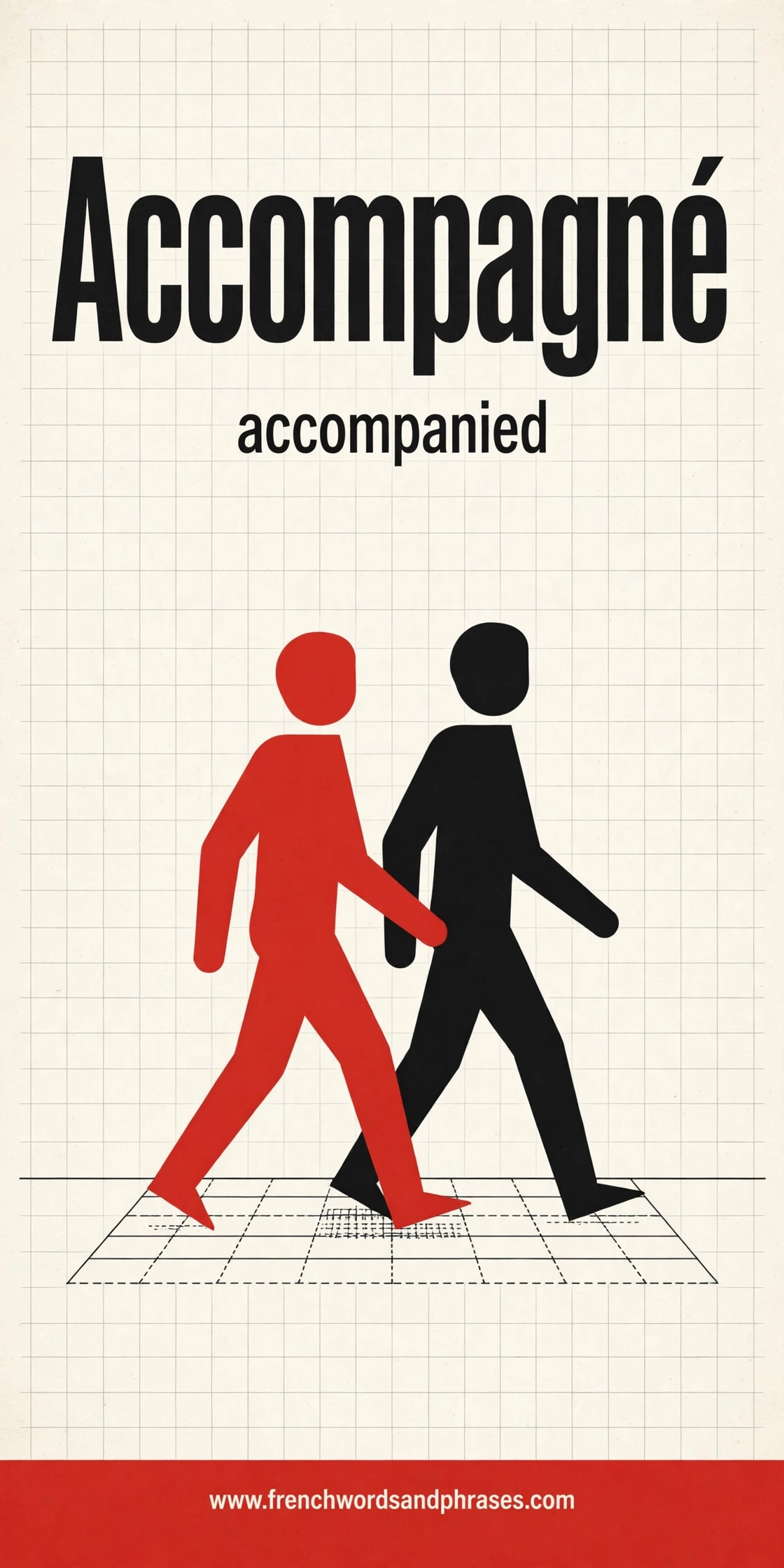
Accompagné means accompanied.
At the little station, the conductor checks the list twice: every child on the school trip must be accompagné — an adult beside each group, no one travelling alone. « Les enfants non accompagnés restent sur le quai », he announces. Accompagné is the adjective of company itself: with someone beside you, never solo.
In this guide, you’ll learn what accompagné means in English, how its feminine accompagnée is formed, the little word de that almost always follows it, and the official phrase every traveller should know: enfant non accompagné. Explore French examples, English translations, and practice quizzes.
Understanding the French Adjective Accompagné
Accompagné is a French adjective of quality — the adjective of company. It is the past participle of the verb accompagner (to accompany, to go with) working as an adjective: un enfant accompagné, une patiente accompagnée, des voyageurs accompagnés. It almost always travels with its own companion, the preposition de: accompagné de sa sœur, accompanied by his sister.
It means accompanied — in company, together with someone: accompagné de ses parents, accompanied by his parents; bien accompagné, in good company; mal accompagné, in bad company. On trains and planes it becomes official: un mineur non accompagné is an unaccompanied minor, travelling alone under the staff’s care.
Type: Adjective of quality — company; past participle of accompagner
Answers the question: What is he like? — accompanied, in company, together
Changes form: Feminine adds -e — accompagné / accompagnée; plurals accompagnés / accompagnées
English equivalents: Accompanied; in company; together; attended.
One important usage detail: accompagné is followed by de, not par, for the person who comes along — accompagné de son frère, accompanied by his brother. And its negative is just as common as the word itself: non accompagné, unaccompanied, is the phrase printed on tickets and airport signs for children travelling alone.
Experience the Word
Accompagné is the adjective of not being alone — the friend at the hospital door, the colleague who walks with you to the difficult meeting, the dog trotting beside the bicycle.
Imagine an old pianist who refuses to play unless his granddaughter turns the pages. « Tout seul, la musique est triste », he says. Accompagné, with her beside him, the same notes become a celebration.
You have not just said someone is with people. You have named the comfort of company — accompagné, the state of having someone at your side.
How to Use Accompagné in French: Complete Guide
Let’s explore how accompagné works in French, beginning with the whole word on one card.
Accompagné at a Glance
Before the details, here is the whole word on one card.
The Whole Word on One Card
Meaning, type, position and forms — accompagné in four lines.
| Point | Accompagné |
|---|---|
| Meaning | accompanied — in company, together |
| Type | adjective of quality — company (participle of accompagner) |
| Usual position | after the noun, followed by de — accompagné de sa mère |
| Form | accompagné / accompagnée — accompagnés / accompagnées in the plural |
Example
L’enfant, accompagné de sa mère, monte dans le train.
The child, accompanied by his mother, gets on the train.
The Four Forms of Accompagné
Accompagné follows the regular participle pattern: the feminine adds an e, the plurals add an s.
| Form | Accompagné | Example |
|---|---|---|
| Masculine singular | accompagné | un patient accompagné — an accompanied patient |
| Feminine singular | accompagnée | une patiente accompagnée — an accompanied patient |
| Masculine plural | accompagnés | des enfants accompagnés — accompanied children |
| Feminine plural | accompagnées | des voyageuses accompagnées — accompanied travellers |
Example
Les voyageuses accompagnées passent le contrôle en premier.
The accompanied travellers go through the check first.
Quick Quiz 1
What is the feminine of accompagné?
Reveal the answer
accompagnée
Une patiente accompagnée — the feminine adds an e.
An accompanied patient.
The Feminine of Accompagné: Accompagnée
Accompagnée is not a separate word to learn later — it is half of this word’s life, formed exactly like the feminine of arrivé or marié.
| Situation | Example |
|---|---|
| Masculine | un visiteur accompagné — an accompanied visitor |
| Feminine | une visiteuse accompagnée — identical but for the added e |
| Why | participle adjectives in -é form their feminine with -ée |
| The plural | add s — des visiteuses accompagnées, accompanied visitors |
Example
La visiteuse, accompagnée de son fils, découvre le musée.
The visitor, accompanied by her son, discovers the museum.
Where Accompagné Goes: After the Noun, with De
Accompagné follows the noun or être, and the companion is introduced by de.
| Pattern | Example |
|---|---|
| After the noun | un enfant accompagné — an accompanied child |
| With de | accompagné de sa sœur — accompanied by his sister |
| After être | elle est bien accompagnée — she is in good company |
| The negative | un mineur non accompagné — an unaccompanied minor |
Example
Il est arrivé accompagné de deux collègues.
He arrived accompanied by two colleagues.
Quick Quiz 2
How do you say ‘accompanied by his sister’ — accompagné par sa sœur or accompagné de sa sœur?
Reveal the answer
accompagné de sa sœur
The companion is introduced by de, not par.
Accompanied by his sister.
More Accompagné: Comparing with Accompagné
Accompagné compares less often than most adjectives, but bien and mal do its comparing for it.
| Degree | Example |
|---|---|
| Well accompanied | bien accompagné — in good company |
| Badly accompanied | mal accompagné — in bad company |
| More accompanied | mieux accompagné — better accompanied |
| The best accompanied (masc.) | le mieux accompagné — le mieux accompagné des invités |
| The best accompanied (fem.) | la mieux accompagnée — la mieux accompagnée des invitées |
Example
De tous les candidats, c’est le mieux accompagné.
Of all the candidates, he is the best accompanied.
Everyday Expressions with Accompagné
Accompagné appears at stations, hospitals and dinner tables — wherever company matters.
| Expression | In English |
|---|---|
| accompagné de | accompanied by |
| bien accompagné | in good company |
| mal accompagné | in bad company |
| un enfant non accompagné | an unaccompanied child |
| un mineur non accompagné | an unaccompanied minor (official) |
| être accompagné | to be accompanied, to have company |
Example
Un mineur non accompagné voyage sous la surveillance du personnel.
An unaccompanied minor travels under the staff’s supervision.
Quick Quiz 3
What does bien accompagné mean?
Reveal the answer
In good company
Bien accompagné — surrounded by the right people.
In good company.
Accompagné and Its Neighbours
Accompagné stands in the family of company, facing its lonely opposite, seul.
| French | In English |
|---|---|
| accompagner | to accompany, to go with — the verb it comes from |
| escorté | escorted — with an official escort |
| entouré | surrounded — entouré de sa famille |
| ensemble | together — the adverb |
| seul | alone — the opposite: un enfant seul |
| l’accompagnement | accompaniment, support — the noun |
Example
Entouré de ses amis, accompagné de sa sœur, il n’est jamais seul.
Surrounded by his friends, accompanied by his sister, he is never alone.
Watch Out: The Traps Around Accompagné
The traps here are the little preposition and a spelling that changes with the person described.
| Trap | The truth |
|---|---|
| The preposition | accompagné de, not par — accompagné de son frère |
| Agreement | une patiente accompagnée, des patientes accompagnées — the participle agrees like any adjective |
| The official phrase | mineur non accompagné is the exact wording on tickets and forms — learn it whole |
| The verb | accompagner also means to accompany in music — le pianiste accompagne la chanteuse |
Example
Accompagnée de sa fille, la patiente entre dans le cabinet.
Accompanied by her daughter, the patient enters the office.
Quick Quiz 4
How do you say ‘an unaccompanied minor’?
Reveal the answer
un mineur non accompagné
The official phrase, word for word, on every French ticket and form.
An unaccompanied minor.
Accompagné in Everyday French: Real-Life Examples
Now that you know the word, let’s see how accompagné appears in everyday French.
Example 1 — At the station
Les enfants accompagnés voyagent avec leurs parents.
The accompanied children travel with their parents.
Example 2 — At the airport
Un mineur non accompagné doit s’enregistrer ici.
An unaccompanied minor must check in here.
Example 3 — At the hospital
La patiente, accompagnée de son mari, attend le médecin.
The patient, accompanied by her husband, waits for the doctor.
Example 4 — At a party
Il est venu accompagné de sa nouvelle amie.
He came accompanied by his new girlfriend.
Example 5 — Good company
Avec eux, tu es toujours bien accompagné.
With them, you are always in good company.
Example 6 — A walk
Le chien, accompagné des enfants, court dans le parc.
The dog, accompanied by the children, runs in the park.
Beyond Translation: The Meaning of Accompagné
English speakers will hear an old friend in accompagné: accompany and company come from the same French root — the person who shares your bread, pain, on the road. To be accompagné is, at the word’s heart, to have a bread-friend beside you.
Accompagné is the adjective of company itself — the comfort, and sometimes the official requirement, of not travelling through life alone.
Learn it with its inseparable de and its famous negative, non accompagné, and you can read every French station sign and describe every arrival.
How to Remember the French Adjective Accompagné
Remember it this way: Accompagné is the accompanied adjective — accompagné for him, accompagnée for her, and de always brings the companion along.
- You learn the pair together — un enfant accompagné, une patiente accompagnée.
- You keep the companion’s key — accompagné de sa sœur, jamais « par ».
- You learn the sign whole — un mineur non accompagné, l’enfant qui voyage seul.
The key idea is accompagné / accompagnée means accompanied; followed by de; non accompagné = unaccompanied.
Test Your Knowledge of Accompagné
Let’s see how much you’ve learned. Try answering these questions before revealing the answers.
Question 1
What does accompagné mean?
Reveal the answer
Accompanied — in company, together with someone.
Question 2
What is the feminine of accompagné?
Reveal the answer
accompagnée — the feminine adds an e.
Question 3
Translate: accompanied by his parents.
Reveal the answer
Accompagné de ses parents.
Question 4
Complete the sentence:
La voyageuse ______ monte dans l’avion.
Reveal the answer
accompagnée
La voyageuse accompagnée monte dans l’avion.
The accompanied traveller boards the plane.
Question 5
How do you say ‘an unaccompanied minor’?
Reveal the answer
un mineur non accompagné — the official phrase on tickets and forms.
Your Final Challenge
Can You Use It?
How would you say this in French?
“The child, accompanied by his mother, gets on the train.”
Reveal the answer
L’enfant, accompagné de sa mère, monte dans le train.
The child, accompanied by his mother, gets on the train.
A little French. A little curiosity. A richer everyday life.
LEARN FRENCH ONE WORD AT A TIME




