
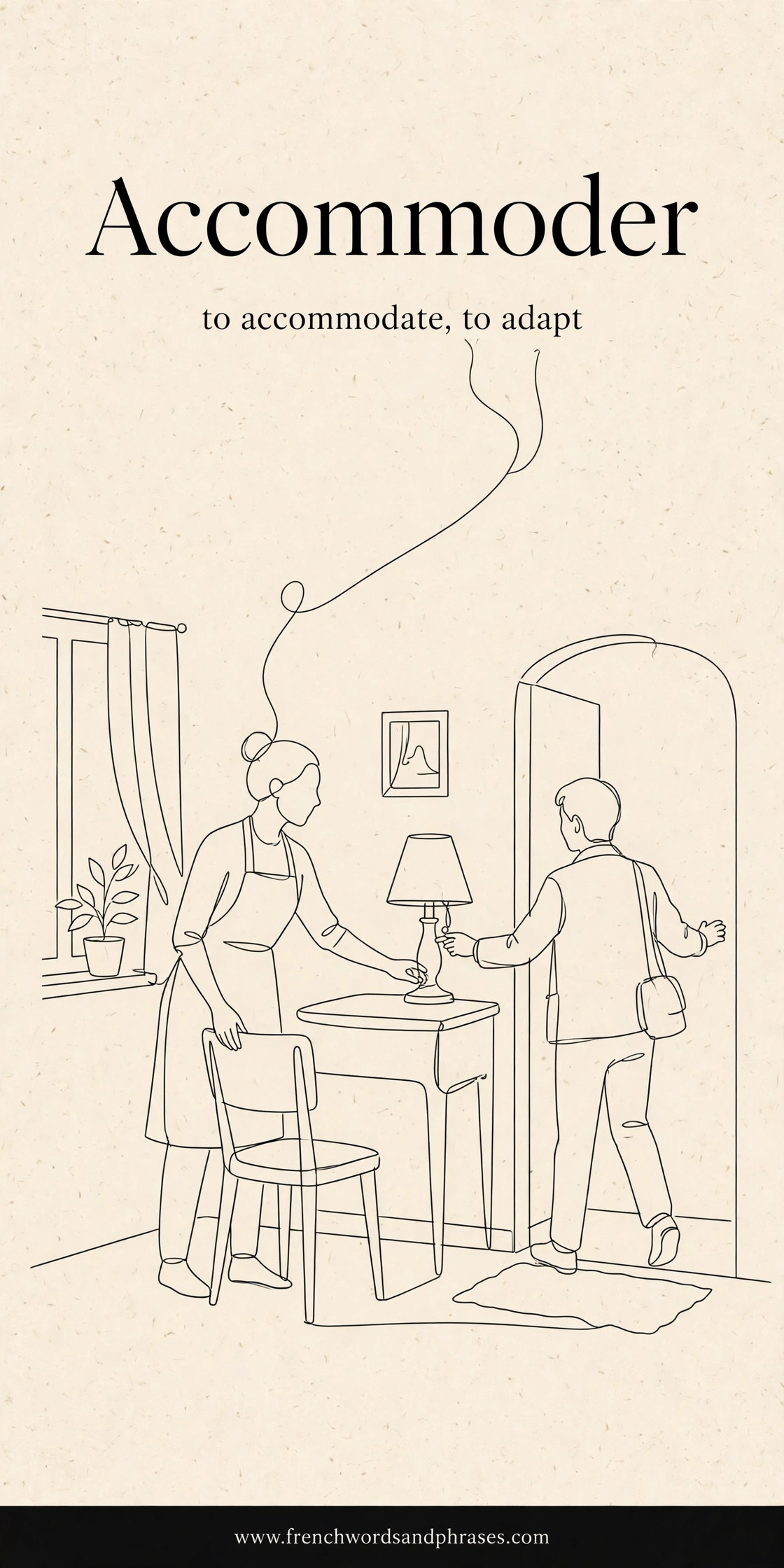
A French Word to Live By
How to Conjugate Accommoder in French
/a.kɔ.mɔ.de/
Accommoder means to accommodate, to adapt — to fit a thing to a person, a text to its readers, or yesterday’s leftovers to tonight’s table.
A teacher reshaping her lesson for younger pupils, a cook turning cold chicken into a shining salad, a grandfather quietly accepting the noisy flat he has been given — accommoder is the verb of fitting things to life: adapting, preparing, and making do.
In this guide, you’ll learn how to conjugate accommoder in all the major French tenses and moods. Explore complete conjugation tables, French examples, English translations, and practice quizzes.
Understanding the French Verb Accommoder
Accommoder is a regular French verb belonging to the first group of verbs, those ending in-er.
It means to accommodate, to adapt. Opticians use it too: l’accommodation is the eye’s focusing, and l’œil accommode. In law and formal French, accommoder can settle or arrange a matter. But its living heart is adaptation — of things to people, of sauces to dishes, and of people to circumstances they did not choose.
Verb classification: First group (-er)
Auxiliary verb: Avoir
Past participle: accommodé
Present participle: accommodant
English equivalents: To accommodate, to adapt, to fit; accommoder quelque chose à — to adapt something to; accommoder les restes — to dress up the leftovers (cooking); accommoder une sauce — to prepare a sauce; s’accommoder de — to put up with, to make do with; l’œil accommode — the eye focuses.
One important detail: accommoder is a verb of fitting, and its three homes are the classroom, the kitchen and the shrug. Teachers accommodent a lesson à their class; cooks accommodent les restes — leftovers dressed, sauced and made new; and the pronominal s’accommoder de means to put up with something without fuss: il s’accommode de tout, he makes do with anything. Do not confuse it with the English hotel sense: for lodging people, French says loger or héberger, not accommoder. The verb is regular: j’accommode, nous accommodons, past participle accommodé — mind the double m and the double c at the start.
Experience the Word
Accommoder is the verb of the good fit — nothing is thrown away and nobody is left out; everything is adjusted until it works.
Imagine a grandmother surveying Sunday’s leftovers: half a chicken, three potatoes, a heel of cheese. An hour later the family sits down to a golden gratin and a salad nobody recognizes as yesterday at all. Elle a accommodé les restes — the leftovers have been fitted, dressed and promoted into dinner.
Nothing new was bought. She has accommodated — accommodé — what there was to what was needed.
How to Conjugate Accommoder: Complete French Conjugation Guide
Let’s explore every major conjugation of accommoder, beginning with the indicative mood.
How to Conjugate Accommoder in the Indicative Mood
The indicative mood is used to express facts, observations, actions, and events.
How to Conjugate Accommoder in the Present Tense (Présent)
Used for actions happening now, habitual actions, and general truths.
| Subject | Conjugation |
|---|---|
| je | accommode |
| tu | accommodes |
| il / elle | accommode |
| nous | accommodons |
| vous | accommodez |
| ils / elles | accommodent |
Example
Le professeur accommode ses explications à l’âge des élèves.
The teacher adapts his explanations to the pupils’ age.
Quick Quiz 1
Complete the sentence:
Nous ______ la salle pour la fête.
Reveal the answer
accommodons
Nous accommodons la salle pour la fête.
We are adapting the room for the party.
How to Conjugate Accommoder in the Passé Composé
Used for completed actions in the past. Accommoder takes the auxiliary verb avoir.
| Subject | Conjugation |
|---|---|
| j’ | ai accommodé |
| tu | as accommodé |
| il / elle | a accommodé |
| nous | avons accommodé |
| vous | avez accommodé |
| ils / elles | ont accommodé |
Example
Elle a accommodé les restes en un délicieux gratin.
She turned the leftovers into a delicious gratin.
How to Conjugate Accommoder in the Imparfait (Imperfect Tense)
Used for habitual past actions, descriptions, and ongoing situations in the past.
| Subject | Conjugation |
|---|---|
| je | accommodais |
| tu | accommodais |
| il / elle | accommodait |
| nous | accommodions |
| vous | accommodiez |
| ils / elles | accommodaient |
Example
Il s’accommodait de tout, sans jamais se plaindre.
He put up with everything, without ever complaining.
Quick Quiz 2
Choose the correct form:
He put up with everything.
Il ______ de tout. (s’accommodait / accommodait)
Reveal the answer
s’accommodait
Il s’accommodait de tout.
To put up with is the pronominal s’accommoder de.
How to Conjugate Accommoder in the Plus-que-parfait
Used to describe an action that had already been completed before another past event.
| Subject | Conjugation |
|---|---|
| j’ | avais accommodé |
| tu | avais accommodé |
| il / elle | avait accommodé |
| nous | avions accommodé |
| vous | aviez accommodé |
| ils / elles | avaient accommodé |
Example
Nous avions accommodé la maison pour nos vieux parents.
We had adapted the house for our elderly parents.
How to Conjugate Accommoder in the Passé Simple
Primarily used in formal writing, literature, and historical narratives. It is rarely used in everyday conversation.
| Subject | Conjugation |
|---|---|
| je | accommodai |
| tu | accommodas |
| il / elle | accommoda |
| nous | accommodâmes |
| vous | accommodâtes |
| ils / elles | accommodèrent |
Example
Le cuisinier accommoda le poisson d’une sauce légère.
The cook dressed the fish with a light sauce.
How to Conjugate Accommoder in the Passé Antérieur
A literary tense used to express an action completed immediately before another past action, generally in the passé simple.
| Subject | Conjugation |
|---|---|
| j’ | eus accommodé |
| tu | eus accommodé |
| il / elle | eut accommodé |
| nous | eûmes accommodé |
| vous | eûtes accommodé |
| ils / elles | eurent accommodé |
Example
Quand il se fut accommodé de sa nouvelle vie, il écrivit à ses amis.
When he had settled into his new life, he wrote to his friends.
How to Conjugate Accommoder in the Future Tense (Futur Simple)
Used to describe actions that will take place in the future.
| Subject | Conjugation |
|---|---|
| je | accommoderai |
| tu | accommoderas |
| il / elle | accommodera |
| nous | accommoderons |
| vous | accommoderez |
| ils / elles | accommoderont |
Example
Nous accommoderons la salle pour la fête de samedi.
We will adapt the room for Saturday’s party.
How to Conjugate Accommoder in the Futur Antérieur (Future Perfect)
Used for an action that will have been completed before a particular point in the future.
| Subject | Conjugation |
|---|---|
| j’ | aurai accommodé |
| tu | auras accommodé |
| il / elle | aura accommodé |
| nous | aurons accommodé |
| vous | aurez accommodé |
| ils / elles | auront accommodé |
Example
Quand tu auras accommodé la sauce, goûte-la avant de servir.
When you have prepared the sauce, taste it before serving.
How to Conjugate Accommoder in the Near Future (Futur Proche)
Used to describe something that is going to happen soon. Formed with aller + infinitive.
| Subject | Conjugation |
|---|---|
| je | vais accommoder |
| tu | vas accommoder |
| il / elle | va accommoder |
| nous | allons accommoder |
| vous | allez accommoder |
| ils / elles | vont accommoder |
Example
Je vais accommoder ces légumes avec des herbes.
I am going to dress these vegetables with herbs.
How to Conjugate Accommoder in the Conditional Mood
The conditional mood expresses what would happen under certain circumstances. It is also frequently used to make polite requests or express wishes.
How to Conjugate Accommoder in the Present Conditional
| Subject | Conjugation |
|---|---|
| je | accommoderais |
| tu | accommoderais |
| il / elle | accommoderait |
| nous | accommoderions |
| vous | accommoderiez |
| ils / elles | accommoderaient |
Example
Un bon tailleur accommoderait la robe à votre taille.
A good tailor would fit the dress to your size.
How to Conjugate Accommoder in the Past Conditional
| Subject | Conjugation |
|---|---|
| j’ | aurais accommodé |
| tu | aurais accommodé |
| il / elle | aurait accommodé |
| nous | aurions accommodé |
| vous | auriez accommodé |
Example
Il s’en serait accommodé si le bruit avait cessé la nuit.
He would have put up with it if the noise had stopped at night.
Accommoder in the Literary Past Conditional Form
This less common literary form uses the imperfect subjunctive of avoir.
| Subject | Conjugation |
|---|---|
| j’ | eusse accommodé |
| tu | eusses accommodé |
| il / elle | eût accommodé |
| nous | eussions accommodé |
| vous | eussiez accommodé |
| ils / elles | eussent accommodé |
Example
Elle se fût accommodée d’une chambre plus petite.
She would have made do with a smaller room.
How to Conjugate Accommoder in the Subjunctive Mood
The subjunctive is used to express wishes, emotions, doubts, necessity, and uncertainty. It frequently follows expressions such as il faut que (it is necessary that) or bien que (although).
How to Conjugate Accommoder in the Present Subjunctive
| Subject | Conjugation |
|---|---|
| que je | accommode |
| que tu | accommodes |
| qu’il / qu’elle | accommode |
| que nous | accommodions |
| que vous | accommodiez |
| qu’ils / qu’elles | accommodent |
Example
Il faut que tu accommodes le menu aux goûts des invités.
You must adapt the menu to the guests’ tastes.
Quick Quiz 3
Complete the sentence using the subjunctive:
Il faut que vous ______ le menu aux invités.
Reveal the answer
accommodiez
Il faut que vous accommodiez le menu aux invités.
You must adapt the menu to the guests.
How to Conjugate Accommoder in the Imperfect Subjunctive
A literary tense, rarely encountered in modern spoken French.
| Subject | Conjugation |
|---|---|
| que je | accommodasse |
| que tu | accommodasses |
| qu’il / qu’elle | accommodât |
| que nous | accommodassions |
| que vous | accommodassiez |
| qu’ils / qu’elles | accommodassent |
Example
On lui demandait qu’il accommodât ses horaires à ceux du bureau.
He was asked to fit his hours to the office’s.
How to Conjugate Accommoder in the Pluperfect Subjunctive
A literary construction used to express an action completed before another past action.
| Subject | Conjugation |
|---|---|
| que j’ | eusse accommodé |
| que tu | eusses accommodé |
| qu’il / qu’elle | eût accommodé |
| que nous | eussions accommodé |
| que vous | eussiez accommodé |
| qu’ils / qu’elles | eussent accommodé |
Example
On admirait qu’elle se fût accommodée de si peu.
People admired that she had made do with so little.
How to Conjugate Accommoder in the Past Subjunctive
| Subject | Conjugation |
|---|---|
| que j’ | aie accommodé |
| que tu | aies accommodé |
| qu’il / qu’elle | ait accommodé |
| que nous | ayons accommodé |
| que vous | ayez accommodé |
| qu’ils / qu’elles | aient accommodé |
Example
Je suis ravi qu’elle ait accommodé son discours au public.
I am delighted she adapted her speech to the audience.
How to Conjugate Accommoder in the Imperative
The imperative is used to give commands, instructions, invitations, or suggestions. Subject pronouns are omitted.
How to Conjugate Accommoder in the Present Imperative
| Person | Conjugation |
|---|---|
| (tu) | accommode |
| (nous) | accommodons |
| (vous) | accommodez |
Example
Accommode-toi de ce que tu as !
Make do with what you have!
Quick Quiz 4
How would you say Make do with what you have (tu form)?
Reveal the answer
Accommode-toi de ce que tu as !
French Participles of Accommoder
Participles are verb forms that can be used in compound tenses and other grammatical constructions.
Present Participle of Accommoder
accommodant
En accommodant les restes, elle invente un plat nouveau.
By dressing up the leftovers, she invents a new dish.
Past Participle of Accommoder
accommodé
Les restes, accommodés en salade, ont fait un excellent dîner.
The leftovers, dressed as a salad, made an excellent dinner.
Accommoder in Everyday French: Real-Life Examples
Now that you know the conjugations, let’s see how accommoder appears in everyday French.
Example 1 — Present
Le professeur accommode le cours à ses élèves.
The teacher adapts the lesson to his pupils.
Example 2 — Passé composé
Elle a accommodé les restes en gratin.
She turned the leftovers into a gratin.
Example 3 — Imparfait
Il s’accommodait de tout.
He put up with everything.
Example 4 — Future
Nous accommoderons la salle pour la fête.
We will adapt the room for the party.
Example 5 — Conditional
Elle s’accommoderait d’une petite chambre.
She would make do with a small room.
Example 6 — Imperative
Accommode-toi de ce que tu as !
Make do with what you have!
Beyond Translation: The Meaning of Accommoder
English accommodate went into the hotel business — rooms, guests, capacity. French accommoder stayed in the kitchen and the workshop.
It is the verb of resourcefulness.
Its root is Latin commodus — fitting, convenient, the same root as commode, a chest of drawers, literally ‘the convenient thing’. To accommoder is to make the world commode: a sauce fits a fish, a lesson fits a child, and a philosopher s’accommode de tout — fits himself to whatever life serves.
How to Remember the French Verb Accommoder
Remember it this way: Accommoder is about the grandmother turning leftovers into a feast — everything fitted to everything.
- Fitting is the key: accommoder quelque chose À quelqu’un ou à quelque chose.
- The kitchen sense is beloved: accommoder les restes — leftovers dressed up as a new dish.
- S’accommoder de = to put up with; and for lodging people, French says loger, not accommoder.
The key idea is the grandmother turning leftovers into a feast — everything fitted to everything.
Test Your Knowledge of Accommoder
Let’s see how much you’ve learned. Try answering these questions before revealing the answers.
Question 1
What does s’accommoder de mean?
Reveal the answer
To put up with, to make do with — il s’accommode de tout, he makes do with anything.
Question 2
How do you say She turned the leftovers into a gratin in French?
Reveal the answer
Elle a accommodé les restes en gratin.
Question 3
Translate: The teacher adapts his explanations to the pupils.
Reveal the answer
Le professeur accommode ses explications aux élèves.
Question 4
What is the past participle of accommoder?
Reveal the answer
Accommodé — double c, double m: a-c-c-o-m-m-o-d-é.
Question 5
Complete the sentence:
Il faut que tu ______ le menu aux goûts des invités.
Reveal the answer
accommodes
Il faut que tu accommodes le menu aux goûts des invités.
You must adapt the menu to the guests’ tastes.
Your Final Challenge
Can You Use It?
How would you say this in French?
She dresses up Sunday’s leftovers, and the family feasts as if it were the first day.
Reveal the answer
Elle accommode les restes du dimanche, et la famille se régale comme au premier jour.
She dresses up Sunday’s leftovers, and the family feasts as if it were the first day.
A little French. A little curiosity. A richer everyday life.
LEARN FRENCH ONE WORD AT A TIME




