
A French Word to Live By
How to Conjugate Acclamer in French
/a.kla.me/
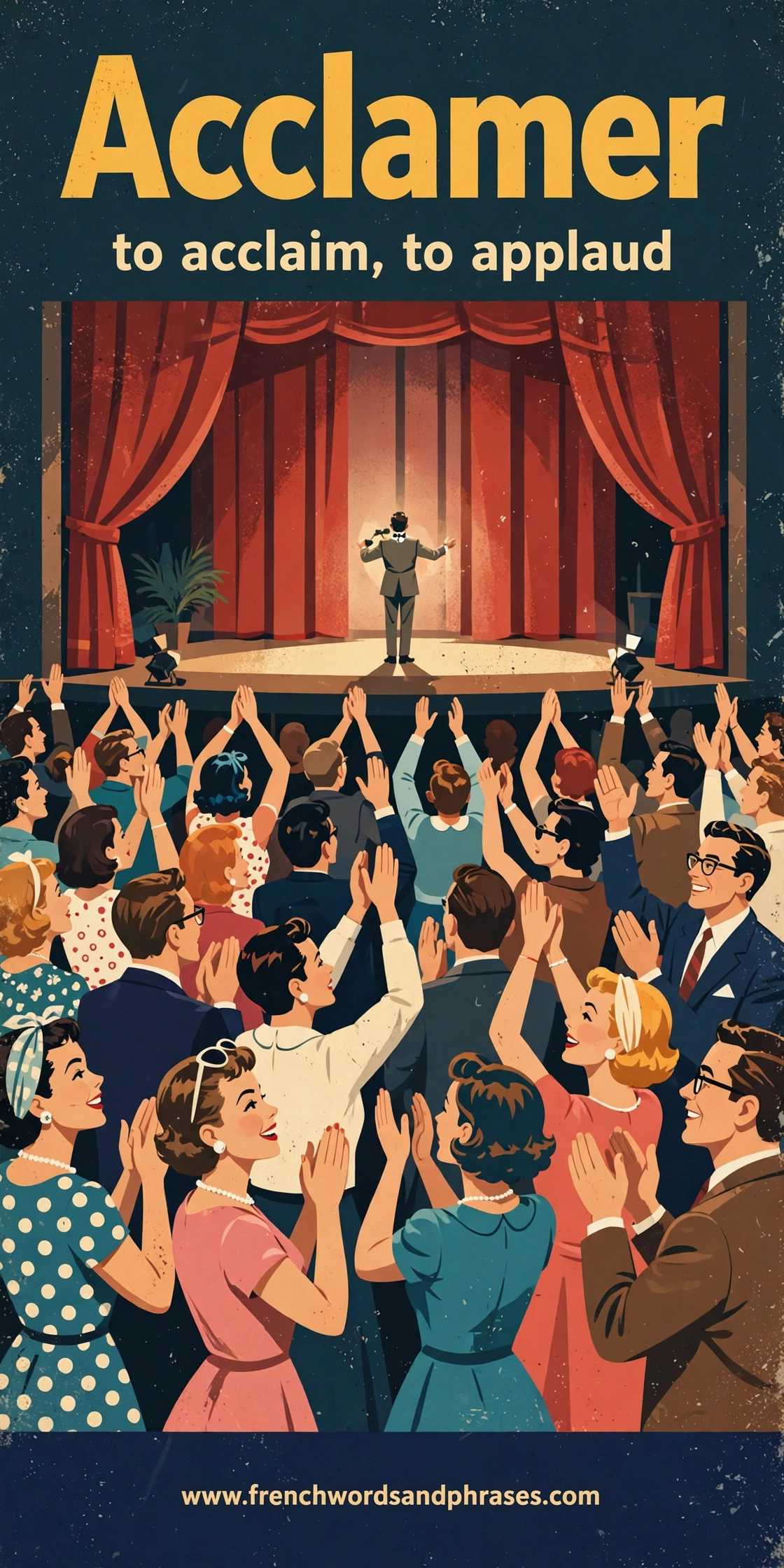
Acclamer means to acclaim, to applaud — to greet a person or a victory with a great roar of clapping, cheering and shouting.
A stadium rising as one when the champion crosses the line, a theatre on its feet before the curtain has even fallen — acclamer is the verb of the crowd’s roar: hands, voices and hearts all applauding together.
In this guide, you’ll learn how to conjugate acclamer in all the major French tenses and moods. Explore complete conjugation tables, French examples, English translations, and practice quizzes.
Understanding the French Verb Acclamer
Acclamer is a regular French verb belonging to the first group of verbs, those ending in-er.
It means to acclaim, to applaud. It belongs to stadiums, theatres, parliaments and triumphal homecomings — anywhere a crowd greets someone as a hero. Newspapers also use it of critics and juries: un film acclamé par la critique, a film acclaimed by the critics.
Verb classification: First group (-er)
Auxiliary verb: Avoir
Past participle: acclamé
Present participle: acclamant
English equivalents: To acclaim, to applaud, to cheer; acclamer un vainqueur — to cheer a winner; être acclamé par la foule — to be acclaimed by the crowd; acclamer un discours — to applaud a speech; les spectateurs acclament les artistes — the audience applauds the performers.
One important detail: acclamer is stronger than applaudir. Applaudir is the hands; acclamer is the whole crowd — voices, cheers and clapping together, usually for a person: a hero, a winner, a returning king. That is why it so often appears in its passive shape: il fut acclamé par la foule, elle a été acclamée par le public. It is the verb of Latin acclamare, to shout to — and French still hears the shouting inside it. The verb itself is perfectly regular: j’acclame, nous acclamons, past participle acclamé.
Experience the Word
Acclamer is the verb of ten thousand hands at once — applause so loud and so united that it becomes a single voice.
Imagine the last metres of a mountain stage of the Tour. The local boy — the one nobody expected — comes round the final bend alone, and the whole mountainside rises: bells, flags, grandparents on balconies, everyone acclamant le coureur as if he were family. He hears his own village roar him up the hill.
They are not just clapping politely. They are acclaiming him — acclamé — carried up the mountain on a wave of noise.
How to Conjugate Acclamer: Complete French Conjugation Guide
Let’s explore every major conjugation of acclamer, beginning with the indicative mood.
How to Conjugate Acclamer in the Indicative Mood
The indicative mood is used to express facts, observations, actions, and events.
How to Conjugate Acclamer in the Present Tense (Présent)
Used for actions happening now, habitual actions, and general truths.
| Subject | Conjugation |
|---|---|
| je | acclame |
| tu | acclames |
| il / elle | acclame |
| nous | acclamons |
| vous | acclamez |
| ils / elles | acclament |
Example
La foule acclame les coureurs à l’arrivée.
The crowd cheers the riders at the finish.
Quick Quiz 1
Complete the sentence:
Nous ______ les marins qui rentrent au port.
Reveal the answer
acclamons
Nous acclamons les marins qui rentrent au port.
We cheer the sailors coming back into port.
How to Conjugate Acclamer in the Passé Composé
Used for completed actions in the past. Acclamer takes the auxiliary verb avoir.
| Subject | Conjugation |
|---|---|
| j’ | ai acclamé |
| tu | as acclamé |
| il / elle | a acclamé |
| nous | avons acclamé |
| vous | avez acclamé |
| ils / elles | ont acclamé |
Example
Le public a acclamé la chanteuse pendant dix minutes.
The audience applauded the singer for ten minutes.
How to Conjugate Acclamer in the Imparfait (Imperfect Tense)
Used for habitual past actions, descriptions, and ongoing situations in the past.
| Subject | Conjugation |
|---|---|
| je | acclamais |
| tu | acclamais |
| il / elle | acclamait |
| nous | acclamions |
| vous | acclamiez |
| ils / elles | acclamaient |
Example
Les spectateurs acclamaient chaque but de l’équipe.
The spectators used to cheer every goal by the team.
Quick Quiz 2
Choose the correct form:
The people acclaimed the general.
Le peuple ______ le général. (a acclamé / est acclamé)
Reveal the answer
a acclamé
Le peuple a acclamé le général.
Acclamer takes avoir.
How to Conjugate Acclamer in the Plus-que-parfait
Used to describe an action that had already been completed before another past event.
| Subject | Conjugation |
|---|---|
| j’ | avais acclamé |
| tu | avais acclamé |
| il / elle | avait acclamé |
| nous | avions acclamé |
| vous | aviez acclamé |
| ils / elles | avaient acclamé |
Example
La foule avait acclamé le roi dès son apparition au balcon.
The crowd had acclaimed the king as soon as he appeared on the balcony.
How to Conjugate Acclamer in the Passé Simple
Primarily used in formal writing, literature, and historical narratives. It is rarely used in everyday conversation.
| Subject | Conjugation |
|---|---|
| je | acclamai |
| tu | acclamas |
| il / elle | acclama |
| nous | acclamâmes |
| vous | acclamâtes |
| ils / elles | acclamèrent |
Example
Le peuple acclama le général victorieux.
The people acclaimed the victorious general.
How to Conjugate Acclamer in the Passé Antérieur
A literary tense used to express an action completed immediately before another past action, generally in the passé simple.
| Subject | Conjugation |
|---|---|
| j’ | eus acclamé |
| tu | eus acclamé |
| il / elle | eut acclamé |
| nous | eûmes acclamé |
| vous | eûtes acclamé |
| ils / elles | eurent acclamé |
Example
Dès que la foule l’eut acclamé, il salua du balcon.
As soon as the crowd had acclaimed him, he waved from the balcony.
How to Conjugate Acclamer in the Future Tense (Futur Simple)
Used to describe actions that will take place in the future.
| Subject | Conjugation |
|---|---|
| je | acclamerai |
| tu | acclameras |
| il / elle | acclamera |
| nous | acclamerons |
| vous | acclamerez |
| ils / elles | acclameront |
Example
Demain, tout le stade acclamera les champions.
Tomorrow, the whole stadium will cheer the champions.
How to Conjugate Acclamer in the Futur Antérieur (Future Perfect)
Used for an action that will have been completed before a particular point in the future.
| Subject | Conjugation |
|---|---|
| j’ | aurai acclamé |
| tu | auras acclamé |
| il / elle | aura acclamé |
| nous | aurons acclamé |
| vous | aurez acclamé |
| ils / elles | auront acclamé |
Example
À la fin du spectacle, le public aura acclamé les artistes trois fois.
By the end of the show, the audience will have applauded the performers three times.
How to Conjugate Acclamer in the Near Future (Futur Proche)
Used to describe something that is going to happen soon. Formed with aller + infinitive.
| Subject | Conjugation |
|---|---|
| je | vais acclamer |
| tu | vas acclamer |
| il / elle | va acclamer |
| nous | allons acclamer |
| vous | allez acclamer |
| ils / elles | vont acclamer |
Example
Écoute, la foule va acclamer le vainqueur.
Listen, the crowd is going to cheer the winner.
How to Conjugate Acclamer in the Conditional Mood
The conditional mood expresses what would happen under certain circumstances. It is also frequently used to make polite requests or express wishes.
How to Conjugate Acclamer in the Present Conditional
| Subject | Conjugation |
|---|---|
| je | acclamerais |
| tu | acclamerais |
| il / elle | acclamerait |
| nous | acclamerions |
| vous | acclameriez |
| ils / elles | acclameraient |
Example
Avec un tel exploit, le public l’acclamerait.
With such a feat, the audience would acclaim him.
How to Conjugate Acclamer in the Past Conditional
| Subject | Conjugation |
|---|---|
| j’ | aurais acclamé |
| tu | aurais acclamé |
| il / elle | aurait acclamé |
| nous | aurions acclamé |
| vous | auriez acclamé |
| ils / elles | auraient acclamé |
Example
Sans la pluie, la foule l’aurait acclamé tout au long du parcours.
Without the rain, the crowd would have cheered him all along the route.
Acclamer in the Literary Past Conditional Form
This less common literary form uses the imperfect subjunctive of avoir.
| Subject | Conjugation |
|---|---|
| j’ | eusse acclamé |
| tu | eusses acclamé |
| il / elle | eût acclamé |
| nous | eussions acclamé |
| vous | eussiez acclamé |
| ils / elles | eussent acclamé |
Example
Le peuple l’eût acclamé s’il était revenu vainqueur.
The people would have acclaimed him if he had come back victorious.
How to Conjugate Acclamer in the Subjunctive Mood
The subjunctive is used to express wishes, emotions, doubts, necessity, and uncertainty. It frequently follows expressions such as il faut que (it is necessary that) or bien que (although).
How to Conjugate Acclamer in the Present Subjunctive
| Subject | Conjugation |
|---|---|
| que je | acclame |
| que tu | acclames |
| qu’il / qu’elle | acclame |
| que nous | acclamions |
| que vous | acclamiez |
| qu’ils / qu’elles | acclament |
Example
Il est juste que la foule acclame ses héros.
It is right that the crowd should cheer its heroes.
Quick Quiz 3
Complete the sentence using the subjunctive:
Il est beau que le public ______ ces jeunes artistes.
Reveal the answer
acclame
Il est beau que le public acclame ces jeunes artistes.
It is lovely that the audience applauds these young artists.
How to Conjugate Acclamer in the Imperfect Subjunctive
A literary tense, rarely encountered in modern spoken French.
| Subject | Conjugation |
|---|---|
| que je | acclamasse |
| que tu | acclamasses |
| qu’il / qu’elle | acclamât |
| que nous | acclamassions |
| que vous | acclamassiez |
| qu’ils / qu’elles | acclamassent |
Example
Il attendait que la salle l’acclamât avant de commencer son discours.
He waited for the hall to applaud him before beginning his speech.
How to Conjugate Acclamer in the Pluperfect Subjunctive
A literary construction used to express an action completed before another past action.
| Subject | Conjugation |
|---|---|
| que j’ | eusse acclamé |
| que tu | eusses acclamé |
| qu’il / qu’elle | eût acclamé |
| que nous | eussions acclamé |
| que vous | eussiez acclamé |
| qu’ils / qu’elles | eussent acclamé |
Example
Les chroniques racontent que le peuple l’eût acclamé dès son retour.
The chronicles tell that the people acclaimed him as soon as he returned.
How to Conjugate Acclamer in the Past Subjunctive
| Subject | Conjugation |
|---|---|
| que j’ | aie acclamé |
| que tu | aies acclamé |
| qu’il / qu’elle | ait acclamé |
| que nous | ayons acclamé |
| que vous | ayez acclamé |
| qu’ils / qu’elles | aient acclamé |
Example
Je suis ému que le public ait acclamé ces jeunes musiciens.
I am moved that the audience applauded these young musicians.
How to Conjugate Acclamer in the Imperative
The imperative is used to give commands, instructions, invitations, or suggestions. Subject pronouns are omitted.
How to Conjugate Acclamer in the Present Imperative
| Person | Conjugation |
|---|---|
| (tu) | acclame |
| (nous) | acclamons |
| (vous) | acclamez |
Example
Acclamez les marins qui rentrent au port !
Cheer the sailors coming back into port!
Quick Quiz 4
How would you say Cheer the winners (tu form)?
Reveal the answer
Acclame les vainqueurs !
French Participles of Acclamer
Participles are verb forms that can be used in compound tenses and other grammatical constructions.
Present Participle of Acclamer
acclamant
Acclamant les vainqueurs, la foule envahit la place.
Cheering the winners, the crowd poured onto the square.
Past Participle of Acclamer
acclamé
Acclamé par des milliers de voix, le champion leva les bras.
Acclaimed by thousands of voices, the champion raised his arms.
Acclamer in Everyday French: Real-Life Examples
Now that you know the conjugations, let’s see how acclamer appears in everyday French.
Example 1 — Present
La foule acclame les champions.
The crowd cheers the champions.
Example 2 — Passé composé
Le public a acclamé la chanteuse.
The audience applauded the singer.
Example 3 — Imparfait
Les spectateurs acclamaient chaque but.
The spectators used to cheer every goal.
Example 4 — Future
Tout le stade acclamera les vainqueurs.
The whole stadium will cheer the winners.
Example 5 — Conditional
Le public l’acclamerait après un tel exploit.
The audience would acclaim him after such a feat.
Example 6 — Imperative
Acclamez les coureurs !
Cheer the riders!
Beyond Translation: The Meaning of Acclamer
English acclaim is a polite, written word — critics acclaim films. French acclamer never lost the noise.
It is shouting, with grammar.
Behind it stands the Latin clamare, to cry out — the same root as clameur, the roar of a crowd. To be acclamé in French is not to receive good reviews; it is to stand in front of a wall of sound and feel it lift you.
How to Remember the French Verb Acclamer
Remember it this way: Acclamer is about the mountainside rising as one — bells, flags and ten thousand voices.
- Stronger than applaudir: acclamer is the whole crowd roaring, not just hands clapping.
- Loves the passive: il fut acclamé par la foule, un film acclamé par la critique.
- Regular -er: j’acclame, nous acclamons, past participle acclamé.
The key idea is the mountainside rising as one — bells, flags and ten thousand voices.
Test Your Knowledge of Acclamer
Let’s see how much you’ve learned. Try answering these questions before revealing the answers.
Question 1
How is acclamer different from applaudir?
Reveal the answer
Applaudir is clapping hands; acclamer is the whole crowd cheering and shouting for a person — a hero, a winner, an artist.
Question 2
How do you say The audience applauded the singer in French?
Reveal the answer
Le public a acclamé la chanteuse.
Question 3
Translate: The crowd cheers the champions.
Reveal the answer
La foule acclame les champions.
Question 4
What is the past participle of acclamer?
Reveal the answer
Acclamé — as in acclamé par la foule.
Question 5
Complete the sentence:
Il est juste que la foule ______ ses héros.
Reveal the answer
acclame
Il est juste que la foule acclame ses héros.
It is right that the crowd should cheer its heroes.
Your Final Challenge
Can You Use It?
How would you say this in French?
The crowd acclaims the winner, and the little stadium shakes like a drum.
Reveal the answer
La foule acclame le vainqueur, et le petit stade tremble comme un tambour.
The crowd acclaims the winner, and the little stadium shakes like a drum.
A little French. A little curiosity. A richer everyday life.
LEARN FRENCH ONE WORD AT A TIME




