A French Word to Live By
Translate Accenteur mouchet to English
/ak.sɑ̃.tœʁ mu.ʃɛ/
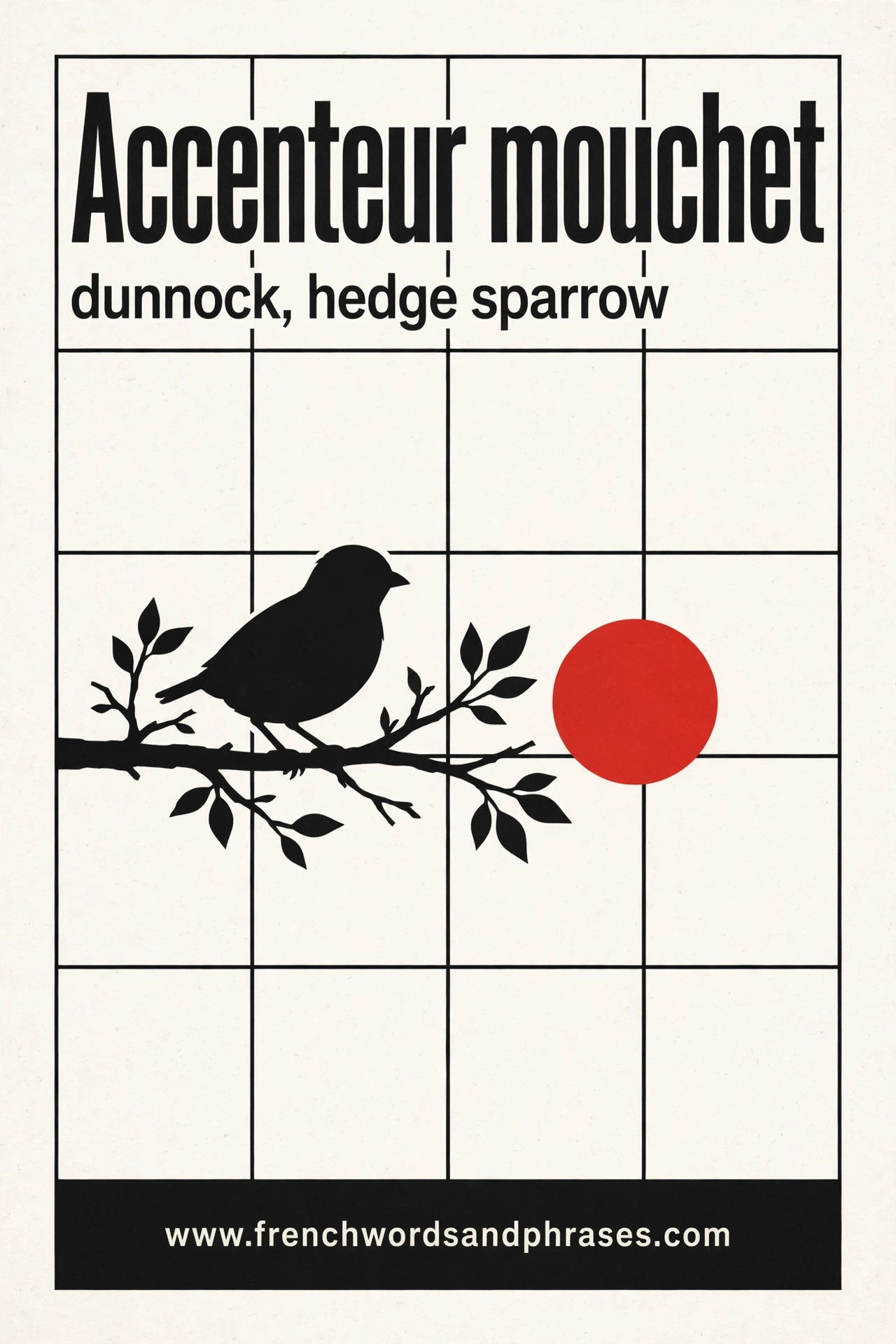
Accenteur mouchet means dunnock, hedge sparrow — the small speckled accentor of gardens and hedges.
Under the garden hedge, a small brown bird shuffles through the leaf litter, flicking its wings, so quiet you have walked past it a hundred times. The old gardener nods at it like a neighbour: « L’accenteur mouchet — il est là toute l’année. »
Let’s explore how accenteur mouchet works in French, beginning with the whole name on one card.
Understanding the French Phrase Accenteur mouchet
Accenteur mouchet is a French bird name built from accenteur (an accentor — a small songbird, a masculine noun that has its own page on this site) and mouchet, an old word for speckled, spotted — from mouche, a fly: the plumage looks flecked with tiny fly-sized spots. Word for word: the speckled accentor.
It means the dunnock, Prunella modularis — the small, secretive accentor of European and Asian gardens, hedgerows and woodland edges, also called the hedge sparrow in English (though it is no sparrow at all). Grey-headed, brown-streaked and famously unobtrusive, it creeps mouse-like under bushes, singing a short, bright song that most people hear for years before they ever see the singer.
Type: Bird name — a species term (accenteur + mouchet)
Answers the need: Naming this exact bird, in the garden, in a guide, in a sighting report
Register: Technical and naturalist — but this is also an everyday garden word
Strength: Precise — one species only, the common accentor of hedges and gardens
One important usage detail: mouchet is a frozen adjective in this name — the bird is un accenteur mouchet, and the plural is des accenteurs mouchets. Do not confuse it with moucheté, the everyday modern word for speckled (un œuf moucheté): the bird keeps the older, shorter form, mouchet, as its fixed surname.
Experience the Word
Accenteur mouchet is the name of the bird you already know without knowing — the shuffle in the hedge, the thin song from the thicket, the little brown shadow at the feeder’s edge.
Imagine the January garden, frost on the lawn, when a small bird creeps out from under the laurel, jerking its tail, picking at seeds the tits have dropped. It never queues at the feeder like the others. It takes the crumbs underneath — l’accenteur mouchet, the modest one.
English calls it dunnock — dun-coloured — or hedge sparrow. French looks closer and names the fine print of the feathers: mouchet, speckled, as if a fly had walked across the plumage.
How to Use Accenteur mouchet in French: Complete Guide
Let’s explore how accenteur mouchet works in French, beginning with the whole name on one card.
Accenteur mouchet at a Glance
The Whole Name on One Card
Real meaning, literal picture, scientific twin and register — accenteur mouchet in five lines.
| Point | Accenteur mouchet |
|---|---|
| What it really means | the dunnock — one exact species, the hedge accentor |
| Word for word | speckled accentor — mouchet, flecked with tiny spots |
| Scientific name | Prunella modularis — the only accentor in most gardens |
| Register | technical and everyday — bird guides and garden conversations alike |
| Use it for | naming the small brown bird under the hedge |
Example
Un accenteur mouchet chante au sommet de la haie, dès l’aube.
A dunnock sings at the top of the hedge, from dawn onwards.
Word by Word: Building the Bird
Two pieces — take them one by one and the quietest bird in the garden appears.
| Word | Literal meaning | Its job in the name |
|---|---|---|
| accenteur | accentor | the family: a small songbird — un accenteur, masculine |
| mouchet | speckled, flecked | the plumage: brown, finely streaked and spotted — from mouche, a fly |
Example
Le dos brun et moucheté de l’accenteur se confond avec les feuilles.
The dunnock’s brown, speckled back blends in with the leaves.
Quick Quiz 1
Where does mouchet come from?
Reveal the answer
From mouche, a fly — the plumage looks flecked with tiny fly-sized specks. The bird’s fixed name keeps this old short form, mouchet.
Un plumage mouchet, comme saupoudré de petites taches.
Speckled plumage, as if dusted with little spots.
Where You Meet It: The Bird in Its World
Accenteur mouchet turns up in moments like these — low, quiet, and closer than you think.
| Situation | Example |
|---|---|
| Its home ground | les haies, les jardins, les sous-bois — hedges, gardens, undergrowth |
| Its look | la tête grise, le dos brun strié — grey head, streaked brown back |
| Its behaviour | il se faufile sous les buissons — it creeps under the bushes |
| Its song | un chant court et vif, souvent caché — a short, bright song, often hidden |
| Its table manners | il mange les miettes sous la mangeoire — it eats the crumbs under the feeder |
Example
Sous la haie, un accenteur mouchet cherche des insectes dans les feuilles mortes.
Under the hedge, a dunnock is looking for insects in the dead leaves.
Make It Yours: The Name in Sentences
The name is fixed — articles and verbs around it do the moving, and mouchet takes the plural s.
| Form | French | In English |
|---|---|---|
| One bird | un accenteur mouchet | a dunnock |
| The bird | l’accenteur mouchet | the dunnock |
| Several | des accenteurs mouchets | dunnocks |
| In the garden | nous avons un accenteur mouchet au jardin | we have a dunnock in the garden |
| All year | l’accenteur mouchet reste chez nous toute l’année | the dunnock stays with us all year |
Example
Des accenteurs mouchets visitent le jardin même en hiver.
Dunnocks visit the garden even in winter.
Quick Quiz 2
Complete it: L’______ mouchet chante caché dans le buisson. (accentor)
Reveal the answer
accenteur — l’accenteur mouchet, with the article elided before the vowel.
L’accenteur mouchet chante caché dans le buisson.
The dunnock sings hidden in the bush.
Everyday Expressions: Talking About the Bird
The name slots into these garden frames — each one ready to use as it stands.
| Frame | In English |
|---|---|
| un accenteur mouchet au jardin | a dunnock in the garden |
| le chant de l’accenteur mouchet | the song of the dunnock |
| un couple d’accenteurs mouchets | a pair of dunnocks |
| l’accenteur mouchet sous la haie | the dunnock under the hedge |
| nourrir l’accenteur mouchet | to feed the dunnock (it takes crumbs from the ground) |
Example
Un couple d’accenteurs mouchets niche dans la haie du fond.
A pair of dunnocks is nesting in the hedge at the back.
Close Cousins: The Other Accentors
The accentor shelf is small — habitat separates the cousins more than plumage does.
| Expression | The difference |
|---|---|
| accenteur mouchet | dunnock — the garden and hedge bird, grey head, speckled back |
| accenteur alpin | alpine accentor — bigger and bolder, lives above the treeline |
| accenteur à gorge noire | black-throated accentor — the rare Asian visitor with the black throat |
| accenteur | accentor on its own — the family name, no species chosen |
Example
Dans nos jardins, un seul accenteur : l’accenteur mouchet.
In our gardens, only one accentor: the dunnock.
Quick Quiz 3
A small brown bird creeps under your hedge in January. Which name fits — accenteur alpin or accenteur mouchet?
Reveal the answer
Accenteur mouchet — the dunnock is the lowland garden bird; the alpine accentor stays in the high mountains.
Sous la haie, en janvier : c’est l’accenteur mouchet.
Under the hedge, in January: it is the dunnock.
Accenteur mouchet and Its Neighbours
The garden shelf around the name — the bird, its haunts and its company.
| French | In English |
|---|---|
| une haie | a hedge |
| un buisson | a bush, a shrub |
| un moineau | a sparrow — the bird it is mistaken for |
| la mangeoire | the bird feeder |
| les feuilles mortes | the dead leaves |
Example
On confond souvent l’accenteur mouchet avec un moineau, mais son bec est fin.
The dunnock is often mistaken for a sparrow, but its beak is thin.
Watch Out: The Traps Around Accenteur mouchet
The traps: a sparrow that is not one, a modern twin of the adjective, and the elided article.
| Trap | The truth |
|---|---|
| calling it a sparrow | the hedge sparrow is no sparrow: thin insect-eater’s beak, accentor family |
| « accenteur moucheté » | everyday French says moucheté for speckled, but the bird’s fixed name is mouchet |
| « le accenteur mouchet » | accenteur starts with a vowel: l’accenteur mouchet |
| looking for it at the feeder | it feeds on the ground underneath, mouse-quiet — watch the crumbs, not the perch |
Example
Regardez sous la mangeoire : l’accenteur mouchet y prend son repas.
Look under the feeder: the dunnock takes its meal there.
Quick Quiz 4
True or false: the dunnock is a kind of sparrow.
Reveal the answer
False — despite the English nickname hedge sparrow, it is an accentor, with a thin insect-eating beak; true sparrows have thick seed-eating beaks.
L’accenteur mouchet n’est pas un moineau, malgré son surnom anglais.
The dunnock is not a sparrow, despite its English nickname.
Accenteur mouchet in Everyday French: Real-Life Examples
Now that you know the word, let’s see how accenteur mouchet appears in everyday French.
Example 1 — In the garden
Un accenteur mouchet vit sous la haie depuis le printemps.
A dunnock has been living under the hedge since spring.
Example 2 — At dawn
L’accenteur mouchet chante avant tous les autres oiseaux.
The dunnock sings before all the other birds.
Example 3 — In winter
L’accenteur mouchet mange les graines tombées de la mangeoire.
The dunnock eats the seeds that have fallen from the feeder.
Example 4 — Comparing
Il est plus discret et plus fin que le moineau.
It is more discreet and slimmer than the sparrow.
Example 5 — Nesting
Un couple d’accenteurs mouchets a fait son nid dans le lierre.
A pair of dunnocks has made its nest in the ivy.
Example 6 — The photograph
Photographier l’accenteur mouchet demande de la patience.
Photographing the dunnock takes patience.
Beyond Translation: The Meaning of Accenteur mouchet
Every garden has a bird that nobody notices, and in Europe it is this one. Accenteur mouchet names it with a miniature precision — speckled, from mouche, a fly, as if the plumage had been printed with the smallest stamp in nature.
To learn accenteur mouchet is to start seeing the invisible bird: the shuffle under every hedge, the first thin song of the morning.
English hid it inside a wrong family — hedge sparrow. French kept it honest: an accentor, speckled, and entirely itself.
How to Remember the French Phrase Accenteur mouchet
Remember it this way: Accenteur mouchet means dunnock — the small speckled accentor of gardens and hedges; mouchet, speckled, comes from mouche, a fly.
- You read the plumage — mouchet, flecked with tiny specks, like fly spots on brown feathers.
- You place the bird — gardens, hedges and undergrowth, on the ground under the feeder.
- You free it from the sparrows — thin beak, accentor family, despite the English nickname.
The key idea is accenteur mouchet = dunnock, hedge sparrow — Prunella modularis; mouchet = speckled, from mouche.
Test Your Knowledge of Accenteur mouchet
Let’s see how much you’ve learned. Try answering these questions before revealing the answers.
Question 1
What does accenteur mouchet mean?
Reveal the answer
Dunnock — also called the hedge sparrow; Prunella modularis.
Question 2
What does mouchet mean, and where does it come from?
Reveal the answer
Speckled, flecked — from mouche, a fly: the plumage looks dusted with tiny fly-sized spots.
Question 3
Translate: A dunnock sings in the hedge.
Reveal the answer
Un accenteur mouchet chante dans la haie.
Question 4
Is the dunnock a sparrow?
Reveal the answer
No — it is an accentor with a thin insect-eating beak; hedge sparrow is only a nickname.
Question 5
Complete the sentence:
L’______ mouchet cherche des insectes sous le buisson. (accentor)
Reveal the answer
accenteur
L’accenteur mouchet cherche des insectes sous le buisson.
The dunnock is looking for insects under the bush.
Your Final Challenge
Can You Use It?
How would you say this in French?
“A dunnock lives under the hedge all year round.”
Reveal the answer
Un accenteur mouchet vit sous la haie toute l’année.
A dunnock lives under the hedge all year round.
A little French. A little curiosity. A richer everyday life.
LEARN FRENCH ONE WORD AT A TIME