A French Word to Live By
How to Conjugate Accaparer in French
/a.ka.pa.ʁe/
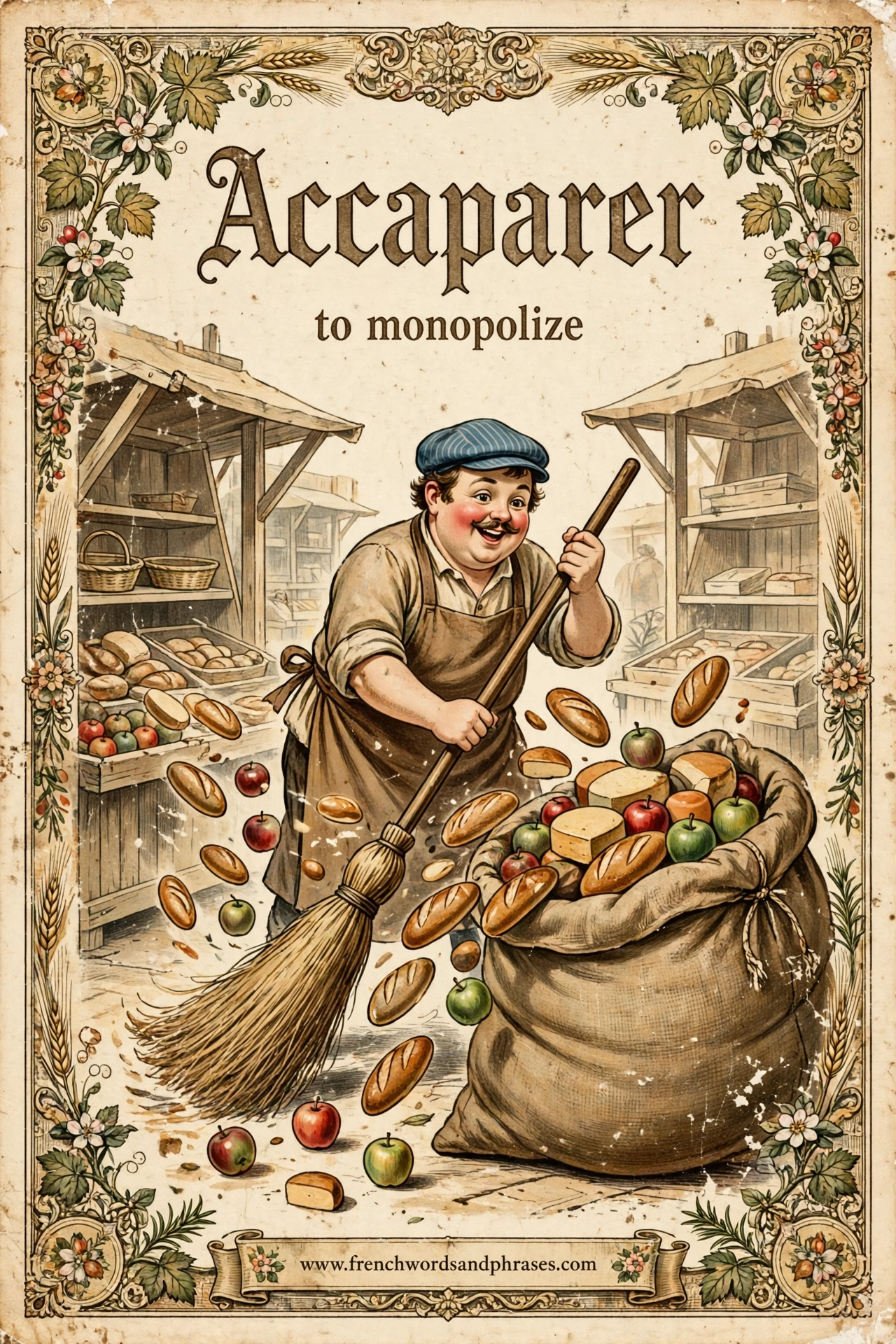
Accaparer means to monopolize — to grab the whole supply, the whole conversation or the whole room for yourself and leave nothing for anyone else.
A merchant quietly buying every sack of grain in the province before the harvest fails, a guest who talks for three hours without letting anyone speak — accaparer is the verb of the greedy grab: taking the lot, cornering it, keeping it.
In this guide, you’ll learn how to conjugate accaparer in all the major French tenses and moods. Explore complete conjugation tables, French examples, English translations, and practice quizzes.
Understanding the French Verb Accaparer
Accaparer is a regular French verb belonging to the first group of verbs, those ending in-er.
It means to monopolize. Today its commonest objects are invisible: attention, conversation, time, the television remote. In business and history it keeps its old force — speculators accaparaient grain, salt or coffee to corner a market — and journalists use it of any firm or state that takes a whole sector for itself.
Verb classification: First group (-er)
Auxiliary verb: Avoir
Past participle: accaparé
Present participle: accaparant
English equivalents: To monopolize, to hog, to corner; accaparer le marché — to corner the market; accaparer les terres — to buy up all the land; accaparer l’attention — to monopolize attention; accaparer la parole — to monopolize the conversation; être accaparé par son travail — to be completely taken up by one’s work.
One important detail: accaparer began in the marketplace — the old dictionaries define it as buying up a whole supply of goods wholesale, hoping to resell dearer — and modern French has stretched it over everything one person can grab alone: le marché, les terres, l’attention, la parole, la couverture (the blanket!). Note also its passive-flavoured twin: être accaparé par means to be fully taken up — elle est très accaparée par son travail, her work monopolizes her. The verb is perfectly regular: j’accapare, nous accaparons, past participle accaparé.
Experience the Word
Accaparer is the verb of the empty shelf and the endless talker — one pair of hands, everything in them.
Imagine a village shop the week before a festival. A stranger arrives at dawn and buys every bottle of the good wine, every kilo of flour, every candle — not to use them, but so that everyone else must come to him and pay his price. Il a tout accaparé: the whole village now queues at his door.
He has not stolen anything. He has monopolized — accaparé — the whole supply, and that is quite enough.
How to Conjugate Accaparer: Complete French Conjugation Guide
Let’s explore every major conjugation of accaparer, beginning with the indicative mood.
How to Conjugate Accaparer in the Indicative Mood
The indicative mood is used to express facts, observations, actions, and events.
How to Conjugate Accaparer in the Present Tense (Présent)
Used for actions happening now, habitual actions, and general truths.
| Subject | Conjugation |
|---|---|
| je | accapare |
| tu | accapares |
| il / elle | accapare |
| nous | accaparons |
| vous | accaparez |
| ils / elles | accaparent |
Example
Une seule entreprise accapare le marché du café.
A single company monopolizes the coffee market.
Quick Quiz 1
Complete the sentence:
Nous ______ tout le marché du village.
Reveal the answer
accaparons
Nous accaparons tout le marché du village.
We are cornering the whole village market.
How to Conjugate Accaparer in the Passé Composé
Used for completed actions in the past. Accaparer takes the auxiliary verb avoir.
| Subject | Conjugation |
|---|---|
| j’ | ai accaparé |
| tu | as accaparé |
| il / elle | a accaparé |
| nous | avons accaparé |
| vous | avez accaparé |
| ils / elles | ont accaparé |
Example
Il a accaparé la parole pendant toute la réunion.
He monopolized the conversation throughout the whole meeting.
How to Conjugate Accaparer in the Imparfait (Imperfect Tense)
Used for habitual past actions, descriptions, and ongoing situations in the past.
| Subject | Conjugation |
|---|---|
| je | accaparais |
| tu | accaparais |
| il / elle | accaparait |
| nous | accaparions |
| vous | accapariez |
| ils / elles | accaparaient |
Example
Les spéculateurs accaparaient les denrées pendant la guerre.
The speculators used to buy up all the foodstuffs during the war.
Quick Quiz 2
Choose the correct form:
The firm bought up all the land.
La firme ______ toutes les terres. (a accaparé / est accaparé)
Reveal the answer
a accaparé
La firme a accaparé toutes les terres.
Accaparer takes avoir.
How to Conjugate Accaparer in the Plus-que-parfait
Used to describe an action that had already been completed before another past event.
| Subject | Conjugation |
|---|---|
| j’ | avais accaparé |
| tu | avais accaparé |
| il / elle | avait accaparé |
| nous | avions accaparé |
| vous | aviez accaparé |
| ils / elles | avaient accaparé |
Example
La firme avait accaparé toutes les terres du village.
The firm had bought up all the land in the village.
How to Conjugate Accaparer in the Passé Simple
Primarily used in formal writing, literature, and historical narratives. It is rarely used in everyday conversation.
| Subject | Conjugation |
|---|---|
| je | accaparai |
| tu | accaparas |
| il / elle | accapara |
| nous | accaparâmes |
| vous | accaparâtes |
| ils / elles | accaparèrent |
Example
En quelques mois, la compagnie accapara le commerce du port.
Within a few months, the company cornered the port’s trade.
How to Conjugate Accaparer in the Passé Antérieur
A literary tense used to express an action completed immediately before another past action, generally in the passé simple.
| Subject | Conjugation |
|---|---|
| j’ | eus accaparé |
| tu | eus accaparé |
| il / elle | eut accaparé |
| nous | eûmes accaparé |
| vous | eûtes accaparé |
| ils / elles | eurent accaparé |
Example
Quand il eut accaparé le marché, les prix montèrent.
When he had cornered the market, prices rose.
How to Conjugate Accaparer in the Future Tense (Futur Simple)
Used to describe actions that will take place in the future.
| Subject | Conjugation |
|---|---|
| je | accaparerai |
| tu | accapareras |
| il / elle | accaparera |
| nous | accaparerons |
| vous | accaparerez |
| ils / elles | accapareront |
Example
Si on le laisse faire, il accaparera toute l’attention.
If he is allowed to, he will monopolize all the attention.
How to Conjugate Accaparer in the Futur Antérieur (Future Perfect)
Used for an action that will have been completed before a particular point in the future.
| Subject | Conjugation |
|---|---|
| j’ | aurai accaparé |
| tu | auras accaparé |
| il / elle | aura accaparé |
| nous | aurons accaparé |
| vous | aurez accaparé |
| ils / elles | auront accaparé |
Example
À la fin de la saison, ils auront accaparé la moitié des récoltes.
By the end of the season, they will have bought up half the harvests.
How to Conjugate Accaparer in the Near Future (Futur Proche)
Used to describe something that is going to happen soon. Formed with aller + infinitive.
| Subject | Conjugation |
|---|---|
| je | vais accaparer |
| tu | vas accaparer |
| il / elle | va accaparer |
| nous | allons accaparer |
| vous | allez accaparer |
| ils / elles | vont accaparer |
Example
Ce grand magasin va accaparer tout le commerce du quartier.
That big store is going to monopolize all the trade in the neighbourhood.
How to Conjugate Accaparer in the Conditional Mood
The conditional mood expresses what would happen under certain circumstances. It is also frequently used to make polite requests or express wishes.
How to Conjugate Accaparer in the Present Conditional
| Subject | Conjugation |
|---|---|
| je | accaparerais |
| tu | accaparerais |
| il / elle | accaparerait |
| nous | accaparerions |
| vous | accapareriez |
| ils / elles | accapareraient |
Example
Sans concurrence, cette marque accaparerait le marché.
Without competition, this brand would corner the market.
How to Conjugate Accaparer in the Past Conditional
| Subject | Conjugation |
|---|---|
| j’ | aurais accaparé |
| tu | aurais accaparé |
| il / elle | aurait accaparé |
| nous | aurions accaparé |
| vous | auriez accaparé |
| ils / elles | auraient accaparé |
Example
Il aurait accaparé la conversation si on l’avait laissé parler.
He would have monopolized the conversation if he had been allowed to speak.
Accaparer in the Literary Past Conditional Form
This less common literary form uses the imperfect subjunctive of avoir.
| Subject | Conjugation |
|---|---|
| j’ | eusse accaparé |
| tu | eusses accaparé |
| il / elle | eût accaparé |
| nous | eussions accaparé |
| vous | eussiez accaparé |
| ils / elles | eussent accaparé |
Example
Il eût accaparé toutes les terres sans la loi nouvelle.
He would have bought up all the land without the new law.
How to Conjugate Accaparer in the Subjunctive Mood
The subjunctive is used to express wishes, emotions, doubts, necessity, and uncertainty. It frequently follows expressions such as il faut que (it is necessary that) or bien que (although).
How to Conjugate Accaparer in the Present Subjunctive
| Subject | Conjugation |
|---|---|
| que je | accapare |
| que tu | accapares |
| qu’il / qu’elle | accapare |
| que nous | accaparions |
| que vous | accapariez |
| qu’ils / qu’elles | accaparent |
Example
Je ne veux pas qu’un seul élève accapare la parole.
I do not want one single pupil to monopolize the speaking time.
Quick Quiz 3
Complete the sentence using the subjunctive:
On craint qu’il ______ les meilleures places.
Reveal the answer
accapare
On craint qu’il accapare les meilleures places.
People fear he might grab all the best seats.
How to Conjugate Accaparer in the Imperfect Subjunctive
A literary tense, rarely encountered in modern spoken French.
| Subject | Conjugation |
|---|---|
| que je | accaparasse |
| que tu | accaparasses |
| qu’il / qu’elle | accaparât |
| que nous | accaparassions |
| que vous | accaparassiez |
| qu’ils / qu’elles | accaparassent |
Example
On craignait qu’il accaparât les meilleures places.
People feared he might grab all the best seats.
How to Conjugate Accaparer in the Pluperfect Subjunctive
A literary construction used to express an action completed before another past action.
| Subject | Conjugation |
|---|---|
| que j’ | eusse accaparé |
| que tu | eusses accaparé |
| qu’il / qu’elle | eût accaparé |
| que nous | eussions accaparé |
| que vous | eussiez accaparé |
| qu’ils / qu’elles | eussent accaparé |
Example
On racontait qu’ils eussent accaparé les réserves de blé.
People said they had bought up the wheat reserves.
How to Conjugate Accaparer in the Past Subjunctive
| Subject | Conjugation |
|---|---|
| que j’ | aie accaparé |
| que tu | aies accaparé |
| qu’il / qu’elle | ait accaparé |
| que nous | ayons accaparé |
| que vous | ayez accaparé |
| qu’ils / qu’elles | aient accaparé |
Example
Il est scandaleux qu’une firme ait accaparé ce marché.
It is scandalous that one firm has cornered this market.
How to Conjugate Accaparer in the Imperative
The imperative is used to give commands, instructions, invitations, or suggestions. Subject pronouns are omitted.
How to Conjugate Accaparer in the Present Imperative
| Person | Conjugation |
|---|---|
| (tu) | accapare |
| (nous) | accaparons |
| (vous) | accaparez |
Example
N’accapare pas la conversation, laisse parler les autres !
Do not monopolize the conversation, let the others speak!
Quick Quiz 4
How would you say Do not hog the blanket (tu form)?
Reveal the answer
N’accapare pas la couverture !
French Participles of Accaparer
Participles are verb forms that can be used in compound tenses and other grammatical constructions.
Present Participle of Accaparer
accaparant
En accaparant le marché, la firme a fait monter les prix.
By cornering the market, the firm pushed prices up.
Past Participle of Accaparer
accaparé
Le blé, accaparé par les spéculateurs, manquait partout.
The wheat, bought up by the speculators, was missing everywhere.
Accaparer in Everyday French: Real-Life Examples
Now that you know the conjugations, let’s see how accaparer appears in everyday French.
Example 1 — Present
Il accapare toujours la parole.
He always monopolizes the conversation.
Example 2 — Passé composé
Elle a accaparé toute l’attention.
She monopolized all the attention.
Example 3 — Imparfait
Les spéculateurs accaparaient le blé.
The speculators used to buy up the wheat.
Example 4 — Future
Cette firme accaparera le marché.
This firm will corner the market.
Example 5 — Conditional
Sans rivaux, il accaparerait tout le commerce.
Without rivals, he would monopolize all the trade.
Example 6 — Imperative
N’accapare pas la couverture !
Do not hog the blanket!
Beyond Translation: The Meaning of Accaparer
English has no everyday verb for this exact grab — monopolize and hog split the work between them, and accaparer does both.
Its story is written in old market law.
French kings once punished les accapareurs — hoarders who bought up grain in famine years — and the word still carries that whiff of scandal: to accaparer is never a neutral act, whether the prize is wheat, land, or the floor at a family dinner.
How to Remember the French Verb Accaparer
Remember it this way: Accaparer is about the merchant who buys the whole harvest — and the guest who takes the whole conversation.
- Born in the marketplace: buying up the whole supply — then stretched to attention, time and la parole.
- Être accaparé par = to be fully taken up by: elle est accaparée par son travail.
- Regular -er: j’accapare, nous accaparons, past participle accaparé.
The key idea is the merchant who buys the whole harvest — and the guest who takes the whole conversation.
Test Your Knowledge of Accaparer
Let’s see how much you’ve learned. Try answering these questions before revealing the answers.
Question 1
What did an accapareur originally buy up?
Reveal the answer
The whole supply of a commodity — grain, salt or coffee — wholesale, to corner the market and resell dearer.
Question 2
How do you say He monopolized the conversation in French?
Reveal the answer
Il a accaparé la parole.
Question 3
Translate: A single company monopolizes the market.
Reveal the answer
Une seule entreprise accapare le marché.
Question 4
What is the past participle of accaparer?
Reveal the answer
Accaparé.
Question 5
Complete the sentence:
Je ne veux pas qu’un seul élève ______ la parole.
Reveal the answer
accapare
Je ne veux pas qu’un seul élève accapare la parole.
I do not want one single pupil to monopolize the speaking time.
Your Final Challenge
Can You Use It?
How would you say this in French?
He monopolizes the conversation at every meal, but tonight his sister speaks first.
Reveal the answer
Il accapare la parole à chaque repas, mais ce soir, sa sœur parle la première.
He monopolizes the conversation at every meal, but tonight his sister speaks first.
A little French. A little curiosity. A richer everyday life.
LEARN FRENCH ONE WORD AT A TIME