
A French Word to Live By
Translate Acariâtre to English
/a.ka.ʁi.ɑtʁ/
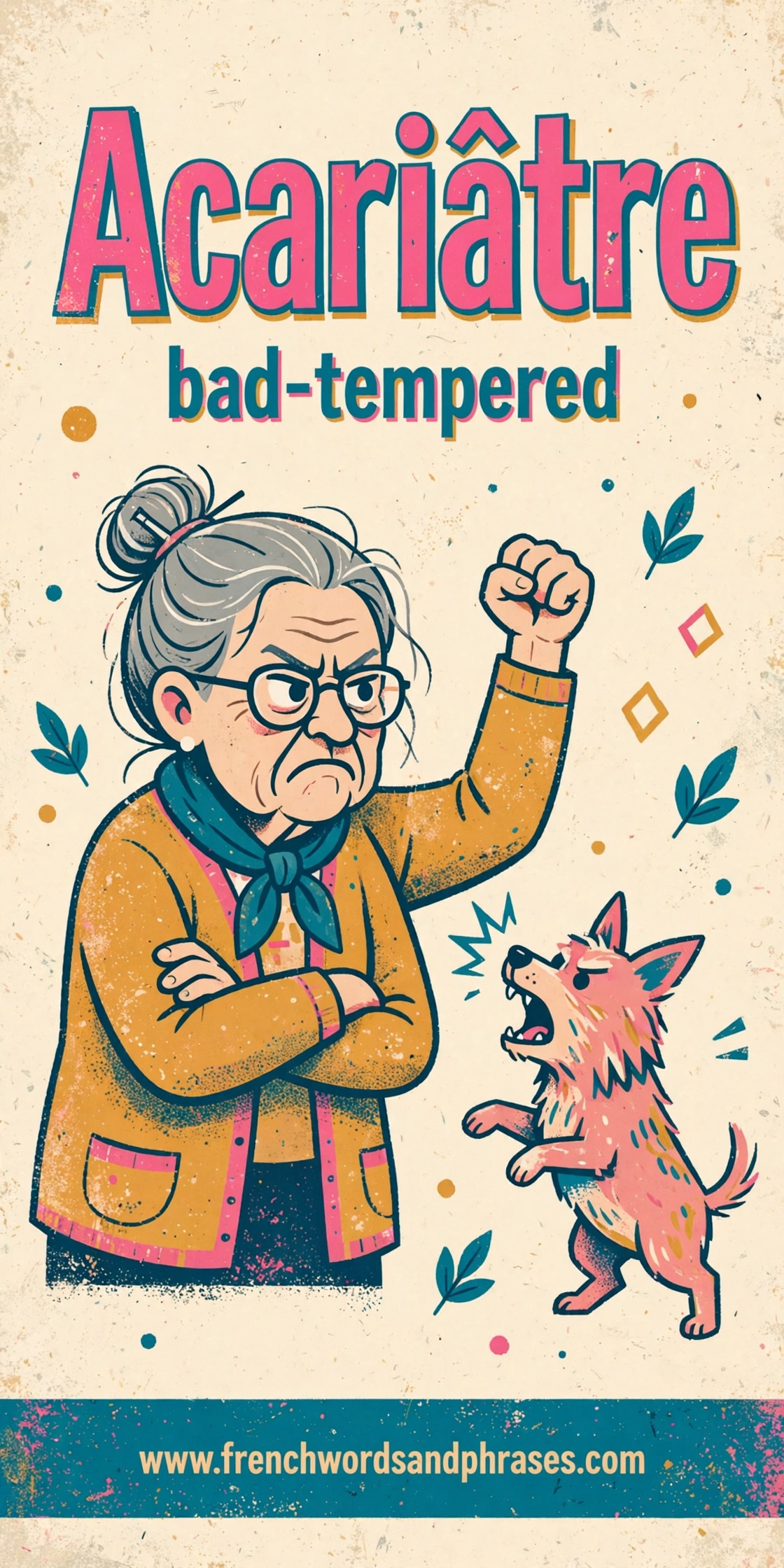
Acariâtre means bad-tempered.
The concierge has already slammed one door this morning, and it is not yet nine o’clock. A parcel delivered to the wrong floor, a question asked twice — everything is a battle. « Quelle femme acariâtre ! » sighs the neighbour on the stairs. Acariâtre is the adjective of the permanently prickly temper: not angry once, but cross by nature.
In this guide, you’ll learn what acariâtre means in English, why its feminine is exactly the same word, where it stands in the sentence, and how it differs from a passing colère. Explore French examples, English translations, and practice quizzes.
Understanding the French Adjective Acariâtre
Acariâtre is a French adjective of character — it describes a person who is habitually bad-tempered, cantankerous, quick to take offence. It is invariable in gender, because it already ends in -e: un homme acariâtre, une femme acariâtre, des voisins acariâtres. Only the plural changes, adding an s. The word is literary-flavoured but well understood, and it is never a compliment.
It means bad-tempered — cross and quarrelsome as a permanent trait: un vieillard acariâtre, a cantankerous old man; un caractère acariâtre, a bad-tempered character; une humeur acariâtre, a sour, prickly mood. Where énervé or en colère describe a moment, acariâtre describes the person: the temper is part of the furniture.
Type: Adjective of character — temperament; slightly literary
Answers the question: What is he/she like? — bad-tempered, cantankerous
Changes form: Invariable in gender — acariâtre for him and for her; plural acariâtres
English equivalents: Bad-tempered; cantankerous; shrewish; prickly.
One important usage detail: acariâtre describes a lasting character, not a single outburst — un gardien acariâtre is cross every day, not just this morning. It stands after the noun or after être, and because it ends in -e, the feminine adds nothing: never invent a different feminine form. Une femme acariâtre, des femmes acariâtres.
Experience the Word
Acariâtre is the adjective of the slammed door and the answer that bites before the question is finished — a temper you can hear through the wall.
Imagine the old bookseller who growls at every customer who touches a spine wrong — and yet keeps a saucer of milk for the street cats behind the shop. Even his kindness comes out acariâtre: grumbled, reluctant, impossible to thank.
You have not just called someone angry. You have named a climate, not a storm — the weather a person lives in every day.
How to Use Acariâtre in French: Complete Guide
Let’s explore how acariâtre works in French, beginning with the whole word on one card.
Acariâtre at a Glance
Before the details, here is the whole word on one card.
The Whole Word on One Card
Meaning, type, position and forms — acariâtre in four lines.
| Point | Acariâtre |
|---|---|
| Meaning | bad-tempered — cross and quarrelsome by nature |
| Type | adjective of character — temperament |
| Usual position | after the noun — un homme acariâtre |
| Form | acariâtre for both genders — acariâtres in the plural |
Example
Un vieillard acariâtre habite au rez-de-chaussée.
A bad-tempered old man lives on the ground floor.
The Four Forms of Acariâtre
Acariâtre already ends in -e, so masculine and feminine are identical; only the plural adds an s.
| Form | Acariâtre | Example |
|---|---|---|
| Masculine singular | acariâtre | un concierge acariâtre — a bad-tempered caretaker |
| Feminine singular | acariâtre | une voisine acariâtre — a bad-tempered neighbour |
| Masculine plural | acariâtres | des vieillards acariâtres — cantankerous old men |
| Feminine plural | acariâtres | des clientes acariâtres — bad-tempered customers |
Example
Des voisins acariâtres se plaignent de tout.
Bad-tempered neighbours complain about everything.
Quick Quiz 1
What is the feminine of acariâtre?
Reveal the answer
acariâtre
Une femme acariâtre — the word already ends in -e, so the feminine changes nothing.
A bad-tempered woman.
The Feminine of Acariâtre: The Same Word
Acariâtre is not a word with a separate feminine to learn later — it keeps a single form for him and for her, like all adjectives ending in -e.
| Situation | Example |
|---|---|
| Masculine | un homme acariâtre — a bad-tempered man |
| Feminine | une femme acariâtre — identical: the -e is already there |
| Why | adjectives ending in -e do not change for the feminine |
| The plural | add s — des femmes acariâtres, bad-tempered women |
Example
Une femme acariâtre répond sèchement au facteur.
A bad-tempered woman answers the postman curtly.
Where Acariâtre Goes: After the Noun
Acariâtre follows the noun it describes, like most French adjectives of character, and it sits naturally after être.
| Pattern | Example |
|---|---|
| After the noun | un caractère acariâtre — a bad-tempered character |
| After être | elle est acariâtre — she is bad-tempered |
| With an adverb | un homme très acariâtre — a very bad-tempered man |
| Before the noun | un acariâtre homme — not in everyday French |
Example
Son humeur acariâtre fatigue tout l’entourage.
His bad-tempered mood wears out everyone around him.
Quick Quiz 2
How do you say ‘a bad-tempered neighbour (female)’ — une acariâtre voisine or une voisine acariâtre?
Reveal the answer
une voisine acariâtre
Acariâtre stands after the noun in everyday French.
A bad-tempered neighbour.
More Acariâtre: Comparing with Acariâtre
Acariâtre compares the regular way, with plus, moins and aussi — a scale of prickliness.
| Degree | Example |
|---|---|
| As bad-tempered as | aussi acariâtre que — as bad-tempered as |
| More bad-tempered | plus acariâtre — more bad-tempered |
| Less bad-tempered | moins acariâtre — less bad-tempered |
| The most bad-tempered (masc.) | le plus acariâtre — le plus acariâtre des voisins |
| The most bad-tempered (fem.) | la plus acariâtre — la plus acariâtre des voisines |
Example
On ne peut pas être plus acariâtre que ce gardien.
Nobody could be more bad-tempered than this caretaker.
Everyday Expressions with Acariâtre
Acariâtre appears wherever French describes the neighbours, concierges and old uncles whose temper is famous in the street.
| Expression | In English |
|---|---|
| un caractère acariâtre | a bad-tempered character |
| une humeur acariâtre | a sour, prickly mood |
| un vieillard acariâtre | a cantankerous old man |
| une femme acariâtre | a shrewish, bad-tempered woman |
| devenir acariâtre | to grow cantankerous (with age) |
| un ton acariâtre | a sharp, ill-tempered tone |
Example
Avec l’âge, il est devenu franchement acariâtre.
With age, he has become downright cantankerous.
Quick Quiz 3
What does un caractère acariâtre mean?
Reveal the answer
A bad-tempered character
Un caractère acariâtre — a nature that is cross and quarrelsome every day, not just once.
A bad-tempered character.
Acariâtre and Its Neighbours
Acariâtre keeps company with the other words of bad temper — and faces the sunny opposites, aimable and doux.
| French | In English |
|---|---|
| grincheux | grumpy — the everyday cousin |
| bourru | gruff, surly — rough manners, often a kind heart |
| revêche | surly, crabby — close synonym |
| irascible | irascible — quick to flare up |
| aimable | kind, pleasant — the opposite |
| doux | gentle, mild — the opposite temperament |
Example
Grincheux le matin, acariâtre toute la journée : il vaut mieux le croiser après le café.
Grumpy in the morning, bad-tempered all day: better to meet him after coffee.
Watch Out: The Traps Around Acariâtre
The traps here are agreement and meaning: acariâtre names a character trait, not a moment of anger, and it is not kind.
| Trap | The truth |
|---|---|
| The feminine | une femme acariâtre — no extra -e, no new form: acariâtre is invariable in gender |
| The plural | des voisins acariâtres — the plural still adds s, for both genders |
| Trait, not moment | acariâtre is a permanent temper — for one outburst, French says en colère or énervé |
| Tone | acariâtre is never praise: it calls someone difficult and quarrelsome |
Example
Elle n’est pas en colère, elle est acariâtre : c’est son caractère.
She is not angry, she is bad-tempered: it is her character.
Quick Quiz 4
How do you say ‘bad-tempered neighbours’?
Reveal the answer
des voisins acariâtres
Acariâtre follows the noun and takes the plural s: acariâtres.
Bad-tempered neighbours.
Acariâtre in Everyday French: Real-Life Examples
Now that you know the word, let’s see how acariâtre appears in everyday French.
Example 1 — The concierge
La concierge acariâtre refuse tous les colis.
The bad-tempered concierge refuses all the parcels.
Example 2 — At the market
Une cliente acariâtre discute chaque prix.
A bad-tempered customer argues over every price.
Example 3 — Family
Mon oncle acariâtre critique tous les plats.
My cantankerous uncle criticises every dish.
Example 4 — At work
Le chef acariâtre fait trembler les nouveaux.
The bad-tempered boss makes the new staff tremble.
Example 5 — Age
En vieillissant, le chien est devenu acariâtre.
As it grew old, the dog became bad-tempered.
Example 6 — A warning
Ne lui parle pas avant son café, il est acariâtre le matin.
Do not talk to him before his coffee, he is bad-tempered in the morning.
Beyond Translation: The Meaning of Acariâtre
Acariâtre is a word with a hidden mite in it: scholars trace it through Old French to the same small creature that gives French acarien, the mite — the itch that never stops, transferred to a temper that never settles. Whether or not every step of that journey is certain, the picture is perfect: an acariâtre character is an itch in human form.
Acariâtre is the adjective of the permanent grumble — the word French reaches for when bad temper is not an event but an address.
Learn it beside grincheux and bourru, and you can grade grumpiness like a novelist: grincheux for the morning, bourru for the rough diamond, acariâtre for the whole climate.
How to Remember the French Adjective Acariâtre
Remember it this way: Acariâtre is the bad-tempered adjective — one form for him and for her, an s in the plural, and its place behind the noun.
- You learn it once for both genders — un homme acariâtre, une femme acariâtre.
- You hear the itch in it — acariâtre, c’est le caractère qui gratte et qui pique.
- You keep it for characters, not moments — un caractère acariâtre, une humeur acariâtre.
The key idea is acariâtre means bad-tempered; invariable in gender, plural acariâtres.
Test Your Knowledge of Acariâtre
Let’s see how much you’ve learned. Try answering these questions before revealing the answers.
Question 1
What does acariâtre mean?
Reveal the answer
Bad-tempered — cross and quarrelsome by nature.
Question 2
What is the feminine of acariâtre?
Reveal the answer
acariâtre — unchanged: the word already ends in -e.
Question 3
Translate: a bad-tempered old man.
Reveal the answer
Un vieillard acariâtre.
Question 4
Complete the sentence:
Des voisins ______ se plaignent de tout.
Reveal the answer
acariâtres
Des voisins acariâtres se plaignent de tout.
Bad-tempered neighbours complain about everything.
Question 5
How do you say ‘a bad-tempered character’?
Reveal the answer
un caractère acariâtre — the adjective follows the noun, in the same form.
Your Final Challenge
Can You Use It?
How would you say this in French?
“A bad-tempered old man lives on the ground floor.”
Reveal the answer
Un vieillard acariâtre habite au rez-de-chaussée.
A bad-tempered old man lives on the ground floor.
A little French. A little curiosity. A richer everyday life.
LEARN FRENCH ONE WORD AT A TIME




