A French Word to Live By
Translate Acantoïde to English
/a.kɑ̃.tɔ.id/
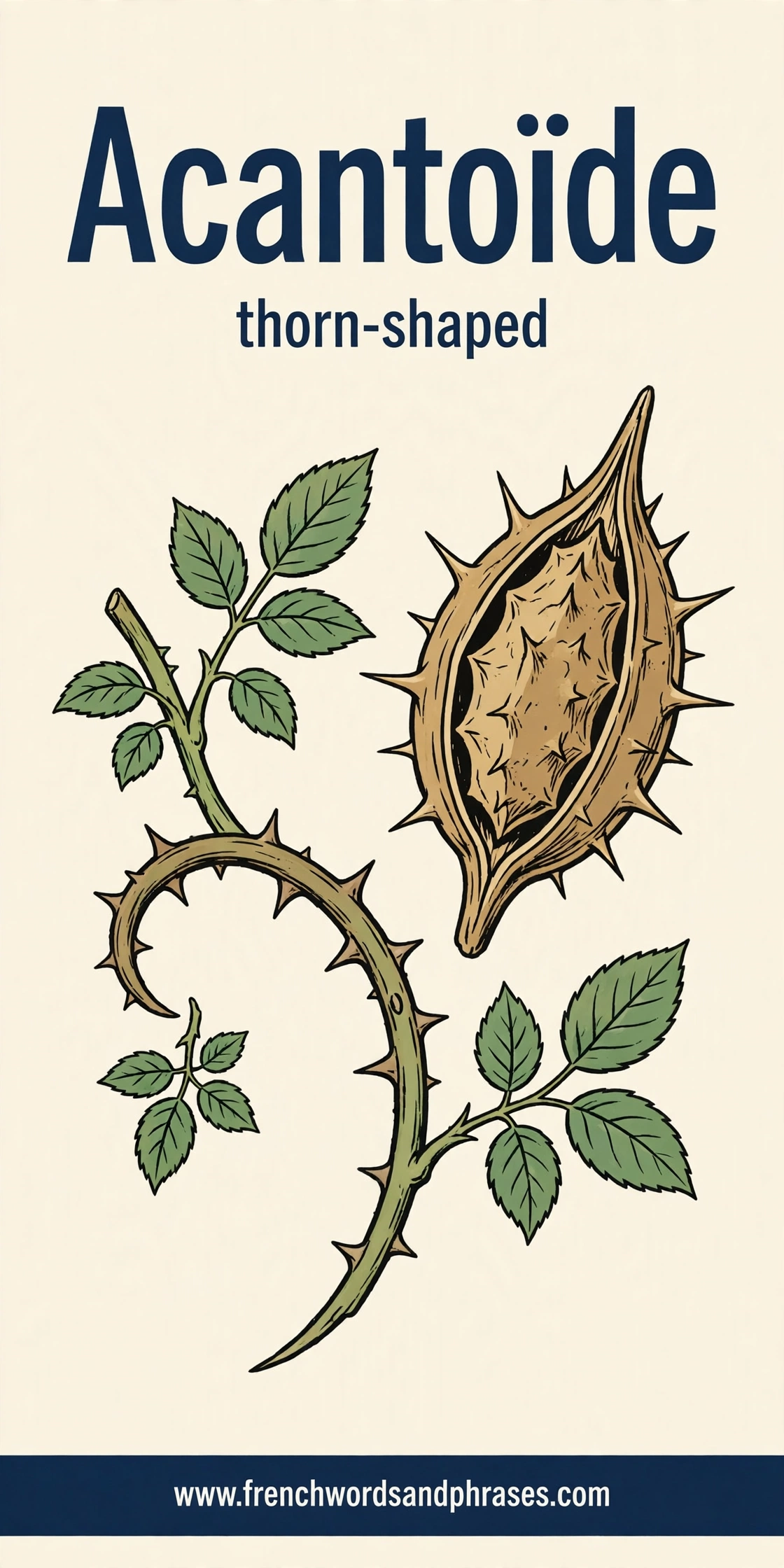
Acantoïde means thorn-shaped.
In the herbarium, the botanist lifts a dried leaf to the light and points at its edge: a row of tiny points, each one curved like the thorn of a rose. « Une feuille acantoïde », she writes in the margin — a leaf shaped like a thorn. Acantoïde is a scientist’s adjective: rare, precise, and built entirely around one shape.
In this guide, you’ll learn what acantoïde means in English, why its feminine is exactly the same word, where it appears in scientific French, and the family of shape words it belongs to. Explore French examples, English translations, and practice quizzes.
Understanding the French Adjective Acantoïde
Acantoïde is a French adjective of shape, used in botany, zoology and anatomy. It is built from the Greek akantha, a thorn, and the ending -oïde, like, resembling — the same ending as in humanoïde. It is invariable in gender, because it already ends in -e: un appendice acantoïde, une feuille acantoïde, des épines acantoïdes. Only the plural changes, adding an s.
It means thorn-shaped — having the form of a thorn or spine: une feuille acantoïde, a thorn-shaped leaf; un processus acantoïde, a spine-like process. You will meet it in scientific descriptions of plants, insects and bones, almost never in everyday conversation. It is a word for naming a shape exactly, the way a drawing would.
Type: Adjective of shape — scientific register (botany, zoology, anatomy)
Answers the question: What shape is it? — shaped like a thorn or spine
Changes form: Invariable in gender — acantoïde for him and for her; plural acantoïdes
English equivalents: Thorn-shaped; spine-shaped; acanthoid.
One important usage detail: acantoïde stands AFTER the noun, like nearly all French adjectives of shape — une feuille acantoïde, des excroissances acantoïdes. And because it ends in -e, the feminine adds nothing: never invent a different feminine form. Outside scientific writing, French would simply say en forme d’épine, shaped like a thorn.
Experience the Word
Acantoïde is the adjective of the magnifying glass — the word a naturalist reaches for when a curve ends in a point and « pointu » is not precise enough.
Imagine a child pressing a rose leaf against a notebook page, tracing its toothed edge with a pencil. A teacher looking over her shoulder smiles: those little teeth, each one a miniature thorn — voilà une bordure acantoïde.
You have not just called something sharp. You have named its shape — the thorn itself, drawn in a word.
How to Use Acantoïde in French: Complete Guide
Let’s explore how acantoïde works in French, beginning with the whole word on one card.
Acantoïde at a Glance
Before the details, here is the whole word on one card.
The Whole Word on One Card
Meaning, type, position and forms — acantoïde in four lines.
| Point | Acantoïde |
|---|---|
| Meaning | thorn-shaped — like a thorn or spine |
| Type | adjective of shape — scientific register |
| Usual position | after the noun — une feuille acantoïde |
| Form | acantoïde for both genders — acantoïdes in the plural |
Example
Cette plante porte des feuilles acantoïdes.
This plant bears thorn-shaped leaves.
The Four Forms of Acantoïde
Acantoïde already ends in -e, so masculine and feminine are identical; only the plural adds an s.
| Form | Acantoïde | Example |
|---|---|---|
| Masculine singular | acantoïde | un appendice acantoïde — a thorn-shaped appendage |
| Feminine singular | acantoïde | une feuille acantoïde — a thorn-shaped leaf |
| Masculine plural | acantoïdes | des processus acantoïdes — thorn-shaped processes |
| Feminine plural | acantoïdes | des épines acantoïdes — thorn-shaped spines |
Example
Des épines acantoïdes protègent la tige.
Thorn-shaped spines protect the stem.
Quick Quiz 1
What is the feminine of acantoïde?
Reveal the answer
acantoïde
Une feuille acantoïde — the word already ends in -e, so the feminine changes nothing.
A thorn-shaped leaf.
The Feminine of Acantoïde: The Same Word
Acantoïde is not a word with a separate feminine to learn later — it keeps one single form for him and for her, like all adjectives ending in -e.
| Situation | Example |
|---|---|
| Masculine | un processus acantoïde — a thorn-shaped process |
| Feminine | une excroissance acantoïde — identical: the -e is already there |
| Why | adjectives ending in -e do not change for the feminine |
| The plural | add s — des excroissances acantoïdes, thorn-shaped growths |
Example
Une excroissance acantoïde se forme sur l’écorce.
A thorn-shaped growth forms on the bark.
Where Acantoïde Goes: After the Noun
Acantoïde follows the noun it describes, like the other French adjectives of shape and scientific description.
| Pattern | Example |
|---|---|
| After the noun | une feuille acantoïde — a thorn-shaped leaf |
| After être | cette pointe est acantoïde — this point is thorn-shaped |
| In a description | des dents acantoïdes — thorn-shaped teeth (of an insect) |
| Before the noun | une acantoïde feuille — not in French |
Example
La marge de la feuille est acantoïde.
The edge of the leaf is thorn-shaped.
Quick Quiz 2
How do you say ‘a thorn-shaped leaf’ — une acantoïde feuille or une feuille acantoïde?
Reveal the answer
une feuille acantoïde
Acantoïde stands after the noun, and its form does not change for the feminine.
A thorn-shaped leaf.
More Acantoïde: Comparing with Acantoïde
Acantoïde compares the regular way, with plus, moins and aussi — though scientists more often let it stand alone.
| Degree | Example |
|---|---|
| As thorn-shaped as | aussi acantoïde que — as thorn-shaped as |
| More thorn-shaped | plus acantoïde — more thorn-shaped |
| Less thorn-shaped | moins acantoïde — less thorn-shaped |
| The most thorn-shaped (masc.) | le plus acantoïde — le plus acantoïde des appendices |
| The most thorn-shaped (fem.) | la plus acantoïde — la plus acantoïde des feuilles |
Example
Cette espèce a les feuilles les plus acantoïdes du genre.
This species has the most thorn-shaped leaves of the genus.
Everyday Expressions with Acantoïde
Acantoïde is a laboratory and herbarium word — its « everyday » is the language of scientific description.
| Expression | In English |
|---|---|
| une feuille acantoïde | a thorn-shaped leaf |
| un processus acantoïde | a spine-like process (anatomy) |
| des épines acantoïdes | thorn-shaped spines |
| une marge acantoïde | a thorn-toothed edge |
| en forme d’épine | thorn-shaped — the everyday way to say it |
| un appendice acantoïde | a thorn-shaped appendage |
Example
Le dessin montre un appendice acantoïde très net.
The drawing shows a very clear thorn-shaped appendage.
Quick Quiz 3
What does une feuille acantoïde mean?
Reveal the answer
A thorn-shaped leaf
Une feuille acantoïde — a leaf whose shape or edge recalls a thorn.
A thorn-shaped leaf.
Acantoïde and Its Neighbours
Acantoïde keeps company with the other shape words of French science — several share its Greek -oïde ending.
| French | In English |
|---|---|
| ovoïde | egg-shaped — from the same -oïde family |
| sphéroïde | sphere-shaped, spheroidal |
| pointu | pointed, sharp — the everyday word |
| épineux | thorny, prickly — covered in thorns |
| denté | toothed — une feuille dentée |
| conique | cone-shaped, conical |
Example
Épineux dit que la plante pique ; acantoïde dit seulement qu’elle en a la forme.
Épineux says the plant pricks; acantoïde only says it has the shape of one.
Watch Out: The Traps Around Acantoïde
The traps here are register and meaning: acantoïde describes a shape, not a danger, and it belongs to science.
| Trap | The truth |
|---|---|
| The feminine | une feuille acantoïde — no extra -e, no new form: acantoïde is invariable in gender |
| The plural | des feuilles acantoïdes — the plural still adds s, for both genders |
| Shape, not sharpness | acantoïde means shaped like a thorn — the thing need not prick at all |
| Register | acantoïde is scientific; in everyday French say en forme d’épine |
Example
Ces dents acantoïdes ne coupent pas : elles ont seulement la forme d’épines.
These thorn-shaped teeth do not cut: they merely have the shape of thorns.
Quick Quiz 4
How do you say ‘thorn-shaped spines’?
Reveal the answer
des épines acantoïdes
Acantoïde follows the noun and takes the plural s: acantoïdes.
Thorn-shaped spines.
Acantoïde in Everyday French: Real-Life Examples
Now that you know the word, let’s see how acantoïde appears in everyday French.
Example 1 — In the herbarium
La planche montre une feuille acantoïde séchée.
The sheet shows a dried thorn-shaped leaf.
Example 2 — At the microscope
Sous la loupe, les dents acantoïdes de l’insecte sont visibles.
Under the magnifying glass, the insect’s thorn-shaped teeth are visible.
Example 3 — In the garden
Ce rosier a des tiges presque acantoïdes.
This rose bush has almost thorn-shaped stems.
Example 4 — Anatomy
Le professeur décrit un processus acantoïde de l’os.
The professor describes a spine-like process of the bone.
Example 5 — Drawing
Dessine une marge acantoïde, avec de petites pointes régulières.
Draw a thorn-toothed edge, with small regular points.
Example 6 — Comparing
Cette feuille est plus acantoïde que l’autre.
This leaf is more thorn-shaped than the other.
Beyond Translation: The Meaning of Acantoïde
Acantoïde is a traveller from Greek: akantha, the thorn, joined to -oïde, resembling — the same building kit that gives French humanoïde and ovoïde. English science kept the cousin acanthoid, and the thorn family spreads wider still: the acanthus leaf carved on Corinthian columns is the same akantha, softened into stone.
Acantoïde is the adjective of the exact shape — the word French science uses when « pointed » is too vague and a drawing would take too long.
Learn it beside ovoïde and épineux, and you can separate the shape of a thorn from the fact of being thorny — a distinction naturalists care about deeply.
How to Remember the French Adjective Acantoïde
Remember it this way: Acantoïde is the thorn-shaped adjective — one form for him and for her, an s in the plural, and its home in scientific description.
- You learn it once for both genders — un appendice acantoïde, une feuille acantoïde.
- You hear the thorn in it — acantoïde vient du grec akantha, l’épine.
- You keep it for shapes, not pricks — une feuille acantoïde a la forme d’une épine.
The key idea is acantoïde means thorn-shaped; invariable in gender, plural acantoïdes.
Test Your Knowledge of Acantoïde
Let’s see how much you’ve learned. Try answering these questions before revealing the answers.
Question 1
What does acantoïde mean?
Reveal the answer
Thorn-shaped — having the shape of a thorn or spine.
Question 2
What is the feminine of acantoïde?
Reveal the answer
acantoïde — unchanged: the word already ends in -e.
Question 3
Translate: a thorn-shaped leaf.
Reveal the answer
Une feuille acantoïde.
Question 4
Complete the sentence:
Des épines ______ protègent la tige.
Reveal the answer
acantoïdes
Des épines acantoïdes protègent la tige.
Thorn-shaped spines protect the stem.
Question 5
How do you say ‘thorn-shaped’ in everyday French?
Reveal the answer
en forme d’épine — acantoïde is the scientific term.
Your Final Challenge
Can You Use It?
How would you say this in French?
“This plant bears thorn-shaped leaves.”
Reveal the answer
Cette plante porte des feuilles acantoïdes.
This plant bears thorn-shaped leaves.
A little French. A little curiosity. A richer everyday life.
LEARN FRENCH ONE WORD AT A TIME