A French Word to Live By
How to Conjugate Enraciner in French
/ɑ̃.ʁa.si.ne/
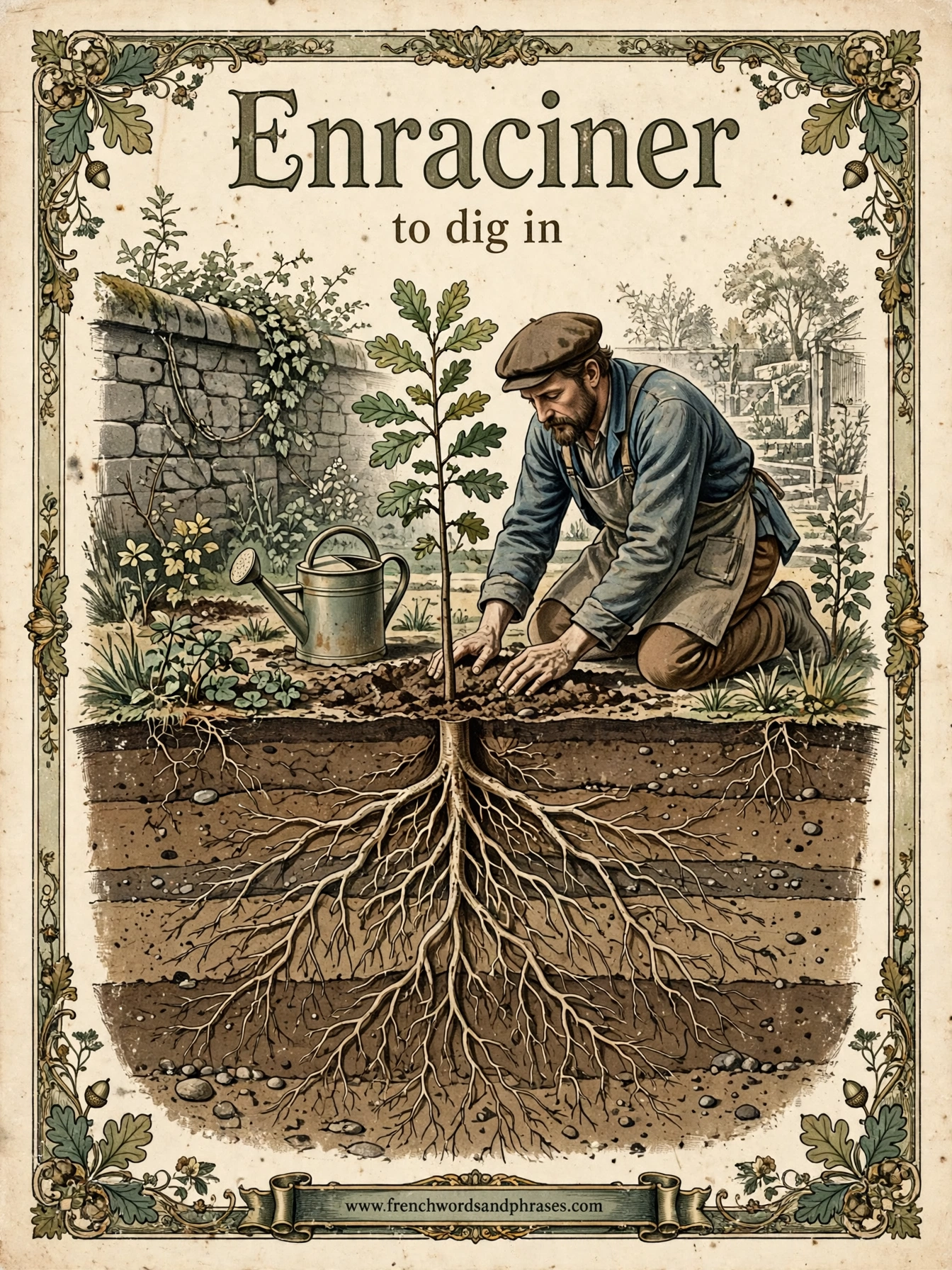
Enraciner means to dig in — to put a plant’s roots down into the soil so it can grow, and, figuratively, to fix a habit or an idea firmly in place.
A gardener pressing a young rose into the earth, firming the soil around it with both hands; a custom repeated so often it can no longer be moved — enraciner is the verb of putting roots down: to dig a plant in, and to fix anything else just as deeply.
In this guide, you’ll learn how to conjugate enraciner in all the major French tenses and moods. Explore complete conjugation tables, French examples, English translations, and practice quizzes.
Understanding the French Verb Enraciner
Enraciner is a regular French verb belonging to the first group of verbs, those ending in-er.
It means to dig in. In the garden it is the deliberate act that precedes s’enraciner: you enracinez the cutting, and then, if all goes well, it s’enracine. In figurative use the active verb is rarer than the participle — French prefers to say that habits, prejudices and traditions sont enracinés, deeply rooted, rather than to name whoever rooted them.
Verb classification: First group (-er)
Auxiliary verb: Avoir
Past participle: enraciné
Present participle: enracinant
English equivalents: To dig in, to root, to implant; enraciner une bouture — to root a cutting; enraciner un arbuste — to plant a shrub firmly; une habitude bien enracinée — a deeply rooted habit; enraciner une idée dans les esprits — to implant an idea in people’s minds.
One important detail: enraciner is built on une racine, a root, and its life is split in two — the gardener enracines plants (enraciner des boutures, des rosiers, des plants), and everyone else uses its past participle for things that can no longer be moved: une habitude enracinée, un préjugé bien enraciné, une tradition enracinée dans la région. The conjugation is a plain regular -er: j’enracine, nous enracinons, ils enracinent, past participle enraciné. For the plant doing it by itself, French switches to the reflexive: la bouture s’enracine.
Experience the Word
Enraciner is the moment of commitment — roots into soil, habits into a life, with no easy way back out.
Imagine an old gardener in October, working down a row of bare rose cuttings. Each one is pushed into the trench, firmed with the heel of his boot, and watered — il enracine, plant after plant, against the winter. By spring most will have taken; the ones he enracined carelessly will be dead sticks. The verb is in his hands: slow, firm, final.
He is not just planting. He is rooting — il enracine — next summer’s roses against the frost.
How to Conjugate Enraciner: Complete French Conjugation Guide
Let’s explore every major conjugation of enraciner, beginning with the indicative mood.
How to Conjugate Enraciner in the Indicative Mood
The indicative mood is used to express facts, observations, actions, and events.
How to Conjugate Enraciner in the Present Tense (Présent)
Used for actions happening now, habitual actions, and general truths.
| Subject | Conjugation |
|---|---|
| je | enracine |
| tu | enracines |
| il / elle | enracine |
| nous | enracinons |
| vous | enracinez |
| ils / elles | enracinent |
Example
Le jardinier enracine les boutures dans un terreau léger.
The gardener roots the cuttings in a light compost.
Quick Quiz 1
Complete the sentence:
Nous ______ les arbustes à l’automne.
Reveal the answer
enracinons
Nous enracinons les arbustes à l’automne.
We plant the shrubs firmly in autumn.
How to Conjugate Enraciner in the Passé Composé
Used for completed actions in the past. Enraciner takes the auxiliary verb avoir.
| Subject | Conjugation |
|---|---|
| j’ | ai enraciné |
| tu | as enraciné |
| il / elle | a enraciné |
| nous | avons enraciné |
| vous | avez enraciné |
| ils / elles | ont enraciné |
Example
Elle a enraciné ses rosiers le long du mur.
She planted her roses firmly along the wall.
How to Conjugate Enraciner in the Imparfait (Imperfect Tense)
Used for habitual past actions, descriptions, and ongoing situations in the past.
| Subject | Conjugation |
|---|---|
| je | enracinais |
| tu | enracinais |
| il / elle | enracinait |
| nous | enracinions |
| vous | enraciniez |
| ils / elles | enracinaient |
Example
Chaque printemps, il enracinait de jeunes plants dans le potager.
Every spring, he used to root young plants in the vegetable garden.
Quick Quiz 2
Choose the correct form:
She planted her roses along the wall.
Elle ______ ses rosiers le long du mur. (a enraciné / est enracinée)
Reveal the answer
a enraciné
Elle a enraciné ses rosiers le long du mur.
Enraciner takes avoir; est enracinée would belong to the reflexive.
How to Conjugate Enraciner in the Plus-que-parfait
Used to describe an action that had already been completed before another past event.
| Subject | Conjugation |
|---|---|
| j’ | avais enraciné |
| tu | avais enraciné |
| il / elle | avait enraciné |
| nous | avions enraciné |
| vous | aviez enraciné |
| ils / elles | avaient enraciné |
Example
Ils avaient enraciné la vigne avant les gelées.
They had planted the vine firmly before the frosts.
How to Conjugate Enraciner in the Passé Simple
Primarily used in formal writing, literature, and historical narratives. It is rarely used in everyday conversation.
| Subject | Conjugation |
|---|---|
| je | enracinai |
| tu | enracinas |
| il / elle | enracina |
| nous | enracinâmes |
| vous | enracinâtes |
| ils / elles | enracinèrent |
Example
Le fermier enracina ses pommiers sur la colline.
The farmer planted his apple trees firmly on the hill.
How to Conjugate Enraciner in the Passé Antérieur
A literary tense used to express an action completed immediately before another past action, generally in the passé simple.
| Subject | Conjugation |
|---|---|
| j’ | eus enraciné |
| tu | eus enraciné |
| il / elle | eut enraciné |
| nous | eûmes enraciné |
| vous | eûtes enraciné |
| ils / elles | eurent enraciné |
Example
Quand il eut enraciné les boutures, il les arrosa.
When he had rooted the cuttings, he watered them.
How to Conjugate Enraciner in the Future Tense (Futur Simple)
Used to describe actions that will take place in the future.
| Subject | Conjugation |
|---|---|
| je | enracinerai |
| tu | enracineras |
| il / elle | enracinera |
| nous | enracinerons |
| vous | enracinerez |
| ils / elles | enracineront |
Example
Nous enracinerons ces arbustes à l’automne.
We will plant these shrubs firmly in the autumn.
How to Conjugate Enraciner in the Futur Antérieur (Future Perfect)
Used for an action that will have been completed before a particular point in the future.
| Subject | Conjugation |
|---|---|
| j’ | aurai enraciné |
| tu | auras enraciné |
| il / elle | aura enraciné |
| nous | aurons enraciné |
| vous | aurez enraciné |
| ils / elles | auront enraciné |
Example
À la fin du mois, tu auras enraciné toutes les boutures.
By the end of the month, you will have rooted all the cuttings.
How to Conjugate Enraciner in the Near Future (Futur Proche)
Used to describe something that is going to happen soon. Formed with aller + infinitive.
| Subject | Conjugation |
|---|---|
| je | vais enraciner |
| tu | vas enraciner |
| il / elle | va enraciner |
| nous | allons enraciner |
| vous | allez enraciner |
| ils / elles | vont enraciner |
Example
Le jardinier va enraciner les plants de tomates.
The gardener is going to plant the tomato plants firmly.
How to Conjugate Enraciner in the Conditional Mood
The conditional mood expresses what would happen under certain circumstances. It is also frequently used to make polite requests or express wishes.
How to Conjugate Enraciner in the Present Conditional
| Subject | Conjugation |
|---|---|
| je | enracinerais |
| tu | enracinerais |
| il / elle | enracinerait |
| nous | enracinerions |
| vous | enracineriez |
| ils / elles | enracineraient |
Example
Avec une meilleure terre, on enracinerait plus vite ces fleurs.
With better soil, we would root these flowers faster.
How to Conjugate Enraciner in the Past Conditional
| Subject | Conjugation |
|---|---|
| j’ | aurais enraciné |
| tu | aurais enraciné |
| il / elle | aurait enraciné |
| nous | aurions enraciné |
| vous | auriez enraciné |
| ils / elles | auraient enraciné |
Example
Elle aurait enraciné les rosiers sans la sécheresse.
She would have planted the roses firmly if not for the drought.
Enraciner in the Literary Past Conditional Form
This less common literary form uses the imperfect subjunctive of avoir.
| Subject | Conjugation |
|---|---|
| j’ | eusse enraciné |
| tu | eusses enraciné |
| il / elle | eût enraciné |
| nous | eussions enraciné |
| vous | eussiez enraciné |
| ils / elles | eussent enraciné |
Example
Il eût enraciné sa vigne avant l’hiver.
He would have planted his vine firmly before winter.
How to Conjugate Enraciner in the Subjunctive Mood
The subjunctive is used to express wishes, emotions, doubts, necessity, and uncertainty. It frequently follows expressions such as il faut que (it is necessary that) or bien que (although).
How to Conjugate Enraciner in the Present Subjunctive
| Subject | Conjugation |
|---|---|
| que je | enracine |
| que tu | enracines |
| qu’il / qu’elle | enracine |
| que nous | enracinions |
| que vous | enraciniez |
| qu’ils / qu’elles | enracinent |
Example
Il faut que tu enracines ces boutures avant vendredi.
You must root these cuttings before Friday.
Quick Quiz 3
Complete the sentence using the subjunctive:
Il faut que vous ______ les plants en rangées.
Reveal the answer
enraciniez
Il faut que vous enraciniez les plants en rangées.
You must plant the seedlings firmly in rows.
How to Conjugate Enraciner in the Imperfect Subjunctive
A literary tense, rarely encountered in modern spoken French.
| Subject | Conjugation |
|---|---|
| que je | enracinasse |
| que tu | enracinasses |
| qu’il / qu’elle | enracinât |
| que nous | enracinassions |
| que vous | enracinassiez |
| qu’ils / qu’elles | enracinassent |
Example
Le jardinier voulait que nous enracinassions les plants en rangées.
The gardener wanted us to plant the seedlings firmly in rows.
How to Conjugate Enraciner in the Pluperfect Subjunctive
A literary construction used to express an action completed before another past action.
| Subject | Conjugation |
|---|---|
| que j’ | eusse enraciné |
| que tu | eusses enraciné |
| qu’il / qu’elle | eût enraciné |
| que nous | eussions enraciné |
| que vous | eussiez enraciné |
| qu’ils / qu’elles | eussent enraciné |
Example
On doutait qu’il eût enraciné quoi que ce soit dans ce sable.
People doubted he had rooted anything at all in that sand.
How to Conjugate Enraciner in the Past Subjunctive
| Subject | Conjugation |
|---|---|
| que j’ | aie enraciné |
| que tu | aies enraciné |
| qu’il / qu’elle | ait enraciné |
| que nous | ayons enraciné |
| que vous | ayez enraciné |
| qu’ils / qu’elles | aient enraciné |
Example
Je suis content qu’elle ait enraciné le rosier de sa mère.
I am glad she planted her mother’s rose bush firmly.
How to Conjugate Enraciner in the Imperative
The imperative is used to give commands, instructions, invitations, or suggestions. Subject pronouns are omitted.
How to Conjugate Enraciner in the Present Imperative
| Person | Conjugation |
|---|---|
| (tu) | enracine |
| (nous) | enracinons |
| (vous) | enracinez |
Example
Enracine ces boutures dans l’eau d’abord !
Root these cuttings in water first!
Quick Quiz 4
How would you say Root these cuttings first (tu form)?
Reveal the answer
Enracine ces boutures d’abord !
French Participles of Enraciner
Participles are verb forms that can be used in compound tenses and other grammatical constructions.
Present Participle of Enraciner
enracinant
En enracinant les plants, on assure la récolte.
By planting the seedlings firmly, we secure the harvest.
Past Participle of Enraciner
enraciné
Enracinées dans l’eau, les boutures sont prêtes à planter.
Rooted in water, the cuttings are ready to plant.
Enraciner in Everyday French: Real-Life Examples
Now that you know the conjugations, let’s see how enraciner appears in everyday French.
Example 1 — Present
Le jardinier enracine les boutures.
The gardener roots the cuttings.
Example 2 — Passé composé
Elle a enraciné ses rosiers le long du mur.
She planted her roses firmly along the wall.
Example 3 — Imparfait
Il enracinait de jeunes plants chaque printemps.
He used to root young plants every spring.
Example 4 — Future
Nous enracinerons ces arbustes à l’automne.
We will plant these shrubs firmly in autumn.
Example 5 — Conditional
On enracinerait plus vite ces fleurs avec une meilleure terre.
We would root these flowers faster with better soil.
Example 6 — Imperative
Enracine ces boutures avant vendredi !
Root these cuttings before Friday!
Beyond Translation: The Meaning of Enraciner
Enraciner is racine — a root — with the prefix en- that means putting into: to put into roots, to root.
French reaches for it whenever something must not move again.
Gardeners enracinent cuttings; history enracine traditions; and the adjective enraciné has become the standard word for anything deep-set and immovable — un préjugé enraciné, a deep-rooted prejudice, is the same picture as the rose in its trench, only harder to dig out.
How to Remember the French Verb Enraciner
Remember it this way: Enraciner is about the old gardener firming each rose cutting into the October trench with his boot.
- Une racine is a root; enraciner is to put roots down — for plants, habits and ideas.
- The participle does the figurative work: une habitude enracinée, un préjugé bien enraciné.
- Regular -er: j’enracine, nous enracinons, past participle enraciné. The plant itself s’enracine.
The key idea is the old gardener firming each rose cutting into the October trench with his boot.
Test Your Knowledge of Enraciner
Let’s see how much you’ve learned. Try answering these questions before revealing the answers.
Question 1
What noun lives inside enraciner?
Reveal the answer
Une racine — a root. Enraciner is to put roots down, literally or figuratively.
Question 2
How do you say The gardener roots the cuttings in French?
Reveal the answer
Le jardinier enracine les boutures.
Question 3
Translate: She planted her roses firmly along the wall.
Reveal the answer
Elle a enraciné ses rosiers le long du mur.
Question 4
What is the past participle of enraciner?
Reveal the answer
Enraciné — as in une habitude bien enracinée, a deeply rooted habit.
Question 5
Complete the sentence:
Il faut que tu ______ ces boutures avant vendredi.
Reveal the answer
enracines
Il faut que tu enracines ces boutures avant vendredi.
You must root these cuttings before Friday.
Your Final Challenge
Can You Use It?
How would you say this in French?
The gardener plants his roses firmly before winter, and the whole garden seems to breathe more calmly.
Reveal the answer
Le jardinier enracine ses rosiers avant l’hiver, et le jardin entier semble respirer plus calmement.
The gardener plants his roses firmly before winter, and the whole garden seems to breathe more calmly.
A little French. A little curiosity. A richer everyday life.
LEARN FRENCH ONE WORD AT A TIME