A French Word to Live By
How to Conjugate Enlier in French
/ɑ̃.lje/
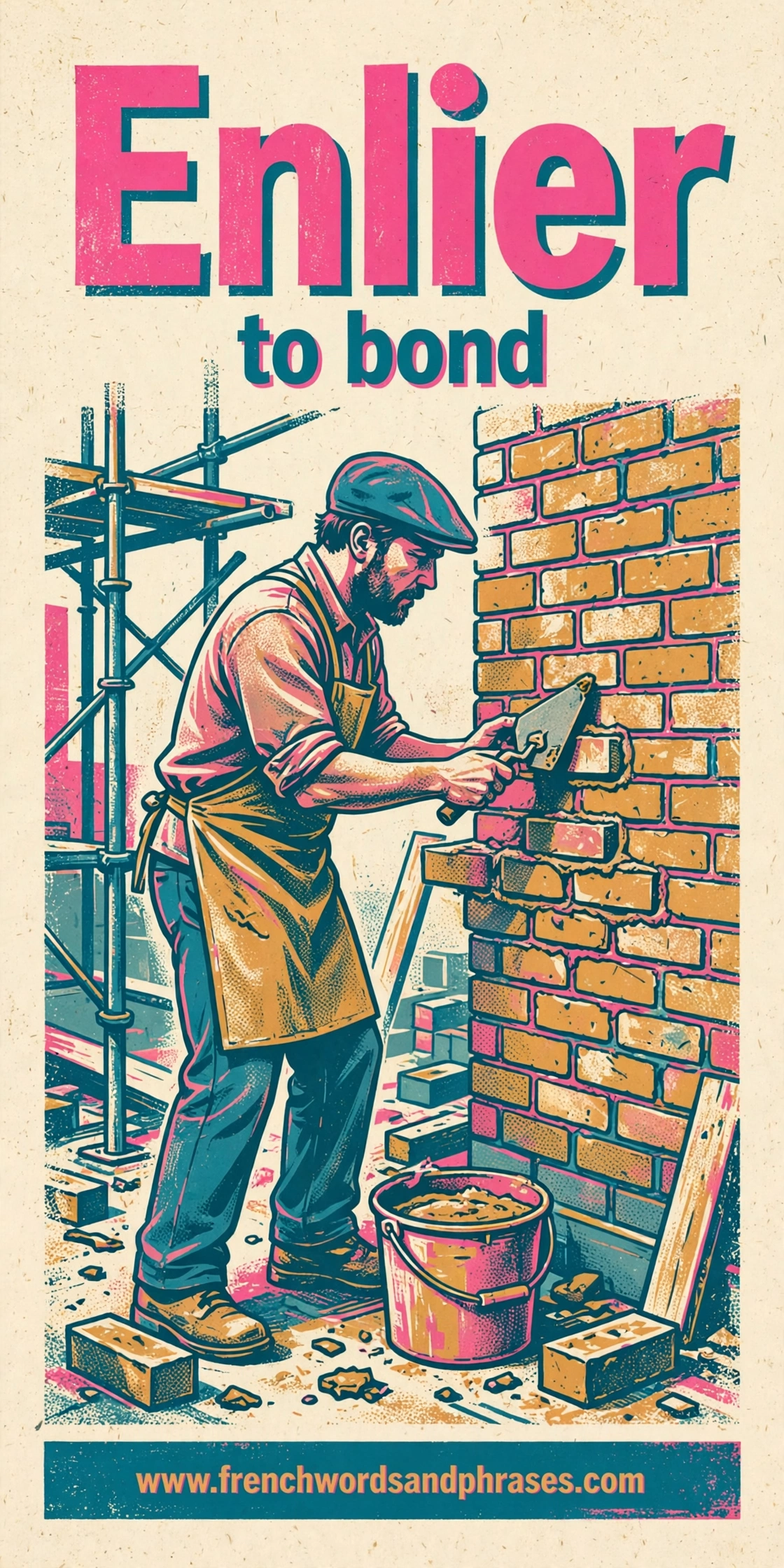
Enlier means to bond — in masonry, to lay bricks or stones so that each course overlaps the joints of the one below, locking the wall into a single strong whole.
A bricklayer’s quiet secret: a wall is not a stack but a weave. Each brick sits across the joint beneath it, and the courses hold one another — enlier is the builder’s verb for that bonding, laying stones and bricks so the wall becomes one body instead of a pile.
In this guide, you’ll learn how to conjugate enlier in all the major French tenses and moods. Explore complete conjugation tables, French examples, English translations, and practice quizzes.
Understanding the French Verb Enlier
Enlier is a regular French verb belonging to the first group of verbs, those ending in-er.
It means to bond. It is used by masons and architects for laying bricks, blocks and stones in bond — running bond, Flemish bond and the rest — and in restoration work on old walls, where matching the original bonding is the difference between a repair and a scar. Outside the building site it is rarely heard.
Verb classification: First group (-er)
Auxiliary verb: Avoir
Past participle: enlié
Present participle: enliant
English equivalents: To bond (masonry), to lay in bond; enlier les briques — to bond the bricks; enlier les pierres — to bond the stones; l’appareil — the bond, the pattern of the masonry; lier — to tie, to bind, the everyday parent verb.
One important detail: enlier is a technical verb of the building trade — its world is brickwork and stonemasonry, where to bond means overlapping the joints so no vertical seam runs through the wall. It is an -ier verb, so the imperfect and the nous/vous subjunctive double the i: nous enliions, vous enliiez, que nous enliions — the first i belongs to the stem, the second to the ending. Do not confuse it with everyday lier (to tie): enlier ties with geometry, not with string.
Experience the Word
Enlier is the verb of the wall that holds together — every brick a handshake with the two beneath it.
Imagine a mason rebuilding a garden wall after the winter. He does not stack brick on brick in columns; he enlie chaque rang, each brick straddling the joint below, until the wall reads like woven cloth — pull one brick and the whole course answers.
The bricks are the same as this morning. They are bonded — enliés — and a pile has become a wall.
How to Conjugate Enlier: Complete French Conjugation Guide
Let’s explore every major conjugation of enlier, beginning with the indicative mood.
How to Conjugate Enlier in the Indicative Mood
The indicative mood is used to express facts, observations, actions, and events.
How to Conjugate Enlier in the Present Tense (Présent)
Used for actions happening now, habitual actions, and general truths.
| Subject | Conjugation |
|---|---|
| je | enlie |
| tu | enlies |
| il / elle | enlie |
| nous | enlions |
| vous | enliez |
| ils / elles | enlient |
Example
Le maçon enlie les briques avec soin.
The mason bonds the bricks with care.
Quick Quiz 1
Complete the sentence:
Nous ______ les briques du mur du fond.
Reveal the answer
enlions
Nous enlions les briques du mur du fond.
We bond the bricks of the back wall.
How to Conjugate Enlier in the Passé Composé
Used for completed actions in the past. Enlier takes the auxiliary verb avoir.
| Subject | Conjugation |
|---|---|
| j’ | ai enlié |
| tu | as enlié |
| il / elle | a enlié |
| nous | avons enlié |
| vous | avez enlié |
| ils / elles | ont enlié |
Example
Il a enlié les pierres à l’ancienne.
He bonded the stones in the old way.
How to Conjugate Enlier in the Imparfait (Imperfect Tense)
Used for habitual past actions, descriptions, and ongoing situations in the past.
| Subject | Conjugation |
|---|---|
| je | enliais |
| tu | enliais |
| il / elle | enliait |
| nous | enliions |
| vous | enliiez |
| ils / elles | enliaient |
Example
Autrefois, on enliait les moellons sans ciment.
In the old days, rubble stones were bonded without cement.
Quick Quiz 2
Choose the correct form:
He bonded the wall before winter.
Il ______ le mur avant l’hiver. (a enlié / est enlié)
Reveal the answer
a enlié
Il a enlié le mur avant l’hiver.
Enlier takes avoir.
How to Conjugate Enlier in the Plus-que-parfait
Used to describe an action that had already been completed before another past event.
| Subject | Conjugation |
|---|---|
| j’ | avais enlié |
| tu | avais enlié |
| il / elle | avait enlié |
| nous | avions enlié |
| vous | aviez enlié |
| ils / elles | avaient enlié |
Example
Elle avait enlié le mur avant la pluie.
She had bonded the wall before the rain.
How to Conjugate Enlier in the Passé Simple
Primarily used in formal writing, literature, and historical narratives. It is rarely used in everyday conversation.
| Subject | Conjugation |
|---|---|
| je | enliai |
| tu | enlias |
| il / elle | enlia |
| nous | enliâmes |
| vous | enliâtes |
| ils / elles | enlièrent |
Example
Les ouvriers enlièrent les briques en une journée.
The workers bonded the bricks in a single day.
How to Conjugate Enlier in the Passé Antérieur
A literary tense used to express an action completed immediately before another past action, generally in the passé simple.
| Subject | Conjugation |
|---|---|
| j’ | eus enlié |
| tu | eus enlié |
| il / elle | eut enlié |
| nous | eûmes enlié |
| vous | eûtes enlié |
| ils / elles | eurent enlié |
Example
Quand il eut enlié le dernier rang, il recula pour juger l’ensemble.
When he had bonded the last course, he stepped back to judge the whole.
How to Conjugate Enlier in the Future Tense (Futur Simple)
Used to describe actions that will take place in the future.
| Subject | Conjugation |
|---|---|
| je | enlierai |
| tu | enlieras |
| il / elle | enliera |
| nous | enlierons |
| vous | enlierez |
| ils / elles | enlieront |
Example
Demain, nous enlierons le mur du fond.
Tomorrow, we will bond the back wall.
How to Conjugate Enlier in the Futur Antérieur (Future Perfect)
Used for an action that will have been completed before a particular point in the future.
| Subject | Conjugation |
|---|---|
| j’ | aurai enlié |
| tu | auras enlié |
| il / elle | aura enlié |
| nous | aurons enlié |
| vous | aurez enlié |
| ils / elles | auront enlié |
Example
À la fin de la semaine, ils auront enlié toute la façade.
By the end of the week, they will have bonded the whole façade.
How to Conjugate Enlier in the Near Future (Futur Proche)
Used to describe something that is going to happen soon. Formed with aller + infinitive.
| Subject | Conjugation |
|---|---|
| je | vais enlier |
| tu | vas enlier |
| il / elle | va enlier |
| nous | allons enlier |
| vous | allez enlier |
| ils / elles | vont enlier |
Example
Je vais enlier ce rang avant que le mortier sèche.
I am going to bond this course before the mortar dries.
How to Conjugate Enlier in the Conditional Mood
The conditional mood expresses what would happen under certain circumstances. It is also frequently used to make polite requests or express wishes.
How to Conjugate Enlier in the Present Conditional
| Subject | Conjugation |
|---|---|
| je | enlierais |
| tu | enlierais |
| il / elle | enlierait |
| nous | enlierions |
| vous | enlieriez |
| ils / elles | enlieraient |
Example
Avec de meilleures briques, on enlierait ce mur plus vite.
With better bricks, this wall would be bonded faster.
How to Conjugate Enlier in the Past Conditional
| Subject | Conjugation |
|---|---|
| j’ | aurais enlié |
| tu | aurais enlié |
| il / elle | aurait enlié |
| nous | aurions enlié |
| vous | auriez enlié |
| ils / elles | auraient enlié |
Example
Il aurait enlié les pierres si le mortier avait été prêt.
He would have bonded the stones if the mortar had been ready.
Enlier in the Literary Past Conditional Form
This less common literary form uses the imperfect subjunctive of avoir.
| Subject | Conjugation |
|---|---|
| j’ | eusse enlié |
| tu | eusses enlié |
| il / elle | eût enlié |
| nous | eussions enlié |
| vous | eussiez enlié |
| ils / elles | eussent enlié |
Example
Le maître maçon eût enlié la tour entière.
The master mason would have bonded the whole tower.
How to Conjugate Enlier in the Subjunctive Mood
The subjunctive is used to express wishes, emotions, doubts, necessity, and uncertainty. It frequently follows expressions such as il faut que (it is necessary that) or bien que (although).
How to Conjugate Enlier in the Present Subjunctive
| Subject | Conjugation |
|---|---|
| que je | enlie |
| que tu | enlies |
| qu’il / qu’elle | enlie |
| que nous | enliions |
| que vous | enliiez |
| qu’ils / qu’elles | enlient |
Example
Il faut que tu enlies chaque rang avec régularité.
You must bond each course evenly.
Quick Quiz 3
Complete the sentence using the subjunctive:
Il faut que vous ______ les pierres comme autrefois.
Reveal the answer
enliiez
Il faut que vous enliiez les pierres comme autrefois.
You must bond the stones as in the old days.
How to Conjugate Enlier in the Imperfect Subjunctive
A literary tense, rarely encountered in modern spoken French.
| Subject | Conjugation |
|---|---|
| que je | enliasse |
| que tu | enliasses |
| qu’il / qu’elle | enliât |
| que nous | enliassions |
| que vous | enliassiez |
| qu’ils / qu’elles | enliassent |
Example
L’architecte exigeait qu’on enliât les pierres comme au XIIe siècle.
The architect required the stones to be bonded as in the twelfth century.
How to Conjugate Enlier in the Pluperfect Subjunctive
A literary construction used to express an action completed before another past action.
| Subject | Conjugation |
|---|---|
| que j’ | eusse enlié |
| que tu | eusses enlié |
| qu’il / qu’elle | eût enlié |
| que nous | eussions enlié |
| que vous | eussiez enlié |
| qu’ils / qu’elles | eussent enlié |
Example
On admirait qu’il eût enlié la voûte sans échafaudage.
People admired that he had bonded the vault without scaffolding.
How to Conjugate Enlier in the Past Subjunctive
| Subject | Conjugation |
|---|---|
| que j’ | aie enlié |
| que tu | aies enlié |
| qu’il / qu’elle | ait enlié |
| que nous | ayons enlié |
| que vous | ayez enlié |
| qu’ils / qu’elles | aient enlié |
Example
Je suis content que vous ayez enlié le mur avant l’hiver.
I am glad you bonded the wall before winter.
How to Conjugate Enlier in the Imperative
The imperative is used to give commands, instructions, invitations, or suggestions. Subject pronouns are omitted.
How to Conjugate Enlier in the Present Imperative
| Person | Conjugation |
|---|---|
| (tu) | enlie |
| (nous) | enlions |
| (vous) | enliez |
Example
Enlie ce rang, et vérifie chaque joint !
Bond this course, and check every joint!
Quick Quiz 4
How would you say Bond this course (tu form)?
Reveal the answer
Enlie ce rang !
French Participles of Enlier
Participles are verb forms that can be used in compound tenses and other grammatical constructions.
Present Participle of Enlier
enliant
En enliant les briques, il chante les vieux airs du métier.
While bonding the bricks, he sings the old songs of the trade.
Past Participle of Enlier
enlié
Enliées avec soin, les pierres tiennent depuis huit siècles.
Bonded with care, the stones have held for eight centuries.
Enlier in Everyday French: Real-Life Examples
Now that you know the conjugations, let’s see how enlier appears in everyday French.
Example 1 — Present
Le maçon enlie les briques avec soin.
The mason bonds the bricks with care.
Example 2 — Passé composé
Il a enlié les pierres à l’ancienne.
He bonded the stones in the old way.
Example 3 — Imparfait
On enliait les moellons sans ciment.
Rubble stones were bonded without cement.
Example 4 — Future
Nous enlierons le mur du fond demain.
We will bond the back wall tomorrow.
Example 5 — Conditional
On enlierait ce mur plus vite avec de meilleures briques.
This wall would be bonded faster with better bricks.
Example 6 — Imperative
Enlie ce rang, et vérifie les joints !
Bond this course, and check the joints!
Beyond Translation: The Meaning of Enlier
English builders say to bond and speak of bonding patterns — enlier is the same idea wearing its parentage openly, built on lier, to tie.
A bonded wall is a tied wall.
No rope, no knot — just overlap upon overlap, each stone tied to its neighbours by position alone, which is why a well-enlié wall outlives the empire that built it.
How to Remember the French Verb Enlier
Remember it this way: Enlier is about each brick straddling the joint beneath it, like woven cloth.
- A builder’s verb: to bond bricks or stones by overlapping the joints — geometry instead of string.
- -ier verb, double i in the imperfect: nous enliions, vous enliiez.
- Regular -er pattern otherwise: j’enlie, nous enlions, past participle enlié.
The key idea is each brick straddling the joint beneath it, like woven cloth.
Test Your Knowledge of Enlier
Let’s see how much you’ve learned. Try answering these questions before revealing the answers.
Question 1
What does enlier mean on a building site?
Reveal the answer
To bond — to lay bricks or stones so each course overlaps the joints below, locking the wall together.
Question 2
How do you say The mason bonds the bricks with care in French?
Reveal the answer
Le maçon enlie les briques avec soin.
Question 3
Translate: He bonded the stones in the old way.
Reveal the answer
Il a enlié les pierres à l’ancienne.
Question 4
What is the past participle of enlier?
Reveal the answer
Enlié.
Question 5
Complete the sentence:
Il faut que tu ______ chaque rang avec régularité.
Reveal the answer
enlies
Il faut que tu enlies chaque rang avec régularité.
You must bond each course evenly.
Your Final Challenge
Can You Use It?
How would you say this in French?
The mason bonds the stones one by one, and the wall, woven rather than stacked, defies the centuries.
Reveal the answer
Le maçon enlie les pierres une à une, et le mur, tissé plutôt qu’empilé, défie les siècles.
The mason bonds the stones one by one, and the wall, woven rather than stacked, defies the centuries.
A little French. A little curiosity. A richer everyday life.
LEARN FRENCH ONE WORD AT A TIME