A French Word to Live By
How to Conjugate Enlever in French
/ɑ̃.lə.ve/
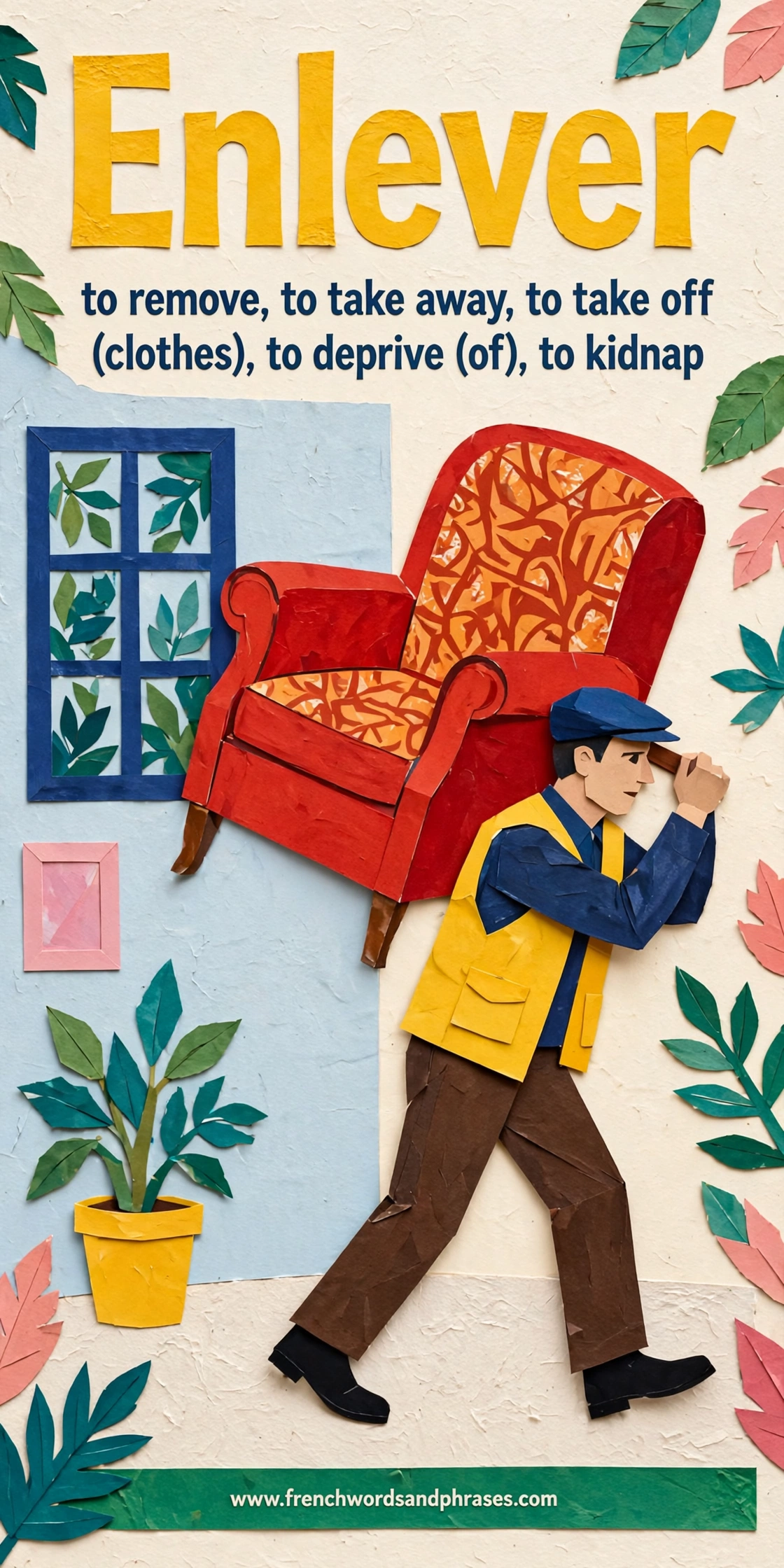
Enlever means to remove, to take away, to take off (clothes), to deprive (of), to kidnap — to lift something or someone away from where they were.
A waiter clearing plates, a mother pulling a jumper over a toddler’s head, a thief snatching a bag, a commando carrying off a prisoner — enlever is the great French verb of taking away: whatever is lifted off, stripped off or carried off is enlevé.
In this guide, you’ll learn how to conjugate enlever in all the major French tenses and moods. Explore complete conjugation tables, French examples, English translations, and practice quizzes.
Understanding the French Verb Enlever
Enlever is a regular French verb belonging to the first group of verbs, those ending in-er.
It means to remove, to take away, to take off (clothes), to deprive (of), to kidnap. It is one of the hardest-working verbs in French: cleaners enlèvent stains, doctors enlèvent stitches and tonsils, waiters enlèvent plates, winter makes you enlever your coat, criminals enlèvent hostages, and life itself can enlever à quelqu’un what he loves most. Whenever English reaches for remove, take off, take away or carry off, enlever is usually the word.
Verb classification: First group (-er)
Auxiliary verb: Avoir
Past participle: enlevé
Present participle: enlevant
English equivalents: To remove, to take away, to take off; enlever une tache — to remove a stain; enlever son manteau — to take off one’s coat; enlever quelque chose à quelqu’un — to take something away from someone, to deprive someone of something; enlever un enfant — to kidnap a child; enlève tes pieds de là ! — get your feet off there!
One important detail: enlever belongs to the lever family — the mute e of the stem becomes è wherever the ending is mute: j’enlève, tu enlèves, il enlève, ils enlèvent, through the whole future and conditional — j’enlèverai, j’enlèverais — and in the tu imperative, enlève ! The e stays plain where the ending is sounded: nous enlevons, vous enlevez, j’enlevais, and in the infinitive and participle, enlever, enlevé. The subjunctive splits the same way: que j’enlève, but que nous enlevions. Its great construction is enlever quelque chose à quelqu’un — the à names the person deprived.
Experience the Word
Enlever is the verb of the clean sweep — what was there a moment ago is simply gone, lifted away.
Imagine a café terrace at closing time. In five minutes the waiter has enlevé les verres, enlevé les nappes, enlevé les chaises — the terrace that buzzed all evening stands bare, and every single removal had the same name.
Plates, cloths, chairs, even the light seems thinner. Everything has been taken away — enlevé — and the day is over.
How to Conjugate Enlever: Complete French Conjugation Guide
Let’s explore every major conjugation of enlever, beginning with the indicative mood.
How to Conjugate Enlever in the Indicative Mood
The indicative mood is used to express facts, observations, actions, and events.
How to Conjugate Enlever in the Present Tense (Présent)
Used for actions happening now, habitual actions, and general truths.
| Subject | Conjugation |
|---|---|
| je | enlève |
| tu | enlèves |
| il / elle | enlève |
| nous | enlevons |
| vous | enlevez |
| ils / elles | enlèvent |
Example
J’enlève mon manteau dès que j’entre.
I take off my coat as soon as I come in.
Quick Quiz 1
Complete the sentence:
Nous ______ nos manteaux en entrant.
Reveal the answer
enlevons
Nous enlevons nos manteaux en entrant.
We take off our coats when we come in.
How to Conjugate Enlever in the Passé Composé
Used for completed actions in the past. Enlever takes the auxiliary verb avoir.
| Subject | Conjugation |
|---|---|
| j’ | ai enlevé |
| tu | as enlevé |
| il / elle | a enlevé |
| nous | avons enlevé |
| vous | avez enlevé |
| ils / elles | ont enlevé |
Example
Le médecin a enlevé les points de suture hier.
The doctor removed the stitches yesterday.
How to Conjugate Enlever in the Imparfait (Imperfect Tense)
Used for habitual past actions, descriptions, and ongoing situations in the past.
| Subject | Conjugation |
|---|---|
| je | enlevais |
| tu | enlevais |
| il / elle | enlevait |
| nous | enlevions |
| vous | enleviez |
| ils / elles | enlevaient |
Example
Le serveur enlevait les assiettes au fur et à mesure.
The waiter kept clearing the plates as he went.
Quick Quiz 2
Choose the correct form:
She removed the stain.
Elle ______ la tache. (a enlevé / est enlevée)
Reveal the answer
a enlevé
Elle a enlevé la tache.
Enlever takes avoir.
How to Conjugate Enlever in the Plus-que-parfait
Used to describe an action that had already been completed before another past event.
| Subject | Conjugation |
|---|---|
| j’ | avais enlevé |
| tu | avais enlevé |
| il / elle | avait enlevé |
| nous | avions enlevé |
| vous | aviez enlevé |
| ils / elles | avaient enlevé |
Example
Elle avait enlevé la tache avec du vinaigre.
She had removed the stain with vinegar.
How to Conjugate Enlever in the Passé Simple
Primarily used in formal writing, literature, and historical narratives. It is rarely used in everyday conversation.
| Subject | Conjugation |
|---|---|
| je | enlevai |
| tu | enlevas |
| il / elle | enleva |
| nous | enlevâmes |
| vous | enlevâtes |
| ils / elles | enlevèrent |
Example
Les ravisseurs enlevèrent l’enfant en plein jour.
The kidnappers carried off the child in broad daylight.
How to Conjugate Enlever in the Passé Antérieur
A literary tense used to express an action completed immediately before another past action, generally in the passé simple.
| Subject | Conjugation |
|---|---|
| j’ | eus enlevé |
| tu | eus enlevé |
| il / elle | eut enlevé |
| nous | eûmes enlevé |
| vous | eûtes enlevé |
| ils / elles | eurent enlevé |
Example
Quand il eut enlevé son casque, on reconnut le champion.
When he had taken off his helmet, people recognised the champion.
How to Conjugate Enlever in the Future Tense (Futur Simple)
Used to describe actions that will take place in the future.
| Subject | Conjugation |
|---|---|
| je | enlèverai |
| tu | enlèveras |
| il / elle | enlèvera |
| nous | enlèverons |
| vous | enlèverez |
| ils / elles | enlèveront |
Example
Demain, la mairie enlèvera les encombrants du trottoir.
Tomorrow, the council will remove the bulky rubbish from the pavement.
How to Conjugate Enlever in the Futur Antérieur (Future Perfect)
Used for an action that will have been completed before a particular point in the future.
| Subject | Conjugation |
|---|---|
| j’ | aurai enlevé |
| tu | auras enlevé |
| il / elle | aura enlevé |
| nous | aurons enlevé |
| vous | aurez enlevé |
| ils / elles | auront enlevé |
Example
À midi, ils auront enlevé tous les meubles de la pièce.
By noon, they will have removed all the furniture from the room.
How to Conjugate Enlever in the Near Future (Futur Proche)
Used to describe something that is going to happen soon. Formed with aller + infinitive.
| Subject | Conjugation |
|---|---|
| je | vais enlever |
| tu | vas enlever |
| il / elle | va enlever |
| nous | allons enlever |
| vous | allez enlever |
| ils / elles | vont enlever |
Example
Je vais enlever cette affiche, elle est déchirée.
I am going to take down this poster, it is torn.
How to Conjugate Enlever in the Conditional Mood
The conditional mood expresses what would happen under certain circumstances. It is also frequently used to make polite requests or express wishes.
How to Conjugate Enlever in the Present Conditional
| Subject | Conjugation |
|---|---|
| je | enlèverais |
| tu | enlèverais |
| il / elle | enlèverait |
| nous | enlèverions |
| vous | enlèveriez |
| ils / elles | enlèveraient |
Example
Ce produit enlèverait même les taches de vin.
This product would remove even wine stains.
How to Conjugate Enlever in the Past Conditional
| Subject | Conjugation |
|---|---|
| j’ | aurais enlevé |
| tu | aurais enlevé |
| il / elle | aurait enlevé |
| nous | aurions enlevé |
| vous | auriez enlevé |
| ils / elles | auraient enlevé |
Example
Il aurait enlevé son chapeau s’il avait su.
He would have taken off his hat if he had known.
Enlever in the Literary Past Conditional Form
This less common literary form uses the imperfect subjunctive of avoir.
| Subject | Conjugation |
|---|---|
| j’ | eusse enlevé |
| tu | eusses enlevé |
| il / elle | eût enlevé |
| nous | eussions enlevé |
| vous | eussiez enlevé |
| ils / elles | eussent enlevé |
Example
Le vent eût enlevé les tuiles du toit.
The wind would have carried off the roof tiles.
How to Conjugate Enlever in the Subjunctive Mood
The subjunctive is used to express wishes, emotions, doubts, necessity, and uncertainty. It frequently follows expressions such as il faut que (it is necessary that) or bien que (although).
How to Conjugate Enlever in the Present Subjunctive
| Subject | Conjugation |
|---|---|
| que je | enlève |
| que tu | enlèves |
| qu’il / qu’elle | enlève |
| que nous | enlevions |
| que vous | enleviez |
| qu’ils / qu’elles | enlèvent |
Example
Il faut que j’enlève cette tache avant le mariage.
I must remove this stain before the wedding.
Quick Quiz 3
Complete the sentence using the subjunctive:
Il faut que vous ______ vos chaussures boueuses.
Reveal the answer
enleviez
Il faut que vous enleviez vos chaussures boueuses.
You must take off your muddy shoes.
How to Conjugate Enlever in the Imperfect Subjunctive
A literary tense, rarely encountered in modern spoken French.
| Subject | Conjugation |
|---|---|
| que je | enlevasse |
| que tu | enlevasses |
| qu’il / qu’elle | enlevât |
| que nous | enlevassions |
| que vous | enlevassiez |
| qu’ils / qu’elles | enlevassent |
Example
Elle ne voulait pas qu’on enlevât l’arbre du jardin.
She did not want the tree in the garden to be removed.
How to Conjugate Enlever in the Pluperfect Subjunctive
A literary construction used to express an action completed before another past action.
| Subject | Conjugation |
|---|---|
| que j’ | eusse enlevé |
| que tu | eusses enlevé |
| qu’il / qu’elle | eût enlevé |
| que nous | eussions enlevé |
| que vous | eussiez enlevé |
| qu’ils / qu’elles | eussent enlevé |
Example
On racontait que les soldats eussent enlevé le pont pendant la nuit.
People said the soldiers had removed the bridge during the night.
How to Conjugate Enlever in the Past Subjunctive
| Subject | Conjugation |
|---|---|
| que j’ | aie enlevé |
| que tu | aies enlevé |
| qu’il / qu’elle | ait enlevé |
| que nous | ayons enlevé |
| que vous | ayez enlevé |
| qu’ils / qu’elles | aient enlevé |
Example
Je suis content que tu aies enlevé tes chaussures boueuses.
I am glad you took off your muddy shoes.
How to Conjugate Enlever in the Imperative
The imperative is used to give commands, instructions, invitations, or suggestions. Subject pronouns are omitted.
How to Conjugate Enlever in the Present Imperative
| Person | Conjugation |
|---|---|
| (tu) | enlève |
| (nous) | enlevons |
| (vous) | enlevez |
Example
Enlève tes pieds de la table !
Take your feet off the table!
Quick Quiz 4
How would you say Take your feet off the table (tu form)?
Reveal the answer
Enlève tes pieds de la table !
French Participles of Enlever
Participles are verb forms that can be used in compound tenses and other grammatical constructions.
Present Participle of Enlever
enlevant
En enlevant le couvercle, elle a libéré tout le parfum du plat.
By lifting the lid, she released all the dish’s aroma.
Past Participle of Enlever
enlevé
Enlevée par le vent, la casquette a fini dans la rivière.
Carried off by the wind, the cap ended up in the river.
Enlever in Everyday French: Real-Life Examples
Now that you know the conjugations, let’s see how enlever appears in everyday French.
Example 1 — Present
J’enlève mon manteau en entrant.
I take off my coat when I come in.
Example 2 — Passé composé
Le médecin a enlevé les points hier.
The doctor removed the stitches yesterday.
Example 3 — Imparfait
Le serveur enlevait les assiettes.
The waiter kept clearing the plates.
Example 4 — Future
La mairie enlèvera les encombrants demain.
The council will remove the bulky rubbish tomorrow.
Example 5 — Conditional
Ce produit enlèverait les taches de vin.
This product would remove wine stains.
Example 6 — Imperative
Enlève tes pieds de la table !
Take your feet off the table!
Beyond Translation: The Meaning of Enlever
English splits this verb five ways — remove, take off, take away, deprive, kidnap — while French keeps one strong image: lever, to lift, with the prefix en- of carrying away.
Everything enlevé has been lifted out of its place.
That is why the same word clears tables and kidnaps children: scale changes, gesture doesn’t — something that was here is, suddenly, gone.
How to Remember the French Verb Enlever
Remember it this way: Enlever is about the waiter’s clean sweep — plates, cloths and chairs all lifted away.
- Lever family spelling: j’enlève with è, nous enlevons with plain e — and j’enlèverai through the future.
- The depriving construction: enlever quelque chose À quelqu’un — the à names the loser.
- One verb for five English ones: remove, take off, take away, deprive, kidnap.
The key idea is the waiter’s clean sweep — plates, cloths and chairs all lifted away.
Test Your Knowledge of Enlever
Let’s see how much you’ve learned. Try answering these questions before revealing the answers.
Question 1
Why does j’enlève have a grave accent but nous enlevons none?
Reveal the answer
The lever-family rule — the stem e becomes è before a mute ending (j’enlève), and stays plain before a sounded one (nous enlevons).
Question 2
How do you say I take off my coat as soon as I come in in French?
Reveal the answer
J’enlève mon manteau dès que j’entre.
Question 3
Translate: The doctor removed the stitches yesterday.
Reveal the answer
Le médecin a enlevé les points de suture hier.
Question 4
What is the past participle of enlever?
Reveal the answer
Enlevé.
Question 5
Complete the sentence:
Il faut que j’______ cette tache avant le mariage.
Reveal the answer
enlève
Il faut que j’enlève cette tache avant le mariage.
I must remove this stain before the wedding.
Your Final Challenge
Can You Use It?
How would you say this in French?
The waiter takes away the last plate, and the terrace, given back to silence, finally breathes.
Reveal the answer
Le serveur enlève la dernière assiette, et la terrasse rendue au silence respire enfin.
The waiter takes away the last plate, and the terrace, given back to silence, finally breathes.
A little French. A little curiosity. A richer everyday life.
LEARN FRENCH ONE WORD AT A TIME