A French Word to Live By
How to Conjugate Enjuguer in French
/ɑ̃.ʒy.ɡe/
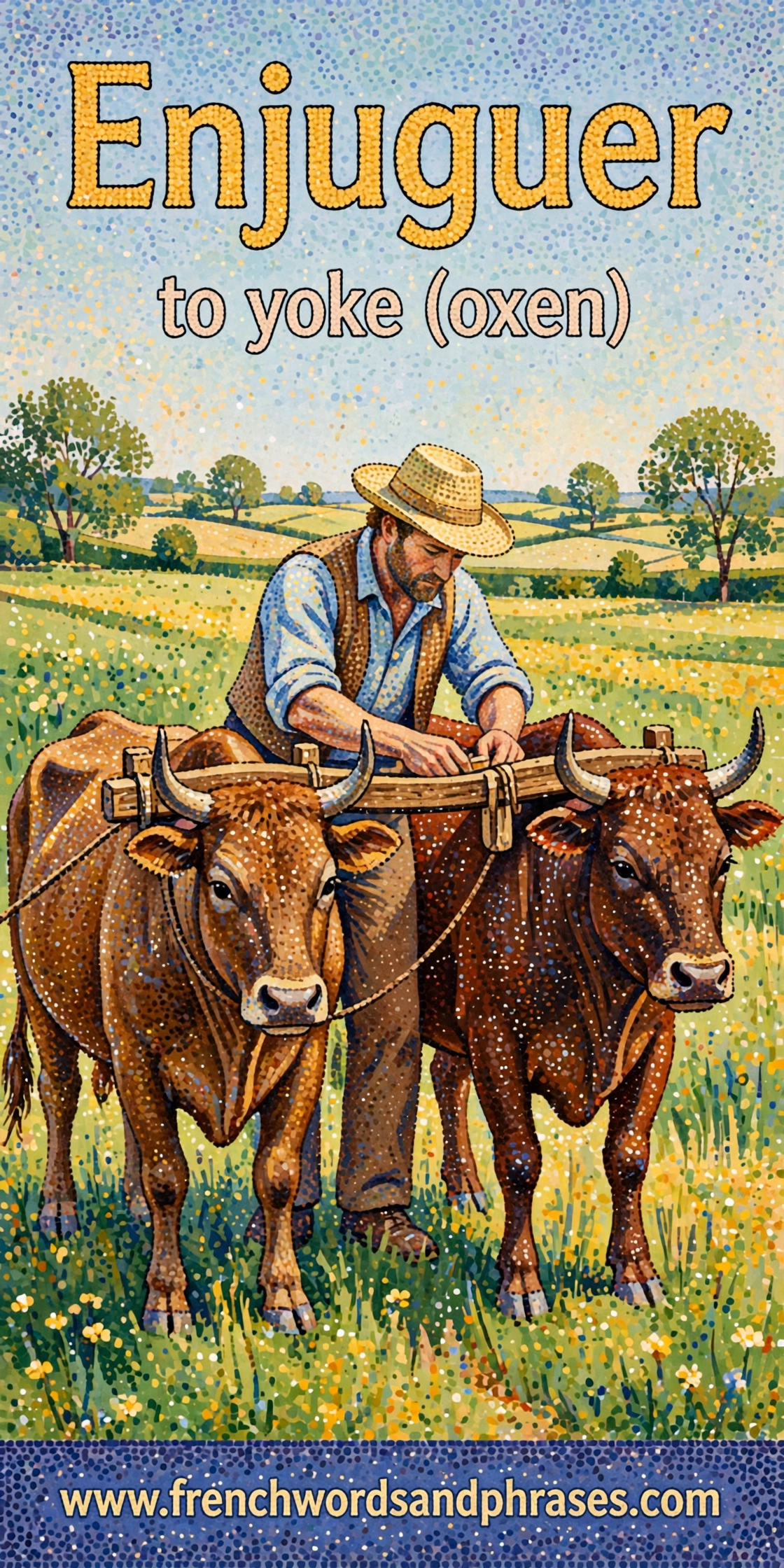
Enjuguer means to yoke oxen — to fasten the wooden yoke across a pair of oxen’s necks so the plough can move.
Dawn on a farm a century ago: two great oxen stand steaming in the cold while the farmer lifts the heavy wooden yoke and settles it across their necks — enjuguer is that precise, vanished gesture, the verb of harnessing draught animals to their work.
In this guide, you’ll learn how to conjugate enjuguer in all the major French tenses and moods. Explore complete conjugation tables, French examples, English translations, and practice quizzes.
Understanding the French Verb Enjuguer
Enjuguer is a regular French verb belonging to the first group of verbs, those ending in-er.
It means to yoke (oxen). It is used on farms and in history books for the literal harnessing of oxen (and occasionally horses) to a plough or cart, and by extension, in elevated style, for peoples and nations brought under a foreign yoke — the same double life English gives to yoke itself.
Verb classification: First group (-er)
Auxiliary verb: Avoir
Past participle: enjugué
Present participle: enjuguant
English equivalents: To yoke (oxen), to put under the yoke; enjuguer les bœufs — to yoke the oxen; le joug — the yoke; enjuguer un peuple (figurative, literary) — to bring a people under the yoke, to subjugate.
One important detail: enjuguer is a -guer verb, so the u after the g never drops — it is there to keep the g hard before every ending: j’enjugue, nous enjuguons, j’enjuguais, en enjuguant. It is built on le joug, the yoke, and belongs to the world of ox-drawn ploughs: outside historical and farming texts you will rarely meet it, and its figurative sense — to subjugate, to bring under the yoke — is purely literary.
Experience the Word
Enjuguer is the verb of the yoke going on — the moment two animals become one engine.
Imagine the farmyard at first light. The farmer calls the pair by name, lifts the joug, worn smooth by forty years of shoulders, and enjugue ses bœufs; the plough is hitched, the first furrow waits, and the whole day hangs on that wooden bar.
The oxen have not moved yet. They are yoked — enjugués — and the field is already half conquered.
How to Conjugate Enjuguer: Complete French Conjugation Guide
Let’s explore every major conjugation of enjuguer, beginning with the indicative mood.
How to Conjugate Enjuguer in the Indicative Mood
The indicative mood is used to express facts, observations, actions, and events.
How to Conjugate Enjuguer in the Present Tense (Présent)
Used for actions happening now, habitual actions, and general truths.
| Subject | Conjugation |
|---|---|
| je | enjugue |
| tu | enjugues |
| il / elle | enjugue |
| nous | enjuguons |
| vous | enjuguez |
| ils / elles | enjuguent |
Example
Le fermier enjugue ses bœufs avant le labour.
The farmer yokes his oxen before the ploughing.
Quick Quiz 1
Complete the sentence:
Nous ______ les bœufs avant le labour.
Reveal the answer
enjuguons
Nous enjuguons les bœufs avant le labour.
We yoke the oxen before the ploughing.
How to Conjugate Enjuguer in the Passé Composé
Used for completed actions in the past. Enjuguer takes the auxiliary verb avoir.
| Subject | Conjugation |
|---|---|
| j’ | ai enjugué |
| tu | as enjugué |
| il / elle | a enjugué |
| nous | avons enjugué |
| vous | avez enjugué |
| ils / elles | ont enjugué |
Example
Il a enjugué les deux bœufs au point du jour.
He yoked the two oxen at daybreak.
How to Conjugate Enjuguer in the Imparfait (Imperfect Tense)
Used for habitual past actions, descriptions, and ongoing situations in the past.
| Subject | Conjugation |
|---|---|
| je | enjuguais |
| tu | enjuguais |
| il / elle | enjuguait |
| nous | enjuguions |
| vous | enjuguiez |
| ils / elles | enjuguaient |
Example
Chaque matin, on enjuguait les bœufs dans la cour.
Every morning, the oxen were yoked in the yard.
Quick Quiz 2
Choose the correct form:
He yoked the two oxen.
Il ______ les deux bœufs. (a enjugué / est enjugué)
Reveal the answer
a enjugué
Il a enjugué les deux bœufs.
Enjuguer takes avoir.
How to Conjugate Enjuguer in the Plus-que-parfait
Used to describe an action that had already been completed before another past event.
| Subject | Conjugation |
|---|---|
| j’ | avais enjugué |
| tu | avais enjugué |
| il / elle | avait enjugué |
| nous | avions enjugué |
| vous | aviez enjugué |
| ils / elles | avaient enjugué |
Example
Elle avait enjugué la paire la plus forte pour le champ pentu.
She had yoked the strongest pair for the steep field.
How to Conjugate Enjuguer in the Passé Simple
Primarily used in formal writing, literature, and historical narratives. It is rarely used in everyday conversation.
| Subject | Conjugation |
|---|---|
| je | enjuguai |
| tu | enjuguas |
| il / elle | enjugua |
| nous | enjuguâmes |
| vous | enjuguâtes |
| ils / elles | enjuguèrent |
Example
Le valet enjugua les bœufs et partit aux champs.
The farmhand yoked the oxen and set off for the fields.
How to Conjugate Enjuguer in the Passé Antérieur
A literary tense used to express an action completed immediately before another past action, generally in the passé simple.
| Subject | Conjugation |
|---|---|
| j’ | eus enjugué |
| tu | eus enjugué |
| il / elle | eut enjugué |
| nous | eûmes enjugué |
| vous | eûtes enjugué |
| ils / elles | eurent enjugué |
Example
Dès qu’il eut enjugué les bœufs, il attela la charrue.
As soon as he had yoked the oxen, he hitched up the plough.
How to Conjugate Enjuguer in the Future Tense (Futur Simple)
Used to describe actions that will take place in the future.
| Subject | Conjugation |
|---|---|
| je | enjuguerai |
| tu | enjugueras |
| il / elle | enjuguera |
| nous | enjuguerons |
| vous | enjuguerez |
| ils / elles | enjugueront |
Example
Demain, nous enjuguerons les jeunes bœufs pour la première fois.
Tomorrow, we will yoke the young oxen for the first time.
How to Conjugate Enjuguer in the Futur Antérieur (Future Perfect)
Used for an action that will have been completed before a particular point in the future.
| Subject | Conjugation |
|---|---|
| j’ | aurai enjugué |
| tu | auras enjugué |
| il / elle | aura enjugué |
| nous | aurons enjugué |
| vous | aurez enjugué |
| ils / elles | auront enjugué |
Example
À sept heures, il aura enjugué toutes les paires.
By seven o’clock, he will have yoked all the pairs.
How to Conjugate Enjuguer in the Near Future (Futur Proche)
Used to describe something that is going to happen soon. Formed with aller + infinitive.
| Subject | Conjugation |
|---|---|
| je | vais enjuguer |
| tu | vas enjuguer |
| il / elle | va enjuguer |
| nous | allons enjuguer |
| vous | allez enjuguer |
| ils / elles | vont enjuguer |
Example
Va enjuguer les bœufs, le champ nous attend.
Go and yoke the oxen, the field is waiting for us.
How to Conjugate Enjuguer in the Conditional Mood
The conditional mood expresses what would happen under certain circumstances. It is also frequently used to make polite requests or express wishes.
How to Conjugate Enjuguer in the Present Conditional
| Subject | Conjugation |
|---|---|
| je | enjuguerais |
| tu | enjuguerais |
| il / elle | enjuguerait |
| nous | enjuguerions |
| vous | enjugueriez |
| ils / elles | enjugueraient |
Example
Avec un joug plus léger, on enjuguerait les bœufs plus vite.
With a lighter yoke, the oxen would be yoked faster.
How to Conjugate Enjuguer in the Past Conditional
| Subject | Conjugation |
|---|---|
| j’ | aurais enjugué |
| tu | aurais enjugué |
| il / elle | aurait enjugué |
| nous | aurions enjugué |
| vous | auriez enjugué |
| ils / elles | auraient enjugué |
Example
Il aurait enjugué la vieille paire si le joug n’avait pas cassé.
He would have yoked the old pair if the yoke had not broken.
Enjuguer in the Literary Past Conditional Form
This less common literary form uses the imperfect subjunctive of avoir.
| Subject | Conjugation |
|---|---|
| j’ | eusse enjugué |
| tu | eusses enjugué |
| il / elle | eût enjugué |
| nous | eussions enjugué |
| vous | eussiez enjugué |
| ils / elles | eussent enjugué |
Example
Le fermier eût enjugué ses bœufs avant l’aube.
The farmer would have yoked his oxen before dawn.
How to Conjugate Enjuguer in the Subjunctive Mood
The subjunctive is used to express wishes, emotions, doubts, necessity, and uncertainty. It frequently follows expressions such as il faut que (it is necessary that) or bien que (although).
How to Conjugate Enjuguer in the Present Subjunctive
| Subject | Conjugation |
|---|---|
| que je | enjugue |
| que tu | enjugues |
| qu’il / qu’elle | enjugue |
| que nous | enjuguions |
| que vous | enjuguiez |
| qu’ils / qu’elles | enjuguent |
Example
Il faut que tu enjugues les bœufs avant la pluie.
You must yoke the oxen before the rain.
Quick Quiz 3
Complete the sentence using the subjunctive:
Il faut que vous ______ les bœufs dès l’aube.
Reveal the answer
enjuguiez
Il faut que vous enjuguiez les bœufs dès l’aube.
You must yoke the oxen from dawn.
How to Conjugate Enjuguer in the Imperfect Subjunctive
A literary tense, rarely encountered in modern spoken French.
| Subject | Conjugation |
|---|---|
| que je | enjuguasse |
| que tu | enjuguasses |
| qu’il / qu’elle | enjuguât |
| que nous | enjuguassions |
| que vous | enjuguassiez |
| qu’ils / qu’elles | enjuguassent |
Example
Il fallait qu’on enjuguât les bœufs dès l’aube.
The oxen had to be yoked from dawn.
How to Conjugate Enjuguer in the Pluperfect Subjunctive
A literary construction used to express an action completed before another past action.
| Subject | Conjugation |
|---|---|
| que j’ | eusse enjugué |
| que tu | eusses enjugué |
| qu’il / qu’elle | eût enjugué |
| que nous | eussions enjugué |
| que vous | eussiez enjugué |
| qu’ils / qu’elles | eussent enjugué |
Example
On racontait qu’il eût enjugué six paires avant midi.
People said he had yoked six pairs before noon.
How to Conjugate Enjuguer in the Past Subjunctive
| Subject | Conjugation |
|---|---|
| que j’ | aie enjugué |
| que tu | aies enjugué |
| qu’il / qu’elle | ait enjugué |
| que nous | ayons enjugué |
| que vous | ayez enjugué |
| qu’ils / qu’elles | aient enjugué |
Example
Je suis content que tu aies enjugué les bœufs à temps.
I am glad you yoked the oxen in time.
How to Conjugate Enjuguer in the Imperative
The imperative is used to give commands, instructions, invitations, or suggestions. Subject pronouns are omitted.
How to Conjugate Enjuguer in the Present Imperative
| Person | Conjugation |
|---|---|
| (tu) | enjugue |
| (nous) | enjuguons |
| (vous) | enjugez |
Example
Enjugue les bœufs, et vite !
Yoke the oxen, and quickly!
Quick Quiz 4
How would you say Yoke the oxen (tu form)?
Reveal the answer
Enjugue les bœufs !
French Participles of Enjuguer
Participles are verb forms that can be used in compound tenses and other grammatical constructions.
Present Participle of Enjuguer
enjuguant
En enjuguant les bœufs, il sifflait un vieil air.
While yoking the oxen, he whistled an old tune.
Past Participle of Enjuguer
enjugué
Enjugués dès l’aube, les bœufs attendaient dans la cour.
Yoked from dawn, the oxen waited in the yard.
Enjuguer in Everyday French: Real-Life Examples
Now that you know the conjugations, let’s see how enjuguer appears in everyday French.
Example 1 — Present
Le fermier enjugue ses bœufs.
The farmer yokes his oxen.
Example 2 — Passé composé
Il a enjugué les bœufs au point du jour.
He yoked the oxen at daybreak.
Example 3 — Imparfait
On enjuguait les bœufs chaque matin.
The oxen were yoked every morning.
Example 4 — Future
Nous enjuguerons les jeunes bœufs demain.
We will yoke the young oxen tomorrow.
Example 5 — Conditional
On enjuguerait les bœufs plus vite avec un joug neuf.
The oxen would be yoked faster with a new yoke.
Example 6 — Imperative
Enjugue les bœufs, le champ nous attend !
Yoke the oxen, the field is waiting for us!
Beyond Translation: The Meaning of Enjuguer
English yoke is a true cousin — the same Indo-European root gives French joug and Latin jugum, which also lives in conjugal and subjugate.
A yoke joins two into one.
That is why enjuguer can stretch, in literary French, from the farmyard to the fate of nations: enjuguer un peuple is to put a whole people under the yoke.
How to Remember the French Verb Enjuguer
Remember it this way: Enjuguer is about the wooden yoke settling across two oxen’s necks at dawn.
- Built on le joug, the yoke: en-jugu-er is putting animals under it.
- A -guer verb: the u never drops — nous enjuguons, j’enjuguais, en enjuguant.
- Regular -er: j’enjugue, nous enjuguons, past participle enjugué.
The key idea is the wooden yoke settling across two oxen’s necks at dawn.
Test Your Knowledge of Enjuguer
Let’s see how much you’ve learned. Try answering these questions before revealing the answers.
Question 1
What is a joug, the noun inside enjuguer?
Reveal the answer
A yoke — the wooden bar fastened across the necks of a pair of oxen.
Question 2
How do you say The farmer yokes his oxen in French?
Reveal the answer
Le fermier enjugue ses bœufs.
Question 3
Translate: He yoked the oxen at daybreak.
Reveal the answer
Il a enjugué les bœufs au point du jour.
Question 4
What is the past participle of enjuguer?
Reveal the answer
Enjugué.
Question 5
Complete the sentence:
Il faut que tu ______ les bœufs avant la pluie.
Reveal the answer
enjugues
Il faut que tu enjugues les bœufs avant la pluie.
You must yoke the oxen before the rain.
Your Final Challenge
Can You Use It?
How would you say this in French?
At dawn, he yokes his oxen in silence, and the day of ploughing begins.
Reveal the answer
À l’aube, il enjugue ses bœufs en silence, et la journée de labour commence.
At dawn, he yokes his oxen in silence, and the day of ploughing begins.
A little French. A little curiosity. A richer everyday life.
LEARN FRENCH ONE WORD AT A TIME