A French Word to Live By
How to Conjugate Enjouer in French
/ɑ̃.ʒwe/
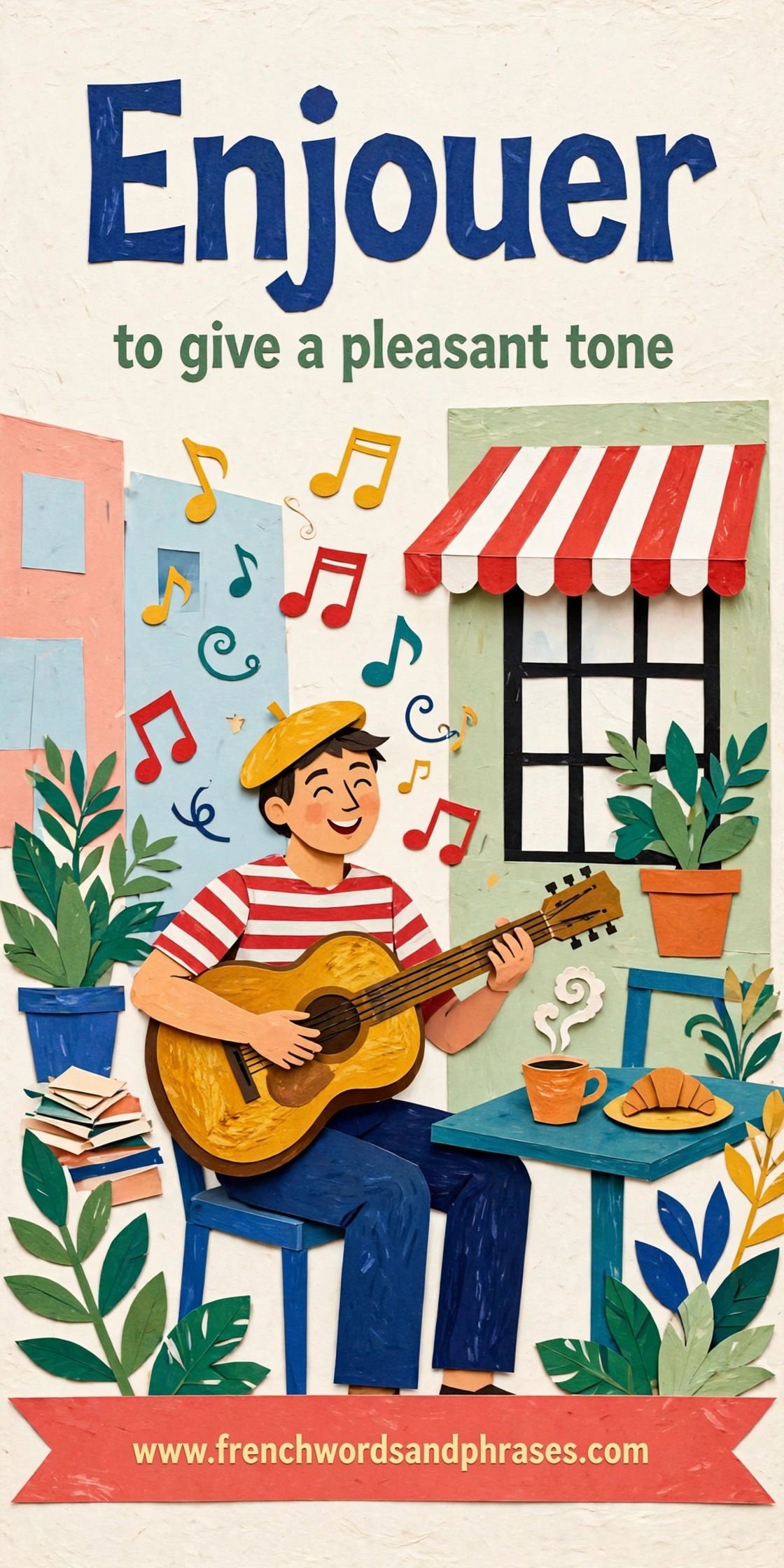
Enjouer means to give a pleasant tone — to sprinkle cheerfulness and play over words, music or company until everything sounds lighter.
A host who turns a stiff dinner into laughter, a writer whose driest subject twinkles, a tune that makes a grey room dance — enjouer is the rare, charming verb for lending things a pleasant, playful tone: it is what a light touch does to a heavy moment.
In this guide, you’ll learn how to conjugate enjouer in all the major French tenses and moods. Explore complete conjugation tables, French examples, English translations, and practice quizzes.
Understanding the French Verb Enjouer
Enjouer is a regular French verb belonging to the first group of verbs, those ending in-er.
It means to give a pleasant tone. It is used of conversations, letters, music and company — anything whose tone can be sweetened. Where everyday French says rendre gai or égayer, enjouer belongs to the written, slightly old-fashioned register, and meeting it in a novel is a small pleasure in itself.
Verb classification: First group (-er)
Auxiliary verb: Avoir
Past participle: enjoué
Present participle: enjouant
English equivalents: To give a pleasant tone, to make cheerful, to brighten; enjouer une conversation — to lend a conversation a playful tone; enjouer un récit — to brighten a story with wit; un ton enjoué — a cheerful, playful tone; l’enjouement — cheerfulness, playfulness.
One important detail: enjouer is a rare verb, and modern French overwhelmingly prefers its adjective and noun — enjoué (cheerful, playful) and l’enjouement (good-humoured liveliness). The verb itself turns up in older and literary prose. Do not confuse it with jouer (to play): enjouer does not mean to play something, it means to make something playful. Its conjugation is perfectly regular: j’enjoue, nous enjouons, ils enjouent, past participle enjoué.
Experience the Word
Enjouer is the verb of the light touch — it takes a flat, serious moment and tunes it to a pleasanter key.
Imagine a provincial notary’s clerk in 1890, writing the dullest letter of the year. Halfway through, a mischievous sentence slips in, then a joke about the weather — il a enjoué sa lettre, and the client reads the whole dreary page smiling.
Nothing in the letter has changed but its music. He has brightened it — enjoué — and dull facts now arrive dancing.
How to Conjugate Enjouer: Complete French Conjugation Guide
Let’s explore every major conjugation of enjouer, beginning with the indicative mood.
How to Conjugate Enjouer in the Indicative Mood
The indicative mood is used to express facts, observations, actions, and events.
How to Conjugate Enjouer in the Present Tense (Présent)
Used for actions happening now, habitual actions, and general truths.
| Subject | Conjugation |
|---|---|
| je | enjoue |
| tu | enjoues |
| il / elle | enjoue |
| nous | enjouons |
| vous | enjouez |
| ils / elles | enjouent |
Example
Sa présence enjoue toutes nos réunions de famille.
Her presence lends a pleasant tone to all our family gatherings.
Quick Quiz 1
Complete the sentence:
Nous ______ la conversation de nos chansons.
Reveal the answer
enjouons
Nous enjouons la conversation de nos chansons.
We give the conversation a pleasant tone with our songs.
How to Conjugate Enjouer in the Passé Composé
Used for completed actions in the past. Enjouer takes the auxiliary verb avoir.
| Subject | Conjugation |
|---|---|
| j’ | ai enjoué |
| tu | as enjoué |
| il / elle | a enjoué |
| nous | avons enjoué |
| vous | avez enjoué |
| ils / elles | ont enjoué |
Example
Il a enjoué son discours d’une pointe d’humour.
He brightened his speech with a touch of humour.
How to Conjugate Enjouer in the Imparfait (Imperfect Tense)
Used for habitual past actions, descriptions, and ongoing situations in the past.
| Subject | Conjugation |
|---|---|
| je | enjouais |
| tu | enjouais |
| il / elle | enjouait |
| nous | enjouions |
| vous | enjouiez |
| ils / elles | enjouaient |
Example
Sa bonne humeur enjouait les soirées les plus tristes.
Her good humour used to brighten the saddest evenings.
Quick Quiz 2
Choose the correct form:
He brightened the evening.
Il ______ la soirée. (a enjoué / est enjoué)
Reveal the answer
a enjoué
Il a enjoué la soirée.
Enjouer takes avoir.
How to Conjugate Enjouer in the Plus-que-parfait
Used to describe an action that had already been completed before another past event.
| Subject | Conjugation |
|---|---|
| j’ | avais enjoué |
| tu | avais enjoué |
| il / elle | avait enjoué |
| nous | avions enjoué |
| vous | aviez enjoué |
| ils / elles | avaient enjoué |
Example
Elle avait enjoué la conversation avant même le dessert.
She had livened up the conversation before dessert had even arrived.
How to Conjugate Enjouer in the Passé Simple
Primarily used in formal writing, literature, and historical narratives. It is rarely used in everyday conversation.
| Subject | Conjugation | |
|---|---|---|
| je | enjouai | |
| tu | enjouas | |
| il / elle | enjoua | |
| nous | enjouâmes | |
| vous | enjouâtes | |
| ils / elles | enjouèrent |
Example
D’un mot, il enjouea la triste assemblée.
With one word, he brightened the gloomy assembly.
How to Conjugate Enjouer in the Passé Antérieur
A literary tense used to express an action completed immediately before another past action, generally in the passé simple.
| Subject | Conjugation |
|---|---|
| j’ | eus enjoué |
| tu | eus enjoué |
| il / elle | eut enjoué |
| nous | eûmes enjoué |
| vous | eûtes enjoué |
| ils / elles | eurent enjoué |
Example
Quand il eut enjoué l’assistance, le maire commença son discours.
When he had put the audience in a cheerful mood, the mayor began his speech.
How to Conjugate Enjouer in the Future Tense (Futur Simple)
Used to describe actions that will take place in the future.
| Subject | Conjugation |
|---|---|
| je | enjouerai |
| tu | enjoueras |
| il / elle | enjouera |
| nous | enjouerons |
| vous | enjouerez |
| ils / elles | enjoueront |
Example
Ta visite enjouera notre dimanche.
Your visit will give our Sunday a pleasant tone.
How to Conjugate Enjouer in the Futur Antérieur (Future Perfect)
Used for an action that will have been completed before a particular point in the future.
| Subject | Conjugation |
|---|---|
| j’ | aurai enjoué |
| tu | auras enjoué |
| il / elle | aura enjoué |
| nous | aurons enjoué |
| vous | aurez enjoué |
| ils / elles | auront enjoué |
Example
À la fin du repas, elle aura enjoué tous les convives.
By the end of the meal, she will have brightened every guest’s mood.
How to Conjugate Enjouer in the Near Future (Futur Proche)
Used to describe something that is going to happen soon. Formed with aller + infinitive.
| Subject | Conjugation |
|---|---|
| je | vais enjouer |
| tu | vas enjouer |
| il / elle | va enjouer |
| nous | allons enjouer |
| vous | allez enjouer |
| ils / elles | vont enjouer |
Example
Ce petit air de musique va enjouer la soirée.
This little tune is going to give the evening a pleasant tone.
How to Conjugate Enjouer in the Conditional Mood
The conditional mood expresses what would happen under certain circumstances. It is also frequently used to make polite requests or express wishes.
How to Conjugate Enjouer in the Present Conditional
| Subject | Conjugation |
|---|---|
| je | enjouerais |
| tu | enjouerais |
| il / elle | enjouerait |
| nous | enjouerions |
| vous | enjoueriez |
| ils / elles | enjoueraient |
Example
Un peu d’humour enjouerait cette réunion.
A little humour would brighten this meeting.
How to Conjugate Enjouer in the Past Conditional
| Subject | Conjugation |
|---|---|
| j’ | aurais enjoué |
| tu | aurais enjoué |
| il / elle | aurait enjoué |
| nous | aurions enjoué |
| vous | auriez enjoué |
| ils / elles | auraient enjoué |
Example
Elle aurait enjoué la fête si elle était venue.
She would have livened up the party if she had come.
Enjouer in the Literary Past Conditional Form
This less common literary form uses the imperfect subjunctive of avoir.
| Subject | Conjugation |
|---|---|
| j’ | eusse enjoué |
| tu | eusses enjoué |
| il / elle | eût enjoué |
| nous | eussions enjoué |
| vous | eussiez enjoué |
| ils / elles | eussent enjoué |
Example
Il eût enjoué la soirée de ses chansons.
He would have brightened the evening with his songs.
How to Conjugate Enjouer in the Subjunctive Mood
The subjunctive is used to express wishes, emotions, doubts, necessity, and uncertainty. It frequently follows expressions such as il faut que (it is necessary that) or bien que (although).
How to Conjugate Enjouer in the Present Subjunctive
| Subject | Conjugation |
|---|---|
| que je | enjoue |
| que tu | enjoues |
| qu’il / qu’elle | enjoue |
| que nous | enjouions |
| que vous | enjouiez |
| qu’ils / qu’elles | enjouent |
Example
Il faut qu’elle enjoue un peu son récit.
She must give her story a slightly more pleasant tone.
Quick Quiz 3
Complete the sentence using the subjunctive:
Il faut que vous ______ ce texte bien sec.
Reveal the answer
enjouiez
Il faut que vous enjouiez ce texte bien sec.
You must give this very dry text a pleasanter tone.
How to Conjugate Enjouer in the Imperfect Subjunctive
A literary tense, rarely encountered in modern spoken French.
| Subject | Conjugation |
|---|---|
| que je | enjouasse |
| que tu | enjouasses |
| qu’il / qu’elle | enjouât |
| que nous | enjouassions |
| que vous | enjouassiez |
| qu’ils / qu’elles | enjouassent |
Example
Je souhaitais qu’il enjouât la conversation.
I wished he would lend the conversation a pleasant tone.
How to Conjugate Enjouer in the Pluperfect Subjunctive
A literary construction used to express an action completed before another past action.
| Subject | Conjugation |
|---|---|
| que j’ | eusse enjoué |
| que tu | eusses enjoué |
| qu’il / qu’elle | eût enjoué |
| que nous | eussions enjoué |
| que vous | eussiez enjoué |
| qu’ils / qu’elles | eussent enjoué |
Example
On disait qu’elle eût enjoué les soirées du château.
People said she had brightened the evenings at the castle.
How to Conjugate Enjouer in the Past Subjunctive
| Subject | Conjugation |
|---|---|
| que j’ | aie enjoué |
| que tu | aies enjoué |
| qu’il / qu’elle | ait enjoué |
| que nous | ayons enjoué |
| que vous | ayez enjoué |
| qu’ils / qu’elles | aient enjoué |
Example
Je suis ravi qu’il ait enjoué notre dîner.
I am delighted he gave our dinner such a pleasant tone.
How to Conjugate Enjouer in the Imperative
The imperative is used to give commands, instructions, invitations, or suggestions. Subject pronouns are omitted.
How to Conjugate Enjouer in the Present Imperative
| Person | Conjugation |
|---|---|
| (tu) | enjoue |
| (nous) | enjouons |
| (vous) | enjouez |
Example
Enjoue un peu ce texte, il est bien sec !
Give this text a pleasanter tone, it is terribly dry!
Quick Quiz 4
How would you say Give your story a pleasanter tone (tu form)?
Reveal the answer
Enjoue un peu ton récit !
French Participles of Enjouer
Participles are verb forms that can be used in compound tenses and other grammatical constructions.
Present Participle of Enjouer
enjouant
En enjouant son récit, elle a conquis ses lecteurs.
By brightening her story, she won over her readers.
Past Participle of Enjouer
enjoué
Enjoué par ses soins, le discours a fait sourire toute la salle.
Brightened by her care, the speech made the whole room smile.
Enjouer in Everyday French: Real-Life Examples
Now that you know the conjugations, let’s see how enjouer appears in everyday French.
Example 1 — Present
Sa présence enjoue la soirée.
Her presence gives the evening a pleasant tone.
Example 2 — Passé composé
Il a enjoué son discours d’une plaisanterie.
He brightened his speech with a joke.
Example 3 — Imparfait
Sa bonne humeur enjouait nos dimanches.
Her good humour used to brighten our Sundays.
Example 4 — Future
Ta visite enjouera notre journée.
Your visit will brighten our day.
Example 5 — Conditional
Un peu d’humour enjouerait cette réunion.
A little humour would brighten this meeting.
Example 6 — Imperative
Enjoue un peu ton récit !
Give your story a pleasanter tone!
Beyond Translation: The Meaning of Enjouer
English has no real equivalent — to brighten comes closest, but enjouer is built on joie and jouer, joy and play, so its pleasant tone is a playful one.
The adjective outlived the verb.
Modern French kept enjoué and l’enjouement in daily use — un enfant enjoué, a playful child — while the verb retired to the pages of older books, where it still does its quiet work.
How to Remember the French Verb Enjouer
Remember it this way: Enjouer is about the light touch that tunes a dull moment to a pleasanter key.
- Rare verb: modern French mostly keeps its adjective enjoué and its noun l’enjouement.
- Not jouer: enjouer means to MAKE playful, not to play — enjouer une conversation.
- Regular -er: j’enjoue, nous enjouons, past participle enjoué.
The key idea is the light touch that tunes a dull moment to a pleasanter key.
Test Your Knowledge of Enjouer
Let’s see how much you’ve learned. Try answering these questions before revealing the answers.
Question 1
What do modern French speakers usually use instead of the verb enjouer?
Reveal the answer
Its adjective and noun — enjoué (cheerful, playful) and l’enjouement (playfulness).
Question 2
How do you say Her presence gives the evening a pleasant tone in French?
Reveal the answer
Sa présence enjoue la soirée.
Question 3
Translate: He brightened his speech with a joke.
Reveal the answer
Il a enjoué son discours d’une plaisanterie.
Question 4
What is the past participle of enjouer?
Reveal the answer
Enjoué.
Question 5
Complete the sentence:
Il faut qu’elle ______ un peu son récit.
Reveal the answer
enjoue
Il faut qu’elle enjoue un peu son récit.
She must give her story a slightly more pleasant tone.
Your Final Challenge
Can You Use It?
How would you say this in French?
She gives the greyest meetings a pleasant tone with a smile, and even the rain seems to listen.
Reveal the answer
Elle enjoue les réunions les plus grises d’un sourire, et la pluie elle-même semble écouter.
She gives the greyest meetings a pleasant tone with a smile, and even the rain seems to listen.
A little French. A little curiosity. A richer everyday life.
LEARN FRENCH ONE WORD AT A TIME