A French Word to Live By
How to Conjugate Enharnacher in French
/ɑ̃.aʁ.na.ʃe/
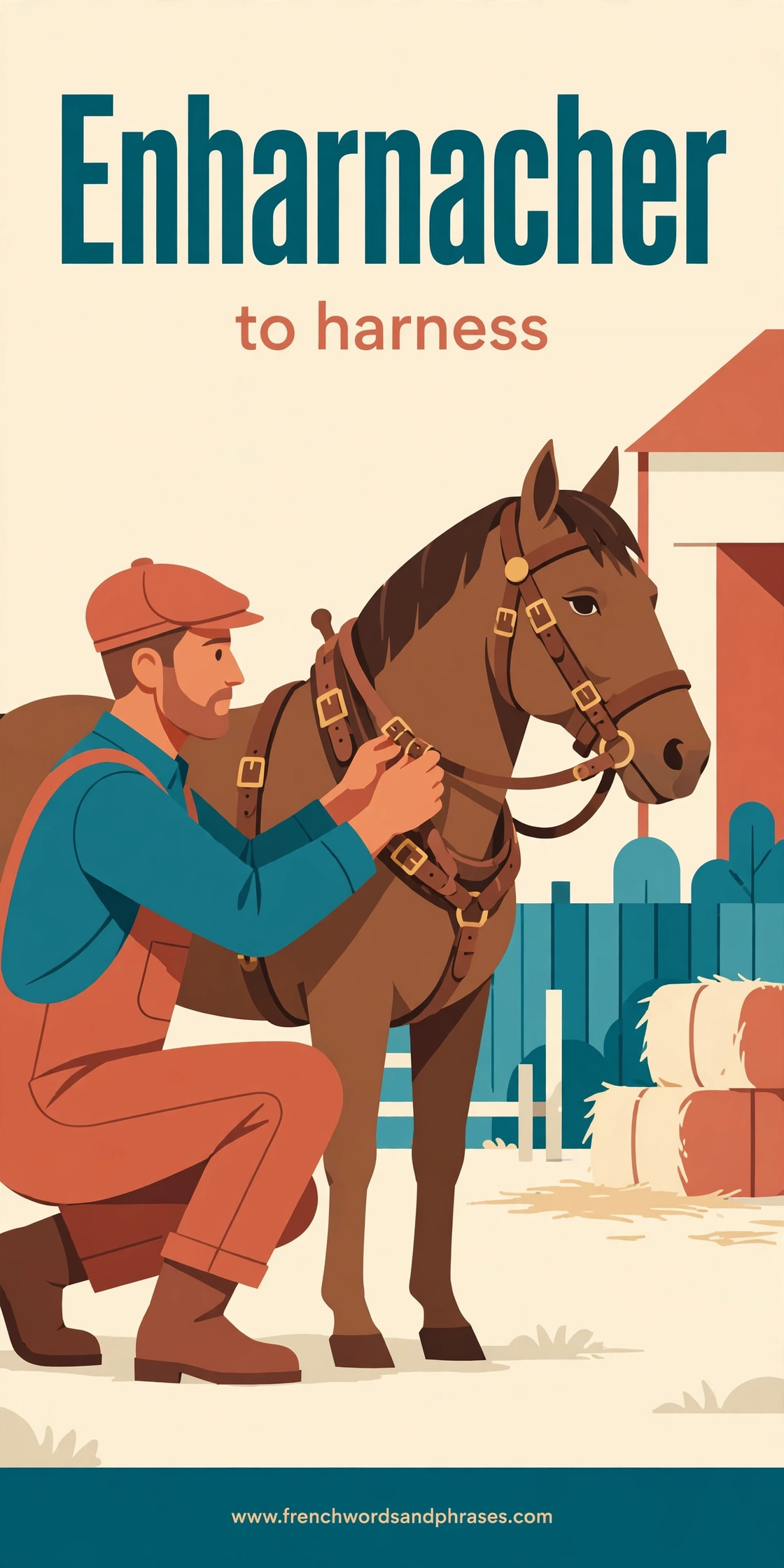
Enharnacher means to harness — to fit a horse with its harness of straps, collar and reins, readying it to pull a cart, a plough or a carriage.
Dawn in a farmyard stable: leather straps over a hook, a collar smelling of sweat and oil, and a heavy horse standing patient while practised hands buckle everything into place. Enharnacher is that whole morning ritual in one verb — harnessing the horse before the work of the day can begin.
In this guide, you’ll learn how to conjugate enharnacher in all the major French tenses and moods. Explore complete conjugation tables, French examples, English translations, and practice quizzes.
Understanding the French Verb Enharnacher
Enharnacher is a regular French verb belonging to the first group of verbs, those ending in-er.
It means to harness. Enharnacher is the technical farm and stable word: mettre le harnais would be the plain description, but enharnacher is the single verb stable hands and old novels use. Its mirror image is déharnacher, to unharness, and together the pair framed the working day of every horse in France for centuries.
Verb classification: First group (-er)
Auxiliary verb: Avoir
Past participle: enharnaché
Present participle: enharnachant
English equivalents: To harness, to harness up; enharnacher un cheval — to harness a horse; enharnacher les bœufs — to harness the oxen; un cheval enharnaché — a harnessed horse; le harnais — the harness.
One important detail: enharnacher is a regular -er verb built on un harnais, a harness — the same root English borrowed for its own word harness. The h inside is silent and the spelling never changes: j’enharnache, nous enharnachons, past participle enharnaché. It belongs to the world of horses and draught animals: you enharnache a horse, an ox or a mule, almost always before work, a journey or a parade.
Experience the Word
Enharnacher is the verb of straps and buckles — the moment a horse becomes a worker.
Imagine a Brittany farm in 1900. Before the sun has cleared the hedge, the farmer is in the stable: collar over the big mare’s head, girth tightened, reins threaded, traces hooked to the cart. En dix minutes, le cheval est enharnaché — and only then can the day’s hauling begin.
Before the harness, a horse. After it, a team. Enharnaché, the animal is ready for the road.
How to Conjugate Enharnacher: Complete French Conjugation Guide
Let’s explore every major conjugation of enharnacher, beginning with the indicative mood.
How to Conjugate Enharnacher in the Indicative Mood
The indicative mood is used to express facts, observations, actions, and events.
How to Conjugate Enharnacher in the Present Tense (Présent)
Used for actions happening now, habitual actions, and general truths.
| Subject | Conjugation |
|---|---|
| je | enharnache |
| tu | enharnaches |
| il / elle | enharnache |
| nous | enharnachons |
| vous | enharnachez |
| ils / elles | enharnachent |
Example
Le fermier enharnache le cheval avant le lever du soleil.
The farmer harnesses the horse before sunrise.
Quick Quiz 1
Complete the sentence:
Nous ______ les chevaux pour la foire.
Reveal the answer
enharnachons
Nous enharnachons les chevaux pour la foire.
We harness the horses for the fair.
How to Conjugate Enharnacher in the Passé Composé
Used for completed actions in the past. Enharnacher takes the auxiliary verb avoir.
| Subject | Conjugation |
|---|---|
| j’ | ai enharnaché |
| tu | as enharnaché |
| il / elle | a enharnaché |
| nous | avons enharnaché |
| vous | avez enharnaché |
| ils / elles | ont enharnaché |
Example
Elle a enharnaché les deux chevaux en dix minutes.
She harnessed the two horses in ten minutes.
How to Conjugate Enharnacher in the Imparfait (Imperfect Tense)
Used for habitual past actions, descriptions, and ongoing situations in the past.
| Subject | Conjugation |
|---|---|
| je | enharnachais |
| tu | enharnachais |
| il / elle | enharnachait |
| nous | enharnachions |
| vous | enharnachiez |
| ils / elles | enharnachaient |
Example
Autrefois, on enharnachait les bœufs pour labourer.
In the old days, they used to harness the oxen for ploughing.
Quick Quiz 2
Choose the correct form:
She harnessed the horses.
Elle ______ les chevaux. (a enharnaché / est enharnachée)
Reveal the answer
a enharnaché
Elle a enharnaché les chevaux.
Enharnacher takes avoir.
How to Conjugate Enharnacher in the Plus-que-parfait
Used to describe an action that had already been completed before another past event.
| Subject | Conjugation |
|---|---|
| j’ | avais enharnaché |
| tu | avais enharnaché |
| il / elle | avait enharnaché |
| nous | avions enharnaché |
| vous | aviez enharnaché |
| ils / elles | avaient enharnaché |
Example
Il avait enharnaché la jument quand la pluie commença.
He had harnessed the mare when the rain began.
How to Conjugate Enharnacher in the Passé Simple
Primarily used in formal writing, literature, and historical narratives. It is rarely used in everyday conversation.
| Subject | Conjugation |
|---|---|
| je | enharnachai |
| tu | enharnachas |
| il / elle | enharnacha |
| nous | enharnachâmes |
| vous | enharnachâtes |
| ils / elles | enharnachèrent |
Example
Le cocher enharnacha les chevaux et partit pour la ville.
The coachman harnessed the horses and set off for town.
How to Conjugate Enharnacher in the Passé Antérieur
A literary tense used to express an action completed immediately before another past action, generally in the passé simple.
| Subject | Conjugation |
|---|---|
| j’ | eus enharnaché |
| tu | eus enharnaché |
| il / elle | eut enharnaché |
| nous | eûmes enharnaché |
| vous | eûtes enharnaché |
| ils / elles | eurent enharnaché |
Example
Dès qu’il eut enharnaché le cheval, il attela la charrette.
As soon as he had harnessed the horse, he hitched up the cart.
How to Conjugate Enharnacher in the Future Tense (Futur Simple)
Used to describe actions that will take place in the future.
| Subject | Conjugation |
|---|---|
| je | enharnacherai |
| tu | enharnacheras |
| il / elle | enharnachera |
| nous | enharnacherons |
| vous | enharnacherez |
| ils / elles | enharnacheront |
Example
Demain, nous enharnacherons les chevaux pour la foire.
Tomorrow, we will harness the horses for the fair.
How to Conjugate Enharnacher in the Futur Antérieur (Future Perfect)
Used for an action that will have been completed before a particular point in the future.
| Subject | Conjugation |
|---|---|
| j’ | aurai enharnaché |
| tu | auras enharnaché |
| il / elle | aura enharnaché |
| nous | aurons enharnaché |
| vous | aurez enharnaché |
| ils / elles | auront enharnaché |
Example
À sept heures, tu auras enharnaché tout l’attelage.
By seven o’clock, you will have harnessed the whole team.
How to Conjugate Enharnacher in the Near Future (Futur Proche)
Used to describe something that is going to happen soon. Formed with aller + infinitive.
| Subject | Conjugation |
|---|---|
| je | vais enharnacher |
| tu | vas enharnacher |
| il / elle | va enharnacher |
| nous | allons enharnacher |
| vous | allez enharnacher |
| ils / elles | vont enharnacher |
Example
Je vais enharnacher le cheval, nous partons dans cinq minutes.
I am going to harness the horse, we leave in five minutes.
How to Conjugate Enharnacher in the Conditional Mood
The conditional mood expresses what would happen under certain circumstances. It is also frequently used to make polite requests or express wishes.
How to Conjugate Enharnacher in the Present Conditional
| Subject | Conjugation |
|---|---|
| je | enharnacherais |
| tu | enharnacherais |
| il / elle | enharnacherait |
| nous | enharnacherions |
| vous | enharnacheriez |
| ils / elles | enharnacheraient |
Example
Avec un aide, j’enharnacherais les chevaux plus vite.
With a helper, I would harness the horses faster.
How to Conjugate Enharnacher in the Past Conditional
| Subject | Conjugation |
|---|---|
| j’ | aurais enharnaché |
| tu | aurais enharnaché |
| il / elle | aurait enharnaché |
| nous | aurions enharnaché |
| vous | auriez enharnaché |
| ils / elles | auraient enharnaché |
Example
Sans la tempête, ils auraient enharnaché les chevaux à l’aube.
Without the storm, they would have harnessed the horses at dawn.
Enharnacher in the Literary Past Conditional Form
This less common literary form uses the imperfect subjunctive of avoir.
| Subject | Conjugation |
|---|---|
| j’ | eusse enharnaché |
| tu | eusses enharnaché |
| il / elle | eût enharnaché |
| nous | eussions enharnaché |
| vous | eussiez enharnaché |
| ils / elles | eussent enharnaché |
Example
Il eût enharnaché les bœufs avant même le chant du coq.
He would have harnessed the oxen before even the cock crowed.
How to Conjugate Enharnacher in the Subjunctive Mood
The subjunctive is used to express wishes, emotions, doubts, necessity, and uncertainty. It frequently follows expressions such as il faut que (it is necessary that) or bien que (although).
How to Conjugate Enharnacher in the Present Subjunctive
| Subject | Conjugation |
|---|---|
| que je | enharnache |
| que tu | enharnaches |
| qu’il / qu’elle | enharnache |
| que nous | enharnachions |
| que vous | enharnachiez |
| qu’ils / qu’elles | enharnachent |
Example
Il faut que tu enharnaches le cheval avant huit heures.
You must harness the horse before eight o’clock.
Quick Quiz 3
Complete the sentence using the subjunctive:
Il faut que vous ______ l’attelage en silence.
Reveal the answer
enharnachiez
Il faut que vous enharnachiez l’attelage en silence.
You must harness the team in silence.
How to Conjugate Enharnacher in the Imperfect Subjunctive
A literary tense, rarely encountered in modern spoken French.
| Subject | Conjugation |
|---|---|
| que je | enharnachasse |
| que tu | enharnachasses |
| qu’il / qu’elle | enharnachât |
| que nous | enharnachassions |
| que vous | enharnachassiez |
| qu’ils / qu’elles | enharnachassent |
Example
Le maître voulait que le valet enharnachât l’attelage en silence.
The master wanted the servant to harness the team in silence.
How to Conjugate Enharnacher in the Pluperfect Subjunctive
A literary construction used to express an action completed before another past action.
| Subject | Conjugation |
|---|---|
| que j’ | eusse enharnaché |
| que tu | eusses enharnaché |
| qu’il / qu’elle | eût enharnaché |
| que nous | eussions enharnaché |
| que vous | eussiez enharnaché |
| qu’ils / qu’elles | eussent enharnaché |
Example
On racontait qu’il eût enharnaché six chevaux en une heure.
People said he had harnessed six horses in one hour.
How to Conjugate Enharnacher in the Past Subjunctive
| Subject | Conjugation |
|---|---|
| que j’ | aie enharnaché |
| que tu | aies enharnaché |
| qu’il / qu’elle | ait enharnaché |
| que nous | ayons enharnaché |
| que vous | ayez enharnaché |
| qu’ils / qu’elles | aient enharnaché |
Example
Je suis content que vous ayez enharnaché les chevaux si tôt.
I am glad you harnessed the horses so early.
How to Conjugate Enharnacher in the Imperative
The imperative is used to give commands, instructions, invitations, or suggestions. Subject pronouns are omitted.
How to Conjugate Enharnacher in the Present Imperative
| Person | Conjugation |
|---|---|
| (tu) | enharnache |
| (nous) | enharnachons |
| (vous) | enharnachez |
Example
Enharnache le cheval, le marché nous attend !
Harness the horse, the market is waiting for us!
Quick Quiz 4
How would you say Harness the horse (tu form)?
Reveal the answer
Enharnache le cheval !
French Participles of Enharnacher
Participles are verb forms that can be used in compound tenses and other grammatical constructions.
Present Participle of Enharnacher
enharnachant
En enharnachant la jument, il vérifia chaque boucle.
While harnessing the mare, he checked every buckle.
Past Participle of Enharnacher
enharnaché
Enharnaché dès l’aube, le cheval attendait devant la grange.
Harnessed since dawn, the horse was waiting in front of the barn.
Enharnacher in Everyday French: Real-Life Examples
Now that you know the conjugations, let’s see how enharnacher appears in everyday French.
Example 1 — Present
Le fermier enharnache le cheval.
The farmer harnesses the horse.
Example 2 — Passé composé
Elle a enharnaché les deux chevaux.
She harnessed the two horses.
Example 3 — Imparfait
On enharnachait les bœufs pour labourer.
They used to harness the oxen for ploughing.
Example 4 — Future
Nous enharnacherons les chevaux pour la foire.
We will harness the horses for the fair.
Example 5 — Conditional
J’enharnacherais les chevaux plus vite avec un aide.
I would harness the horses faster with a helper.
Example 6 — Imperative
Enharnachez les chevaux avant huit heures !
Harness the horses before eight o’clock!
Beyond Translation: The Meaning of Enharnacher
English harness and French harnais are the same old word — armour for a horse, which is why old texts use harnais for a knight’s equipment too.
Enharnacher is therefore a verb with a thousand years of work in it.
Every morning, in every stable in France, it marked the border between rest and labour: the horse enharnaché belonged to the day; déharnaché in the evening, it belonged to itself again.
How to Remember the French Verb Enharnacher
Remember it this way: Enharnacher is about straps, buckles and a patient horse at dawn.
- Built on harnais, a harness — the very word English borrowed as harness.
- Regular -er: j’enharnache, nous enharnachons, past participle enharnaché.
- Its partner is déharnacher, to unharness: harness at dawn, unharness at dusk.
The key idea is straps, buckles and a patient horse at dawn.
Test Your Knowledge of Enharnacher
Let’s see how much you’ve learned. Try answering these questions before revealing the answers.
Question 1
What noun lives inside enharnacher?
Reveal the answer
Un harnais — a harness (the word English borrowed as harness).
Question 2
How do you say The farmer harnesses the horse in French?
Reveal the answer
Le fermier enharnache le cheval.
Question 3
Translate: She harnessed the two horses in ten minutes.
Reveal the answer
Elle a enharnaché les deux chevaux en dix minutes.
Question 4
What is the past participle of enharnacher?
Reveal the answer
Enharnaché.
Question 5
Complete the sentence:
Il faut que tu ______ le cheval avant huit heures.
Reveal the answer
enharnaches
Il faut que tu enharnaches le cheval avant huit heures.
You must harness the horse before eight o’clock.
Your Final Challenge
Can You Use It?
How would you say this in French?
Harnessed before dawn, the old horse looked at the road with the patience of animals that know the way.
Reveal the answer
Enharnaché avant l’aube, le vieux cheval regarda la route avec la patience des bêtes qui connaissent le chemin.
Harnessed before dawn, the old horse looked at the road with the patience of animals that know the way.
A little French. A little curiosity. A richer everyday life.
LEARN FRENCH ONE WORD AT A TIME