A French Word to Live By
How to Conjugate Se enfiévrer in French
/sə ɑ̃.fje.vʁe/
Se enfiévrer means to get excited — to heat up with enthusiasm or agitation the way a body heats up with fever.
Supporters before a final, children on the eve of a holiday, a hall warming up before the star comes on — s’enfiévrer is the reflexive of rising heat: people catching excitement from one another like a fever.
In this guide, you’ll learn how to conjugate se enfiévrer in all the major French tenses and moods. Explore complete conjugation tables, French examples, English translations, and practice quizzes.
Understanding the French Verb Se enfiévrer
Se enfiévrer is a regular French verb belonging to the first group of verbs, those ending in-er.
It means to get excited. It is used of crowds, supporters and whole towns warming up for matches, concerts and elections, and of individuals getting worked up in an argument — les esprits s’enfièvrent is the standard phrase for tempers rising. The excitement can be joyful or dangerous, and context decides.
Verb classification: First group (-er), reflexive
Auxiliary verb: Être
Past participle: enfiévré
Present participle: enfiévrant
English equivalents: To get excited, to get worked up, to become feverish; s’enfiévrer pour un match — to get excited about a match; la foule s’enfièvre — the crowd is getting excited; les esprits s’enfièvrent — tempers are heating up; ne t’enfièvre pas ! — do not get worked up!
One important detail: s’enfiévrer follows the espérer-type spelling of enfiévrer — the é of the stem opens to è in the present singular and third plural, in the subjunctive singular and third plural, and in the tu imperative: je m’enfièvre, ils s’enfièvrent. But the future and conditional keep é: je m’enfiévrerai, je m’enfiévrerais. Being reflexive, it takes être in every compound tense and the past participle agrees with the subject: elle s’est enfiévrée, ils se sont enfiévrés. The tu imperative tucks the pronoun behind the verb: enfièvre-toi !
Experience the Word
S’enfiévrer is excitement as contagion — one person heats up, and the whole room catches the fever.
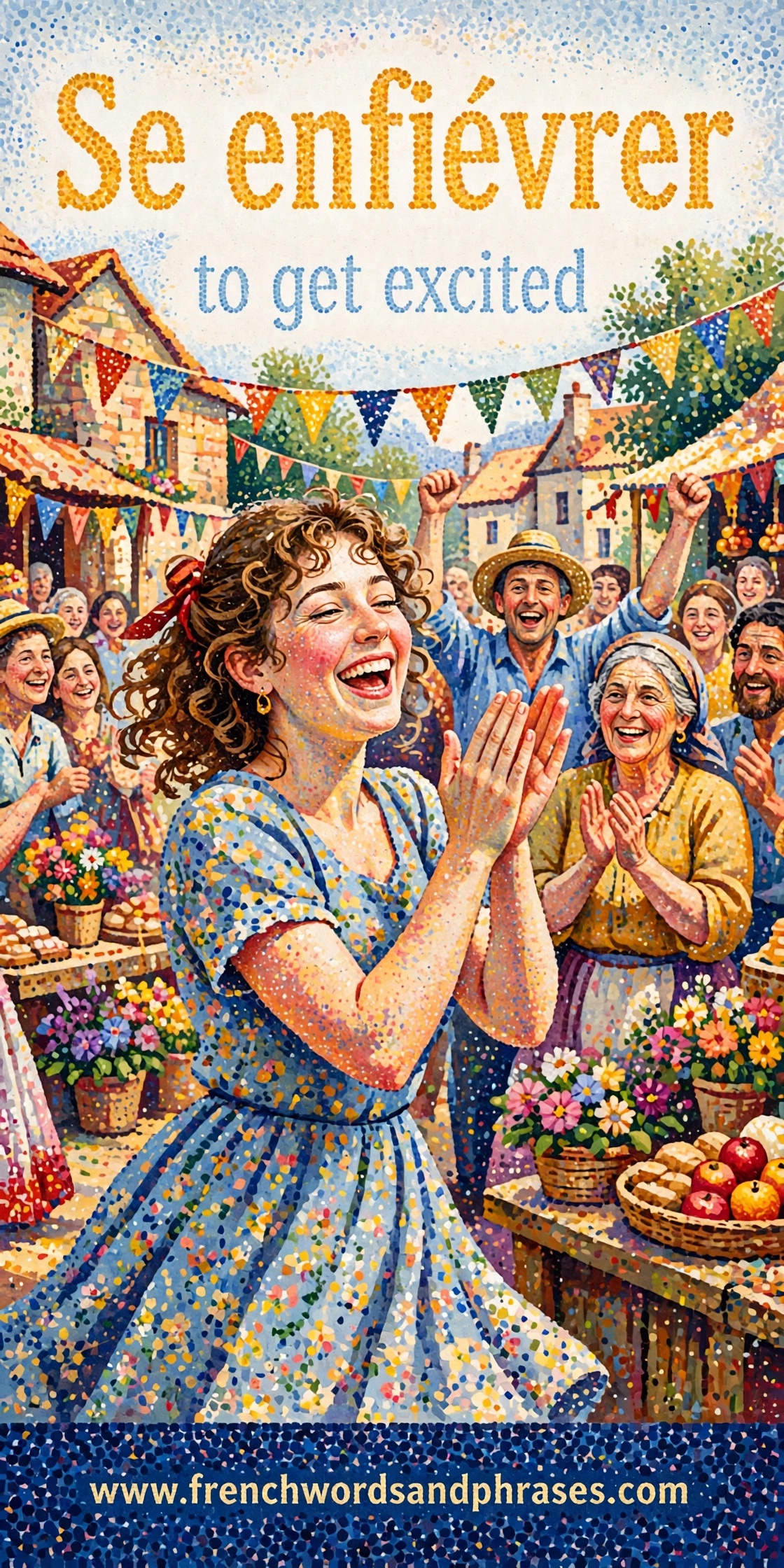
Imagine a village square an hour before the fireworks. At first people simply wait, chatting quietly; then the band arrives, the children start running, the first rockets are unpacked — et peu à peu, tout le village s’enfièvre, until the waiting itself becomes a party.
Nothing has happened yet. The village has simply got excited — enfiévré, together, in advance.
How to Conjugate Se enfiévrer: Complete French Conjugation Guide
Let’s explore every major conjugation of se enfiévrer, beginning with the indicative mood.
How to Conjugate Se enfiévrer in the Indicative Mood
The indicative mood is used to express facts, observations, actions, and events.
How to Conjugate Se enfiévrer in the Present Tense (Présent)
Used for actions happening now, habitual actions, and general truths.
| Subject | Conjugation |
|---|---|
| je | m’enfièvre |
| tu | t’enfièvres |
| il / elle | s’enfièvre |
| nous | nous enfiévrons |
| vous | vous enfiévrez |
| ils / elles | s’enfièvrent |
Example
La foule s’enfièvre à l’approche du match.
The crowd is getting excited as the match approaches.
Quick Quiz 1
Complete the sentence:
Nous nous ______ à l’approche de la finale.
Reveal the answer
enfiévrons
Nous nous enfiévrons à l’approche de la finale.
We are getting excited as the final approaches.
How to Conjugate Se enfiévrer in the Passé Composé
Used for completed actions in the past. Se enfiévrer takes the auxiliary verb être.
| Subject | Conjugation |
|---|---|
| je | me suis enfiévré / me suis enfiévrée |
| tu | t’es enfiévré / t’es enfiévrée |
| il / elle | s’est enfiévré / s’est enfiévrée |
| nous | nous sommes enfiévrés / nous sommes enfiévrées |
| vous | vous êtes enfiévrés / vous êtes enfiévrées / vous êtes enfiévré / vous êtes enfiévrée |
| ils / elles | se sont enfiévrés / se sont enfiévrées |
Example
Les supporters se sont enfiévrés dès le premier but.
The supporters got excited from the very first goal.
How to Conjugate Se enfiévrer in the Imparfait (Imperfect Tense)
Used for habitual past actions, descriptions, and ongoing situations in the past.
| Subject | Conjugation |
|---|---|
| je | m’enfiévrais |
| tu | t’enfiévrais |
| il / elle | s’enfiévrait |
| nous | nous enfiévrions |
| vous | vous enfiévriez |
| ils / elles | s’enfiévraient |
Example
Le village s’enfiévrait chaque année avant la fête.
The village used to get excited every year before the festival.
Quick Quiz 2
Choose the correct form:
She got excited about the concert.
Elle ______ pour le concert. (s’est enfiévrée / a enfiévré)
Reveal the answer
s’est enfiévrée
Elle s’est enfiévrée pour le concert.
S’enfiévrer is reflexive, takes être, and the participle agrees: enfiévrée.
How to Conjugate Se enfiévrer in the Plus-que-parfait
Used to describe an action that had already been completed before another past event.
| Subject | Conjugation |
|---|---|
| je | m’étais enfiévré / m’étais enfiévrée |
| tu | t’étais enfiévré / t’étais enfiévrée |
| il / elle | s’était enfiévré / s’était enfiévrée |
| nous | nous étions enfiévrés / nous étions enfiévrées |
| vous | vous étiez enfiévrés / vous étiez enfiévrées / vous étiez enfiévré / vous étiez enfiévrée |
| ils / elles | s’étaient enfiévrés / s’étaient enfiévrées |
Example
Les esprits s’étaient enfiévrés bien avant le discours.
Tempers had heated up well before the speech.
How to Conjugate Se enfiévrer in the Passé Simple
Primarily used in formal writing, literature, and historical narratives. It is rarely used in everyday conversation.
| Subject | Conjugation |
|---|---|
| je | m’enfiévrai |
| tu | t’enfiévras |
| il / elle | s’enfiévra |
| nous | nous enfiévrâmes |
| vous | vous enfiévrâtes |
| ils / elles | s’enfiévrèrent |
Example
La salle s’enfiévra dès les premières notes.
The hall got excited from the very first notes.
How to Conjugate Se enfiévrer in the Passé Antérieur
A literary tense used to express an action completed immediately before another past action, generally in the passé simple.
| Subject | Conjugation |
|---|---|
| je | me fus enfiévré / me fus enfiévrée |
| tu | te fus enfiévré / te fus enfiévrée |
| il / elle | se fut enfiévré / se fut enfiévrée |
| nous | nous fûmes enfiévrés / nous fûmes enfiévrées |
| vous | vous fûtes enfiévrés / vous fûtes enfiévrées / vous fûtes enfiévré / vous fûtes enfiévrée |
| ils / elles | se furent enfiévrés / se furent enfiévrées |
Example
Dès que la foule se fut enfiévrée, le match commença.
As soon as the crowd had got excited, the match began.
How to Conjugate Se enfiévrer in the Future Tense (Futur Simple)
Used to describe actions that will take place in the future.
| Subject | Conjugation |
|---|---|
| je | m’enfiévrerai |
| tu | t’enfiévreras |
| il / elle | s’enfiévrera |
| nous | nous enfiévrerons |
| vous | vous enfiévrerez |
| ils / elles | s’enfiévreront |
Example
Les enfants s’enfiévreront à l’idée des vacances.
The children will get excited at the thought of the holidays.
How to Conjugate Se enfiévrer in the Futur Antérieur (Future Perfect)
Used for an action that will have been completed before a particular point in the future.
| Subject | Conjugation |
|---|---|
| je | me serai enfiévré / me serai enfiévrée |
| tu | te seras enfiévré / te seras enfiévrée |
| il / elle | se sera enfiévré / se sera enfiévrée |
| nous | nous serons enfiévrés / nous serons enfiévrées |
| vous | vous serez enfiévrés / vous serez enfiévrées / vous serez enfiévré / vous serez enfiévrée |
| ils / elles | se seront enfiévrés / se seront enfiévrées |
Example
À vingt heures, tout le stade se sera enfiévré.
By eight o’clock, the whole stadium will have got excited.
How to Conjugate Se enfiévrer in the Near Future (Futur Proche)
Used to describe something that is going to happen soon. Formed with aller + infinitive.
| Subject | Conjugation |
|---|---|
| je | vais m’enfiévrer |
| tu | vas t’enfiévrer |
| il / elle | va s’enfiévrer |
| nous | allons nous enfiévrer |
| vous | allez vous enfiévrer |
| ils / elles | vont s’enfiévrer |
Example
Regarde-les, ils vont s’enfiévrer pour un rien.
Look at them, they are going to get worked up over nothing.
How to Conjugate Se enfiévrer in the Conditional Mood
The conditional mood expresses what would happen under certain circumstances. It is also frequently used to make polite requests or express wishes.
How to Conjugate Se enfiévrer in the Present Conditional
| Subject | Conjugation |
|---|---|
| je | m’enfiévrerais |
| tu | t’enfiévrerais |
| il / elle | s’enfiévrerait |
| nous | nous enfiévrerions |
| vous | vous enfiévreriez |
| ils / elles | s’enfiévreraient |
Example
Le public s’enfiévrerait davantage avec une meilleure musique.
The audience would get more excited with better music.
How to Conjugate Se enfiévrer in the Past Conditional
| Subject | Conjugation |
|---|---|
| je | me serais enfiévré / me serais enfiévrée |
| tu | te serais enfiévré / te serais enfiévrée |
| il / elle | se serait enfiévré / se serait enfiévrée |
| nous | nous serions enfiévrés / nous serions enfiévrées |
| vous | vous seriez enfiévrés / vous seriez enfiévrées / vous seriez enfiévré / vous seriez enfiévrée |
| ils / elles | se seraient enfiévrés / se seraient enfiévrées |
Example
Elle se serait enfiévrée pour le concert si elle avait eu un billet.
She would have got excited about the concert if she had had a ticket.
Se enfiévrer in the Literary Past Conditional Form
This less common literary form uses the imperfect subjunctive of être.
| Subject | Conjugation |
|---|---|
| je | me fusse enfiévré / me fusse enfiévrée |
| tu | te fusses enfiévré / te fusses enfiévrée |
| il / elle | se fût enfiévré / se fût enfiévrée |
| nous | nous fussions enfiévrés / nous fussions enfiévrées |
| vous | vous fussiez enfiévrés / vous fussiez enfiévrées / vous fussiez enfiévré / vous fussiez enfiévrée |
| ils / elles | se fussent enfiévrés / se fussent enfiévrées |
Example
La foule se fût enfiévrée dès la première chanson.
The crowd would have got excited from the very first song.
How to Conjugate Se enfiévrer in the Subjunctive Mood
The subjunctive is used to express wishes, emotions, doubts, necessity, and uncertainty. It frequently follows expressions such as il faut que (it is necessary that) or bien que (although).
How to Conjugate Se enfiévrer in the Present Subjunctive
| Subject | Conjugation |
|---|---|
| que je | m’enfièvre |
| que tu | t’enfièvres |
| qu’il / qu’elle | s’enfièvre |
| que nous | nous enfiévrions |
| que vous | vous enfiévriez |
| qu’ils / qu’elles | s’enfièvrent |
Example
Je ne veux pas que les esprits s’enfièvrent avant le vote.
I do not want tempers to heat up before the vote.
Quick Quiz 3
Complete the sentence using the subjunctive:
Il ne faut pas que tu t’______ pour si peu.
Reveal the answer
enfièvres
Il ne faut pas que tu t’enfièvres pour si peu.
You must not get worked up over so little.
How to Conjugate Se enfiévrer in the Imperfect Subjunctive
A literary tense, rarely encountered in modern spoken French.
| Subject | Conjugation |
|---|---|
| que je | m’enfiévrasse |
| que tu | t’enfiévrasses |
| qu’il / qu’elle | s’enfiévrât |
| que nous | nous enfiévrassions |
| que vous | vous enfiévrassiez |
| qu’ils / qu’elles | s’enfiévrassent |
Example
On craignait que la foule s’enfiévrât trop vite.
People feared the crowd might get excited too quickly.
How to Conjugate Se enfiévrer in the Pluperfect Subjunctive
A literary construction used to express an action completed before another past action.
| Subject | Conjugation |
|---|---|
| que je | me fusse enfiévré / me fusse enfiévrée |
| que tu | te fusses enfiévré / te fusses enfiévrée |
| qu’il / qu’elle | se fût enfiévré / se fût enfiévrée |
| que nous | nous fussions enfiévrés / nous fussions enfiévrées |
| que vous | vous fussiez enfiévrés / vous fussiez enfiévrées / vous fussiez enfiévré / vous fussiez enfiévrée |
| qu’ils / qu’elles | se fussent enfiévrés / se fussent enfiévrées |
Example
On racontait qu’ils se fussent enfiévrés pour une simple rumeur.
People said they had got worked up over a mere rumour.
How to Conjugate Se enfiévrer in the Past Subjunctive
| Subject | Conjugation |
|---|---|
| que je | me sois enfiévré / me sois enfiévrée |
| que tu | te sois enfiévré / te sois enfiévrée |
| qu’il / qu’elle | se soit enfiévré / se soit enfiévrée |
| que nous | nous soyons enfiévrés / nous soyons enfiévrées |
| que vous | vous soyez enfiévrés / vous soyez enfiévrées / vous soyez enfiévré / vous soyez enfiévrée |
| qu’ils / qu’elles | se soient enfiévrés / se soient enfiévrées |
Example
Je suis étonné qu’il se soit enfiévré pour si peu.
I am amazed he got worked up over so little.
How to Conjugate Se enfiévrer in the Imperative
The imperative is used to give commands, instructions, invitations, or suggestions. Subject pronouns are omitted.
How to Conjugate Se enfiévrer in the Present Imperative
| Person | Conjugation |
|---|---|
| (tu) | enfièvre-toi |
| (nous) | enfiévrons-nous |
| (vous) | enfiévrez-vous |
Example
Ne t’enfièvre pas, le match n’a pas encore commencé !
Do not get worked up, the match has not started yet!
Quick Quiz 4
How would you say Do not get worked up (tu form)?
Reveal the answer
Ne t’enfièvre pas !
French Participles of Se enfiévrer
Participles are verb forms that can be used in compound tenses and other grammatical constructions.
Present Participle of Se enfiévrer
enfiévrant
En s’enfiévrant, les supporters ont renversé les barrières.
In getting excited, the supporters knocked over the barriers.
Past Participle of Se enfiévrer
enfiévré
Enfiévrée par l’attente, la foule chantait déjà.
Fired up by the waiting, the crowd was already singing.
Se enfiévrer in Everyday French: Real-Life Examples
Now that you know the conjugations, let’s see how se enfiévrer appears in everyday French.
Example 1 — Present
La foule s’enfièvre avant le match.
The crowd is getting excited before the match.
Example 2 — Passé composé
Les supporters se sont enfiévrés dès le premier but.
The supporters got excited from the first goal.
Example 3 — Imparfait
Le village s’enfiévrait avant la fête.
The village used to get excited before the festival.
Example 4 — Future
Les enfants s’enfiévreront avant les vacances.
The children will get excited before the holidays.
Example 5 — Conditional
Le public s’enfiévrerait avec plus de musique.
The audience would get more excited with more music.
Example 6 — Imperative
Ne t’enfièvre pas pour si peu !
Do not get worked up over so little!
Beyond Translation: The Meaning of Se enfiévrer
English to get excited is neutral; French s’enfiévrer keeps the thermometer in the picture — la fièvre, the fever, is inside the verb.
Excitement here is a temperature, not a decision.
That is why s’enfiévrer suits crowds so well: nobody chooses it, it spreads — les esprits s’enfièvrent — and the wise speaker, like the wise doctor, watches the temperature before it climbs too high.
How to Remember the French Verb Se enfiévrer
Remember it this way: Se enfiévrer is about a crowd catching excitement like a fever.
- Espérer-type spelling: je m’enfièvre with è in the present, but je m’enfiévrerai with é in the future.
- Always reflexive: être in compound tenses, participle agreeing — elle s’est enfiévrée.
- The classic frame: les esprits s’enfièvrent — tempers heating up.
The key idea is a crowd catching excitement like a fever.
Test Your Knowledge of Se enfiévrer
Let’s see how much you’ve learned. Try answering these questions before revealing the answers.
Question 1
Which auxiliary does s’enfiévrer use, and why?
Reveal the answer
Être — it is a reflexive verb: elle s’est enfiévrée avant le concert.
Question 2
How do you say The crowd is getting excited in French?
Reveal the answer
La foule s’enfièvre.
Question 3
Translate: The supporters got excited from the first goal.
Reveal the answer
Les supporters se sont enfiévrés dès le premier but.
Question 4
What is the past participle of s’enfiévrer?
Reveal the answer
Enfiévré — agreeing: enfiévrée, enfiévrés, enfiévrées.
Question 5
Complete the sentence:
Je ne veux pas que les esprits s’______ avant le vote.
Reveal the answer
enfièvrent
Je ne veux pas que les esprits s’enfièvrent avant le vote.
I do not want tempers to heat up before the vote.
Your Final Challenge
Can You Use It?
How would you say this in French?
The village slowly gets excited before the festival, like a gentle fever rising with the evening.
Reveal the answer
Le village s’enfièvre doucement avant la fête, comme une fièvre douce qui monte avec le soir.
The village slowly gets excited before the festival, like a gentle fever rising with the evening.
A little French. A little curiosity. A richer everyday life.
LEARN FRENCH ONE WORD AT A TIME