A French Word to Live By
How to Conjugate Enfiévrer in French
/ɑ̃.fje.vʁe/
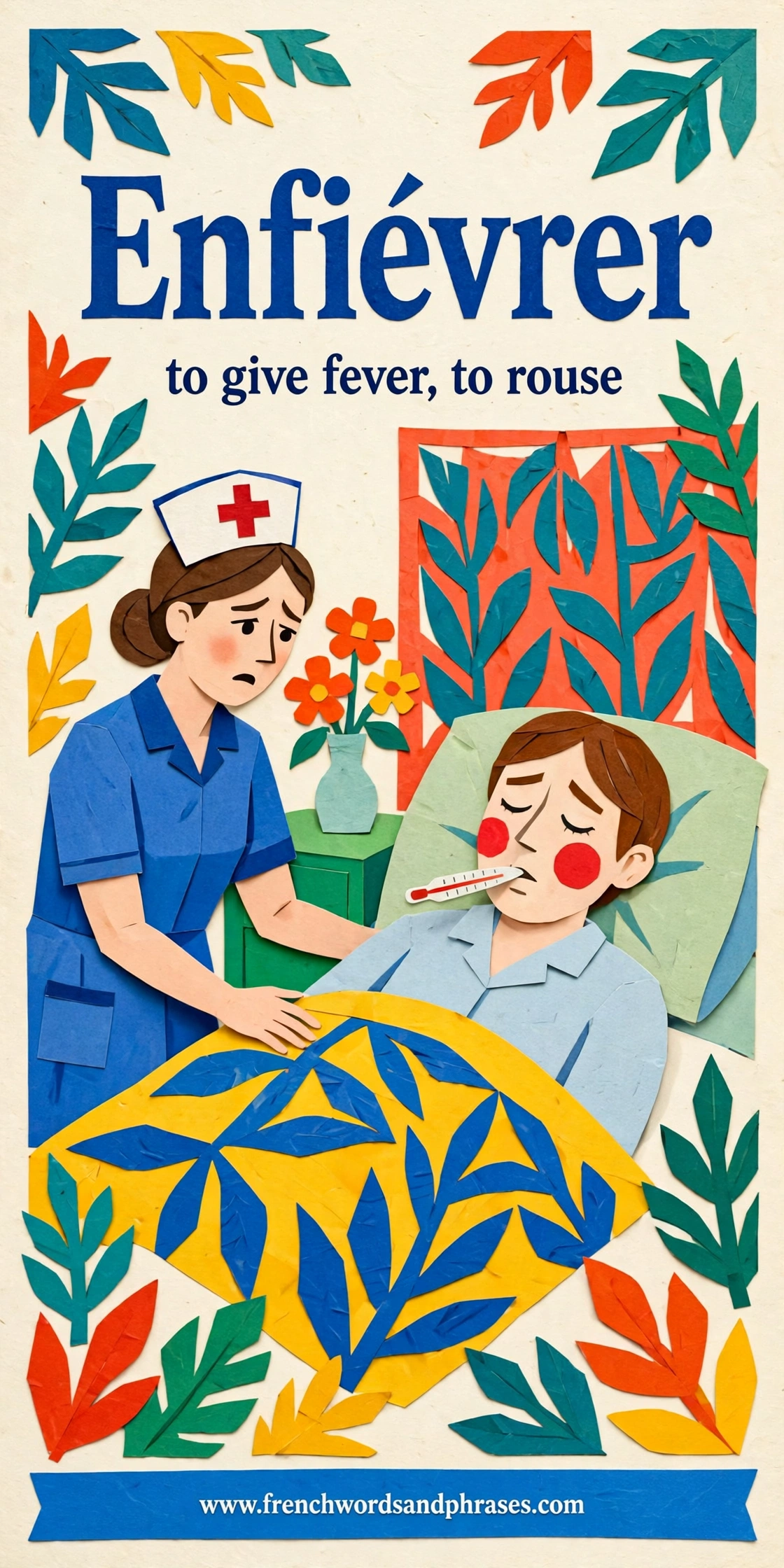
Enfiévrer means to give fever, to rouse — to heat a body with illness or a crowd with passion until everything burns a little.
A sick child glowing with heat, a stadium rising as one when the music starts — enfiévrer is the verb of rising temperature, in the blood and in the crowd: whatever it touches runs hotter.
In this guide, you’ll learn how to conjugate enfiévrer in all the major French tenses and moods. Explore complete conjugation tables, French examples, English translations, and practice quizzes.
Understanding the French Verb Enfiévrer
Enfiévrer is a regular French verb belonging to the first group of verbs, those ending in-er.
It means to give fever, to rouse. It works in both directions of heat: a virus or an infection enfièvre a patient, and a speech, a song or a match enfièvre a crowd. The figurative use is now the commoner one — enfiévrer les esprits, enfiévrer une salle — wherever excitement rises like a temperature.
Verb classification: First group (-er)
Auxiliary verb: Avoir
Past participle: enfiévré
Present participle: enfiévrant
English equivalents: To give fever to, to make feverish, to rouse, to fire up; enfiévrer un malade — to give a patient fever; enfiévrer les esprits — to inflame minds; enfiévrer la foule — to fire up the crowd; une salle enfiévrée — a feverish, excited hall.
One important detail: enfiévrer is an espérer-type verb — the é of the stem opens to è in the present singular and third plural, in the subjunctive singular and third plural, and in the tu imperative: j’enfièvre, tu enfièvres, il enfièvre, ils enfièvrent. But watch the future and conditional: there the é stays — j’enfiévrerai, j’enfiévrerais, never with è. The é also survives wherever the ending is sounded: nous enfiévrons, vous enfiévrez, j’enfiévrais, and in the infinitive and participle, enfiévrer, enfiévré.
Experience the Word
Enfiévrer is the verb of the thermometer and the stadium alike — it measures every kind of rising heat.
Imagine a summer festival at midnight. The band strikes the first chord of the song everyone has been waiting for, and the whole square rises — chantant, dansant, enfiévrée — as if the music had quite literally given ten thousand people a fever.
Nobody is ill. The crowd has been roused — enfiévrée, deliciously, by nothing but rhythm and joy.
How to Conjugate Enfiévrer: Complete French Conjugation Guide
Let’s explore every major conjugation of enfiévrer, beginning with the indicative mood.
How to Conjugate Enfiévrer in the Indicative Mood
The indicative mood is used to express facts, observations, actions, and events.
How to Conjugate Enfiévrer in the Present Tense (Présent)
Used for actions happening now, habitual actions, and general truths.
| Subject | Conjugation |
|---|---|
| je | enfièvre |
| tu | enfièvres |
| il / elle | enfièvre |
| nous | enfiévrons |
| vous | enfiévrez |
| ils / elles | enfièvrent |
Example
Cette musique enfièvre la foule dès les premières notes.
This music fires up the crowd from the very first notes.
Quick Quiz 1
Complete the sentence:
Nous ______ la foule avec nos chants.
Reveal the answer
enfiévrons
Nous enfiévrons la foule avec nos chants.
We fire up the crowd with our songs.
How to Conjugate Enfiévrer in the Passé Composé
Used for completed actions in the past. Enfiévrer takes the auxiliary verb avoir.
| Subject | Conjugation |
|---|---|
| j’ | ai enfiévré |
| tu | as enfiévré |
| il / elle | a enfiévré |
| nous | avons enfiévré |
| vous | avez enfiévré |
| ils / elles | ont enfiévré |
Example
L’infection a enfiévré le malade pendant deux jours.
The infection gave the patient a fever for two days.
How to Conjugate Enfiévrer in the Imparfait (Imperfect Tense)
Used for habitual past actions, descriptions, and ongoing situations in the past.
| Subject | Conjugation |
|---|---|
| je | enfiévrais |
| tu | enfiévrais |
| il / elle | enfiévrait |
| nous | enfiévrions |
| vous | enfiévriez |
| ils / elles | enfiévraient |
Example
Ses discours enfiévraient les jeunes gens du quartier.
His speeches used to rouse the young people of the neighbourhood.
Quick Quiz 2
Choose the correct form:
The infection gave the patient a fever.
L’infection ______ le malade. (a enfiévré / est enfiévré)
Reveal the answer
a enfiévré
L’infection a enfiévré le malade.
Enfiévrer takes avoir.
How to Conjugate Enfiévrer in the Plus-que-parfait
Used to describe an action that had already been completed before another past event.
| Subject | Conjugation |
|---|---|
| j’ | avais enfiévré |
| tu | avais enfiévré |
| il / elle | avait enfiévré |
| nous | avions enfiévré |
| vous | aviez enfiévré |
| ils / elles | avaient enfiévré |
Example
La chaleur avait enfiévré les esprits avant même le match.
The heat had inflamed minds even before the match.
How to Conjugate Enfiévrer in the Passé Simple
Primarily used in formal writing, literature, and historical narratives. It is rarely used in everyday conversation.
| Subject | Conjugation |
|---|---|
| je | enfiévrai |
| tu | enfiévras |
| il / elle | enfiévra |
| nous | enfiévrâmes |
| vous | enfiévrâtes |
| ils / elles | enfiévrèrent |
Example
Le chant des supporters enfiévra tout le stade.
The supporters’ singing fired up the whole stadium.
How to Conjugate Enfiévrer in the Passé Antérieur
A literary tense used to express an action completed immediately before another past action, generally in the passé simple.
| Subject | Conjugation |
|---|---|
| j’ | eus enfiévré |
| tu | eus enfiévré |
| il / elle | eut enfiévré |
| nous | eûmes enfiévré |
| vous | eûtes enfiévré |
| ils / elles | eurent enfiévré |
Example
Quand le virus eut enfiévré l’enfant, on appela le médecin.
When the virus had given the child a fever, they called the doctor.
How to Conjugate Enfiévrer in the Future Tense (Futur Simple)
Used to describe actions that will take place in the future.
| Subject | Conjugation |
|---|---|
| je | enfiévrerai |
| tu | enfiévreras |
| il / elle | enfiévrera |
| nous | enfiévrerons |
| vous | enfiévrerez |
| ils / elles | enfiévreront |
Example
Ce discours enfiévrera les esprits, j’en suis sûr.
This speech will inflame minds, I am sure of it.
How to Conjugate Enfiévrer in the Futur Antérieur (Future Perfect)
Used for an action that will have been completed before a particular point in the future.
| Subject | Conjugation |
|---|---|
| j’ | aurai enfiévré |
| tu | auras enfiévré |
| il / elle | aura enfiévré |
| nous | aurons enfiévré |
| vous | aurez enfiévré |
| ils / elles | auront enfiévré |
Example
À minuit, la fête aura enfiévré tout le village.
By midnight, the party will have fired up the whole village.
How to Conjugate Enfiévrer in the Near Future (Futur Proche)
Used to describe something that is going to happen soon. Formed with aller + infinitive.
| Subject | Conjugation |
|---|---|
| je | vais enfiévrer |
| tu | vas enfiévrer |
| il / elle | va enfiévrer |
| nous | allons enfiévrer |
| vous | allez enfiévrer |
| ils / elles | vont enfiévrer |
Example
Ce rythme va enfiévrer la salle entière.
This rhythm is going to fire up the whole hall.
How to Conjugate Enfiévrer in the Conditional Mood
The conditional mood expresses what would happen under certain circumstances. It is also frequently used to make polite requests or express wishes.
How to Conjugate Enfiévrer in the Present Conditional
| Subject | Conjugation |
|---|---|
| je | enfiévrerais |
| tu | enfiévrerais |
| il / elle | enfiévrerait |
| nous | enfiévrerions |
| vous | enfiévreriez |
| ils / elles | enfiévreraient |
Example
Un bon chanteur enfiévrerait le public en cinq minutes.
A good singer would fire up the audience in five minutes.
How to Conjugate Enfiévrer in the Past Conditional
| Subject | Conjugation |
|---|---|
| j’ | aurais enfiévré |
| tu | aurais enfiévré |
| il / elle | aurait enfiévré |
| nous | aurions enfiévré |
| vous | auriez enfiévré |
| ils / elles | auraient enfiévré |
Example
Son discours aurait enfiévré la foule avec un peu plus de passion.
His speech would have roused the crowd with a little more passion.
Enfiévrer in the Literary Past Conditional Form
This less common literary form uses the imperfect subjunctive of avoir.
| Subject | Conjugation |
|---|---|
| j’ | eusse enfiévré |
| tu | eusses enfiévré |
| il / elle | eût enfiévré |
| nous | eussions enfiévré |
| vous | eussiez enfiévré |
| ils / elles | eussent enfiévré |
Example
La musique eût enfiévré la salle entière.
The music would have fired up the whole hall.
How to Conjugate Enfiévrer in the Subjunctive Mood
The subjunctive is used to express wishes, emotions, doubts, necessity, and uncertainty. It frequently follows expressions such as il faut que (it is necessary that) or bien que (although).
How to Conjugate Enfiévrer in the Present Subjunctive
| Subject | Conjugation |
|---|---|
| que je | enfièvre |
| que tu | enfièvres |
| qu’il / qu’elle | enfièvre |
| que nous | enfiévrions |
| que vous | enfiévriez |
| qu’ils / qu’elles | enfièvrent |
Example
Il faut que ce rythme enfièvre la salle dès le début.
This rhythm must fire up the hall right from the start.
Quick Quiz 3
Complete the sentence using the subjunctive:
Il faut que vous ______ les esprits, pas les corps.
Reveal the answer
enfiévriez
Il faut que vous enfiévriez les esprits, pas les corps.
You must inflame minds, not bodies.
How to Conjugate Enfiévrer in the Imperfect Subjunctive
A literary tense, rarely encountered in modern spoken French.
| Subject | Conjugation |
|---|---|
| que je | enfiévrasse |
| que tu | enfiévrasses |
| qu’il / qu’elle | enfiévrât |
| que nous | enfiévrassions |
| que vous | enfiévrassiez |
| qu’ils / qu’elles | enfiévrassent |
Example
On espérait que le chanteur enfiévrât le public.
People hoped the singer would fire up the audience.
How to Conjugate Enfiévrer in the Pluperfect Subjunctive
A literary construction used to express an action completed before another past action.
| Subject | Conjugation |
|---|---|
| que j’ | eusse enfiévré |
| que tu | eusses enfiévré |
| qu’il / qu’elle | eût enfiévré |
| que nous | eussions enfiévré |
| que vous | eussiez enfiévré |
| qu’ils / qu’elles | eussent enfiévré |
Example
On racontait que son discours eût enfiévré toute la ville.
People said his speech had inflamed the whole town.
How to Conjugate Enfiévrer in the Past Subjunctive
| Subject | Conjugation |
|---|---|
| que j’ | aie enfiévré |
| que tu | aies enfiévré |
| qu’il / qu’elle | ait enfiévré |
| que nous | ayons enfiévré |
| que vous | ayez enfiévré |
| qu’ils / qu’elles | aient enfiévré |
Example
Je suis content que la fête ait enfiévré tout le village.
I am glad the party fired up the whole village.
How to Conjugate Enfiévrer in the Imperative
The imperative is used to give commands, instructions, invitations, or suggestions. Subject pronouns are omitted.
How to Conjugate Enfiévrer in the Present Imperative
| Person | Conjugation |
|---|---|
| (tu) | enfièvre |
| (nous) | enfiévrons |
| (vous) | enfiévrez |
Example
Enfièvre la foule avec ton discours !
Fire up the crowd with your speech!
Quick Quiz 4
How would you say Fire up the crowd (tu form)?
Reveal the answer
Enfièvre la foule !
French Participles of Enfiévrer
Participles are verb forms that can be used in compound tenses and other grammatical constructions.
Present Participle of Enfiévrer
enfiévrant
En enfiévrant les esprits, l’orateur risquait l’émeute.
By inflaming minds, the speaker was risking a riot.
Past Participle of Enfiévrer
enfiévré
Enfiévrée par la musique, la foule dansait sans relâche.
Fired up by the music, the crowd danced without stopping.
Enfiévrer in Everyday French: Real-Life Examples
Now that you know the conjugations, let’s see how enfiévrer appears in everyday French.
Example 1 — Present
Cette musique enfièvre la foule.
This music fires up the crowd.
Example 2 — Passé composé
L’infection a enfiévré le malade.
The infection gave the patient a fever.
Example 3 — Imparfait
Ses discours enfiévraient les jeunes.
His speeches used to rouse the young people.
Example 4 — Future
Ce chant enfiévrera tout le stade.
This song will fire up the whole stadium.
Example 5 — Conditional
Un bon orateur enfiévrerait la salle.
A good speaker would fire up the hall.
Example 6 — Imperative
Enfièvre la foule !
Fire up the crowd!
Beyond Translation: The Meaning of Enfiévrer
English fever is the noun; French enfiévrer turns it into an action — la fièvre is the fever, and enfiévrer is to hand it to someone.
A crowd can catch it like a patient.
That is the verb’s whole charm: illness and enthusiasm obey the same grammar, and an esprit enfiévré is simply a mind running a temperature — for better or for worse.
How to Remember the French Verb Enfiévrer
Remember it this way: Enfiévrer is about the thermometer and the stadium — every rising heat.
- Espérer-type spelling: j’enfièvre with è in the present, but je enfiévrerai with é in the future.
- Two heats, one verb: a virus enfièvre a patient; a song enfièvre a crowd.
- Past participle enfiévré: la foule enfiévrée, les esprits enfiévrés.
The key idea is the thermometer and the stadium — every rising heat.
Test Your Knowledge of Enfiévrer
Let’s see how much you’ve learned. Try answering these questions before revealing the answers.
Question 1
Why does je enfièvre have a grave accent but je enfiévrerai an acute one?
Reveal the answer
The espérer-type rule — é becomes è in the present and subjunctive stems, but the future and conditional keep é: je enfiévrerai.
Question 2
How do you say This music fires up the crowd in French?
Reveal the answer
Cette musique enfièvre la foule.
Question 3
Translate: The infection gave the patient a fever.
Reveal the answer
L’infection a enfiévré le malade.
Question 4
What is the past participle of enfiévrer?
Reveal the answer
Enfiévré.
Question 5
Complete the sentence:
Il faut que ce rythme ______ la salle dès le début.
Reveal the answer
enfièvre
Il faut que ce rythme enfièvre la salle dès le début.
This rhythm must fire up the hall right from the start.
Your Final Challenge
Can You Use It?
How would you say this in French?
The music fires up the whole square, and the village dances as if it had a fever of happiness.
Reveal the answer
La musique enfièvre la place entière, et le village danse comme s’il avait la fièvre du bonheur.
The music fires up the whole square, and the village dances as if it had a fever of happiness.
A little French. A little curiosity. A richer everyday life.
LEARN FRENCH ONE WORD AT A TIME