A French Word to Live By
Translate Bol to English
/bɔl/
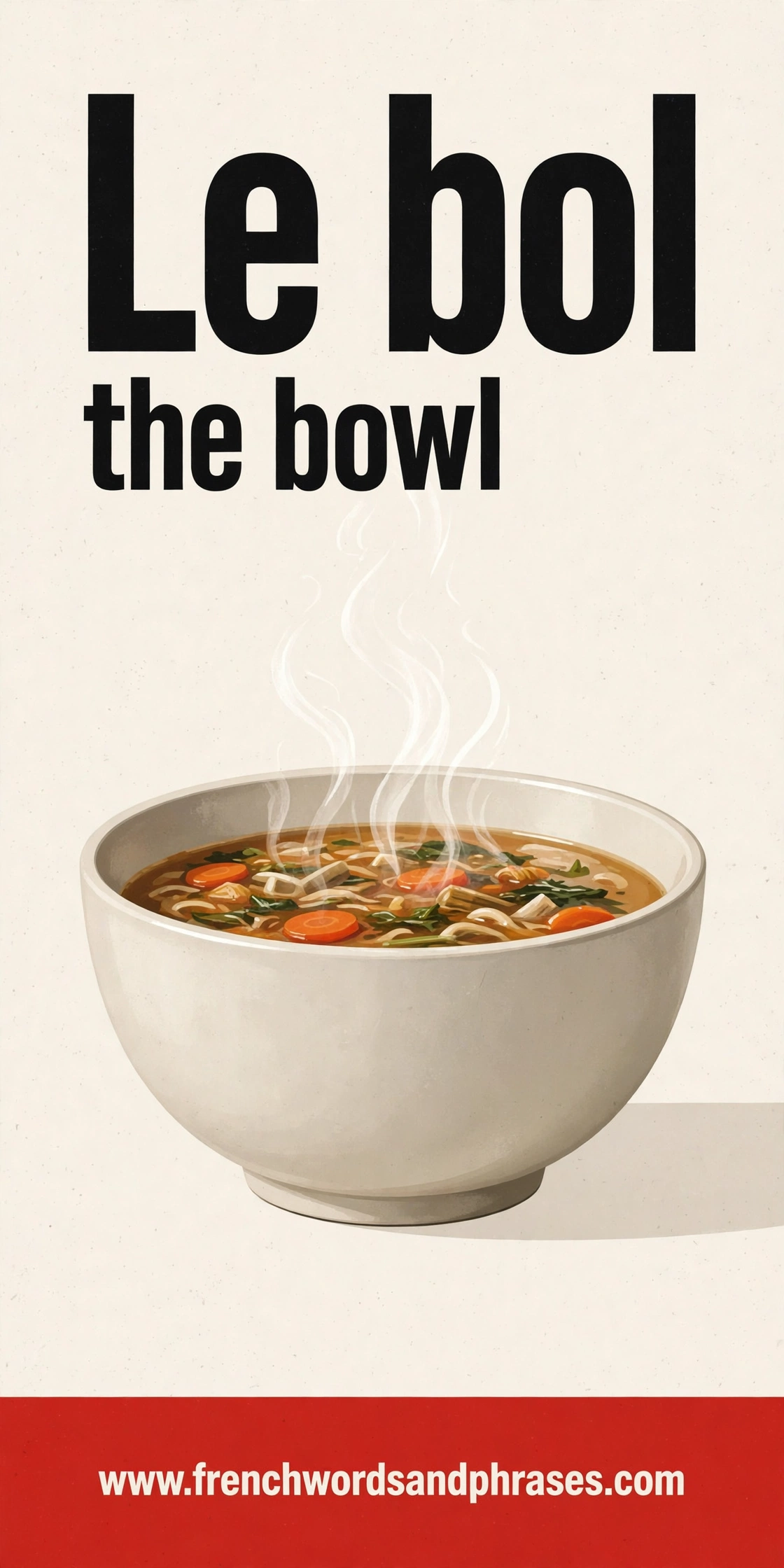
Le bol means the bowl.
Breakfast in a French farmhouse: no mug, no glass, but a wide bowl of café au lait with both hands wrapped around it — le bol, the bowl, the morning’s embrace.
In this guide, you’ll learn what bol means in English, how to use it with its articles, how to form its plural, and how it appears in everyday French. Explore French examples, English translations, and practice quizzes.
Understanding the French Noun Bol
Bol is a masculine French noun, learned with its article: le bol, un bol. It is the deep, round bowl without handles — for soup, for cereal, and for the famous breakfast café au lait into which generations of French children have dunked their tartines.
It means the bowl — and, like the tasse, its contents too: un bol de soupe is a bowl of soup. The bol is deeper than une assiette, the plate, and humbler than un saladier, the big salad bowl. And when the bol fills to the brim, French has a phrase for the feeling — see the note below.
Gender: Masculine — le bol
Definite article: le — le bol (the bowl)
Indefinite article: un — un bol (a bowl)
Plural: les bols
Double sense: The bowl and its contents: un bol de soupe
Famous idiom: en avoir ras le bol — to be fed up
English equivalents: The bowl.
Two phrases make bol unforgettable. A breath of fresh air is un bol d’air frais. And when you have had absolutely enough, French fills the bowl to the brim: j’en ai ras le bol ! — I’m fed up! The image is a bowl so full that one more spoonful would spill over the edge.
Experience the Word
Bol is the bowl of beginnings: the first coffee of the day, the soup that cures a cold, the rice that accompanies everything.
Imagine a crêperie in Brittany, where even the cider arrives not in a glass but in a bol — some bowls are for drinking from, and Brittany never forgot it.
You have not just eaten soup. You have held the day in both hands — un bol, warm and generous.
How to Use Bol in French: Complete Guide
Let’s explore how bol works in French, beginning with its articles — le bol, un bol, des bols.
Bol with the Definite Article (Le, Les)
Used for a specific bowl — the one on the table, the one with your name on it.
| Form | French |
|---|---|
| Masculine singular | le bol |
| Plural | les bols |
Example
Le bol est trop chaud, attends un peu.
The bowl is too hot, wait a little.
Bol with the Indefinite Article (Un, Des)
Used for a bowl in general — a bowl of something good.
| Form | French |
|---|---|
| Masculine singular | un bol |
| Plural | des bols |
Example
Elle verse la soupe dans un grand bol.
She pours the soup into a large bowl.
Bol with the Partitive and Quantities (Un bol de…)
Bowls are measured by what fills them — soup, rice, and even fresh air.
| Quantity | French |
|---|---|
| a bowl of soup | un bol de soupe |
| a bowl of rice | un bol de riz |
| a bowl of fresh air | un bol d’air frais |
| a full bowl | un bol plein |
| half a bowl | un demi-bol |
Example
Après la promenade, rien de tel qu’un bol de soupe chaude.
After the walk, nothing like a bowl of hot soup.
Quick Quiz 1
Complete the sentence:
Elle verse la soupe dans ______ bol. (the)
Reveal the answer
le
Elle verse la soupe dans le bol.
She pours the soup into the bowl — bol is masculine, so le.
The Plural of Bol
Bol adds an -s in the plural — les bols, stacked in every French kitchen cupboard.
| Number | French |
|---|---|
| Singular | le bol |
| Plural | les bols |
Example
Il empile les bols propres dans le placard.
He stacks the clean bowls in the cupboard.
Bol with Possessive Adjectives (Mon, Ton, Son…)
Possessives agree with the noun: bol is masculine, so mon, ton, son in the singular.
| Owner | French |
|---|---|
| my | mon bol |
| your (tu) | ton bol |
| his / her | son bol |
| our | notre bol |
| your (vous) | votre bol |
| their | leur bol |
Example
Mon bol préféré est celui avec les rayures bleues.
My favourite bowl is the one with the blue stripes.
Quick Quiz 2
Complete the sentence:
Passe-moi ______ bol, s’il te plaît. (my)
Reveal the answer
mon
Passe-moi mon bol, s’il te plaît.
Pass me my bowl, please.
Bol with Demonstrative Adjectives (Ce, Ces)
Used to point: ce bol, this bowl.
| Form | French |
|---|---|
| Masculine singular | ce bol |
| Plural | ces bols |
Example
Ce bol est pour la soupe, pas pour les céréales.
This bowl is for soup, not for cereal.
Bol with Adjectives
Adjectives agree with bol — masculine singular: un grand bol, un bol profond.
| Adjective | With Bol |
|---|---|
| grand (big) | un grand bol |
| profond (deep) | un bol profond |
| plein (full) | un bol plein |
| vide (empty) | un bol vide |
| en céramique (ceramic) | un bol en céramique |
Example
Un bol profond garde la soupe chaude plus longtemps.
A deep bowl keeps the soup hot for longer.
Quick Quiz 3
Complete the sentence:
Sers la soupe dans un bol ______. (deep)
Reveal the answer
profond
Sers la soupe dans un bol profond.
Serve the soup in a deep bowl.
Everyday Expressions with Bol
Fresh air and full brims — the bol phrases of daily life.
| Expression | In English |
|---|---|
| un bol de soupe | a bowl of soup |
| un bol d’air frais | a breath of fresh air |
| en avoir ras le bol | to be fed up |
| un bol de café au lait | a bowl of milky coffee |
| le bol tibétain | a Tibetan singing bowl |
Example
Après cette semaine difficile, j’en ai ras le bol.
After this difficult week, I’ve had enough — I’m fed up.
Words from the Same Family as Bol
Tureens, soup plates and the soup itself — the words that travel with bol.
| French | In English |
|---|---|
| le saladier | the salad bowl, the mixing bowl |
| la soupière | the soup tureen |
| l’assiette creuse | the soup plate |
| la soupe | the soup |
| la cuillère | the spoon |
Example
La soupière arrive au centre de la table, fumante.
The tureen arrives in the middle of the table, steaming.
Quick Quiz 4
What does j’en ai ras le bol mean?
Reveal the answer
I’m fed up — I’ve had it up to here, like a bowl filled to the very brim.
Il y a trop de bruit, j’en ai ras le bol !
There is too much noise, I’m fed up!
Bol in Everyday French: Real-Life Examples
Now that you know the word, let’s see how bol appears in everyday French.
Example 1 — Breakfast
Les enfants boivent leur chocolat dans un bol.
The children drink their hot chocolate from a bowl.
Example 2 — Soup
Un bol de soupe et un morceau de pain, merci.
A bowl of soup and a piece of bread, please.
Example 3 — Fresh air
Ouvre la fenêtre, j’ai besoin d’un bol d’air frais.
Open the window, I need a breath of fresh air.
Example 4 — Fed up
J’en ai ras le bol de ce bruit !
I’m fed up with this noise!
Example 5 — In the kitchen
Mélange la farine et les œufs dans un grand bol.
Mix the flour and the eggs in a large bowl.
Example 6 — Names on bowls
Chaque enfant a un bol avec son prénom.
Each child has a bowl with their name on it.
Beyond Translation: The Meaning of Bol
The bol is a piece of French childhood: generations have started the day with a bol of café au lait or hot chocolate, their name painted on the side, dunking buttered tartines until the bowl is empty. Brittany drinks its cider from bols, a habit older than the wine glass in those parts. And the language trusts the bol with its feelings — joy is un bol d’air frais, and despair is ras le bol, the brim reached.
To say bol is to measure the day in warmth — and to know exactly when the bowl is full.
It evokes the farmhouse breakfast and the steaming soup, the full bowl and the final straw.
How to Remember the French Noun Bol
Remember it this way: Bol is the bowl — masculine, deep and handle-less: le bol, un bol de soupe.
- The breakfast bowl — le bol of café au lait, with your name painted on it.
- The fresh air — un bol d’air frais, a breath of fresh air.
- The full brim — ras le bol, fed up to overflowing.
The key idea is le bol — the bowl, and ras le bol means fed up.
Test Your Knowledge of Bol
Let’s see how much you’ve learned. Try answering these questions before revealing the answers.
Question 1
Is bol masculine or feminine?
Reveal the answer
Masculine — le bol, un bol.
Question 2
What is un bol d’air frais?
Reveal the answer
A breath of fresh air.
Question 3
Translate: She pours the soup into a bowl.
Reveal the answer
Elle verse la soupe dans un bol.
Question 4
What does « j’en ai ras le bol » mean?
Reveal the answer
I’m fed up — literally, my bowl is full to the brim.
Question 5
Complete the sentence:
Les enfants boivent leur chocolat dans ______ bol. (a)
Reveal the answer
un
Les enfants boivent leur chocolat dans un bol.
The children drink their hot chocolate from a bowl.
Your Final Challenge
Can You Use It?
How would you say this in French?
“She eats a bowl of soup at lunch.”
Reveal the answer
Elle mange un bol de soupe au déjeuner.
She eats a bowl of soup at lunch.
A little French. A little curiosity. A richer everyday life.
LEARN FRENCH ONE WORD AT A TIME