How to Conjugate Relativiser in French
/ʁə.la.ti.vi.ze/
Relativiser means to put into perspective — to set a worry, a failure or a triumph back among the facts of a whole life until it finds its true size.
A failed exam at twenty that feels like the end of the world, a scratched car, a rude email at midnight — relativiser is the verb of stepping back: the problem does not change, but the frame widens until the problem shrinks to its real proportions.
In this guide, you’ll learn how to conjugate relativiser in all the major French tenses and moods. Explore complete conjugation tables, French examples, English translations, and practice quizzes.
Understanding the French Verb Relativiser
Relativiser is a regular French verb belonging to the first group of verbs, those ending in -er.
It means to put into perspective. It is the verb of wise friends, good managers and sports coaches after a defeat: relativiser un échec, relativiser une défaite, relativiser les risques. It never denies the problem — it resizes it, which is why psychologists and philosophers both claim the word.
Verb classification: First group (-er)
Auxiliary verb: Avoir
Past participle: relativisé
Present participle: relativisant
English equivalents: To put into perspective, to put in context, to keep in proportion; relativiser un échec — to put a failure into perspective; relativiser l’importance de quelque chose — to put the importance of something in perspective; savoir relativiser — to keep things in proportion; tout est relatif — everything is relative.
One important detail: relativiser is perfectly regular — je relativise, nous relativisons, past participle relativisé — and its grammar is the least of its lessons. The usage to fix is the reflex phrase savoir relativiser, to know how to keep things in proportion, the compliment French pays to calm people; and its commonest frame, il faut relativiser — come on, put it in perspective — the gentlest possible way to tell someone their catastrophe is small.
Experience the Word
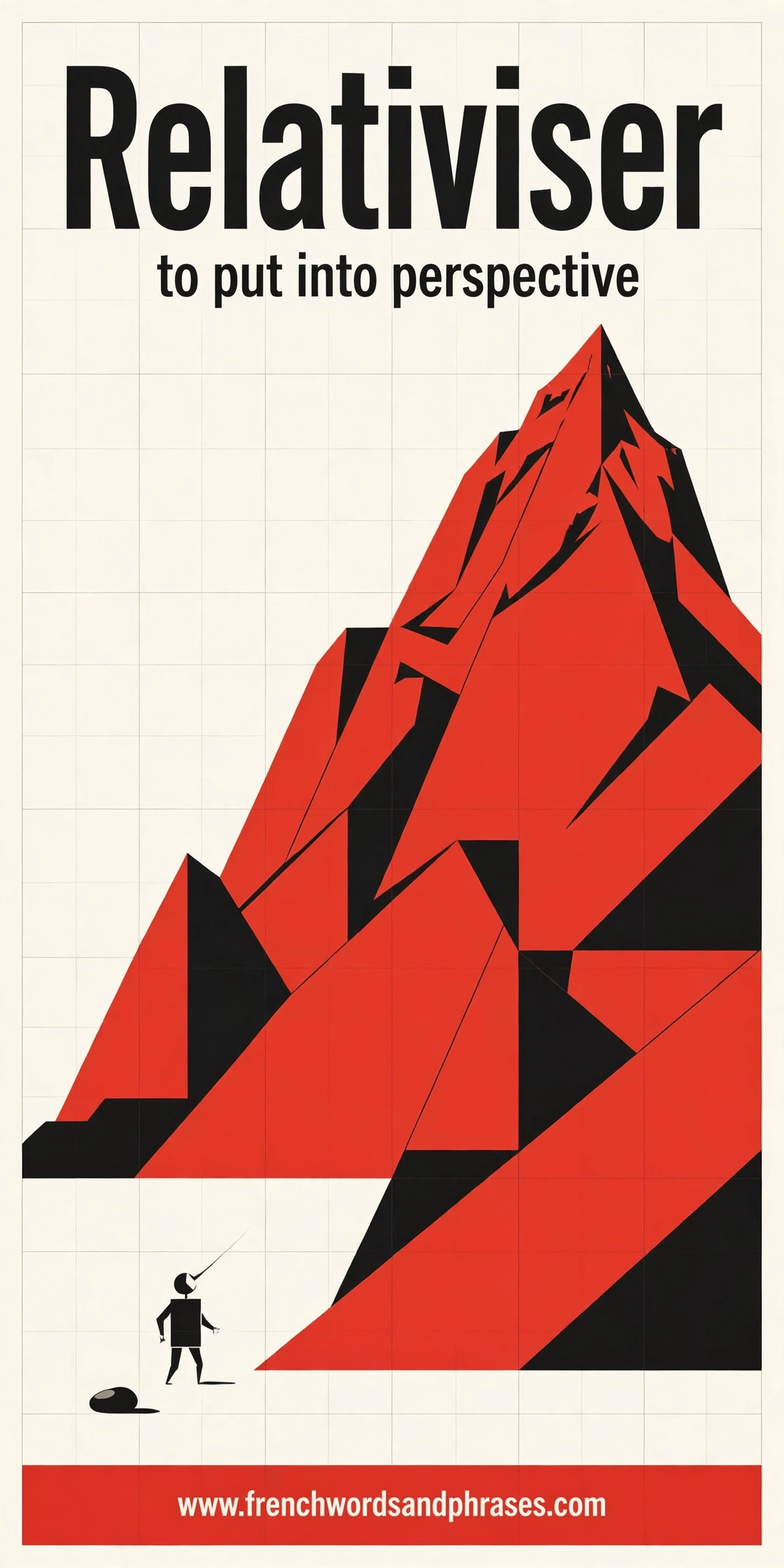
Relativiser is the verb of the wide shot — zoom out, and the mountain becomes a hill again.
Imagine a student in tears over a failed exam, certain her future is finished. Her grandmother pours tea and tells of the war, of starting again with one suitcase at her age — la grand-mère relativise, and by the second cup the exam is what it always was: one bad morning, not a verdict on a life.
The failure has not moved. It has been put into perspective — relativisé — and it fits in a teacup now.
How to Conjugate Relativiser: Complete French Conjugation Guide
Let’s explore every major conjugation of relativiser, beginning with the indicative mood.
How to Conjugate Relativiser in the Indicative Mood
The indicative mood is used to express facts, observations, actions, and events.
How to Conjugate Relativiser in the Present Tense (Présent)
Used for actions happening now, habitual actions, and general truths.
| Subject | Conjugation |
|---|---|
| je | relativise |
| tu | relativises |
| il / elle | relativise |
| nous | relativisons |
| vous | relativisez |
| ils / elles | relativisent |
Avec l’âge, on relativise les petits ennuis.
With age, one puts little troubles into perspective.
Complete the sentence:
Nous ______ les petits ennuis de la vie quotidienne.
Reveal the answer
relativisons
Nous relativisons les petits ennuis de la vie quotidienne.
We put the little troubles of daily life into perspective.
How to Conjugate Relativiser in the Passé Composé
Used for completed actions in the past. Relativiser takes the auxiliary verb avoir.
| Subject | Conjugation |
|---|---|
| j’ | ai relativisé |
| tu | as relativisé |
| il / elle | a relativisé |
| nous | avons relativisé |
| vous | avez relativisé |
| ils / elles | ont relativisé |
Elle a relativisé son échec après quelques mois.
She put her failure into perspective after a few months.
How to Conjugate Relativiser in the Imparfait (Imperfect Tense)
Used for habitual past actions, descriptions, and ongoing situations in the past.
| Subject | Conjugation |
|---|---|
| je | relativisais |
| tu | relativisais |
| il / elle | relativisait |
| nous | relativisions |
| vous | relativisiez |
| ils / elles | relativisaient |
Il relativisait tout, même les mauvaises nouvelles.
He put everything into perspective, even bad news.
Choose the correct form:
She put her failure into perspective.
Elle ______ son échec. (a relativisé / est relativisée)
Reveal the answer
a relativisé
Elle a relativisé son échec.
Relativiser takes avoir.
How to Conjugate Relativiser in the Plus-que-parfait
Used to describe an action that had already been completed before another past event.
| Subject | Conjugation |
|---|---|
| j’ | avais relativisé |
| tu | avais relativisé |
| il / elle | avait relativisé |
| nous | avions relativisé |
| vous | aviez relativisé |
| ils / elles | avaient relativisé |
Nous avions relativisé la gravité de la panne.
We had put the seriousness of the breakdown into perspective.
How to Conjugate Relativiser in the Passé Simple
Primarily used in formal writing, literature, and historical narratives. It is rarely used in everyday conversation.
| Subject | Conjugation |
|---|---|
| je | relativisai |
| tu | relativisas |
| il / elle | relativisa |
| nous | relativisâmes |
| vous | relativisâtes |
| ils / elles | relativisèrent |
Le vieillard relativisa la perte en souriant.
The old man put the loss into perspective with a smile.
How to Conjugate Relativiser in the Passé Antérieur
A literary tense used to express an action completed immediately before another past action, generally in the passé simple.
| Subject | Conjugation |
|---|---|
| j’ | eus relativisé |
| tu | eus relativisé |
| il / elle | eut relativisé |
| nous | eûmes relativisé |
| vous | eûtes relativisé |
| ils / elles | eurent relativisé |
Quand elle eut relativisé l’incident, elle présenta ses excuses.
When she had put the incident into perspective, she apologised.
How to Conjugate Relativiser in the Future Tense (Futur Simple)
Used to describe actions that will take place in the future.
| Subject | Conjugation |
|---|---|
| je | relativiserai |
| tu | relativiseras |
| il / elle | relativisera |
| nous | relativiserons |
| vous | relativiserez |
| ils / elles | relativiseront |
Le temps relativisera cette dispute.
Time will put this quarrel into perspective.
How to Conjugate Relativiser in the Futur Antérieur (Future Perfect)
Used for an action that will have been completed before a particular point in the future.
| Subject | Conjugation |
|---|---|
| j’ | aurai relativisé |
| tu | auras relativisé |
| il / elle | aura relativisé |
| nous | aurons relativisé |
| vous | aurez relativisé |
| ils / elles | auront relativisé |
À la retraite, tu auras relativisé bien des soucis.
By retirement, you will have put many worries into perspective.
How to Conjugate Relativiser in the Near Future (Futur Proche)
Used to describe something that is going to happen soon. Formed with aller + infinitive.
| Subject | Conjugation |
|---|---|
| je | vais relativiser |
| tu | vas relativiser |
| il / elle | va relativiser |
| nous | allons relativiser |
| vous | allez relativiser |
| ils / elles | vont relativiser |
Respire un grand coup, tu vas relativiser dans cinq minutes.
Take a deep breath, you will put it into perspective in five minutes.
How to Conjugate Relativiser in the Conditional Mood
The conditional mood expresses what would happen under certain circumstances. It is also frequently used to make polite requests or express wishes.
How to Conjugate Relativiser in the Present Conditional
| Subject | Conjugation |
|---|---|
| je | relativiserais |
| tu | relativiserais |
| il / elle | relativiserait |
| nous | relativiserions |
| vous | relativiseriez |
| ils / elles | relativiseraient |
Avec un peu de recul, tu relativiserais mieux la situation.
With a little distance, you would put the situation into better perspective.
How to Conjugate Relativiser in the Past Conditional
| Subject | Conjugation |
|---|---|
| j’ | aurais relativisé |
| tu | aurais relativisé |
| il / elle | aurait relativisé |
| nous | aurions relativisé |
| vous | auriez relativisé |
| ils / elles | auraient relativisé |
Il aurait relativisé s’il avait connu la suite.
He would have kept it in proportion if he had known what came next.
Relativiser in the Literary Past Conditional Form
This less common literary form uses the imperfect subjunctive of avoir.
| Subject | Conjugation |
|---|---|
| j’ | eusse relativisé |
| tu | eusses relativisé |
| il / elle | eût relativisé |
| nous | eussions relativisé |
| vous | eussiez relativisé |
| ils / elles | eussent relativisé |
Le philosophe eût relativisé toutes nos certitudes.
The philosopher would have put all our certainties into perspective.
How to Conjugate Relativiser in the Subjunctive Mood
The subjunctive is used to express wishes, emotions, doubts, necessity, and uncertainty. It frequently follows expressions such as il faut que (it is necessary that) or bien que (although).
How to Conjugate Relativiser in the Present Subjunctive
| Subject | Conjugation |
|---|---|
| que je | relativise |
| que tu | relativises |
| qu’il / qu’elle | relativise |
| que nous | relativisions |
| que vous | relativisiez |
| qu’ils / qu’elles | relativisent |
Il est bon que tu relativises cet échec.
It is good that you are putting this failure into perspective.
Complete the sentence using the subjunctive:
Il est bon que vous ______ ce problème.
Reveal the answer
relativisiez
Il est bon que vous relativisiez ce problème.
It is good that you are putting this problem into perspective.
How to Conjugate Relativiser in the Imperfect Subjunctive
A literary tense, rarely encountered in modern spoken French.
| Subject | Conjugation |
|---|---|
| que je | relativisasse |
| que tu | relativisasses |
| qu’il / qu’elle | relativisât |
| que nous | relativisassions |
| que vous | relativisassiez |
| qu’ils / qu’elles | relativisassent |
Je voulais qu’il relativisât ses craintes.
I wanted him to put his fears into perspective.
How to Conjugate Relativiser in the Pluperfect Subjunctive
A literary construction used to express an action completed before another past action.
| Subject | Conjugation |
|---|---|
| que j’ | eusse relativisé |
| que tu | eusses relativisé |
| qu’il / qu’elle | eût relativisé |
| que nous | eussions relativisé |
| que vous | eussiez relativisé |
| qu’ils / qu’elles | eussent relativisé |
On admirait qu’elle eût relativisé tant de drames.
People admired that she had put so many dramas into perspective.
How to Conjugate Relativiser in the Past Subjunctive
| Subject | Conjugation |
|---|---|
| que j’ | aie relativisé |
| que tu | aies relativisé |
| qu’il / qu’elle | ait relativisé |
| que nous | ayons relativisé |
| que vous | ayez relativisé |
| qu’ils / qu’elles | aient relativisé |
Je suis content que vous ayez relativisé le problème.
I am glad you put the problem into perspective.
How to Conjugate Relativiser in the Imperative
The imperative is used to give commands, instructions, invitations, or suggestions. Subject pronouns are omitted.
How to Conjugate Relativiser in the Present Imperative
| Person | Conjugation |
|---|---|
| (tu) | relativise |
| (nous) | relativisons |
| (vous) | relativisez |
Relativise un peu, ce n’est pas la fin du monde !
Put it into perspective, it is not the end of the world!
How would you say Put it into perspective (tu form)?
Reveal the answer
Relativise un peu !
French Participles of Relativiser
Participles are verb forms that can be used in compound tenses and other grammatical constructions.
Present Participle of Relativiser
relativisant
En relativisant ainsi, elle garde toujours son calme.
By keeping things in perspective like that, she always stays calm.
Past Participle of Relativiser
relativisé
Relativisée par l’expérience, la défaite semblait légère.
Put into perspective by experience, the defeat seemed light.
Relativiser in Everyday French: Real-Life Examples
Now that you know the conjugations, let’s see how relativiser appears in everyday French.
Avec l’âge, on relativise les ennuis.
With age, one puts troubles into perspective.
Elle a relativisé son échec.
She put her failure into perspective.
Il relativisait toutes les mauvaises nouvelles.
He put all bad news into perspective.
Le temps relativisera cette dispute.
Time will put this quarrel into perspective.
Tu relativiserais mieux avec du recul.
You would put it into better perspective with some distance.
Relativise, ce n’est pas grave !
Put it into perspective, it is not serious!
Beyond Translation: The Meaning of Relativiser
English put into perspective needs four words where French uses one — relativiser is a whole philosophy compressed into a verb.
Behind it stands the national motto: tout est relatif.
Everything is relative. The French reach for relativiser the way others reach for a shrug: not to dismiss a problem, but to measure it honestly against health, time and the whole of a life — and find it, very often, smaller than it felt at midnight.
How to Remember the French Verb Relativiser
Remember it this way: Relativiser is about the wide shot — zoom out until the mountain is a hill again.
- One verb for the whole English phrase: to put into perspective is relativiser.
- The compliment to learn: savoir relativiser — to know how to keep things in proportion.
- Regular -er: je relativise, nous relativisons, past participle relativisé.
The key idea is the wide shot — zoom out until the mountain is a hill again.
Test Your Knowledge of Relativiser
Let’s see how much you’ve learned. Try answering these questions before revealing the answers.
What does the compliment savoir relativiser mean?
Reveal the answer
To know how to keep things in proportion — the mark of a calm, wise person.
How do you say She put her failure into perspective in French?
Reveal the answer
Elle a relativisé son échec.
Translate: Time will put this quarrel into perspective.
Reveal the answer
Le temps relativisera cette dispute.
What is the past participle of relativiser?
Reveal the answer
Relativisé.
Complete the sentence:
Il est bon que tu ______ cet échec.
Reveal the answer
relativises
Il est bon que tu relativises cet échec.
It is good that you are putting this failure into perspective.
Can You Use It?
How would you say this in French?
Putting things into perspective does not erase the pain, it simply gives it back its true size.
Reveal the answer
Relativiser n’efface pas la douleur, il lui rend simplement sa taille véritable.
Putting things into perspective does not erase the pain, it simply gives it back its true size.
LEARN FRENCH ONE WORD AT A TIME