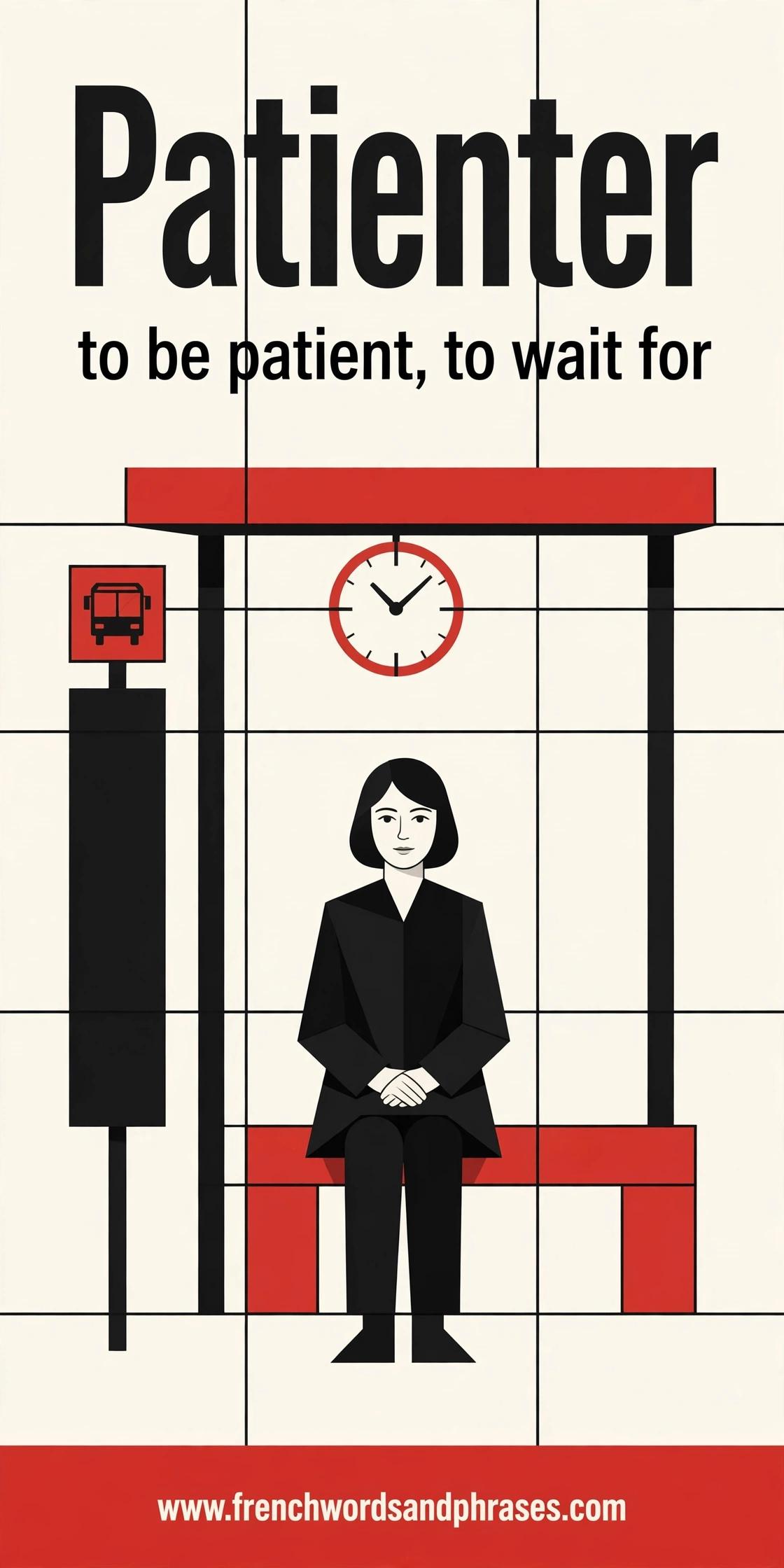
How to Conjugate Patienter in French
/pa.sjɑ̃.te/
Patienter means to be patient, to wait for — to hold on calmly until the moment, or the person, finally arrives.
A recorded voice in a station hall asks the whole platform to patienter; a nurse smiles at the queue in the waiting room; a child counts the days before his birthday. Patienter is the polite, official verb of waiting: not the waiting itself, but the patience inside it.
In this guide, you’ll learn how to conjugate patienter in all the major French tenses and moods. Explore complete conjugation tables, French examples, English translations, and practice quizzes.
Understanding the French Verb Patienter
Patienter is a regular French verb belonging to the first group of verbs, those ending in -er.
It means to be patient, to wait for. It is the word of announcements, reception desks and polite instructions — patienter is what institutions ask of you, where attendre is what you simply do. Between friends it can sound gently ironic: patiente, ça vient ! — hold on, it’s coming. The noun it leaves behind, la patience, is both the virtue and the card game.
Verb classification: First group (-er)
Auxiliary verb: Avoir
Past participle: patienté
Present participle: patientant
English equivalents: To be patient, to wait, to hold on; patienter un instant — to wait a moment; faire patienter quelqu’un — to keep someone waiting; veuillez patienter — please hold, please wait; patienter jusqu’à l’arrivée du train — to wait patiently until the train arrives.
One important detail: patienter is attendre with its temper kept. Attendre simply waits, and takes its object directly — j’attends le train; patienter waits patiently, and usually stands alone or with a time phrase: patientez un instant, nous patientons depuis une heure. To make someone else do it, French wraps it in faire: faire patienter quelqu’un, to keep someone waiting. The verb is a regular -er built on patient: je patiente, nous patientons, ils patientent, past participle patienté — and the announcement formula veuillez patienter is the one you will hear in every French station, surgery and call centre.
Experience the Word
Patienter is the verb of the well-behaved wait — time passing, temper intact.
Imagine a small station in the rain, the loudspeaker crackling: le train aura vingt minutes de retard, veuillez patienter. Nobody storms off; coats are buttoned, newspapers opened — tout le monde patiente, because the verb itself is a small lesson in how to wait.
They are not merely delayed. They are being patient — ils patientent — and the platform stays calm.
How to Conjugate Patienter: Complete French Conjugation Guide
Let’s explore every major conjugation of patienter, beginning with the indicative mood.
How to Conjugate Patienter in the Indicative Mood
The indicative mood is used to express facts, observations, actions, and events.
How to Conjugate Patienter in the Present Tense (Présent)
Used for actions happening now, habitual actions, and general truths.
| Subject | Conjugation |
|---|---|
| je | patiente |
| tu | patientes |
| il / elle | patiente |
| nous | patientons |
| vous | patientez |
| ils / elles | patientent |
Les voyageurs patientent sur le quai sous la pluie.
The travellers are waiting patiently on the platform in the rain.
Complete the sentence:
Nous ______ dans la salle d’attente.
Reveal the answer
patientons
Nous patientons dans la salle d’attente.
We are waiting patiently in the waiting room.
How to Conjugate Patienter in the Passé Composé
Used for completed actions in the past. Patienter takes the auxiliary verb avoir.
| Subject | Conjugation |
|---|---|
| j’ | ai patienté |
| tu | as patienté |
| il / elle | a patienté |
| nous | avons patienté |
| vous | avez patienté |
| ils / elles | ont patienté |
Nous avons patienté une heure dans la salle d’attente.
We waited patiently for an hour in the waiting room.
How to Conjugate Patienter in the Imparfait (Imperfect Tense)
Used for habitual past actions, descriptions, and ongoing situations in the past.
| Subject | Conjugation |
|---|---|
| je | patientais |
| tu | patientais |
| il / elle | patientait |
| nous | patientions |
| vous | patientiez |
| ils / elles | patientaient |
Elle patientait devant la porte du médecin sans se plaindre.
She used to wait patiently outside the doctor’s door without complaining.
Choose the correct form:
We waited patiently for an hour.
Nous ______ une heure. (avons patienté / sommes patientés)
Reveal the answer
avons patienté
Nous avons patienté une heure.
Patienter takes avoir.
How to Conjugate Patienter in the Plus-que-parfait
Used to describe an action that had already been completed before another past event.
| Subject | Conjugation |
|---|---|
| j’ | avais patienté |
| tu | avais patienté |
| il / elle | avait patienté |
| nous | avions patienté |
| vous | aviez patienté |
| ils / elles | avaient patienté |
Il avait patienté trois jours avant de recevoir la réponse.
He had waited patiently for three days before receiving the answer.
How to Conjugate Patienter in the Passé Simple
Primarily used in formal writing, literature, and historical narratives. It is rarely used in everyday conversation.
| Subject | Conjugation |
|---|---|
| je | patientai |
| tu | patientas |
| il / elle | patienta |
| nous | patientâmes |
| vous | patientâtes |
| ils / elles | patientèrent |
La foule patienta en silence devant les portes du théâtre.
The crowd waited patiently in silence before the theatre doors.
How to Conjugate Patienter in the Passé Antérieur
A literary tense used to express an action completed immediately before another past action, generally in the passé simple.
| Subject | Conjugation |
|---|---|
| j’ | eus patienté |
| tu | eus patienté |
| il / elle | eut patienté |
| nous | eûmes patienté |
| vous | eûtes patienté |
| ils / elles | eurent patienté |
Quand ils eurent patienté jusqu’au soir, la nouvelle arriva enfin.
When they had waited patiently until evening, the news finally arrived.
How to Conjugate Patienter in the Future Tense (Futur Simple)
Used to describe actions that will take place in the future.
| Subject | Conjugation |
|---|---|
| je | patienterai |
| tu | patienteras |
| il / elle | patientera |
| nous | patienterons |
| vous | patienterez |
| ils / elles | patienteront |
Vous patienterez quelques minutes, le docteur arrive.
You will wait a few minutes, the doctor is coming.
How to Conjugate Patienter in the Futur Antérieur (Future Perfect)
Used for an action that will have been completed before a particular point in the future.
| Subject | Conjugation |
|---|---|
| j’ | aurai patienté |
| tu | auras patienté |
| il / elle | aura patienté |
| nous | aurons patienté |
| vous | aurez patienté |
| ils / elles | auront patienté |
À midi, nous aurons patienté deux heures à la gare.
By noon, we will have waited patiently two hours at the station.
How to Conjugate Patienter in the Near Future (Futur Proche)
Used to describe something that is going to happen soon. Formed with aller + infinitive.
| Subject | Conjugation |
|---|---|
| je | vais patienter |
| tu | vas patienter |
| il / elle | va patienter |
| nous | allons patienter |
| vous | allez patienter |
| ils / elles | vont patienter |
Je vais patienter encore un peu, il ne va pas tarder.
I am going to wait a little longer, he won’t be long.
How to Conjugate Patienter in the Conditional Mood
The conditional mood expresses what would happen under certain circumstances. It is also frequently used to make polite requests or express wishes.
How to Conjugate Patienter in the Present Conditional
| Subject | Conjugation |
|---|---|
| je | patienterais |
| tu | patienterais |
| il / elle | patienterait |
| nous | patienterions |
| vous | patienteriez |
| ils / elles | patienteraient |
Avec un bon livre, je patienterais sans peine.
With a good book, I would wait patiently without difficulty.
How to Conjugate Patienter in the Past Conditional
| Subject | Conjugation |
|---|---|
| j’ | aurais patienté |
| tu | aurais patienté |
| il / elle | aurait patienté |
| nous | aurions patienté |
| vous | auriez patienté |
| ils / elles | auraient patienté |
Elle aurait patienté plus longtemps si on l’avait prévenue.
She would have waited longer if she had been warned.
Patienter in the Literary Past Conditional Form
This less common literary form uses the imperfect subjunctive of avoir.
| Subject | Conjugation |
|---|---|
| j’ | eusse patienté |
| tu | eusses patienté |
| il / elle | eût patienté |
| nous | eussions patienté |
| vous | eussiez patienté |
| ils / elles | eussent patienté |
Le voyageur eût patienté jusqu’à l’aube sur le quai désert.
The traveller would have waited until dawn on the deserted platform.
How to Conjugate Patienter in the Subjunctive Mood
The subjunctive is used to express wishes, emotions, doubts, necessity, and uncertainty. It frequently follows expressions such as il faut que (it is necessary that) or bien que (although).
How to Conjugate Patienter in the Present Subjunctive
| Subject | Conjugation |
|---|---|
| que je | patiente |
| que tu | patientes |
| qu’il / qu’elle | patiente |
| que nous | patientions |
| que vous | patientiez |
| qu’ils / qu’elles | patientent |
Il faut que vous patientiez encore un moment.
You must wait a moment longer.
Complete the sentence using the subjunctive:
Il faut que tu ______ encore un peu.
Reveal the answer
patientes
Il faut que tu patientes encore un peu.
You must wait a little longer.
How to Conjugate Patienter in the Imperfect Subjunctive
A literary tense, rarely encountered in modern spoken French.
| Subject | Conjugation |
|---|---|
| que je | patientasse |
| que tu | patientasses |
| qu’il / qu’elle | patientât |
| que nous | patientassions |
| que vous | patientassiez |
| qu’ils / qu’elles | patientassent |
Le médecin demandait que les malades patientassent dans le couloir.
The doctor asked the patients to wait in the corridor.
How to Conjugate Patienter in the Pluperfect Subjunctive
A literary construction used to express an action completed before another past action.
| Subject | Conjugation |
|---|---|
| que j’ | eusse patienté |
| que tu | eusses patienté |
| qu’il / qu’elle | eût patienté |
| que nous | eussions patienté |
| que vous | eussiez patienté |
| qu’ils / qu’elles | eussent patienté |
On admirait qu’elle eût patienté si calmement toute la nuit.
People admired that she had waited so calmly all night.
How to Conjugate Patienter in the Past Subjunctive
| Subject | Conjugation |
|---|---|
| que j’ | aie patienté |
| que tu | aies patienté |
| qu’il / qu’elle | ait patienté |
| que nous | ayons patienté |
| que vous | ayez patienté |
| qu’ils / qu’elles | aient patienté |
Je suis étonné qu’il ait patienté sans un mot.
I am amazed he waited without a word.
How to Conjugate Patienter in the Imperative
The imperative is used to give commands, instructions, invitations, or suggestions. Subject pronouns are omitted.
How to Conjugate Patienter in the Present Imperative
| Person | Conjugation |
|---|---|
| (tu) | patiente |
| (nous) | patientons |
| (vous) | patientez |
Patientez un instant, s’il vous plaît !
Please wait a moment!
How would you say Wait a moment (tu form)?
Reveal the answer
Patiente un instant !
French Participles of Patienter
Participles are verb forms that can be used in compound tenses and other grammatical constructions.
Present Participle of Patienter
patientant
En patientant, elle relit sa lettre pour la dixième fois.
While waiting patiently, she rereads her letter for the tenth time.
Past Participle of Patienter
patienté
Après des heures patientées à la gare, ils montèrent enfin dans le train.
After hours spent waiting at the station, they finally boarded the train.
Patienter in Everyday French: Real-Life Examples
Now that you know the conjugations, let’s see how patienter appears in everyday French.
Les voyageurs patientent sur le quai.
The travellers are waiting patiently on the platform.
Nous avons patienté une heure.
We waited patiently for an hour.
Elle patientait sans se plaindre.
She used to wait without complaining.
Vous patienterez quelques minutes.
You will wait a few minutes.
Avec un bon livre, je patienterais sans peine.
With a good book, I would wait without difficulty.
Patiente un instant, j’arrive !
Wait a moment, I’m coming!
Beyond Translation: The Meaning of Patienter
The word is the virtue itself at work: patient comes from Latin patiens, enduring — the same root that gives the hospital its patients, those who endure and wait.
Every French institution speaks it.
Veuillez patienter — on the phone, at the station, in the surgery — is the official music of French waiting. And the language repays the patient: la patience is also a card game for one, invented, one suspects, in a waiting room.
How to Remember the French Verb Patienter
Remember it this way: Patienter is about the calm platform voice saying veuillez patienter.
- Attendre waits; patienter waits patiently — and usually without a direct object: patientez un instant.
- Veuillez patienter is the announcement formula — stations, surgeries and call centres all say it.
- Regular -er from patient: je patiente, nous patientons, past participle patienté; faire patienter quelqu’un = to keep someone waiting.
The key idea is the calm platform voice saying veuillez patienter.
Test Your Knowledge of Patienter
Let’s see how much you’ve learned. Try answering these questions before revealing the answers.
How does patienter differ from attendre?
Reveal the answer
Patienter is attendre with patience — it stresses calm endurance and usually takes no direct object: patientez un instant.
How do you say Please wait a moment in French (formal)?
Reveal the answer
Veuillez patienter un instant.
Translate: We waited patiently for an hour.
Reveal the answer
Nous avons patienté une heure.
What is the past participle of patienter?
Reveal the answer
Patienté.
Complete the sentence:
Il faut que vous ______ encore un moment.
Reveal the answer
patientiez
Il faut que vous patientiez encore un moment.
You must wait a moment longer.
Can You Use It?
How would you say this in French?
She waits patiently on the platform, a book in her hand, and the train’s delay becomes almost a gift.
Reveal the answer
Elle patiente sur le quai, un livre à la main, et le retard du train devient presque un cadeau.
She waits patiently on the platform, a book in her hand, and the train’s delay becomes almost a gift.
LEARN FRENCH ONE WORD AT A TIME