How to Conjugate Passepoiler in French
/pas.pwa.le/
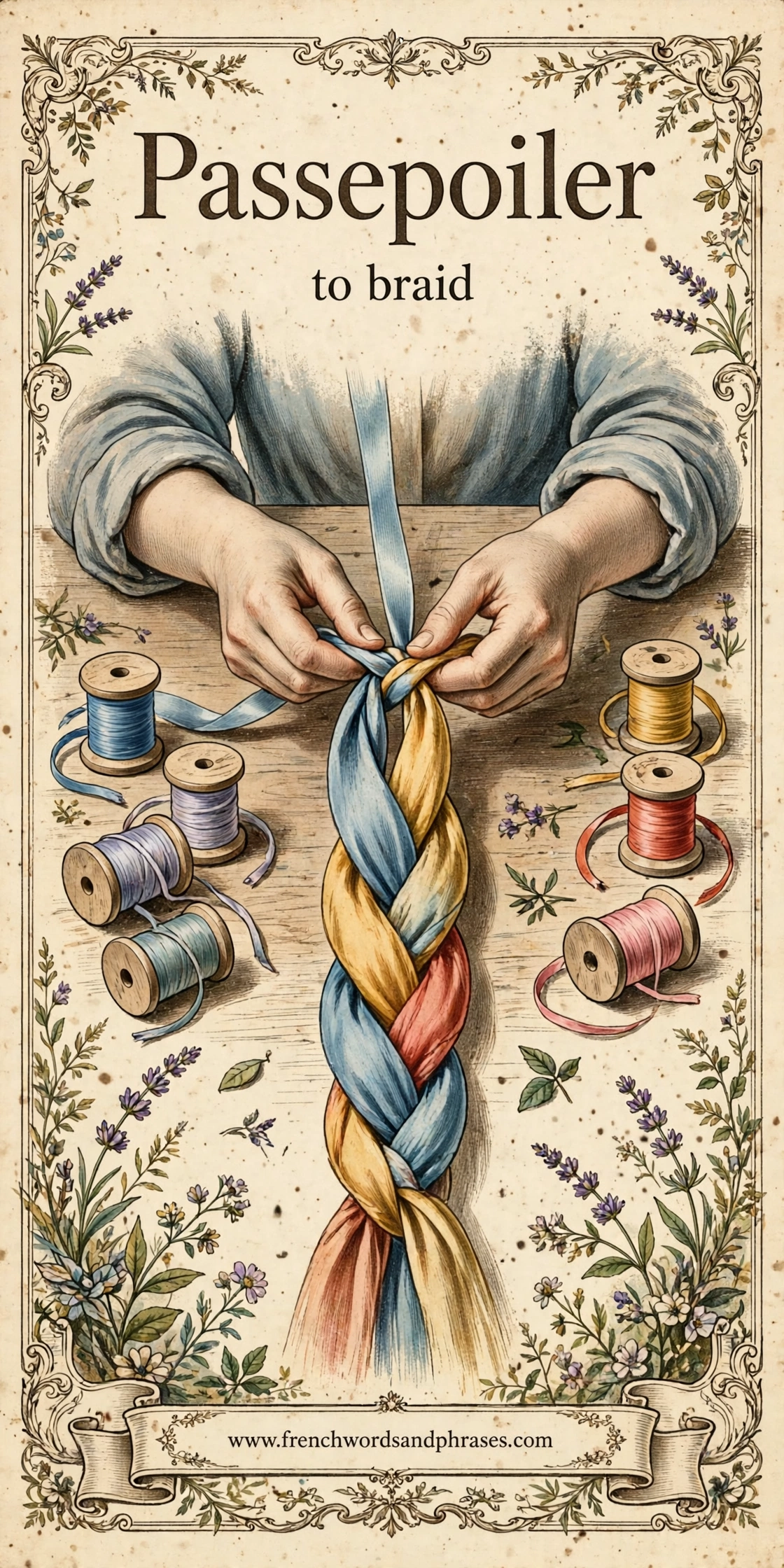
Passepoiler means to braid — to sew piping, a slim corded braid, along the seams and edges of a garment.
A dressmaker turns a jacket inside out and runs a narrow corded edge — un passepoil — along every seam, so the finished garment stands crisp and outlined. Passepoiler is the verb of that corded edge: to braid piping into a seam so the line of the cloth holds its shape.
In this guide, you’ll learn how to conjugate passepoiler in all the major French tenses and moods. Explore complete conjugation tables, French examples, English translations, and practice quizzes.
Understanding the French Verb Passepoiler
Passepoiler is a regular French verb belonging to the first group of verbs, those ending in -er.
It means to braid. It belongs to dressmaking, tailoring and upholstery: jackets, cushions, pyjamas and armchairs are passepoilés so their edges stay sharp and wear well. Outside the workshop the word is rare — but anyone who sews in France uses it without thinking.
Verb classification: First group (-er)
Auxiliary verb: Avoir
Past participle: passepoilé
Present participle: passepoilant
English equivalents: To pipe, to edge with piping, to braid; passepoiler une veste — to pipe a jacket; passepoiler les coutures — to braid piping into the seams; un passepoil — piping, a corded braid; un coussin passepoilé — a piped cushion.
One important detail: passepoiler is the verb of the noun un passepoil — the piping itself — and the noun is a little picture: passe + poil, the cord that passes like a hair along the seam. The verb is a regular -er with nothing hidden: je passepoile, nous passepoilons, ils passepoilent, past participle passepoilé. Do not confuse it with its atelier neighbour passementer: the passement is the broad decorative braid; the passepoil is the thin cord hidden in the seam.
Experience the Word
Passepoiler is the verb of the crisp edge — the fine cord that makes a seam look deliberate.
Imagine a tailor finishing a waistcoat for a wedding. The cloth is cut, the lining set; now, slowly, il passepoile chaque couture d’un cordonnet de satin — and the plain waistcoat suddenly looks tailored, outlined like a drawing.
It is only a cord in a seam. It has been piped — passepoilé — and the whole garment stands straighter.
How to Conjugate Passepoiler: Complete French Conjugation Guide
Let’s explore every major conjugation of passepoiler, beginning with the indicative mood.
How to Conjugate Passepoiler in the Indicative Mood
The indicative mood is used to express facts, observations, actions, and events.
How to Conjugate Passepoiler in the Present Tense (Présent)
Used for actions happening now, habitual actions, and general truths.
| Subject | Conjugation |
|---|---|
| je | passepoile |
| tu | passepoiles |
| il / elle | passepoile |
| nous | passepoilons |
| vous | passepoilez |
| ils / elles | passepoilent |
Elle passepoile les coutures de la veste.
She is piping the seams of the jacket.
Complete the sentence:
Nous ______ les coussins du salon.
Reveal the answer
passepoilons
Nous passepoilons les coussins du salon.
We are piping the living-room cushions.
How to Conjugate Passepoiler in the Passé Composé
Used for completed actions in the past. Passepoiler takes the auxiliary verb avoir.
| Subject | Conjugation |
|---|---|
| j’ | ai passepoilé |
| tu | as passepoilé |
| il / elle | a passepoilé |
| nous | avons passepoilé |
| vous | avez passepoilé |
| ils / elles | ont passepoilé |
Nous avons passepoilé les coussins du salon.
We piped the living-room cushions.
How to Conjugate Passepoiler in the Imparfait (Imperfect Tense)
Used for habitual past actions, descriptions, and ongoing situations in the past.
| Subject | Conjugation |
|---|---|
| je | passepoilais |
| tu | passepoilais |
| il / elle | passepoilait |
| nous | passepoilions |
| vous | passepoiliez |
| ils / elles | passepoilaient |
Ma grand-mère passepoilait tous ses tabliers.
My grandmother used to pipe all her aprons.
Choose the correct form:
She piped the dress.
Elle ______ la robe. (a passepoilé / est passepoilée)
Reveal the answer
a passepoilé
Elle a passepoilé la robe.
Passepoiler takes avoir.
How to Conjugate Passepoiler in the Plus-que-parfait
Used to describe an action that had already been completed before another past event.
| Subject | Conjugation |
|---|---|
| j’ | avais passepoilé |
| tu | avais passepoilé |
| il / elle | avait passepoilé |
| nous | avions passepoilé |
| vous | aviez passepoilé |
| ils / elles | avaient passepoilé |
Le tailleur avait passepoilé le gilet avant l’essayage.
The tailor had piped the waistcoat before the fitting.
How to Conjugate Passepoiler in the Passé Simple
Primarily used in formal writing, literature, and historical narratives. It is rarely used in everyday conversation.
| Subject | Conjugation |
|---|---|
| je | passepoilai |
| tu | passepoilas |
| il / elle | passepoila |
| nous | passepoilâmes |
| vous | passepoilâtes |
| ils / elles | passepoilèrent |
La couturière passepoila la robe en une après-midi.
The dressmaker piped the dress in one afternoon.
How to Conjugate Passepoiler in the Passé Antérieur
A literary tense used to express an action completed immediately before another past action, generally in the passé simple.
| Subject | Conjugation |
|---|---|
| j’ | eus passepoilé |
| tu | eus passepoilé |
| il / elle | eut passepoilé |
| nous | eûmes passepoilé |
| vous | eûtes passepoilé |
| ils / elles | eurent passepoilé |
Quand il eut passepoilé le manteau, il le livra.
When he had piped the coat, he delivered it.
How to Conjugate Passepoiler in the Future Tense (Futur Simple)
Used to describe actions that will take place in the future.
| Subject | Conjugation |
|---|---|
| je | passepoilerai |
| tu | passepoileras |
| il / elle | passepoilera |
| nous | passepoilerons |
| vous | passepoilerez |
| ils / elles | passepoileront |
Je passepoilerai les rideaux avec un cordon bleu.
I will pipe the curtains with a blue cord.
How to Conjugate Passepoiler in the Futur Antérieur (Future Perfect)
Used for an action that will have been completed before a particular point in the future.
| Subject | Conjugation |
|---|---|
| j’ | aurai passepoilé |
| tu | auras passepoilé |
| il / elle | aura passepoilé |
| nous | aurons passepoilé |
| vous | aurez passepoilé |
| ils / elles | auront passepoilé |
À six heures, elle aura passepoilé les six coussins.
By six o’clock, she will have piped the six cushions.
How to Conjugate Passepoiler in the Near Future (Futur Proche)
Used to describe something that is going to happen soon. Formed with aller + infinitive.
| Subject | Conjugation |
|---|---|
| je | vais passepoiler |
| tu | vas passepoiler |
| il / elle | va passepoiler |
| nous | allons passepoiler |
| vous | allez passepoiler |
| ils / elles | vont passepoiler |
Tu vas passepoiler ce pyjama, n’est-ce pas ?
You are going to pipe this pyjama, aren’t you?
How to Conjugate Passepoiler in the Conditional Mood
The conditional mood expresses what would happen under certain circumstances. It is also frequently used to make polite requests or express wishes.
How to Conjugate Passepoiler in the Present Conditional
| Subject | Conjugation |
|---|---|
| je | passepoilerais |
| tu | passepoilerais |
| il / elle | passepoilerait |
| nous | passepoilerions |
| vous | passepoileriez |
| ils / elles | passepoileraient |
Un cordon noir passepoilerait mieux ce tissu clair.
A black cord would pipe this light fabric better.
How to Conjugate Passepoiler in the Past Conditional
| Subject | Conjugation |
|---|---|
| j’ | aurais passepoilé |
| tu | aurais passepoilé |
| il / elle | aurait passepoilé |
| nous | aurions passepoilé |
| vous | auriez passepoilé |
| ils / elles | auraient passepoilé |
Elle aurait passepoilé la veste si elle avait eu le cordon.
She would have piped the jacket if she had had the cord.
Passepoiler in the Literary Past Conditional Form
This less common literary form uses the imperfect subjunctive of avoir.
| Subject | Conjugation |
|---|---|
| j’ | eusse passepoilé |
| tu | eusses passepoilé |
| il / elle | eût passepoilé |
| nous | eussions passepoilé |
| vous | eussiez passepoilé |
| ils / elles | eussent passepoilé |
La modiste eût passepoilé la cape pour la reine.
The milliner would have piped the cape for the queen.
How to Conjugate Passepoiler in the Subjunctive Mood
The subjunctive is used to express wishes, emotions, doubts, necessity, and uncertainty. It frequently follows expressions such as il faut que (it is necessary that) or bien que (although).
How to Conjugate Passepoiler in the Present Subjunctive
| Subject | Conjugation |
|---|---|
| que je | passepoile |
| que tu | passepoiles |
| qu’il / qu’elle | passepoile |
| que nous | passepoilions |
| que vous | passepoiliez |
| qu’ils / qu’elles | passepoilent |
Il faut que je passepoile les manches aujourd’hui.
I must pipe the sleeves today.
Complete the sentence using the subjunctive:
Il faut que vous ______ le fauteuil avant vendredi.
Reveal the answer
passepoiliez
Il faut que vous passepoiliez le fauteuil avant vendredi.
You must pipe the armchair before Friday.
How to Conjugate Passepoiler in the Imperfect Subjunctive
A literary tense, rarely encountered in modern spoken French.
| Subject | Conjugation |
|---|---|
| que je | passepoilasse |
| que tu | passepoilasses |
| qu’il / qu’elle | passepoilât |
| que nous | passepoilassions |
| que vous | passepoilassiez |
| qu’ils / qu’elles | passepoilassent |
Le client demandait qu’elle passepoilât le gilet de satin.
The client asked her to pipe the waistcoat with satin.
How to Conjugate Passepoiler in the Pluperfect Subjunctive
A literary construction used to express an action completed before another past action.
| Subject | Conjugation |
|---|---|
| que j’ | eusse passepoilé |
| que tu | eusses passepoilé |
| qu’il / qu’elle | eût passepoilé |
| que nous | eussions passepoilé |
| que vous | eussiez passepoilé |
| qu’ils / qu’elles | eussent passepoilé |
On admirait qu’il eût passepoilé tout le trousseau à la main.
People admired that he had piped the whole trousseau by hand.
How to Conjugate Passepoiler in the Past Subjunctive
| Subject | Conjugation |
|---|---|
| que j’ | aie passepoilé |
| que tu | aies passepoilé |
| qu’il / qu’elle | ait passepoilé |
| que nous | ayons passepoilé |
| que vous | ayez passepoilé |
| qu’ils / qu’elles | aient passepoilé |
Je suis content que tu aies passepoilé les coussins.
I am glad you piped the cushions.
How to Conjugate Passepoiler in the Imperative
The imperative is used to give commands, instructions, invitations, or suggestions. Subject pronouns are omitted.
How to Conjugate Passepoiler in the Present Imperative
| Person | Conjugation |
|---|---|
| (tu) | passepoile |
| (nous) | passepoilons |
| (vous) | passepoilez |
Passepoile les coutures avant de coudre les boutons !
Pipe the seams before sewing on the buttons!
How would you say Pipe the seams (tu form)?
Reveal the answer
Passepoile les coutures !
French Participles of Passepoiler
Participles are verb forms that can be used in compound tenses and other grammatical constructions.
Present Participle of Passepoiler
passepoilant
En passepoilant le fauteuil, elle suit le bord au millimètre.
While piping the armchair, she follows the edge to the millimetre.
Past Participle of Passepoiler
passepoilé
Passepoilé de satin rouge, le gilet avait fière allure.
Piped with red satin, the waistcoat looked splendid.
Passepoiler in Everyday French: Real-Life Examples
Now that you know the conjugations, let’s see how passepoiler appears in everyday French.
Elle passepoile les coutures de la veste.
She is piping the seams of the jacket.
Nous avons passepoilé les coussins.
We piped the cushions.
Ma grand-mère passepoilait ses tabliers.
My grandmother used to pipe her aprons.
Je passepoilerai les rideaux.
I will pipe the curtains.
Un cordon noir passepoilerait mieux ce tissu.
A black cord would pipe this fabric better.
Passepoile les manches aujourd’hui !
Pipe the sleeves today!
Beyond Translation: The Meaning of Passepoiler
The noun tells the story: passepoil joins passer, to pass, and poil, a hair — the cord passes along the seam as fine as a hair.
It is the invisible luxury of good sewing.
Nobody notices a passepoil at first glance, yet it is what keeps a cushion’s edge from sagging and a jacket’s line from blurring — passepoiler is tailoring’s quiet engineering.
How to Remember the French Verb Passepoiler
Remember it this way: Passepoiler is about the fine cord running like a hair along the seam.
- Un passepoil is piping; passepoiler is sewing that piping in — passe + poil, the cord fine as a hair.
- Not the same as passementer: the passepoil is the thin cord in the seam, the passement is the showy braid on top.
- Regular -er: je passepoile, nous passepoilons, past participle passepoilé.
The key idea is the fine cord running like a hair along the seam.
Test Your Knowledge of Passepoiler
Let’s see how much you’ve learned. Try answering these questions before revealing the answers.
What is un passepoil?
Reveal the answer
Piping — the slim corded braid sewn into a seam; passepoiler means putting it in.
How do you say She is piping the seams of the jacket in French?
Reveal the answer
Elle passepoile les coutures de la veste.
Translate: We piped the cushions.
Reveal the answer
Nous avons passepoilé les coussins.
What is the past participle of passepoiler?
Reveal the answer
Passepoilé.
Complete the sentence:
Il faut que je ______ les manches aujourd’hui.
Reveal the answer
passepoile
Il faut que je passepoile les manches aujourd’hui.
I must pipe the sleeves today.
Can You Use It?
How would you say this in French?
She pipes the waistcoat with a satin cord, and the garment takes on a ceremonial air.
Reveal the answer
Elle passepoile le gilet d’un cordon de satin, et le vêtement prend une allure de cérémonie.
She pipes the waistcoat with a satin cord, and the garment takes on a ceremonial air.
LEARN FRENCH ONE WORD AT A TIME