How to Conjugate Partouser in French
/paʁ.tu.ze/
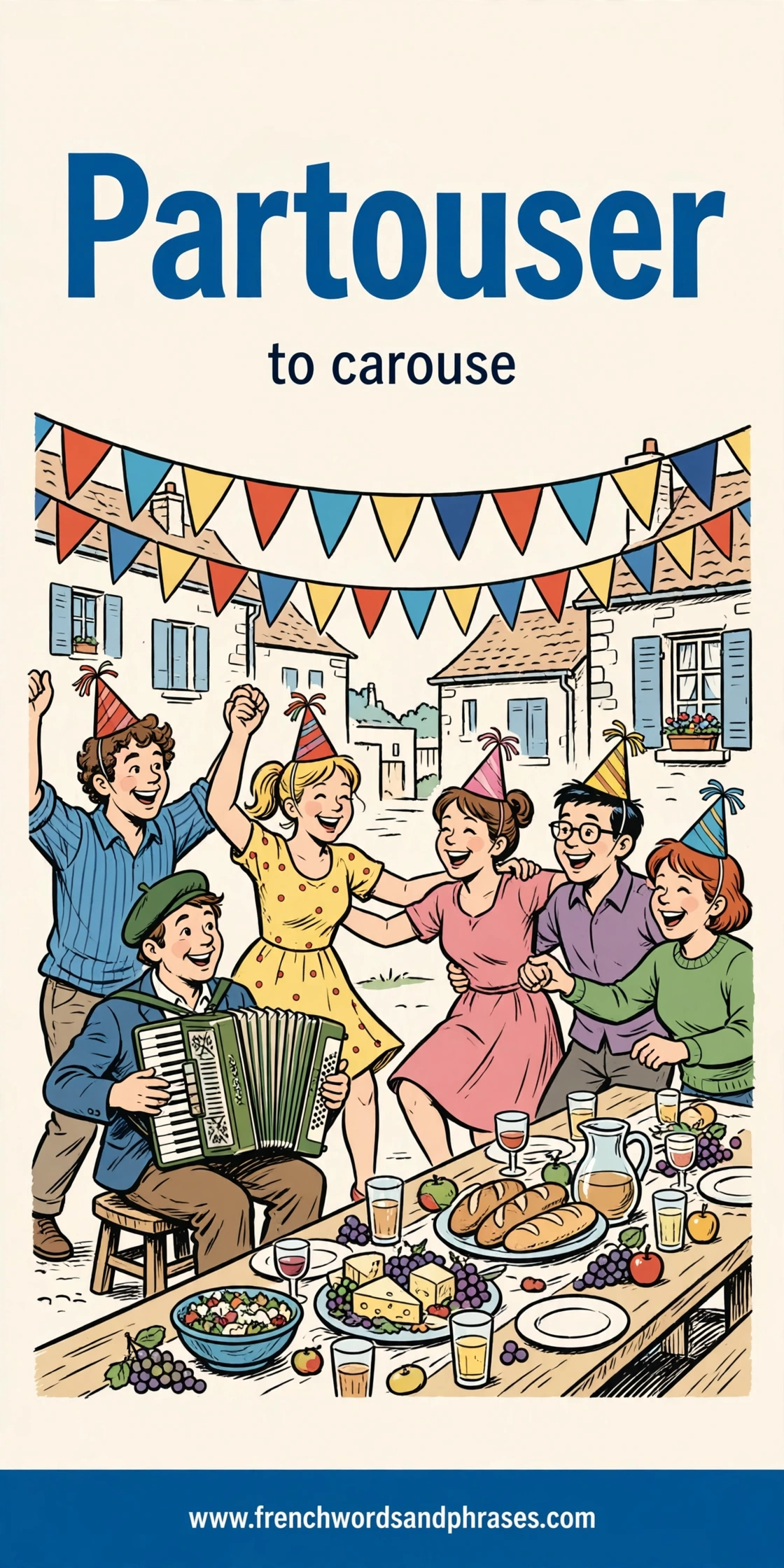
Partouser means to carouse — to party hard, late and in a crowd, in the cheerful disorder of the partouze.
Music through the walls at 3 a.m., forty guests where twelve were invited, somebody’s cousin asleep in the bathtub — partouser is the slang verb of the wild group party: the night that starts as an evening among friends and ends as village legend.
In this guide, you’ll learn how to conjugate partouser in all the major French tenses and moods. Explore complete conjugation tables, French examples, English translations, and practice quizzes.
Understanding the French Verb Partouser
Partouser is a regular French verb belonging to the first group of verbs, those ending in -er.
It means to carouse. In its strict sense the noun une partouze names a group sex party, and the verb keeps that naughty reputation; in looser everyday slang it simply means partying very hard in a group, all night and with total abandon. Either way it is used with a grin and a raised eyebrow — the word itself is half the joke, and French speakers reach for it when an ordinary fête would sound far too innocent.
Verb classification: First group (-er)
Auxiliary verb: Avoir
Past participle: partousé
Present participle: partousant
English equivalents: To carouse, to party wildly in a group; une partouze — a wild group party, an orgy; partouser toute la nuit — to carouse all night; partouser entre copains — to party hard among friends; register: argot (slang), cheeky — a word for the morning-after story, not for polite company.
One important detail: partouser is also spelled partouzer — the dictionary itself notes the variant, because the s is pronounced /z/, and both spellings live side by side. The verb is a regular -er either way: je partouse, nous partousons, ils partousent, past participle partousé. The real trap is register, not spelling: this is argot, slang with a wink, built on the noun une partouze — fine in a joke among friends, and absolutely not a word for the office, the classroom or your host’s mother.
Experience the Word
Partouser is the verb of the party that got out of hand — the one the neighbours will mention for a year.
Imagine students the night the exam results come out. Someone has a cousin with a big flat; someone else has a speaker; by midnight the whole staircase is dancing, and by dawn the survivors are eating croissants on the roof. Ils ont partousé — and the concierge, sweeping up feathers and corks, will tell the story better than any of them.
It was not a dinner, not a soirée, not even a fête. It was a partouze — partousé until sunrise, and remembered forever.
How to Conjugate Partouser: Complete French Conjugation Guide
Let’s explore every major conjugation of partouser, beginning with the indicative mood.
How to Conjugate Partouser in the Indicative Mood
The indicative mood is used to express facts, observations, actions, and events.
How to Conjugate Partouser in the Present Tense (Présent)
Used for actions happening now, habitual actions, and general truths.
| Subject | Conjugation |
|---|---|
| je | partouse |
| tu | partouses |
| il / elle | partouse |
| nous | partousons |
| vous | partousez |
| ils / elles | partousent |
Après les examens, certains étudiants partousent jusqu’au matin.
After the exams, some students carouse until morning.
Complete the sentence:
Nous ______ rarement, mais ce soir, oui !
Reveal the answer
partousons
Nous partousons rarement, mais ce soir, oui !
We rarely carouse, but tonight, yes!
How to Conjugate Partouser in the Passé Composé
Used for completed actions in the past. Partouser takes the auxiliary verb avoir.
| Subject | Conjugation |
|---|---|
| j’ | ai partousé |
| tu | as partousé |
| il / elle | a partousé |
| nous | avons partousé |
| vous | avez partousé |
| ils / elles | ont partousé |
Ils ont partousé toute la nuit dans une villa louée.
They caroused all night in a rented villa.
How to Conjugate Partouser in the Imparfait (Imperfect Tense)
Used for habitual past actions, descriptions, and ongoing situations in the past.
| Subject | Conjugation |
|---|---|
| je | partousais |
| tu | partousais |
| il / elle | partousait |
| nous | partousions |
| vous | partousiez |
| ils / elles | partousaient |
Dans les années folles, on partousait dans les cabarets de Montmartre.
In the Roaring Twenties, people used to carouse in the cabarets of Montmartre.
Choose the correct form:
They caroused all night.
Ils ______ toute la nuit. (ont partousé / sont partousés)
Reveal the answer
ont partousé
Ils ont partousé toute la nuit.
Partouser takes avoir.
How to Conjugate Partouser in the Plus-que-parfait
Used to describe an action that had already been completed before another past event.
| Subject | Conjugation |
|---|---|
| j’ | avais partousé |
| tu | avais partousé |
| il / elle | avait partousé |
| nous | avions partousé |
| vous | aviez partousé |
| ils / elles | avaient partousé |
Ils avaient partousé trois nuits de suite avant le mariage.
They had caroused three nights in a row before the wedding.
How to Conjugate Partouser in the Passé Simple
Primarily used in formal writing, literature, and historical narratives. It is rarely used in everyday conversation.
| Subject | Conjugation |
|---|---|
| je | partousai |
| tu | partousas |
| il / elle | partousa |
| nous | partousâmes |
| vous | partousâtes |
| ils / elles | partousèrent |
La bande partousa jusqu’à l’aube, puis s’endormit sur la plage.
The gang caroused until dawn, then fell asleep on the beach.
How to Conjugate Partouser in the Passé Antérieur
A literary tense used to express an action completed immediately before another past action, generally in the passé simple.
| Subject | Conjugation |
|---|---|
| j’ | eus partousé |
| tu | eus partousé |
| il / elle | eut partousé |
| nous | eûmes partousé |
| vous | eûtes partousé |
| ils / elles | eurent partousé |
Quand ils eurent partousé assez longtemps, le silence revint dans la maison.
When they had caroused long enough, silence returned to the house.
How to Conjugate Partouser in the Future Tense (Futur Simple)
Used to describe actions that will take place in the future.
| Subject | Conjugation |
|---|---|
| je | partouserai |
| tu | partouseras |
| il / elle | partousera |
| nous | partouserons |
| vous | partouserez |
| ils / elles | partouseront |
Ce week-end, les copains partouseront chez Maxime.
This weekend, the friends will carouse at Maxime’s place.
How to Conjugate Partouser in the Futur Antérieur (Future Perfect)
Used for an action that will have been completed before a particular point in the future.
| Subject | Conjugation |
|---|---|
| j’ | aurai partousé |
| tu | auras partousé |
| il / elle | aura partousé |
| nous | aurons partousé |
| vous | aurez partousé |
| ils / elles | auront partousé |
À la fin des vacances, ils auront partousé plus que dormi.
By the end of the holidays, they will have caroused more than they slept.
How to Conjugate Partouser in the Near Future (Futur Proche)
Used to describe something that is going to happen soon. Formed with aller + infinitive.
| Subject | Conjugation |
|---|---|
| je | vais partouser |
| tu | vas partouser |
| il / elle | va partouser |
| nous | allons partouser |
| vous | allez partouser |
| ils / elles | vont partouser |
Ce soir, la bande va partouser pour fêter la victoire.
Tonight, the gang is going to carouse to celebrate the victory.
How to Conjugate Partouser in the Conditional Mood
The conditional mood expresses what would happen under certain circumstances. It is also frequently used to make polite requests or express wishes.
How to Conjugate Partouser in the Present Conditional
| Subject | Conjugation |
|---|---|
| je | partouserais |
| tu | partouserais |
| il / elle | partouserait |
| nous | partouserions |
| vous | partouseriez |
| ils / elles | partouseraient |
Sans les voisins, on partouserait tous les samedis.
Without the neighbours, we would carouse every Saturday.
How to Conjugate Partouser in the Past Conditional
| Subject | Conjugation |
|---|---|
| j’ | aurais partousé |
| tu | aurais partousé |
| il / elle | aurait partousé |
| nous | aurions partousé |
| vous | auriez partousé |
| ils / elles | auraient partousé |
Ils auraient partousé jusqu’au matin si les voisins n’avaient pas appelé la police.
They would have caroused until morning if the neighbours had not called the police.
Partouser in the Literary Past Conditional Form
This less common literary form uses the imperfect subjunctive of avoir.
| Subject | Conjugation |
|---|---|
| j’ | eusse partousé |
| tu | eusses partousé |
| il / elle | eût partousé |
| nous | eussions partousé |
| vous | eussiez partousé |
| ils / elles | eussent partousé |
Les mousquetaires eussent partousé toute la nuit sans le couvre-feu.
The musketeers would have caroused all night, without the curfew.
How to Conjugate Partouser in the Subjunctive Mood
The subjunctive is used to express wishes, emotions, doubts, necessity, and uncertainty. It frequently follows expressions such as il faut que (it is necessary that) or bien que (although).
How to Conjugate Partouser in the Present Subjunctive
| Subject | Conjugation |
|---|---|
| que je | partouse |
| que tu | partouses |
| qu’il / qu’elle | partouse |
| que nous | partousions |
| que vous | partousiez |
| qu’ils / qu’elles | partousent |
Je doute que ses parents sachent qu’il partouse le week-end.
I doubt his parents know he carouses at weekends.
Complete the sentence using the subjunctive:
Il est possible qu’ils ______ toute la nuit.
Reveal the answer
aient partousé
Il est possible qu’ils aient partousé toute la nuit.
It is possible they caroused all night.
How to Conjugate Partouser in the Imperfect Subjunctive
A literary tense, rarely encountered in modern spoken French.
| Subject | Conjugation |
|---|---|
| que je | partousasse |
| que tu | partousasses |
| qu’il / qu’elle | partousât |
| que nous | partousassions |
| que vous | partousassiez |
| qu’ils / qu’elles | partousassent |
On murmurait que les étudiants partousassent dans les caves du quartier.
People whispered that the students were carousing in the cellars of the neighbourhood.
How to Conjugate Partouser in the Pluperfect Subjunctive
A literary construction used to express an action completed before another past action.
| Subject | Conjugation |
|---|---|
| que j’ | eusse partousé |
| que tu | eusses partousé |
| qu’il / qu’elle | eût partousé |
| que nous | eussions partousé |
| que vous | eussiez partousé |
| qu’ils / qu’elles | eussent partousé |
On racontait qu’ils eussent partousé chez le comte.
People said they had caroused at the count’s house.
How to Conjugate Partouser in the Past Subjunctive
| Subject | Conjugation |
|---|---|
| que j’ | aie partousé |
| que tu | aies partousé |
| qu’il / qu’elle | ait partousé |
| que nous | ayons partousé |
| que vous | ayez partousé |
| qu’ils / qu’elles | aient partousé |
Il est possible qu’ils aient partousé toute la nuit.
It is possible they caroused all night.
How to Conjugate Partouser in the Imperative
The imperative is used to give commands, instructions, invitations, or suggestions. Subject pronouns are omitted.
How to Conjugate Partouser in the Present Imperative
| Person | Conjugation |
|---|---|
| (tu) | partouse |
| (nous) | partousons |
| (vous) | partousez |
Partousez si vous voulez, mais pas chez moi !
Carouse if you like, but not at my place!
How would you say Carouse if you like, but not at my place (tu form)?
Reveal the answer
Partouse si tu veux, mais pas chez moi !
French Participles of Partouser
Participles are verb forms that can be used in compound tenses and other grammatical constructions.
Present Participle of Partouser
partousant
En partousant ainsi, ils ont réveillé tout l’immeuble.
By carousing like that, they woke the whole building.
Past Participle of Partouser
partousé
Après avoir partousé trois nuits, ils dormaient debout.
After carousing for three nights, they were asleep on their feet.
Partouser in Everyday French: Real-Life Examples
Now that you know the conjugations, let’s see how partouser appears in everyday French.
Certains étudiants partousent jusqu’au matin.
Some students carouse until morning.
Ils ont partousé toute la nuit.
They caroused all night.
On partousait dans les cabarets de Montmartre.
People used to carouse in the cabarets of Montmartre.
Les copains partouseront chez Maxime.
The friends will carouse at Maxime’s place.
On partouserait tous les samedis sans les voisins.
We would carouse every Saturday without the neighbours.
Partousez si vous voulez, mais pas chez moi !
Carouse if you like, but not at my place!
Beyond Translation: The Meaning of Partouser
The word is a piece of pure French slang engineering: take partout, everywhere, shake it with the idea of a party that spills into every room, and you get partouze — and its verb partouser.
Handle with a grin.
Dictionaries list it without blushing, comedians use it for the laugh of recognition, and everyone understands the raised eyebrow that comes with it. It is the vocabulary of the morning after: technically about a party, practically about a legend.
How to Remember the French Verb Partouser
Remember it this way: Partouser is about the exam-results party that ends with croissants on the roof at dawn.
- Two spellings, one verb: partouser and partouzer are both correct — the s sounds like a z.
- Register: argot. A word for jokes among friends, never for the office or the in-laws.
- Regular -er: je partouse, nous partousons, past participle partousé.
The key idea is the exam-results party that ends with croissants on the roof at dawn.
Test Your Knowledge of Partouser
Let’s see how much you’ve learned. Try answering these questions before revealing the answers.
What is the other accepted spelling of partouser, and why?
Reveal the answer
Partouzer — because the s is pronounced /z/, both spellings exist side by side.
How do you say They caroused all night in French?
Reveal the answer
Ils ont partousé toute la nuit.
Translate: We would carouse every Saturday without the neighbours.
Reveal the answer
On partouserait tous les samedis sans les voisins.
What is the past participle of partouser?
Reveal the answer
Partousé.
Complete the sentence:
Je doute que ses parents sachent qu’il ______ le week-end.
Reveal the answer
partouse
Je doute que ses parents sachent qu’il partouse le week-end.
I doubt his parents know he carouses at weekends.
Can You Use It?
How would you say this in French?
They caroused until dawn, and the neighbourhood is still talking about it.
Reveal the answer
Ils ont partousé jusqu’à l’aube, et le quartier en parle encore.
They caroused until dawn, and the neighbourhood is still talking about it.
LEARN FRENCH ONE WORD AT A TIME