How to Conjugate Parsemer in French
/paʁ.sə.me/
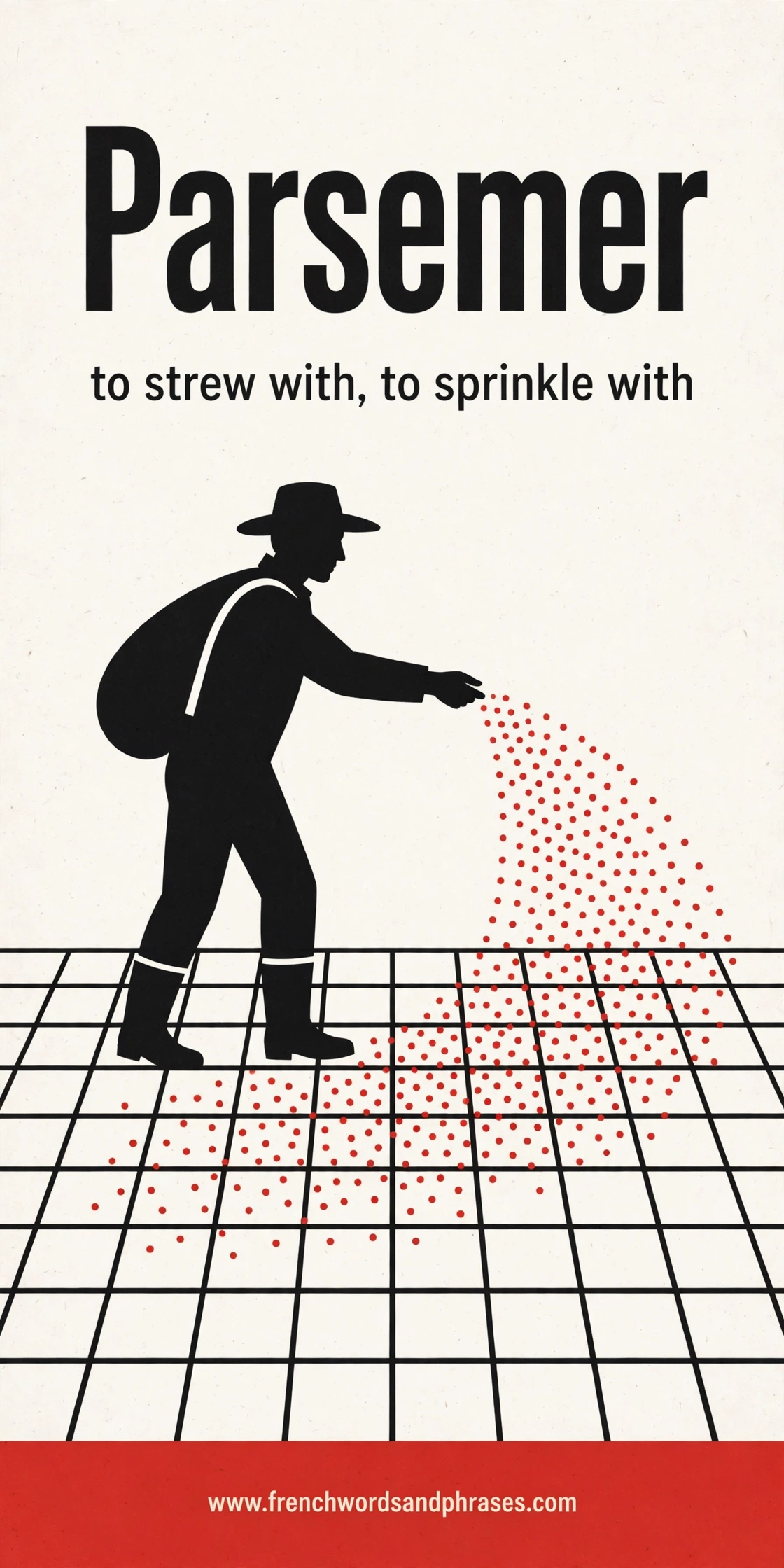
Parsemer means to strew with, to sprinkle with — to scatter small things over a surface until they dot it from end to end.
A cook scattering parsley over a white soup, confetti settling over a wedding crowd, stars appearing one by one over a darkening plain — parsemer is the verb of the dotted surface: take something small, scatter it generously, and watch a plain expanse turn speckled and alive.
In this guide, you’ll learn how to conjugate parsemer in all the major French tenses and moods. Explore complete conjugation tables, French examples, English translations, and practice quizzes.
Understanding the French Verb Parsemer
Parsemer is a regular French verb belonging to the first group of verbs, those ending in -er.
It means to strew with, to sprinkle with. It works in the kitchen (parsemer de fines herbes), in the garden (parsemer de graines), in the sky (un ciel parsemé d’étoiles) and in prose, where speeches and books are parsemés de citations, d’exemples or d’erreurs — peppered with quotations, examples or, less happily, mistakes. The passive participle parsemé de is everywhere: a text parsemé de fautes is riddled with errors.
Verb classification: First group (-er)
Auxiliary verb: Avoir
Past participle: parsemé
Present participle: parsemant
English equivalents: To strew with, to sprinkle with, to scatter over; parsemer quelque chose de fleurs — to strew something with flowers; parsemer un plat de persil — to sprinkle a dish with parsley; un ciel parsemé d’étoiles — a sky strewn with stars; parsemer son discours de citations — to pepper one’s speech with quotations; the scattered thing is always introduced by de.
One important detail: parsemer is a semer-type verb, and like semer and acheter it opens its stem vowel to è wherever the next syllable is mute: je parsème, tu parsèmes, il parsème, ils parsèment, and all through the future and conditional: je parsèmerai, je parsèmerais. The plain e survives where the ending is sounded: nous parsemons, vous parsemez, je parsemais, en parsemant, and in the infinitive and participle, parsemer, parsemé. The subjunctive splits the same way: que je parsème, but que nous parsemions. And remember the construction: the surface is the direct object, the scattered matter follows de — parsemer le chemin de fleurs.
Experience the Word
Parsemer is the verb of the generous scatter — nothing placed one by one, everything sown broadcast over a surface.
Imagine a June wedding in a village square. As the couple comes down the church steps, fifty hands rise at once and the air fills with petals; a minute later the whole square — the steps, the cobbles, the bride’s hair — is parsemé de roses, and the photographs will show a world dotted pink.
Nobody placed a single petal. They were strewn — parsemées — and the scattering was the celebration.
How to Conjugate Parsemer: Complete French Conjugation Guide
Let’s explore every major conjugation of parsemer, beginning with the indicative mood.
How to Conjugate Parsemer in the Indicative Mood
The indicative mood is used to express facts, observations, actions, and events.
How to Conjugate Parsemer in the Present Tense (Présent)
Used for actions happening now, habitual actions, and general truths.
| Subject | Conjugation |
|---|---|
| je | parsème |
| tu | parsèmes |
| il / elle | parsème |
| nous | parsemons |
| vous | parsemez |
| ils / elles | parsèment |
La cuisinière parsème la salade de fines herbes.
The cook sprinkles the salad with herbs.
Complete the sentence:
Nous ______ la pelouse de trèfle.
Reveal the answer
parsemons
Nous parsemons la pelouse de trèfle.
We scatter clover over the lawn.
How to Conjugate Parsemer in the Passé Composé
Used for completed actions in the past. Parsemer takes the auxiliary verb avoir.
| Subject | Conjugation |
|---|---|
| j’ | ai parsemé |
| tu | as parsemé |
| il / elle | a parsemé |
| nous | avons parsemé |
| vous | avez parsemé |
| ils / elles | ont parsemé |
Il a parsemé le chemin de pétales de roses.
He strewed the path with rose petals.
How to Conjugate Parsemer in the Imparfait (Imperfect Tense)
Used for habitual past actions, descriptions, and ongoing situations in the past.
| Subject | Conjugation |
|---|---|
| je | parsemais |
| tu | parsemais |
| il / elle | parsemait |
| nous | parsemions |
| vous | parsemiez |
| ils / elles | parsemaient |
Le vent parsemait la cour de feuilles mortes.
The wind used to scatter dead leaves all over the yard.
Choose the correct form:
The cook sprinkles the salad with herbs.
La cuisinière ______ la salade de fines herbes. (parsème / parseme)
Reveal the answer
parsème
La cuisinière parsème la salade de fines herbes.
The stem vowel opens to è before the mute ending.
How to Conjugate Parsemer in the Plus-que-parfait
Used to describe an action that had already been completed before another past event.
| Subject | Conjugation |
|---|---|
| j’ | avais parsemé |
| tu | avais parsemé |
| il / elle | avait parsemé |
| nous | avions parsemé |
| vous | aviez parsemé |
| ils / elles | avaient parsemé |
Elle avait parsemé son discours de citations latines.
She had peppered her speech with Latin quotations.
How to Conjugate Parsemer in the Passé Simple
Primarily used in formal writing, literature, and historical narratives. It is rarely used in everyday conversation.
| Subject | Conjugation |
|---|---|
| je | parsemai |
| tu | parsemas |
| il / elle | parsema |
| nous | parsemâmes |
| vous | parsemâtes |
| ils / elles | parsemèrent |
La neige parsema les toits de blanc pendant la nuit.
The snow sprinkled the roofs with white during the night.
How to Conjugate Parsemer in the Passé Antérieur
A literary tense used to express an action completed immediately before another past action, generally in the passé simple.
| Subject | Conjugation |
|---|---|
| j’ | eus parsemé |
| tu | eus parsemé |
| il / elle | eut parsemé |
| nous | eûmes parsemé |
| vous | eûtes parsemé |
| ils / elles | eurent parsemé |
Quand il eut parsemé le gâteau de sucre glace, il le servit.
When he had dusted the cake with icing sugar, he served it.
How to Conjugate Parsemer in the Future Tense (Futur Simple)
Used to describe actions that will take place in the future.
| Subject | Conjugation |
|---|---|
| je | parsèmerai |
| tu | parsèmeras |
| il / elle | parsèmera |
| nous | parsèmerons |
| vous | parsèmerez |
| ils / elles | parsèmeront |
Demain, je parsèmerai le jardin de graines de fleurs.
Tomorrow, I will scatter flower seeds all over the garden.
How to Conjugate Parsemer in the Futur Antérieur (Future Perfect)
Used for an action that will have been completed before a particular point in the future.
| Subject | Conjugation |
|---|---|
| j’ | aurai parsemé |
| tu | auras parsemé |
| il / elle | aura parsemé |
| nous | aurons parsemé |
| vous | aurez parsemé |
| ils / elles | auront parsemé |
À la fin du repas, elle aura parsemé la table de confettis.
By the end of the meal, she will have scattered confetti all over the table.
How to Conjugate Parsemer in the Near Future (Futur Proche)
Used to describe something that is going to happen soon. Formed with aller + infinitive.
| Subject | Conjugation |
|---|---|
| je | vais parsemer |
| tu | vas parsemer |
| il / elle | va parsemer |
| nous | allons parsemer |
| vous | allez parsemer |
| ils / elles | vont parsemer |
Le jardinier va parsemer la pelouse de trèfle.
The gardener is going to scatter clover over the lawn.
How to Conjugate Parsemer in the Conditional Mood
The conditional mood expresses what would happen under certain circumstances. It is also frequently used to make polite requests or express wishes.
How to Conjugate Parsemer in the Present Conditional
| Subject | Conjugation |
|---|---|
| je | parsèmerais |
| tu | parsèmerais |
| il / elle | parsèmerait |
| nous | parsèmerions |
| vous | parsèmeriez |
| ils / elles | parsèmeraient |
Sans fleurs, tu parsèmerais le chemin de gravier fin.
Without flowers, you would strew the path with fine gravel.
How to Conjugate Parsemer in the Past Conditional
| Subject | Conjugation |
|---|---|
| j’ | aurais parsemé |
| tu | aurais parsemé |
| il / elle | aurait parsemé |
| nous | aurions parsemé |
| vous | auriez parsemé |
| ils / elles | auraient parsemé |
Ils auraient parsemé la route de branches si le vent avait soufflé.
They would have strewn the road with branches if the wind had blown.
Parsemer in the Literary Past Conditional Form
This less common literary form uses the imperfect subjunctive of avoir.
| Subject | Conjugation |
|---|---|
| j’ | eusse parsemé |
| tu | eusses parsemé |
| il / elle | eût parsemé |
| nous | eussions parsemé |
| vous | eussiez parsemé |
| ils / elles | eussent parsemé |
La mariée eût parsemé l’allée de roses sans la pluie.
The bride would have strewn the aisle with roses, without the rain.
How to Conjugate Parsemer in the Subjunctive Mood
The subjunctive is used to express wishes, emotions, doubts, necessity, and uncertainty. It frequently follows expressions such as il faut que (it is necessary that) or bien que (although).
How to Conjugate Parsemer in the Present Subjunctive
| Subject | Conjugation |
|---|---|
| que je | parsème |
| que tu | parsèmes |
| qu’il / qu’elle | parsème |
| que nous | parsemions |
| que vous | parsemiez |
| qu’ils / qu’elles | parsèment |
Il faut que tu parsèmes le plat de persil.
You must sprinkle the dish with parsley.
Complete the sentence using the subjunctive:
Il faut que vous ______ le gâteau de chocolat.
Reveal the answer
parsemiez
Il faut que vous parsemiez le gâteau de chocolat.
You must sprinkle the cake with chocolate.
How to Conjugate Parsemer in the Imperfect Subjunctive
A literary tense, rarely encountered in modern spoken French.
| Subject | Conjugation |
|---|---|
| que je | parsemasse |
| que tu | parsemasses |
| qu’il / qu’elle | parsemât |
| que nous | parsemassions |
| que vous | parsemassiez |
| qu’ils / qu’elles | parsemassent |
On voulait que le jardinier parsemât l’allée de sable.
They wanted the gardener to strew the path with sand.
How to Conjugate Parsemer in the Pluperfect Subjunctive
A literary construction used to express an action completed before another past action.
| Subject | Conjugation |
|---|---|
| que j’ | eusse parsemé |
| que tu | eusses parsemé |
| qu’il / qu’elle | eût parsemé |
| que nous | eussions parsemé |
| que vous | eussiez parsemé |
| qu’ils / qu’elles | eussent parsemé |
On admirait qu’elle eût parsemé son texte de tant d’images.
People admired that she had scattered so many images through her text.
How to Conjugate Parsemer in the Past Subjunctive
| Subject | Conjugation |
|---|---|
| que j’ | aie parsemé |
| que tu | aies parsemé |
| qu’il / qu’elle | ait parsemé |
| que nous | ayons parsemé |
| que vous | ayez parsemé |
| qu’ils / qu’elles | aient parsemé |
Je suis content que vous ayez parsemé le gâteau de chocolat.
I am glad you sprinkled the cake with chocolate.
How to Conjugate Parsemer in the Imperative
The imperative is used to give commands, instructions, invitations, or suggestions. Subject pronouns are omitted.
How to Conjugate Parsemer in the Present Imperative
| Person | Conjugation |
|---|---|
| (tu) | parsème |
| (nous) | parsemons |
| (vous) | parsemez |
Parsème le riz de coriandre fraîche !
Sprinkle the rice with fresh coriander!
How would you say Sprinkle the rice with coriander (tu form)?
Reveal the answer
Parsème le riz de coriandre !
French Participles of Parsemer
Participles are verb forms that can be used in compound tenses and other grammatical constructions.
Present Participle of Parsemer
parsemant
En parsemant le chemin de cailloux, le Petit Poucet marquait sa route.
By scattering pebbles along the path, Hop-o’-my-Thumb marked his way.
Past Participle of Parsemer
parsemé
Parsemée de fleurs, la prairie attirait les abeilles.
Strewn with flowers, the meadow attracted the bees.
Parsemer in Everyday French: Real-Life Examples
Now that you know the conjugations, let’s see how parsemer appears in everyday French.
La cuisinière parsème la salade de fines herbes.
The cook sprinkles the salad with herbs.
Il a parsemé le chemin de pétales.
He strewed the path with petals.
Le vent parsemait la cour de feuilles.
The wind used to scatter leaves over the yard.
Je parsèmerai le jardin de graines.
I will scatter seeds all over the garden.
Tu parsèmerais le chemin de gravier sans fleurs.
You would strew the path with gravel if there were no flowers.
Parsème le riz de coriandre !
Sprinkle the rice with coriander!
Beyond Translation: The Meaning of Parsemer
Inside parsemer sleeps semer, to sow — the farmer’s great gesture, arm swinging over the field — with par- stretching it across the whole surface: to sow all over, through and through.
That is why its participle describes half the surfaces in French.
Un ciel parsemé d’étoiles, une prairie parsemée de fleurs, un devoir parsemé de fautes — a sky, a meadow and a school essay, all dotted the same way: the sower’s handful, scattered over everything.
How to Remember the French Verb Parsemer
Remember it this way: Parsemer is about the cook’s hand scattering parsley over a white soup.
- Semer-type accent: je parsème with è, but nous parsemons with plain e.
- The future and conditional take è all the way through: je parsèmerai, je parsèmerais.
- Construction: the surface is the object, the scattered stuff follows de — parsemer le chemin de fleurs.
The key idea is the cook’s hand scattering parsley over a white soup.
Test Your Knowledge of Parsemer
Let’s see how much you’ve learned. Try answering these questions before revealing the answers.
Why does je parsème have a grave accent but nous parsemons none?
Reveal the answer
The semer/acheter rule — the stem vowel opens to è before a mute syllable (je parsème) and stays plain e where the ending is sounded (nous parsemons).
How do you say The cook sprinkles the salad with herbs in French?
Reveal the answer
La cuisinière parsème la salade de fines herbes.
Translate: He strewed the path with rose petals.
Reveal the answer
Il a parsemé le chemin de pétales de roses.
What is the past participle of parsemer?
Reveal the answer
Parsemé — as in un ciel parsemé d’étoiles, a sky strewn with stars.
Complete the sentence:
Il faut que tu ______ le plat de persil.
Reveal the answer
parsèmes
Il faut que tu parsèmes le plat de persil.
You must sprinkle the dish with parsley.
Can You Use It?
How would you say this in French?
The wind strews the yard with golden leaves, and autumn signs its passing.
Reveal the answer
Le vent parsème la cour de feuilles d’or, et l’automne signe son passage.
The wind strews the yard with golden leaves, and autumn signs its passing.
LEARN FRENCH ONE WORD AT A TIME