How to Conjugate Parrainer in French
/pa.ʁɛ.ne/
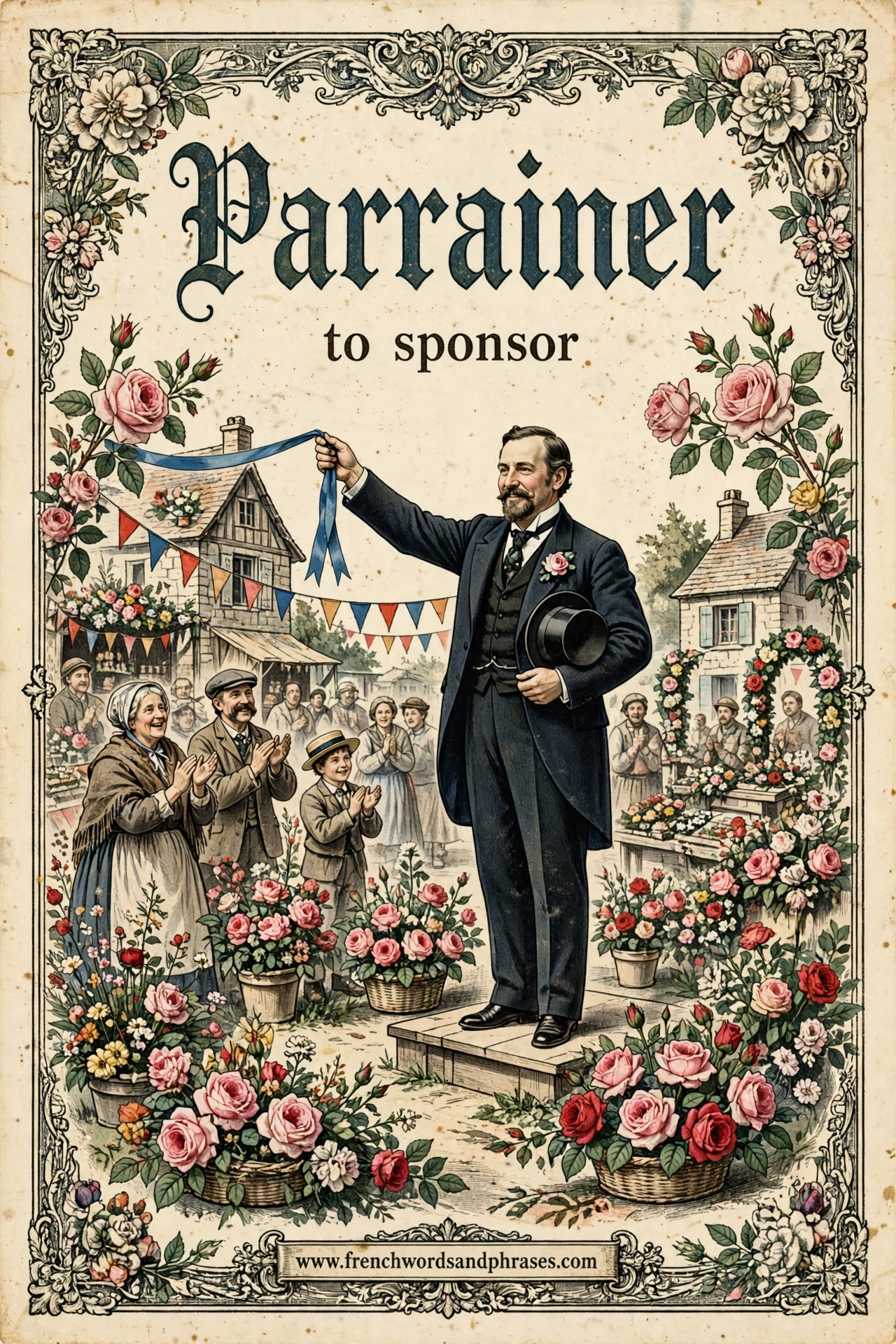
Parrainer means to sponsor — to stand behind a person, a project or an event with your name, your guidance or your money.
A bank’s name on a jazz festival poster, a senior engineer guiding a nervous newcomer through his first year, a godfather holding a baby at the font — parrainer is the verb of standing behind someone: lending your name, your experience and your protection to help them start.
In this guide, you’ll learn how to conjugate parrainer in all the major French tenses and moods. Explore complete conjugation tables, French examples, English translations, and practice quizzes.
Understanding the French Verb Parrainer
Parrainer is a regular French verb belonging to the first group of verbs, those ending in -er.
It means to sponsor. It works at every scale of French life: companies parrainent festivals and sports teams, members parrainent new members into clubs and professions, mentors parrainent juniors at work, and at a baptism the parrain and the marraine parrainent the child for life. Where English splits sponsor, mentor and godparent into three words, French happily uses one.
Verb classification: First group (-er)
Auxiliary verb: Avoir
Past participle: parrainé
Present participle: parrainant
English equivalents: To sponsor, to act as patron or mentor; parrainer un festival — to sponsor a festival; parrainer un projet — to back a project; parrainer un enfant — to be a child’s godparent; parrainer un nouveau membre — to sponsor a new member; un parrain — a godfather, a sponsor; une marraine — a godmother.
One important detail: parrainer is the verb of the parrain — the godfather or sponsor — and it is perfectly regular: je parraine, nous parrainons, ils parrainent, past participle parrainé. Watch the double n that runs through the whole family: parrain, parrainer, parrainage (sponsorship). And do not confuse it with its near-twin marraine, the godmother: a child is traditionally parrainé by one of each.
Experience the Word
Parrainer is the verb of the name lent to a good cause — your reputation goes first, and the newcomer walks in behind it.
Imagine a young luthier in Mirecourt with beautiful violins and no customers. The town’s old master, whose name every orchestra knows, agrees to parrainer her workshop: his name on her sign, his word in the right ears. Within a year the order book is full — not because her violins changed, but because someone stood behind them.
Talent did the work. But sponsorship — le parrainage — opened the door, and parrainer is what the old master did.
How to Conjugate Parrainer: Complete French Conjugation Guide
Let’s explore every major conjugation of parrainer, beginning with the indicative mood.
How to Conjugate Parrainer in the Indicative Mood
The indicative mood is used to express facts, observations, actions, and events.
How to Conjugate Parrainer in the Present Tense (Présent)
Used for actions happening now, habitual actions, and general truths.
| Subject | Conjugation |
|---|---|
| je | parraine |
| tu | parraines |
| il / elle | parraine |
| nous | parrainons |
| vous | parrainez |
| ils / elles | parrainent |
Une grande banque parraine ce festival de jazz.
A big bank sponsors this jazz festival.
Complete the sentence:
Nous ______ vingt jeunes artistes cette année.
Reveal the answer
parrainons
Nous parrainons vingt jeunes artistes cette année.
We are sponsoring twenty young artists this year.
How to Conjugate Parrainer in the Passé Composé
Used for completed actions in the past. Parrainer takes the auxiliary verb avoir.
| Subject | Conjugation |
|---|---|
| j’ | ai parrainé |
| tu | as parrainé |
| il / elle | a parrainé |
| nous | avons parrainé |
| vous | avez parrainé |
| ils / elles | ont parrainé |
Il a parrainé son filleul à son baptême.
He stood godfather to his godson at his baptism.
How to Conjugate Parrainer in the Imparfait (Imperfect Tense)
Used for habitual past actions, descriptions, and ongoing situations in the past.
| Subject | Conjugation |
|---|---|
| je | parrainais |
| tu | parrainais |
| il / elle | parrainait |
| nous | parrainions |
| vous | parrainiez |
| ils / elles | parrainaient |
La ville parrainait une équipe de jeunes musiciens.
The town used to sponsor a team of young musicians.
Choose the correct form:
She sponsored three students.
Elle ______ trois étudiants. (a parrainé / est parrainée)
Reveal the answer
a parrainé
Elle a parrainé trois étudiants.
Parrainer takes avoir.
How to Conjugate Parrainer in the Plus-que-parfait
Used to describe an action that had already been completed before another past event.
| Subject | Conjugation |
|---|---|
| j’ | avais parrainé |
| tu | avais parrainé |
| il / elle | avait parrainé |
| nous | avions parrainé |
| vous | aviez parrainé |
| ils / elles | avaient parrainé |
Elle avait parrainé trois étudiants étrangers.
She had sponsored three foreign students.
How to Conjugate Parrainer in the Passé Simple
Primarily used in formal writing, literature, and historical narratives. It is rarely used in everyday conversation.
| Subject | Conjugation |
|---|---|
| je | parrainai |
| tu | parrainas |
| il / elle | parraina |
| nous | parrainâmes |
| vous | parrainâtes |
| ils / elles | parrainèrent |
Le duc parraina la fondation de l’hôpital.
The duke sponsored the founding of the hospital.
How to Conjugate Parrainer in the Passé Antérieur
A literary tense used to express an action completed immediately before another past action, generally in the passé simple.
| Subject | Conjugation |
|---|---|
| j’ | eus parrainé |
| tu | eus parrainé |
| il / elle | eut parrainé |
| nous | eûmes parrainé |
| vous | eûtes parrainé |
| ils / elles | eurent parrainé |
Quand il eut parrainé le projet, les fonds arrivèrent.
When he had sponsored the project, the funds arrived.
How to Conjugate Parrainer in the Future Tense (Futur Simple)
Used to describe actions that will take place in the future.
| Subject | Conjugation |
|---|---|
| je | parrainerai |
| tu | parraineras |
| il / elle | parrainera |
| nous | parrainerons |
| vous | parrainerez |
| ils / elles | parraineront |
Qui parrainera la prochaine édition du concours ?
Who will sponsor the next edition of the competition?
How to Conjugate Parrainer in the Futur Antérieur (Future Perfect)
Used for an action that will have been completed before a particular point in the future.
| Subject | Conjugation |
|---|---|
| j’ | aurai parrainé |
| tu | auras parrainé |
| il / elle | aura parrainé |
| nous | aurons parrainé |
| vous | aurez parrainé |
| ils / elles | auront parrainé |
À la fin de l’année, nous aurons parrainé vingt jeunes artistes.
By the end of the year, we will have sponsored twenty young artists.
How to Conjugate Parrainer in the Near Future (Futur Proche)
Used to describe something that is going to happen soon. Formed with aller + infinitive.
| Subject | Conjugation |
|---|---|
| je | vais parrainer |
| tu | vas parrainer |
| il / elle | va parrainer |
| nous | allons parrainer |
| vous | allez parrainer |
| ils / elles | vont parrainer |
Cette entreprise va parrainer notre équipe.
This company is going to sponsor our team.
How to Conjugate Parrainer in the Conditional Mood
The conditional mood expresses what would happen under certain circumstances. It is also frequently used to make polite requests or express wishes.
How to Conjugate Parrainer in the Present Conditional
| Subject | Conjugation |
|---|---|
| je | parrainerais |
| tu | parrainerais |
| il / elle | parrainerait |
| nous | parrainerions |
| vous | parraineriez |
| ils / elles | parraineraient |
Sans aide, le village ne parrainerait aucun festival.
Without help, the village would not sponsor any festival.
How to Conjugate Parrainer in the Past Conditional
| Subject | Conjugation |
|---|---|
| j’ | aurais parrainé |
| tu | aurais parrainé |
| il / elle | aurait parrainé |
| nous | aurions parrainé |
| vous | auriez parrainé |
| ils / elles | auraient parrainé |
Tu aurais parrainé ce candidat s’il t’avait convaincu.
You would have sponsored this candidate if he had convinced you.
Parrainer in the Literary Past Conditional Form
This less common literary form uses the imperfect subjunctive of avoir.
| Subject | Conjugation |
|---|---|
| j’ | eusse parrainé |
| tu | eusses parrainé |
| il / elle | eût parrainé |
| nous | eussions parrainé |
| vous | eussiez parrainé |
| ils / elles | eussent parrainé |
Le roi eût parrainé les arts sans la guerre.
The king would have sponsored the arts, without the war.
How to Conjugate Parrainer in the Subjunctive Mood
The subjunctive is used to express wishes, emotions, doubts, necessity, and uncertainty. It frequently follows expressions such as il faut que (it is necessary that) or bien que (although).
How to Conjugate Parrainer in the Present Subjunctive
| Subject | Conjugation |
|---|---|
| que je | parraine |
| que tu | parraines |
| qu’il / qu’elle | parraine |
| que nous | parrainions |
| que vous | parrainiez |
| qu’ils / qu’elles | parrainent |
Il est juste que cette fondation parraine les jeunes talents.
It is right that this foundation should sponsor young talents.
Complete the sentence using the subjunctive:
Il est juste que vous ______ les jeunes talents.
Reveal the answer
parrainiez
Il est juste que vous parrainiez les jeunes talents.
It is right that you should sponsor young talents.
How to Conjugate Parrainer in the Imperfect Subjunctive
A literary tense, rarely encountered in modern spoken French.
| Subject | Conjugation |
|---|---|
| que je | parrainasse |
| que tu | parrainasses |
| qu’il / qu’elle | parrainât |
| que nous | parrainassions |
| que vous | parrainassiez |
| qu’ils / qu’elles | parrainassent |
On espérait que le ministre parrainât la réforme.
People hoped the minister would sponsor the reform.
How to Conjugate Parrainer in the Pluperfect Subjunctive
A literary construction used to express an action completed before another past action.
| Subject | Conjugation |
|---|---|
| que j’ | eusse parrainé |
| que tu | eusses parrainé |
| qu’il / qu’elle | eût parrainé |
| que nous | eussions parrainé |
| que vous | eussiez parrainé |
| qu’ils / qu’elles | eussent parrainé |
On disait qu’il eût parrainé la moitié des artistes de la ville.
People said he had sponsored half the artists in the town.
How to Conjugate Parrainer in the Past Subjunctive
| Subject | Conjugation |
|---|---|
| que j’ | aie parrainé |
| que tu | aies parrainé |
| qu’il / qu’elle | ait parrainé |
| que nous | ayons parrainé |
| que vous | ayez parrainé |
| qu’ils / qu’elles | aient parrainé |
Je suis fier que tu aies parrainé ce projet.
I am proud that you sponsored this project.
How to Conjugate Parrainer in the Imperative
The imperative is used to give commands, instructions, invitations, or suggestions. Subject pronouns are omitted.
How to Conjugate Parrainer in the Present Imperative
| Person | Conjugation |
|---|---|
| (tu) | parraine |
| (nous) | parrainons |
| (vous) | parrainez |
Parrainez les jeunes, ils ont besoin de vous !
Sponsor the young people, they need you!
How would you say Sponsor the young people (tu form)?
Reveal the answer
Parraine les jeunes !
French Participles of Parrainer
Participles are verb forms that can be used in compound tenses and other grammatical constructions.
Present Participle of Parrainer
parrainant
En parrainant ce festival, la banque soigne son image.
By sponsoring this festival, the bank polishes its image.
Past Participle of Parrainer
parrainé
Parrainé par une grande entreprise, le festival a doublé son public.
Sponsored by a big company, the festival doubled its audience.
Parrainer in Everyday French: Real-Life Examples
Now that you know the conjugations, let’s see how parrainer appears in everyday French.
Une grande banque parraine ce festival.
A big bank sponsors this festival.
Elle a parrainé trois étudiants étrangers.
She sponsored three foreign students.
La ville parrainait une équipe de jeunes.
The town used to sponsor a youth team.
Qui parrainera le concours cette année ?
Who will sponsor the competition this year?
Le village parrainerait un festival avec un peu d’aide.
The village would sponsor a festival with a little help.
Parrainez les jeunes talents !
Sponsor young talents!
Beyond Translation: The Meaning of Parrainer
The word carries a christening inside it: Latin patrinus, the little father, gave French parrain, the godfather — the man who stands beside the parents and answers for the child.
Every sponsor is still a kind of godfather.
When a bank parraine a festival or a craftsman parraine an apprentice, the old ceremony is still visible underneath: a name offered, a hand extended, a beginner presented to the world by someone the world already trusts.
How to Remember the French Verb Parrainer
Remember it this way: Parrainer is about the old master lending his name to the young luthier’s workshop.
- Un parrain is a godfather and a sponsor in one word; parrainer is what he does — stand behind someone.
- Double n everywhere: parrain, parrainer, parrainage — never a single n in the middle.
- Regular -er: je parraine, nous parrainons, past participle parrainé.
The key idea is the old master lending his name to the young luthier’s workshop.
Test Your Knowledge of Parrainer
Let’s see how much you’ve learned. Try answering these questions before revealing the answers.
What three English roles does parrainer cover?
Reveal the answer
Sponsor, mentor and godparent — a company sponsors a festival, a senior mentors a junior, and a parrain stands godfather at a baptism.
How do you say A big bank sponsors this festival in French?
Reveal the answer
Une grande banque parraine ce festival.
Translate: She sponsored three foreign students.
Reveal the answer
Elle a parrainé trois étudiants étrangers.
What is the past participle of parrainer?
Reveal the answer
Parrainé.
Complete the sentence:
Il est juste que cette fondation ______ les jeunes talents.
Reveal the answer
parraine
Il est juste que cette fondation parraine les jeunes talents.
It is right that this foundation should sponsor young talents.
Can You Use It?
How would you say this in French?
To sponsor a young talent is to lend your name to a future that is just beginning.
Reveal the answer
Parrainer un jeune talent, c’est prêter son nom à un avenir qui commence.
To sponsor a young talent is to lend your name to a future that is just beginning.
LEARN FRENCH ONE WORD AT A TIME