How to Conjugate Parementer in French
/paʁ.mɑ̃.te/
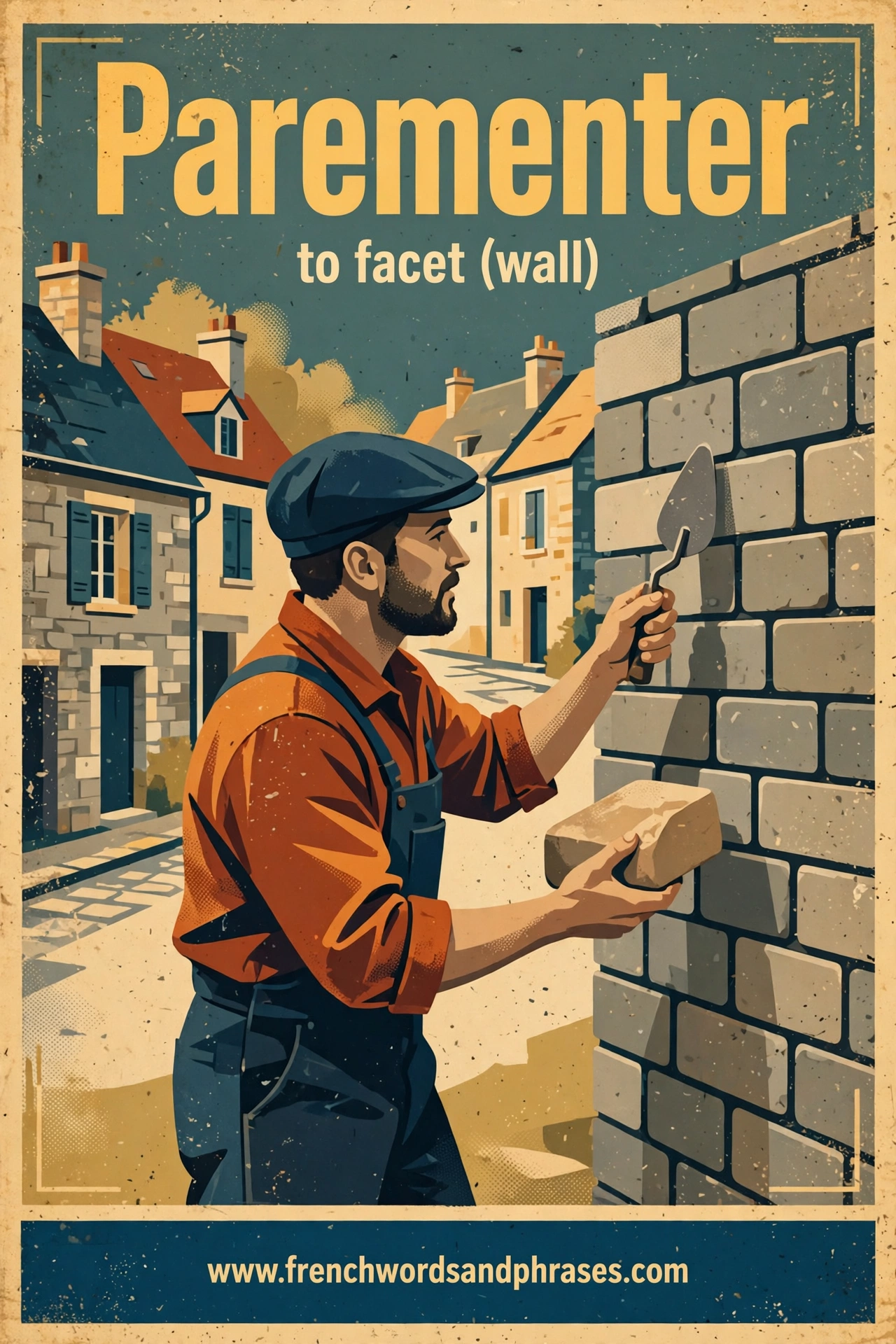
Parementer means to facet (wall) — to give a wall its visible face of dressed stone, the skin of the building that meets the weather and the eye.
A building site in old stone country: a rough rubble wall stands waiting, and beside it, a neat pile of cut, squared stones. The mason takes one, beds it in mortar, taps it level — parementer is the stonemason’s verb for facing a wall: covering the rough core with the handsome, regular stones everyone will actually see.
In this guide, you’ll learn how to conjugate parementer in all the major French tenses and moods. Explore complete conjugation tables, French examples, English translations, and practice quizzes.
Understanding the French Verb Parementer
Parementer is a regular French verb belonging to the first group of verbs, those ending in -er.
It means to facet (wall). Parementer lives in the vocabulary of stonemasonry, restoration and old building trades. A wall has two realities: the rough filling inside and the parement, the dressed face outside; parementer names the skilled work of laying that face, stone by chosen stone. You will meet it on restoration sites and in specifications far more than in conversation.
Verb classification: First group (-er)
Auxiliary verb: Avoir
Past participle: parementé
Present participle: parementant
English equivalents: To face, to facet (a wall); parementer un mur — to face a wall; parementer en pierre de taille — to face with dressed stone; parementer une façade — to face a façade; un mur parementé de moellons — a wall faced with rubble stones.
One important detail: parementer is a builder’s word, from parement, the visible face of a wall or of a single dressed stone. It is a perfectly regular -er verb — je paremente, nous parementons, past participle parementé — with no stem tricks at all. Do not confuse it with its near-neighbour parer (to adorn, to ward off): parementer belongs to scaffolding and mortar, and its object is always masonry — un mur, une façade, un parement.
Experience the Word
Parementer is the verb of the wall’s public face — the difference between a heap of stones and a façade.
Imagine a farmhouse restoration in the Dordogne. All summer the masons rebuild the gable: the inside is rough rubble and lime, but stone by stone the outside changes — squared, honey-coloured blocks, each one chosen, each one tapped true. By September, ils ont parementé le mur, and the house has its face back.
The wall was always strong. Now it is also beautiful — parementé, faced, finished.
How to Conjugate Parementer: Complete French Conjugation Guide
Let’s explore every major conjugation of parementer, beginning with the indicative mood.
How to Conjugate Parementer in the Indicative Mood
The indicative mood is used to express facts, observations, actions, and events.
How to Conjugate Parementer in the Present Tense (Présent)
Used for actions happening now, habitual actions, and general truths.
| Subject | Conjugation |
|---|---|
| je | paremente |
| tu | parementes |
| il / elle | paremente |
| nous | parementons |
| vous | parementez |
| ils / elles | parementent |
Les maçons parementent le mur avec des pierres de taille.
The masons face the wall with dressed stones.
Complete the sentence:
Nous ______ le mur avec des pierres de taille.
Reveal the answer
parementons
Nous parementons le mur avec des pierres de taille.
We face the wall with dressed stones.
How to Conjugate Parementer in the Passé Composé
Used for completed actions in the past. Parementer takes the auxiliary verb avoir.
| Subject | Conjugation |
|---|---|
| j’ | ai parementé |
| tu | as parementé |
| il / elle | a parementé |
| nous | avons parementé |
| vous | avez parementé |
| ils / elles | ont parementé |
Ils ont parementé la façade en pierre blonde.
They faced the façade with pale stone.
How to Conjugate Parementer in the Imparfait (Imperfect Tense)
Used for habitual past actions, descriptions, and ongoing situations in the past.
| Subject | Conjugation |
|---|---|
| je | parementais |
| tu | parementais |
| il / elle | parementait |
| nous | parementions |
| vous | parementiez |
| ils / elles | parementaient |
Autrefois, on parementait les murs avec des moellons choisis.
In the old days, walls were faced with selected rubble stones.
Choose the correct form:
They faced the façade.
Ils ont ______ la façade. (parementé / parementer)
Reveal the answer
parementé
Ils ont parementé la façade.
After avoir, the past participle parementé completes the passé composé.
How to Conjugate Parementer in the Plus-que-parfait
Used to describe an action that had already been completed before another past event.
| Subject | Conjugation |
|---|---|
| j’ | avais parementé |
| tu | avais parementé |
| il / elle | avait parementé |
| nous | avions parementé |
| vous | aviez parementé |
| ils / elles | avaient parementé |
L’équipe avait parementé tout le rez-de-chaussée avant l’hiver.
The team had faced the whole ground floor before winter.
How to Conjugate Parementer in the Passé Simple
Primarily used in formal writing, literature, and historical narratives. It is rarely used in everyday conversation.
| Subject | Conjugation |
|---|---|
| je | parementai |
| tu | parementas |
| il / elle | parementa |
| nous | parementâmes |
| vous | parementâtes |
| ils / elles | parementèrent |
Les compagnons parementèrent la tour en trois étés.
The journeymen faced the tower over three summers.
How to Conjugate Parementer in the Passé Antérieur
A literary tense used to express an action completed immediately before another past action, generally in the passé simple.
| Subject | Conjugation |
|---|---|
| j’ | eus parementé |
| tu | eus parementé |
| il / elle | eut parementé |
| nous | eûmes parementé |
| vous | eûtes parementé |
| ils / elles | eurent parementé |
Quand il eut parementé le mur, le maçon nettoya ses outils.
When he had faced the wall, the mason cleaned his tools.
How to Conjugate Parementer in the Future Tense (Futur Simple)
Used to describe actions that will take place in the future.
| Subject | Conjugation |
|---|---|
| je | parementerai |
| tu | parementeras |
| il / elle | parementera |
| nous | parementerons |
| vous | parementerez |
| ils / elles | parementeront |
Demain, nous parementerons le mur du jardin.
Tomorrow, we will face the garden wall.
How to Conjugate Parementer in the Futur Antérieur (Future Perfect)
Used for an action that will have been completed before a particular point in the future.
| Subject | Conjugation |
|---|---|
| j’ | aurai parementé |
| tu | auras parementé |
| il / elle | aura parementé |
| nous | aurons parementé |
| vous | aurez parementé |
| ils / elles | auront parementé |
À la fin du mois, ils auront parementé toute la cour.
By the end of the month, they will have faced the whole courtyard.
How to Conjugate Parementer in the Near Future (Futur Proche)
Used to describe something that is going to happen soon. Formed with aller + infinitive.
| Subject | Conjugation |
|---|---|
| je | vais parementer |
| tu | vas parementer |
| il / elle | va parementer |
| nous | allons parementer |
| vous | allez parementer |
| ils / elles | vont parementer |
Attention, il va parementer le mur sans échafaudage.
Careful, he is going to face the wall without scaffolding.
How to Conjugate Parementer in the Conditional Mood
The conditional mood expresses what would happen under certain circumstances. It is also frequently used to make polite requests or express wishes.
How to Conjugate Parementer in the Present Conditional
| Subject | Conjugation |
|---|---|
| je | parementerais |
| tu | parementerais |
| il / elle | parementerait |
| nous | parementerions |
| vous | parementeriez |
| ils / elles | parementeraient |
Avec de meilleures pierres, je parementerais ce mur moi-même.
With better stones, I would face this wall myself.
How to Conjugate Parementer in the Past Conditional
| Subject | Conjugation |
|---|---|
| j’ | aurais parementé |
| tu | aurais parementé |
| il / elle | aurait parementé |
| nous | aurions parementé |
| vous | auriez parementé |
| ils / elles | auraient parementé |
Sans la pluie, ils auraient parementé la façade en une semaine.
Without the rain, they would have faced the façade in a week.
Parementer in the Literary Past Conditional Form
This less common literary form uses the imperfect subjunctive of avoir.
| Subject | Conjugation |
|---|---|
| j’ | eusse parementé |
| tu | eusses parementé |
| il / elle | eût parementé |
| nous | eussions parementé |
| vous | eussiez parementé |
| ils / elles | eussent parementé |
Il eût parementé la tour entière, si le chantier avait duré.
He would have faced the whole tower, if the works had lasted.
How to Conjugate Parementer in the Subjunctive Mood
The subjunctive is used to express wishes, emotions, doubts, necessity, and uncertainty. It frequently follows expressions such as il faut que (it is necessary that) or bien que (although).
How to Conjugate Parementer in the Present Subjunctive
| Subject | Conjugation |
|---|---|
| que je | paremente |
| que tu | parementes |
| qu’il / qu’elle | paremente |
| que nous | parementions |
| que vous | parementiez |
| qu’ils / qu’elles | parementent |
Il faut que tu parementes ce mur avant vendredi.
You must face this wall before Friday.
Complete the sentence using the subjunctive:
Il faut que vous ______ la tour avant l’hiver.
Reveal the answer
parementiez
Il faut que vous parementiez la tour avant l’hiver.
You must face the tower before winter.
How to Conjugate Parementer in the Imperfect Subjunctive
A literary tense, rarely encountered in modern spoken French.
| Subject | Conjugation |
|---|---|
| que je | parementasse |
| que tu | parementasses |
| qu’il / qu’elle | parementât |
| que nous | parementassions |
| que vous | parementassiez |
| qu’ils / qu’elles | parementassent |
Le maître exigeait qu’ils parementassent le mur avec soin.
The master craftsman required them to face the wall carefully.
How to Conjugate Parementer in the Pluperfect Subjunctive
A literary construction used to express an action completed before another past action.
| Subject | Conjugation |
|---|---|
| que j’ | eusse parementé |
| que tu | eusses parementé |
| qu’il / qu’elle | eût parementé |
| que nous | eussions parementé |
| que vous | eussiez parementé |
| qu’ils / qu’elles | eussent parementé |
On disait que les anciens eussent parementé ce mur à mains nues.
It was said the old builders had faced this wall with their bare hands.
How to Conjugate Parementer in the Past Subjunctive
| Subject | Conjugation |
|---|---|
| que j’ | aie parementé |
| que tu | aies parementé |
| qu’il / qu’elle | ait parementé |
| que nous | ayons parementé |
| que vous | ayez parementé |
| qu’ils / qu’elles | aient parementé |
Je suis fier que tu aies parementé ce mur tout seul.
I am proud that you faced this wall all alone.
How to Conjugate Parementer in the Imperative
The imperative is used to give commands, instructions, invitations, or suggestions. Subject pronouns are omitted.
How to Conjugate Parementer in the Present Imperative
| Person | Conjugation |
|---|---|
| (tu) | paremente |
| (nous) | parementons |
| (vous) | parementez |
Paremente ce mur avec les pierres les plus régulières !
Face this wall with the most even stones!
How would you say Face this wall (tu form)?
Reveal the answer
Paremente ce mur !
French Participles of Parementer
Participles are verb forms that can be used in compound tenses and other grammatical constructions.
Present Participle of Parementer
parementant
En parementant le mur, il choisit chaque pierre à la main.
While facing the wall, he chooses each stone by hand.
Past Participle of Parementer
parementé
Parementé de pierres dorées, le mur capte le soleil du soir.
Faced with golden stones, the wall catches the evening sun.
Parementer in Everyday French: Real-Life Examples
Now that you know the conjugations, let’s see how parementer appears in everyday French.
Les maçons parementent le mur.
The masons are facing the wall.
Ils ont parementé la façade.
They faced the façade.
On parementait les murs en pierre blonde.
Walls were faced with pale stone.
Nous parementerons le mur du jardin.
We will face the garden wall.
Je parementerais ce mur moi-même.
I would face this wall myself.
Paremente ce mur avant vendredi !
Face this wall before Friday!
Beyond Translation: The Meaning of Parementer
The noun parement does double duty in French building: it is both the facing of a wall and the dressed face of a single stone — and, in church language, the embroidered front of an altar.
Parementer is parer grown up and gone to work on a building site.
Both verbs come from Latin parare, to prepare, to make ready: to adorn a bride and to face a wall are, at root, the same gesture — preparing a surface to be seen.
How to Remember the French Verb Parementer
Remember it this way: Parementer is about a mason tapping a dressed stone into place — the wall gets its face.
- A builder’s verb: its object is always masonry — parementer un mur, une façade.
- Perfectly regular -er: je paremente, nous parementons, past participle parementé.
- From parement, the visible face of a wall — parementer gives the wall its face.
The key idea is a mason tapping a dressed stone into place — the wall gets its face.
Test Your Knowledge of Parementer
Let’s see how much you’ve learned. Try answering these questions before revealing the answers.
What does parementer apply to?
Reveal the answer
Masonry — to face a wall or façade with dressed stone: parementer un mur.
How do you say They faced the façade with pale stone in French?
Reveal the answer
Ils ont parementé la façade en pierre blonde.
Translate: Tomorrow, we will face the garden wall.
Reveal the answer
Demain, nous parementerons le mur du jardin.
What is the past participle of parementer?
Reveal the answer
Parementé — regular: parementé, parementée, parementés, parementées.
Complete the sentence:
Il faut que tu ______ ce mur avant vendredi.
Reveal the answer
parementes
Il faut que tu parementes ce mur avant vendredi.
You must face this wall before Friday.
Can You Use It?
How would you say this in French?
Stone after stone, the mason faces the wall, and the old house gets its face back.
Reveal the answer
Pierre après pierre, le maçon paremente le mur, et la vieille maison retrouve son visage.
Stone after stone, the mason faces the wall, and the old house gets its face back.
LEARN FRENCH ONE WORD AT A TIME