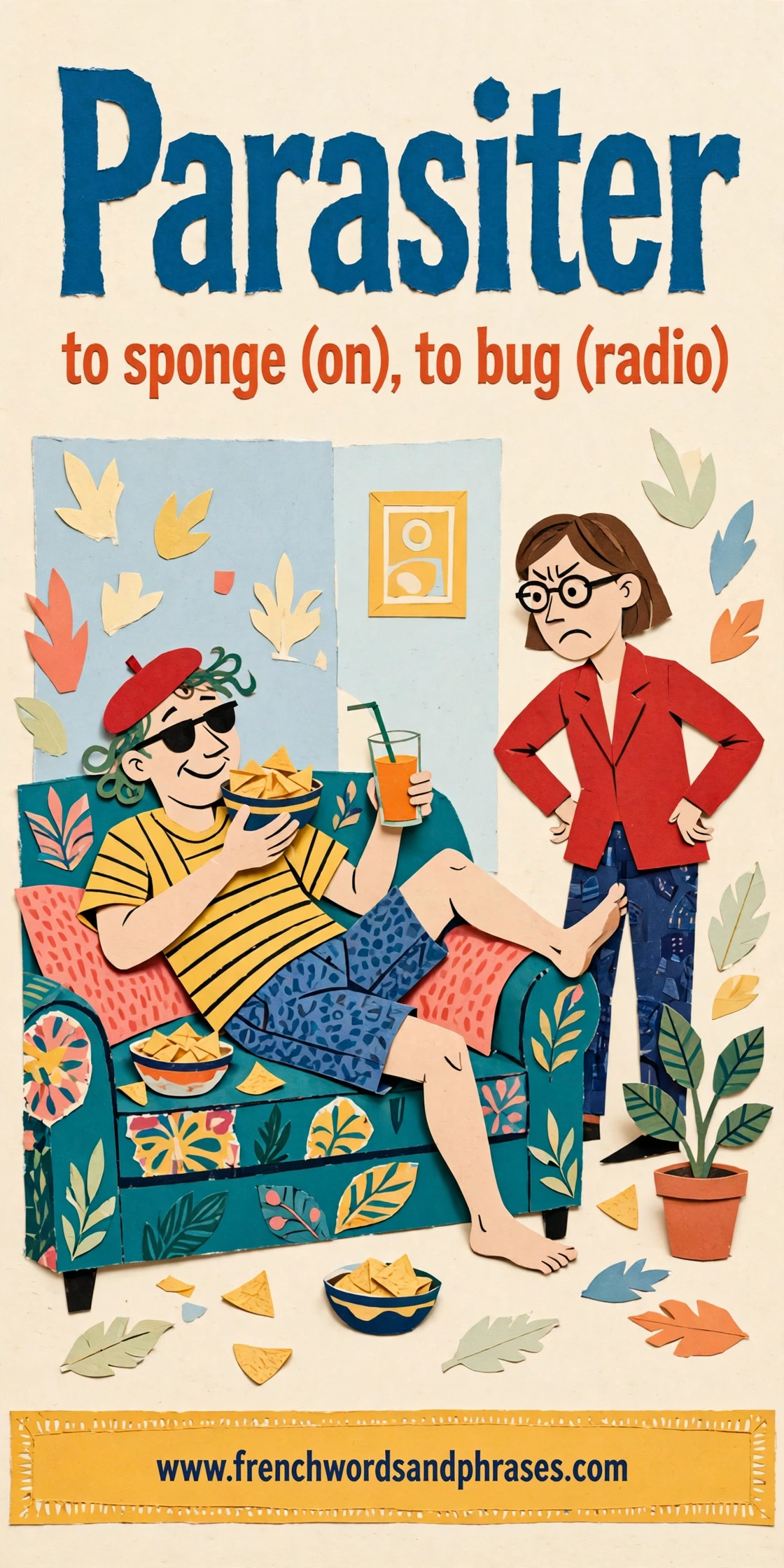
How to Conjugate Parasiter in French
/pa.ʁa.zi.te/
Parasiter means to sponge (on), to bug (radio) — to live off a host like a parasite, or to fill a broadcast with crackling interference.
A cousin who has been sleeping on your sofa since March, a radio voice drowned in static — parasiter is the verb of the unwelcome guest: living at someone else’s expense, or jamming the signal everyone is trying to hear.
In this guide, you’ll learn how to conjugate parasiter in all the major French tenses and moods. Explore complete conjugation tables, French examples, English translations, and practice quizzes.
Understanding the French Verb Parasiter
Parasiter is a regular French verb belonging to the first group of verbs, those ending in -er.
It means to sponge (on), to bug (radio). It is commonly used, with disapproval, of people who live off others without contributing — adult children, eternal guests, hangers-on — and in technical and everyday talk about broadcasts spoiled by interference. A third, biological use exists for insects and plants that live on a host, but the sponger and the static are the two a learner will meet.
Verb classification: First group (-er)
Auxiliary verb: Avoir
Past participle: parasité
Present participle: parasitant
English equivalents: To sponge on, to live off; (radio) to jam, to interfere with; parasiter chez des amis — to sponge off friends; un parasite — a parasite, a sponger; des parasites (radio) — static, interference; parasiter une émission — to jam a broadcast with noise.
One important detail: parasiter has two lives, and both come from the noun un parasite. Of people, it is blunt and familiar: il parasite chez ses parents depuis deux ans — he has been sponging off his parents for two years. Of radios and televisions, les parasites are the crackle and snow that spoil reception, and the verb means to interfere: la tempête parasite les ondes. The verb itself is perfectly regular: je parasite, nous parasitons.
Experience the Word
Parasiter is the verb of taking without giving — a bed, a dinner, a salary, or a clean radio signal.
Imagine a family dinner in Lyon. The uncle raises his glass and toasts his nephew, who arrived for the weekend in 2019 and never left. « À Kevin, qui parasite mon canapé depuis trois ans ! » Everyone laughs — Kevin loudest of all — and the toast is affectionate, but only just.
Three years on one sofa. He is sponging — il parasite — and the whole family has made a proverb of it.
How to Conjugate Parasiter: Complete French Conjugation Guide
Let’s explore every major conjugation of parasiter, beginning with the indicative mood.
How to Conjugate Parasiter in the Indicative Mood
The indicative mood is used to express facts, observations, actions, and events.
How to Conjugate Parasiter in the Present Tense (Présent)
Used for actions happening now, habitual actions, and general truths.
| Subject | Conjugation |
|---|---|
| je | parasite |
| tu | parasites |
| il / elle | parasite |
| nous | parasitons |
| vous | parasitez |
| ils / elles | parasitent |
Il parasite chez ses parents depuis deux ans.
He has been sponging off his parents for two years.
Complete the sentence:
Nous ne ______ personne, nous payons notre part.
Reveal the answer
parasitons
Nous ne parasitons personne, nous payons notre part.
We sponge off nobody, we pay our share.
How to Conjugate Parasiter in the Passé Composé
Used for completed actions in the past. Parasiter takes the auxiliary verb avoir.
| Subject | Conjugation |
|---|---|
| j’ | ai parasité |
| tu | as parasité |
| il / elle | a parasité |
| nous | avons parasité |
| vous | avez parasité |
| ils / elles | ont parasité |
La tempête a parasité la radio toute la nuit.
The storm filled the radio with static all night.
How to Conjugate Parasiter in the Imparfait (Imperfect Tense)
Used for habitual past actions, descriptions, and ongoing situations in the past.
| Subject | Conjugation |
|---|---|
| je | parasitais |
| tu | parasitais |
| il / elle | parasitait |
| nous | parasitions |
| vous | parasitiez |
| ils / elles | parasitaient |
Ce cousin parasitait la famille entière sans rien payer.
That cousin used to sponge off the whole family without paying a thing.
Choose the correct form:
The storm jammed the broadcast.
La tempête ______ l’émission. (a parasité / est parasité)
Reveal the answer
a parasité
La tempête a parasité l’émission.
Parasiter takes avoir.
How to Conjugate Parasiter in the Plus-que-parfait
Used to describe an action that had already been completed before another past event.
| Subject | Conjugation |
|---|---|
| j’ | avais parasité |
| tu | avais parasité |
| il / elle | avait parasité |
| nous | avions parasité |
| vous | aviez parasité |
| ils / elles | avaient parasité |
Ils avaient parasité l’émission avec leurs émetteurs.
They had jammed the broadcast with their transmitters.
How to Conjugate Parasiter in the Passé Simple
Primarily used in formal writing, literature, and historical narratives. It is rarely used in everyday conversation.
| Subject | Conjugation |
|---|---|
| je | parasitai |
| tu | parasitas |
| il / elle | parasita |
| nous | parasitâmes |
| vous | parasitâtes |
| ils / elles | parasitèrent |
L’orage parasita les communications du régiment.
The storm jammed the regiment’s communications.
How to Conjugate Parasiter in the Passé Antérieur
A literary tense used to express an action completed immediately before another past action, generally in the passé simple.
| Subject | Conjugation |
|---|---|
| j’ | eus parasité |
| tu | eus parasité |
| il / elle | eut parasité |
| nous | eûmes parasité |
| vous | eûtes parasité |
| ils / elles | eurent parasité |
Quand il eut parasité assez de repas, on lui montra la porte.
When he had sponged enough meals, he was shown the door.
How to Conjugate Parasiter in the Future Tense (Futur Simple)
Used to describe actions that will take place in the future.
| Subject | Conjugation |
|---|---|
| je | parasiterai |
| tu | parasiteras |
| il / elle | parasitera |
| nous | parasiterons |
| vous | parasiterez |
| ils / elles | parasiteront |
Si tu ne travailles pas, tu parasiteras tes amis.
If you do not work, you will sponge off your friends.
How to Conjugate Parasiter in the Futur Antérieur (Future Perfect)
Used for an action that will have been completed before a particular point in the future.
| Subject | Conjugation |
|---|---|
| j’ | aurai parasité |
| tu | auras parasité |
| il / elle | aura parasité |
| nous | aurons parasité |
| vous | aurez parasité |
| ils / elles | auront parasité |
À la fin du mois, il aura parasité dix repas de famille.
By the end of the month, he will have sponged ten family meals.
How to Conjugate Parasiter in the Near Future (Futur Proche)
Used to describe something that is going to happen soon. Formed with aller + infinitive.
| Subject | Conjugation |
|---|---|
| je | vais parasiter |
| tu | vas parasiter |
| il / elle | va parasiter |
| nous | allons parasiter |
| vous | allez parasiter |
| ils / elles | vont parasiter |
Ce vieux poste va parasiter toutes les stations.
That old set is going to fill every station with static.
How to Conjugate Parasiter in the Conditional Mood
The conditional mood expresses what would happen under certain circumstances. It is also frequently used to make polite requests or express wishes.
How to Conjugate Parasiter in the Present Conditional
| Subject | Conjugation |
|---|---|
| je | parasiterais |
| tu | parasiterais |
| il / elle | parasiterait |
| nous | parasiterions |
| vous | parasiteriez |
| ils / elles | parasiteraient |
Avec un meilleur émetteur, rien ne parasiterait l’émission.
With a better transmitter, nothing would interfere with the broadcast.
How to Conjugate Parasiter in the Past Conditional
| Subject | Conjugation |
|---|---|
| j’ | aurais parasité |
| tu | aurais parasité |
| il / elle | aurait parasité |
| nous | aurions parasité |
| vous | auriez parasité |
| ils / elles | auraient parasité |
Elle aurait parasité ses voisins si sa sœur ne l’avait pas aidée.
She would have sponged off her neighbours if her sister had not helped her.
Parasiter in the Literary Past Conditional Form
This less common literary form uses the imperfect subjunctive of avoir.
| Subject | Conjugation |
|---|---|
| j’ | eusse parasité |
| tu | eusses parasité |
| il / elle | eût parasité |
| nous | eussions parasité |
| vous | eussiez parasité |
| ils / elles | eussent parasité |
Le brouillard eût parasité les signaux du phare toute la nuit.
The fog would have jammed the lighthouse signals all night.
How to Conjugate Parasiter in the Subjunctive Mood
The subjunctive is used to express wishes, emotions, doubts, necessity, and uncertainty. It frequently follows expressions such as il faut que (it is necessary that) or bien que (although).
How to Conjugate Parasiter in the Present Subjunctive
| Subject | Conjugation |
|---|---|
| que je | parasite |
| que tu | parasites |
| qu’il / qu’elle | parasite |
| que nous | parasitions |
| que vous | parasitiez |
| qu’ils / qu’elles | parasitent |
Je ne veux pas qu’il parasite encore chez nous.
I do not want him sponging off us any more.
Complete the sentence using the subjunctive:
Je ne veux pas que tu ______ tes voisins.
Reveal the answer
parasites
Je ne veux pas que tu parasites tes voisins.
I do not want you sponging off your neighbours.
How to Conjugate Parasiter in the Imperfect Subjunctive
A literary tense, rarely encountered in modern spoken French.
| Subject | Conjugation |
|---|---|
| que je | parasitasse |
| que tu | parasitasses |
| qu’il / qu’elle | parasitât |
| que nous | parasitassions |
| que vous | parasitassiez |
| qu’ils / qu’elles | parasitassent |
On craignait que l’orage parasitât les ondes.
People feared the storm might jam the airwaves.
How to Conjugate Parasiter in the Pluperfect Subjunctive
A literary construction used to express an action completed before another past action.
| Subject | Conjugation |
|---|---|
| que j’ | eusse parasité |
| que tu | eusses parasité |
| qu’il / qu’elle | eût parasité |
| que nous | eussions parasité |
| que vous | eussiez parasité |
| qu’ils / qu’elles | eussent parasité |
On racontait qu’ils eussent parasité la famille pendant des années.
People said they had sponged off the family for years.
How to Conjugate Parasiter in the Past Subjunctive
| Subject | Conjugation |
|---|---|
| que j’ | aie parasité |
| que tu | aies parasité |
| qu’il / qu’elle | ait parasité |
| que nous | ayons parasité |
| que vous | ayez parasité |
| qu’ils / qu’elles | aient parasité |
Je suis étonné qu’il ait parasité ses amis si longtemps.
I am amazed he sponged off his friends for so long.
How to Conjugate Parasiter in the Imperative
The imperative is used to give commands, instructions, invitations, or suggestions. Subject pronouns are omitted.
How to Conjugate Parasiter in the Present Imperative
| Person | Conjugation |
|---|---|
| (tu) | parasite |
| (nous) | parasitons |
| (vous) | parasitez |
Ne parasite pas tes parents, trouve un travail !
Do not sponge off your parents, find a job!
How would you say Do not sponge off your parents (tu form)?
Reveal the answer
Ne parasite pas tes parents !
French Participles of Parasiter
Participles are verb forms that can be used in compound tenses and other grammatical constructions.
Present Participle of Parasiter
parasitant
En parasitant le canapé, il regarde la télévision toute la journée.
Sponging on the sofa, he watches television all day.
Past Participle of Parasiter
parasité
Parasitée par la tempête, l’émission devint inaudible.
Filled with static by the storm, the broadcast became inaudible.
Parasiter in Everyday French: Real-Life Examples
Now that you know the conjugations, let’s see how parasiter appears in everyday French.
Il parasite chez ses parents.
He sponges off his parents.
La tempête a parasité la radio.
The storm filled the radio with static.
Ce cousin parasitait toute la famille.
That cousin used to sponge off the whole family.
Tu parasiteras tes amis si tu ne travailles pas.
You will sponge off your friends if you do not work.
Rien ne parasiterait l’émission avec un bon émetteur.
Nothing would interfere with the broadcast with a good transmitter.
Ne parasite pas tes parents !
Do not sponge off your parents!
Beyond Translation: The Meaning of Parasiter
The Greek parasitos was, astonishingly, an honoured guest — an official who ate at the public table — before the word slid down into the comic sponger of the stage, and then into biology.
From honoured guest to unwelcome one.
French keeps every floor of that history: the insect on its host, the cousin on the sofa, and the crackle on the radio are all parasites — each one feeding, uninvited, on something that belongs to another.
How to Remember the French Verb Parasiter
Remember it this way: Parasiter is about the eternal guest on the sofa — and static drowning the radio.
- Two pictures, one word: the cousin on the sofa (sponging) and the crackle on the radio (interference).
- Des parasites on the radio is static — when the broadcast crackles, the waves are parasitées.
- Regular -er: je parasite, nous parasitons, past participle parasité.
The key idea is the eternal guest on the sofa — and static drowning the radio.
Test Your Knowledge of Parasiter
Let’s see how much you’ve learned. Try answering these questions before revealing the answers.
What are les parasites on a French radio?
Reveal the answer
Static, interference — the crackling noise that spoils reception.
How do you say He has been sponging off his parents for two years in French?
Reveal the answer
Il parasite chez ses parents depuis deux ans.
Translate: The storm filled the radio with static all night.
Reveal the answer
La tempête a parasité la radio toute la nuit.
What is the past participle of parasiter?
Reveal the answer
Parasité.
Complete the sentence:
Je ne veux pas qu’il ______ encore chez nous.
Reveal the answer
parasite
Je ne veux pas qu’il parasite encore chez nous.
I do not want him sponging off us any more.
Can You Use It?
How would you say this in French?
Sponging off others is easy; the hard part is leaving before dessert.
Reveal the answer
Parasiter les autres est facile ; le difficile est de partir avant le dessert.
Sponging off others is easy; the hard part is leaving before dessert.
LEARN FRENCH ONE WORD AT A TIME