How to Conjugate Paraphraser in French
/pa.ʁa.fʁa.ze/
Paraphraser means to paraphrase — to say the same thing in other words, usually longer and clearer ones.
A student who must explain an author without copying him, a journalist retelling a minister’s tangled sentence, a teacher unpacking a poem line by line — paraphraser is the verb of the second wording: same meaning, new words.
In this guide, you’ll learn how to conjugate paraphraser in all the major French tenses and moods. Explore complete conjugation tables, French examples, English translations, and practice quizzes.
Understanding the French Verb Paraphraser
Paraphraser is a regular French verb belonging to the first group of verbs, those ending in -er.
It means to paraphrase. It is common in schools and universities, where essays must paraphraser les auteurs without copying them, and in journalism and commentary, where long official statements are paraphrased for readers. It always implies the same content in different, usually fuller, words.
Verb classification: First group (-er)
Auxiliary verb: Avoir
Past participle: paraphrasé
Present participle: paraphrasant
English equivalents: To paraphrase, to restate in other words; paraphraser un texte — to paraphrase a text; paraphraser un auteur — to restate an author’s ideas; une paraphrase — a paraphrase; paraphraser au lieu de citer — to paraphrase instead of quoting.
One important detail: paraphraser is a regular -er verb — je paraphrase, nous paraphrasons, ils paraphrasent — and teachers use it as both a tool and an accusation. As a tool, paraphraser proves you understood: you can only reword what you have grasped. As an accusation, tu ne fais que paraphraser means you are merely padding the author’s words instead of thinking — the difference between the two is the difference between an exercise and a fault.
Experience the Word
Paraphraser is the verb of understanding made visible — if you can say it differently, you have probably understood it.
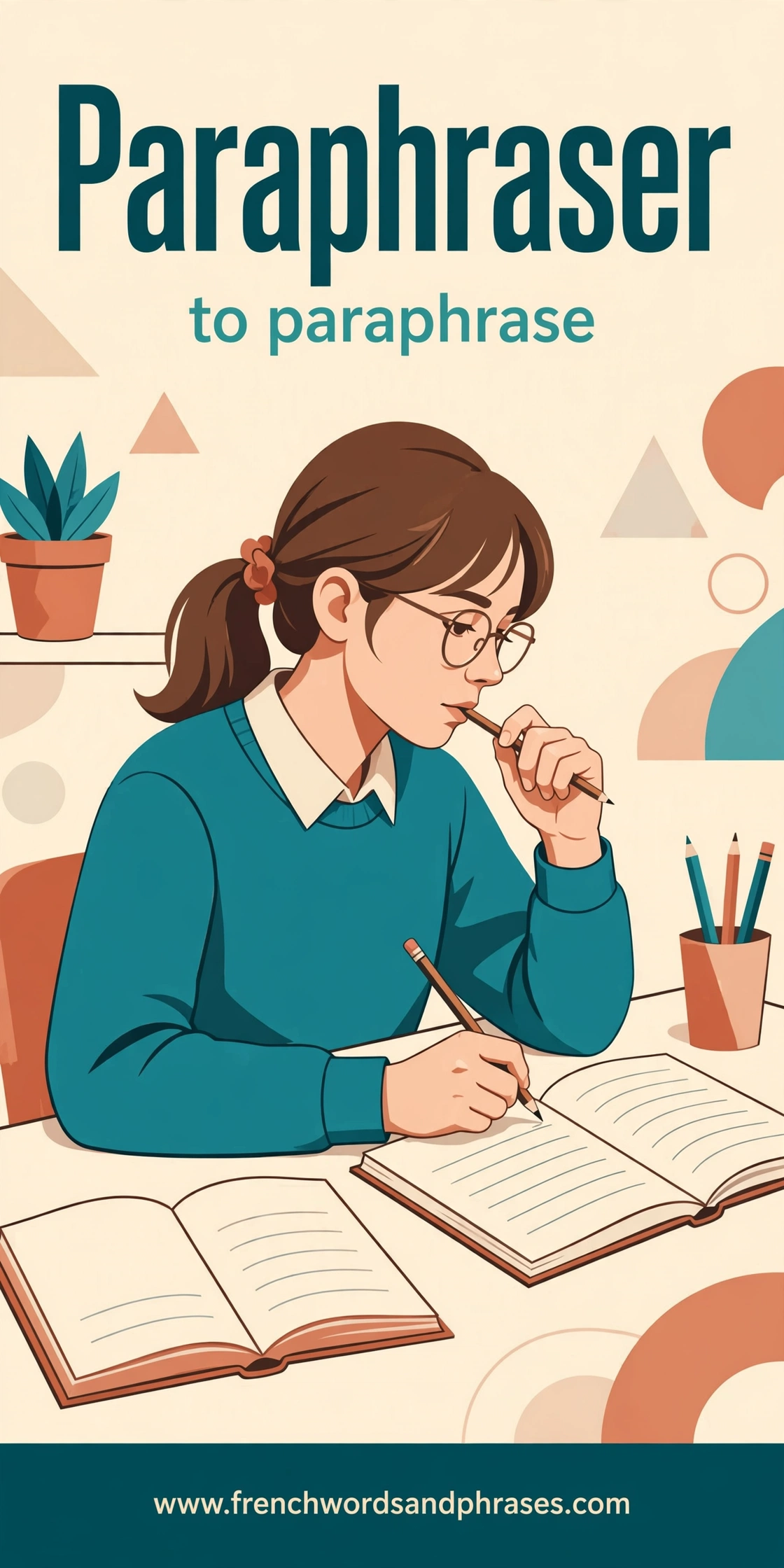
Imagine a student facing one dense page of philosophy. Copying it would be plagiarism; ignoring it would be surrender. So she reads, closes the book, and paraphrase l’idée in her own sentences — slower, longer, clearer — and somewhere in the third sentence, the idea finally becomes hers.
The words are all different. The meaning has been paraphrased — paraphrasé — and, in the process, understood.
How to Conjugate Paraphraser: Complete French Conjugation Guide
Let’s explore every major conjugation of paraphraser, beginning with the indicative mood.
How to Conjugate Paraphraser in the Indicative Mood
The indicative mood is used to express facts, observations, actions, and events.
How to Conjugate Paraphraser in the Present Tense (Présent)
Used for actions happening now, habitual actions, and general truths.
| Subject | Conjugation |
|---|---|
| je | paraphrase |
| tu | paraphrases |
| il / elle | paraphrase |
| nous | paraphrasons |
| vous | paraphrasez |
| ils / elles | paraphrasent |
L’élève paraphrase le poème avec ses propres mots.
The pupil paraphrases the poem in his own words.
Complete the sentence:
Nous ______ le texte avec nos propres mots.
Reveal the answer
paraphrasons
Nous paraphrasons le texte avec nos propres mots.
We paraphrase the text in our own words.
How to Conjugate Paraphraser in the Passé Composé
Used for completed actions in the past. Paraphraser takes the auxiliary verb avoir.
| Subject | Conjugation |
|---|---|
| j’ | ai paraphrasé |
| tu | as paraphrasé |
| il / elle | a paraphrasé |
| nous | avons paraphrasé |
| vous | avez paraphrasé |
| ils / elles | ont paraphrasé |
Le journaliste a paraphrasé le discours du ministre.
The journalist paraphrased the minister’s speech.
How to Conjugate Paraphraser in the Imparfait (Imperfect Tense)
Used for habitual past actions, descriptions, and ongoing situations in the past.
| Subject | Conjugation |
|---|---|
| je | paraphrasais |
| tu | paraphrasais |
| il / elle | paraphrasait |
| nous | paraphrasions |
| vous | paraphrasiez |
| ils / elles | paraphrasaient |
Le professeur paraphrasait chaque texte difficile.
The teacher used to paraphrase every difficult text.
Choose the correct form:
She paraphrased the passage correctly.
Elle ______ correctement le passage. (a paraphrasé / est paraphrasé)
Reveal the answer
a paraphrasé
Elle a paraphrasé correctement le passage.
Paraphraser takes avoir.
How to Conjugate Paraphraser in the Plus-que-parfait
Used to describe an action that had already been completed before another past event.
| Subject | Conjugation |
|---|---|
| j’ | avais paraphrasé |
| tu | avais paraphrasé |
| il / elle | avait paraphrasé |
| nous | avions paraphrasé |
| vous | aviez paraphrasé |
| ils / elles | avaient paraphrasé |
Elle avait paraphrasé l’auteur sans le citer une seule fois.
She had paraphrased the author without quoting him once.
How to Conjugate Paraphraser in the Passé Simple
Primarily used in formal writing, literature, and historical narratives. It is rarely used in everyday conversation.
| Subject | Conjugation |
|---|---|
| je | paraphrasai |
| tu | paraphrasas |
| il / elle | paraphrasa |
| nous | paraphrasâmes |
| vous | paraphrasâtes |
| ils / elles | paraphrasèrent |
Le commentateur paraphrasa la lettre en termes simples.
The commentator paraphrased the letter in simple terms.
How to Conjugate Paraphraser in the Passé Antérieur
A literary tense used to express an action completed immediately before another past action, generally in the passé simple.
| Subject | Conjugation |
|---|---|
| j’ | eus paraphrasé |
| tu | eus paraphrasé |
| il / elle | eut paraphrasé |
| nous | eûmes paraphrasé |
| vous | eûtes paraphrasé |
| ils / elles | eurent paraphrasé |
Quand il eut paraphrasé le passage, la classe comprit enfin.
When he had paraphrased the passage, the class finally understood.
How to Conjugate Paraphraser in the Future Tense (Futur Simple)
Used to describe actions that will take place in the future.
| Subject | Conjugation |
|---|---|
| je | paraphraserai |
| tu | paraphraseras |
| il / elle | paraphrasera |
| nous | paraphraserons |
| vous | paraphraserez |
| ils / elles | paraphraseront |
Dans ton devoir, tu paraphraseras les idées sans les copier.
In your essay, you will paraphrase the ideas without copying them.
How to Conjugate Paraphraser in the Futur Antérieur (Future Perfect)
Used for an action that will have been completed before a particular point in the future.
| Subject | Conjugation |
|---|---|
| j’ | aurai paraphrasé |
| tu | auras paraphrasé |
| il / elle | aura paraphrasé |
| nous | aurons paraphrasé |
| vous | aurez paraphrasé |
| ils / elles | auront paraphrasé |
À la fin du cours, ils auront paraphrasé tout le chapitre.
By the end of the lesson, they will have paraphrased the whole chapter.
How to Conjugate Paraphraser in the Near Future (Futur Proche)
Used to describe something that is going to happen soon. Formed with aller + infinitive.
| Subject | Conjugation |
|---|---|
| je | vais paraphraser |
| tu | vas paraphraser |
| il / elle | va paraphraser |
| nous | allons paraphraser |
| vous | allez paraphraser |
| ils / elles | vont paraphraser |
Je vais paraphraser sa réponse, elle est trop longue.
I am going to paraphrase his answer, it is too long.
How to Conjugate Paraphraser in the Conditional Mood
The conditional mood expresses what would happen under certain circumstances. It is also frequently used to make polite requests or express wishes.
How to Conjugate Paraphraser in the Present Conditional
| Subject | Conjugation |
|---|---|
| je | paraphraserais |
| tu | paraphraserais |
| il / elle | paraphraserait |
| nous | paraphraserions |
| vous | paraphraseriez |
| ils / elles | paraphraseraient |
Sans le texte sous les yeux, je paraphraserais mal cette idée.
Without the text in front of me, I would paraphrase this idea badly.
How to Conjugate Paraphraser in the Past Conditional
| Subject | Conjugation |
|---|---|
| j’ | aurais paraphrasé |
| tu | aurais paraphrasé |
| il / elle | aurait paraphrasé |
| nous | aurions paraphrasé |
| vous | auriez paraphrasé |
| ils / elles | auraient paraphrasé |
Il aurait paraphrasé l’auteur s’il l’avait vraiment lu.
He would have paraphrased the author if he had really read him.
Paraphraser in the Literary Past Conditional Form
This less common literary form uses the imperfect subjunctive of avoir.
| Subject | Conjugation |
|---|---|
| j’ | eusse paraphrasé |
| tu | eusses paraphrasé |
| il / elle | eût paraphrasé |
| nous | eussions paraphrasé |
| vous | eussiez paraphrasé |
| ils / elles | eussent paraphrasé |
Le maître eût paraphrasé le psaume pour ses élèves.
The master would have paraphrased the psalm for his pupils.
How to Conjugate Paraphraser in the Subjunctive Mood
The subjunctive is used to express wishes, emotions, doubts, necessity, and uncertainty. It frequently follows expressions such as il faut que (it is necessary that) or bien que (although).
How to Conjugate Paraphraser in the Present Subjunctive
| Subject | Conjugation |
|---|---|
| que je | paraphrase |
| que tu | paraphrases |
| qu’il / qu’elle | paraphrase |
| que nous | paraphrasions |
| que vous | paraphrasiez |
| qu’ils / qu’elles | paraphrasent |
Il faut que tu paraphrases sans changer le sens.
You must paraphrase without changing the meaning.
Complete the sentence using the subjunctive:
Il faut que vous ______ l’idée sans la copier.
Reveal the answer
paraphrasiez
Il faut que vous paraphrasiez l’idée sans la copier.
You must paraphrase the idea without copying it.
How to Conjugate Paraphraser in the Imperfect Subjunctive
A literary tense, rarely encountered in modern spoken French.
| Subject | Conjugation |
|---|---|
| que je | paraphrasasse |
| que tu | paraphrasasses |
| qu’il / qu’elle | paraphrasât |
| que nous | paraphrasassions |
| que vous | paraphrasassiez |
| qu’ils / qu’elles | paraphrasassent |
Le professeur exigeait que l’élève paraphrasât le texte entier.
The teacher required the pupil to paraphrase the whole text.
How to Conjugate Paraphraser in the Pluperfect Subjunctive
A literary construction used to express an action completed before another past action.
| Subject | Conjugation |
|---|---|
| que j’ | eusse paraphrasé |
| que tu | eusses paraphrasé |
| qu’il / qu’elle | eût paraphrasé |
| que nous | eussions paraphrasé |
| que vous | eussiez paraphrasé |
| qu’ils / qu’elles | eussent paraphrasé |
On lui reprocha qu’il eût paraphrasé au lieu d’analyser.
He was reproached for having paraphrased instead of analysing.
How to Conjugate Paraphraser in the Past Subjunctive
| Subject | Conjugation |
|---|---|
| que j’ | aie paraphrasé |
| que tu | aies paraphrasé |
| qu’il / qu’elle | ait paraphrasé |
| que nous | ayons paraphrasé |
| que vous | ayez paraphrasé |
| qu’ils / qu’elles | aient paraphrasé |
Je suis content qu’elle ait paraphrasé correctement le passage.
I am glad she paraphrased the passage correctly.
How to Conjugate Paraphraser in the Imperative
The imperative is used to give commands, instructions, invitations, or suggestions. Subject pronouns are omitted.
How to Conjugate Paraphraser in the Present Imperative
| Person | Conjugation |
|---|---|
| (tu) | paraphrase |
| (nous) | paraphrasons |
| (vous) | paraphrasez |
Paraphrase cette phrase avec tes mots à toi !
Paraphrase this sentence in your own words!
How would you say Paraphrase this sentence (tu form)?
Reveal the answer
Paraphrase cette phrase !
French Participles of Paraphraser
Participles are verb forms that can be used in compound tenses and other grammatical constructions.
Present Participle of Paraphraser
paraphrasant
En paraphrasant le poème, il en a découvert le sens caché.
By paraphrasing the poem, he discovered its hidden meaning.
Past Participle of Paraphraser
paraphrasé
Paraphrasé par les élèves, le texte est devenu clair pour tous.
Paraphrased by the pupils, the text became clear to everyone.
Paraphraser in Everyday French: Real-Life Examples
Now that you know the conjugations, let’s see how paraphraser appears in everyday French.
L’élève paraphrase le poème.
The pupil paraphrases the poem.
Le journaliste a paraphrasé le discours.
The journalist paraphrased the speech.
Le professeur paraphrasait les textes difficiles.
The teacher used to paraphrase the difficult texts.
Tu paraphraseras les idées sans les copier.
You will paraphrase the ideas without copying them.
Je paraphraserais mal cette idée sans le texte.
I would paraphrase this idea badly without the text.
Paraphrase avec tes propres mots !
Paraphrase in your own words!
Beyond Translation: The Meaning of Paraphraser
Greek schoolchildren were already doing it: paraphrasis was a set exercise of the ancient classroom — retell the passage in other words, longer and clearer.
The oldest homework in the world.
Two thousand years later the same exercise fills French classrooms, and paraphraser still carries both its honours: the proof of understanding, and the suspicion of padding.
How to Remember the French Verb Paraphraser
Remember it this way: Paraphraser is about the student closing the book and saying it her own way.
- Same meaning, other words: if you can paraphrase it, you have understood it.
- Teachers both demand it and reproach it — paraphraser les auteurs, oui; ne faire que paraphraser, non.
- Regular -er: je paraphrase, nous paraphrasons, past participle paraphrasé.
The key idea is the student closing the book and saying it her own way.
Test Your Knowledge of Paraphraser
Let’s see how much you’ve learned. Try answering these questions before revealing the answers.
What does a good paraphrase keep, and what does it change?
Reveal the answer
It keeps the meaning and changes all the words — usually into longer, clearer ones.
How do you say The pupil paraphrases the poem in French?
Reveal the answer
L’élève paraphrase le poème.
Translate: The journalist paraphrased the minister’s speech.
Reveal the answer
Le journaliste a paraphrasé le discours du ministre.
What is the past participle of paraphraser?
Reveal the answer
Paraphrasé.
Complete the sentence:
Il faut que tu ______ sans changer le sens.
Reveal the answer
paraphrases
Il faut que tu paraphrases sans changer le sens.
You must paraphrase without changing the meaning.
Can You Use It?
How would you say this in French?
To paraphrase a great author is to translate him without leaving your own language.
Reveal the answer
Paraphraser un grand auteur, c’est le traduire sans quitter sa propre langue.
To paraphrase a great author is to translate him without leaving your own language.
LEARN FRENCH ONE WORD AT A TIME